
Morgan Stanley(MS)

Search documents
外资唱多中国股市
财联社· 2025-11-24 08:35
Core Viewpoint - The rise of Chinese stocks driven by artificial intelligence (AI) is not a bubble, as Chinese tech companies still have room to enhance valuations and profits through a focus on AI applications [1][3] Group 1: AI Investment and Market Dynamics - China is directing more funds towards AI applications compared to the U.S., leading to stronger short-term commercialization potential for AI in China [1] - The demand for AI-related products needs to be effectively converted into actual revenue by companies [1] - The optimistic sentiment surrounding China's emergence as an AI superpower has been fueled by the launch of efficient and low-cost AI models by startups like DeepSeek and major tech companies introducing new AI tools [1] Group 2: Valuation Comparisons - The total market capitalization of China's top ten tech companies is approximately $2.5 trillion, while their U.S. counterparts stand at $25 trillion, indicating a tenfold difference [3] - U.S. tech giants account for about 40% of the S&P 500 index's total market capitalization, whereas Chinese tech giants represent only around 15% [3] - The AI investment cycle in China is approximately 18 months behind that of the U.S., suggesting further growth potential and the possibility of translating this into profit and revenue growth [3] Group 3: Profit Growth and Market Outlook - Goldman Sachs forecasts a profit growth rate for Chinese companies of 12% to 13% next year, a significant increase from the current expectation of 2% to 3% [4] - After a 48% increase in the price-to-earnings ratio of the MSCI China Index since the end of 2022, future valuation adjustments are expected to slow to around 5% to 10% [4] - By 2027, Chinese stocks are projected to rise an additional 30% [4] - Factors contributing to profit growth include AI investment, overall GDP growth in China, anti-involution policies, and the globalization of Chinese companies [4] Group 4: Foreign Investment and Market Sentiment - Strong capital inflows from both domestic and international investors are expected to support the continuation of the bull market in Chinese stocks [5] - Global investors are increasingly willing to explore investment opportunities in China, recognizing the strong growth potential in the tech and AI sectors [5] - Clients from emerging markets such as Mexico, Chile, and the Middle East are actively investing in Chinese assets, viewing the tech sector as crucial for long-term growth and diversification [5] Group 5: Positive Outlook from Foreign Investment Banks - Despite recent pullbacks in global tech stocks, several foreign investment banks have expressed bullish views on Chinese stocks [6] - Morgan Stanley predicts that Chinese stocks will continue to rise through 2026, maintaining the strong momentum seen this year [7] - JPMorgan analysts indicate that the recovery of Chinese tech stocks from their lows is still in its early stages, with significant growth potential driven by tech companies and Hong Kong stocks [7] - UBS anticipates another fruitful year for Chinese stocks in 2026, supported by favorable factors including developments in innovative sectors [7]



大摩:2026年的主要风险是“AI资本狂潮未能提升生产力”
美股IPO· 2025-11-24 03:41
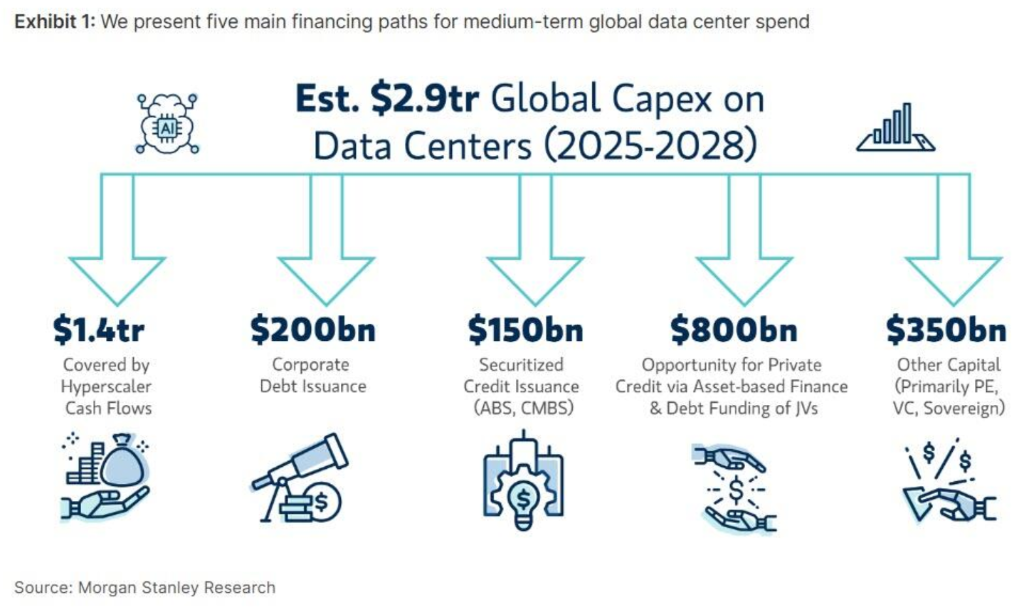
Group 1 - The core view of Morgan Stanley's 2026 outlook is that an AI-driven capital expenditure wave of nearly $3 trillion will propel the market higher, with the S&P 500 index expected to reach 7800 points [1][2][8] - The report highlights that the shift in U.S. policy towards industrial policy and strategic investments is driving a significant rebound in corporate capital expenditures [3][4] - Morgan Stanley predicts that global AI-related capital expenditures will approach $3 trillion, with approximately $1.5 trillion needing to be financed through public and private credit markets, contributing 0.4 percentage points to the projected 1.8% GDP growth in the U.S. by 2026 [5][6] Group 2 - Investment opportunities are expected to be broad-based across various industries, not limited to a few leading AI companies, with industrial firms, tech component suppliers, and financial institutions likely to benefit [8] - In the credit market, high-yield bonds are forecasted to outperform investment-grade bonds due to increased issuance pressures on investment-grade bonds, while high-yield bonds are expected to provide around 6-7% total returns [8] - Despite the positive outlook for 2026, there are warnings about potential cyclical pressures from trade policies and interest rate fluctuations, with the Fed possibly starting to cut rates in early 2026 [9] Group 3 - The main risk identified is the potential failure of the AI capital expenditure wave to translate into substantial productivity gains, which could lead to rising corporate leverage outpacing output growth and causing credit market concerns [10] - However, the likelihood of this risk materializing in 2026 is considered low, as corporate fundamentals remain strong with healthy balance sheets and low leverage [10] - It is crucial for investors to monitor key indicators such as corporate leverage, market valuations, and the conversion of investment waves into actual output starting in 2026 [10]

2026 年全球经济展望_十字路口抉择
2025-11-24 01:46
M Global Insight November 16, 2025 06:00 PM GMT 2026 Global Economics Outlook At the Crossroads Global growth and inflation have an unusually wide range of outcomes in 2026, so we use scenarios to frame the picture. The base case sees continued disinflation and growth settling near potential in 2027… but potential itself might improve. We show two upside scenarios contrasting the forces of stronger spending and rising productivity, while the downside scenario is mild. Morgan Stanley does and seeks to do bus ...
大摩:2026年的主要风险是“AI资本狂潮未能提升生产力”
Hua Er Jie Jian Wen· 2025-11-24 00:40
Group 1 - The core view of the article is that a capital expenditure boom driven by AI is emerging, but it carries significant risks if not translated into productivity growth [1][6] - Morgan Stanley's report predicts that global AI-related capital expenditures will approach $3 trillion, with approximately $1.5 trillion needing to be financed through public and private credit markets [2][4] - The investment wave is expected to directly impact the real economy, contributing 0.4 percentage points to the projected 1.8% GDP growth in the U.S. by 2026 [2] Group 2 - The investment opportunities arising from this policy-driven cycle are expected to benefit multiple industries, not just a few leading AI companies [4] - Morgan Stanley forecasts the S&P 500 index to reach a target of 7800 points by the end of 2026, driven by earnings growth across various sectors and company sizes [4] - In the credit market, high-yield bonds are expected to outperform investment-grade bonds due to increased AI financing demand, with total returns projected at around 6-7% [4] Group 3 - Despite the positive outlook for 2026, there are warnings about potential cyclical pressures from trade policies and interest rate fluctuations [5] - The report anticipates that the Federal Reserve may begin to lower interest rates in early 2026, with 10-year Treasury yields expected to rise to 4.05% by year-end [5] - The dollar index (DXY) is projected to decline to around 94 in the first half of 2026 before rebounding, but could experience volatility due to political or trade risks [5] Group 4 - A key risk highlighted is the potential failure of the AI capital expenditure boom to deliver substantial productivity gains, which could lead to rising corporate leverage and credit market concerns [6] - However, the likelihood of this risk materializing in 2026 is considered low, as corporate fundamentals remain strong with healthy balance sheets and low leverage [6][7] - Investors are advised to monitor corporate leverage, market valuations, and whether the investment wave translates into actual output, as these indicators will influence investment recommendations [7]
继大摩之后,小摩也放弃美联储12月降息预测!摩根大通:仍然预计美联储将在明年1月和4月降息
Sou Hu Cai Jing· 2025-11-21 06:27
此前,摩根士丹利也撤回了美联储12月降息的预测,目前预计美联储将在明年1月、4月和6月降息,最 终将政策利率降至3%至3.25%区间。 【免责声明】本文仅代表作者本人观点,与和讯网无关。和讯网站对文中陈述、观点判断保持中立,不 对所包含内容的准确性、可靠性或完整性提供任何明示或暗示的保证。请读者仅作参考,并请自行承担 全部责任。邮箱:news_center@staff.hexun.com 在美国公布强于预期的就业报告后,摩根大通也撤回了对美联储12月降息25个基点的预测。 摩根大通在美国当地时间周四晚间发布的一份报告中说,仍然预计美联储将在明年1月和4月降息。 ...

Fed Rate Cut Hopes Dim as Mortgage Rates Climb and U.S. Stocks Dip
Stock Market News· 2025-11-20 17:38
Core Insights - Financial markets are reacting negatively to a shift in interest rate expectations, with major U.S. stock indices experiencing a downturn [2] - Morgan Stanley has revised its forecast, no longer expecting an interest rate cut by the U.S. Federal Reserve in December [9] - The housing market is facing challenges as mortgage rates continue to rise, with the average U.S. 30-year fixed-rate mortgage increasing to 6.26% [3][9] Market Performance - The broader U.S. stock market reflected cautious sentiment, with the S&P 500 down 0.3%, Nasdaq down 0.5%, and Dow down 0.2% [4][9] - Individual stock performance showed Nvidia shares declining by 1%, indicating negative trends in the technology sector [5][9] Geopolitical Context - Geopolitical developments were noted, including the death of two members of Iran's IRGC during weapons training, contributing to the global risk landscape [6][9]


全球股市跳水!瑞银、摩根士丹利却逆势唱多中国资产
Sou Hu Cai Jing· 2025-11-20 17:01
Core Viewpoint - The global market experienced a significant downturn on November 18, 2025, with major indices and assets plummeting, yet UBS and Morgan Stanley maintain a bullish outlook on the Chinese market for 2026, highlighting a stark contrast in market sentiment [2][3]. Group 1: Market Reactions and Predictions - The U.S. Federal Reserve's interest rate cut expectations have dramatically shifted, with the probability of a 25 basis point cut in December dropping from 95% to below 50% due to hawkish signals from Fed officials [2]. - Japan's 10-year government bond yield surged to 1.75%, the highest since 2008, raising concerns about a potential massive fiscal stimulus plan from Prime Minister Fumio Kishida, estimated at 17 trillion yen [2][3]. - Bitcoin fell over 6% within 24 hours, with over 180,000 liquidations amounting to $1 billion, while gold also dropped below $4,000, indicating a rare simultaneous decline in risk and safe-haven assets [7][19]. Group 2: UBS and Morgan Stanley Insights - UBS forecasts a 14% upside for the MSCI China Index by the end of 2026, driven by a projected 10% growth in earnings per share, supported by revenue growth and improved profit margins due to policy changes [8][11]. - Morgan Stanley adopts a more cautious stance, predicting a modest increase for the Hang Seng Index and the CSI 300 Index, emphasizing a "stability-first" strategy with a focus on high-quality tech and dividend stocks [12][13]. Group 3: Structural Adjustments and Market Dynamics - UBS has made significant portfolio adjustments, removing high-dividend stocks and increasing exposure to "outbound" concept stocks, while also favoring sectors like internet, hardware technology, and brokerage [10]. - The A-share market showed a clear shift in focus, with AI application concepts performing well despite overall declines, indicating a movement of funds from high-priced themes to undervalued tech stocks [15][16]. - Domestic tech companies are accelerating AI commercialization, with Baidu reporting AI application revenue of 2.6 billion yuan, reflecting the ongoing innovation-driven profit logic [16]. Group 4: External Factors and Risks - Japan's bond market volatility poses risks to global liquidity, as its net foreign assets stand at $3.7 trillion, potentially impacting global capital flows [18]. - The upcoming Nvidia earnings report is seen as a critical factor for market direction, with concerns about a repeat of the negative market reaction following its previous report [18]. - The correlation between Bitcoin and tech stocks has reached concerning levels, with potential for a chain reaction of sell-offs if Bitcoin continues to decline [19].
摩根士丹利:不再预计美联储在 12 月降息,目前预计明年将进行三次降息
Sou Hu Cai Jing· 2025-11-20 15:57
Core Insights - Strong non-farm payroll data reduces the risk of rising unemployment, leading to a revised outlook on Federal Reserve interest rate cuts [1] - Morgan Stanley analyst Michael Gapen no longer expects a rate cut in December, now forecasting three rate cuts in 2024 [1] - The final interest rate prediction is maintained at 3-3.25% [1]
X @Wu Blockchain
Wu Blockchain· 2025-11-20 15:46
Monetary Policy Outlook - Morgan Stanley no longer anticipates a December Fed rate cut [1] - The bank now forecasts three rate cuts in 2025: January, April, and June [1] - Morgan Stanley maintains its terminal rate forecast at 3-325% [1] Economic Indicators - Stronger payrolls data reduces the perceived risk of rising unemployment [1]
Here’s What Lifted Morgan Stanley (MS) in Q3
Yahoo Finance· 2025-11-20 13:22
Core Insights - Cullen Capital Management's SCCM Value Equity Strategy reported a gross return of 6.9% and a net return of 6.8% for Q3 2025, outperforming the Russell 1000 Value's 5.3% and underperforming the S&P 500's 8.1% during the same period [1] - Year-to-date, the strategy achieved a gross return of 13.0%, compared to Russell 1000 Value's +11.7% and S&P 500's +14.8% [1] Company Performance - Morgan Stanley (NYSE:MS) demonstrated strong performance with a one-month return of 2.64% and a 52-week gain of 23.24%, closing at $162.29 per share with a market capitalization of $259.069 billion on November 19, 2025 [2] - The financial sector, particularly Morgan Stanley, was the largest contributor to the SCCM Value Equity Strategy's relative performance, with Morgan Stanley reporting a 13.6% increase in stock value [3] - Morgan Stanley's Q3 2025 revenues reached $18.2 billion, with an EPS of $2.80, and its Wealth Management division saw a 14% year-over-year revenue growth [4] Sector Insights - The financial sector's strong stock selection contributed significantly to the overall performance of the SCCM Value Equity Strategy [3] - Despite Morgan Stanley's potential, the company is not among the top 30 most popular stocks among hedge funds, with 67 hedge fund portfolios holding its shares at the end of Q2 2025 [4]