NTES(NTES)

Search documents
科技赋能未来!网易伏羲亮相2025青科会,展示游戏AI前沿实践
Sou Hu Cai Jing· 2025-10-28 09:24
Core Insights - The 2025 World Youth Scientist Summit, co-initiated by the China Association for Science and Technology and the Zhejiang Provincial Government, took place in Wenzhou, Zhejiang, attracting nearly 800 scientists, venture capitalists, and entrepreneurs from 47 countries and regions, making it a significant platform for technological exchange and future connections [1] - NetEase Fuxi showcased cutting-edge technologies such as game AI, embodied intelligence, and collective intelligence at the summit, drawing widespread attention from academia and industry [1][10] Group 1: Event Highlights - The "Dominion Helmet" project, developed by NetEase Fuxi in collaboration with Ruiling Technology and Yushu Technology, gained significant attention at the event, utilizing a non-invasive brain-computer interface to capture brainwave signals, allowing users to control multiple robots through thought [2][3] - The event featured a high volume of visitors at NetEase Fuxi's booth, where attendees experienced the charm of human-computer interaction through video displays and interactive experiences, reflecting on the transformation of gaming concepts into tangible technological breakthroughs [5] Group 2: AI Innovations in Gaming - NetEase Fuxi introduced several AI-driven innovations in gaming, including: 1. AI teammates in the mobile game "Naraka: Bladepoint," which is the industry's first voice AI teammate feature, enabling AI to understand commands, engage in conversation, and participate in battles [7] 2. The industry's first photo and text-based character customization feature, allowing diverse character designs through various input methods [7] 3. Highly intelligent NPCs that utilize LLM technology for multi-modal interaction and memory capabilities, enhancing player immersion and game dynamics [7] - AI is also enhancing social interactions within games, as demonstrated in "Naraka: Bladepoint," where AI optimizes player connections through friend and team recommendations based on existing social relationships [8] Group 3: Broader Applications of AI - NetEase Fuxi is expanding the application of game AI technologies into other sectors, exemplified by the Lingdong unmanned excavator, which addresses challenges in the mining industry such as safety risks and operational efficiency [9] - The company emphasizes that while AI can optimize existing functionalities, the creation of new gameplay experiences stems from human insight into user needs and trends, highlighting the irreplaceable role of human creativity in innovation [9] Group 4: Future Directions - The integration of game AI into real-world applications signifies a shift towards enhancing industrial efficiency and user experience, as showcased by the "Dominion Helmet" and other AI innovations [10] - NetEase Fuxi aims to continue advancing game AI technologies, fostering human-machine collaboration to explore broader possibilities in various fields [10]


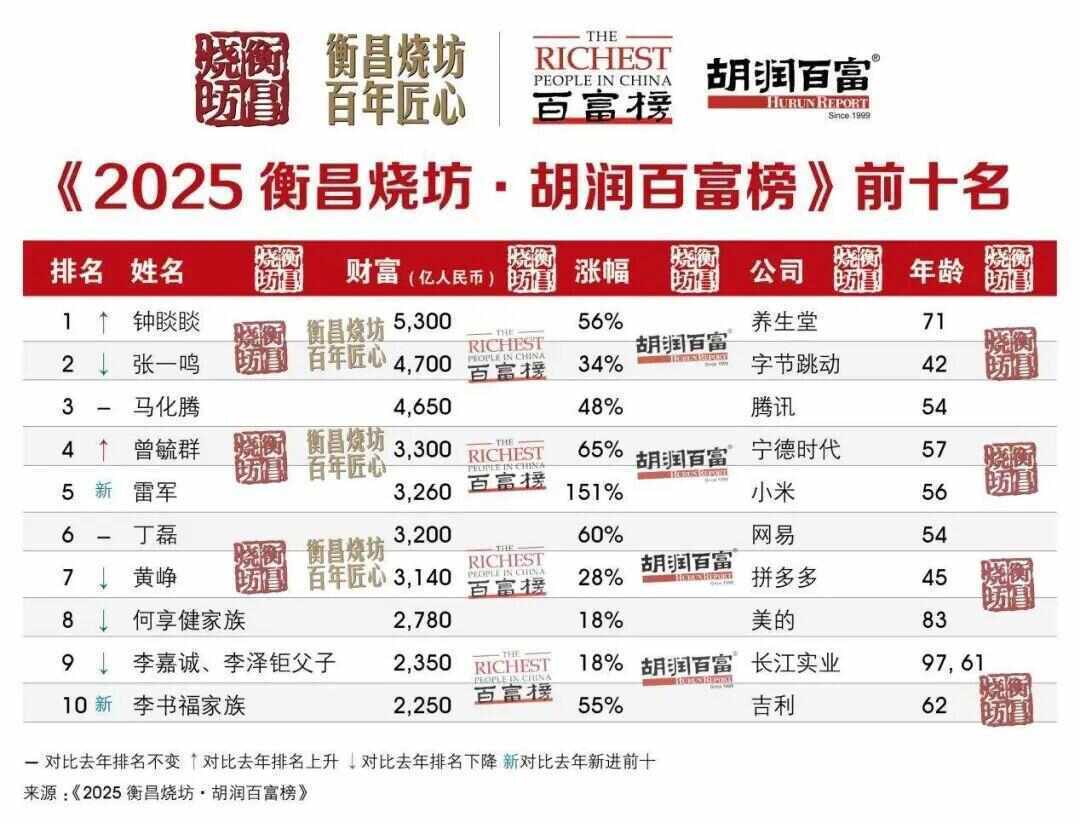
2025胡润百富中国富豪榜TOP10:钟睒财富5300亿第四次成中国首富,张一鸣4700亿退居第二,马化腾4650亿第三,雷军3260亿第五
Ge Long Hui· 2025-10-28 08:10
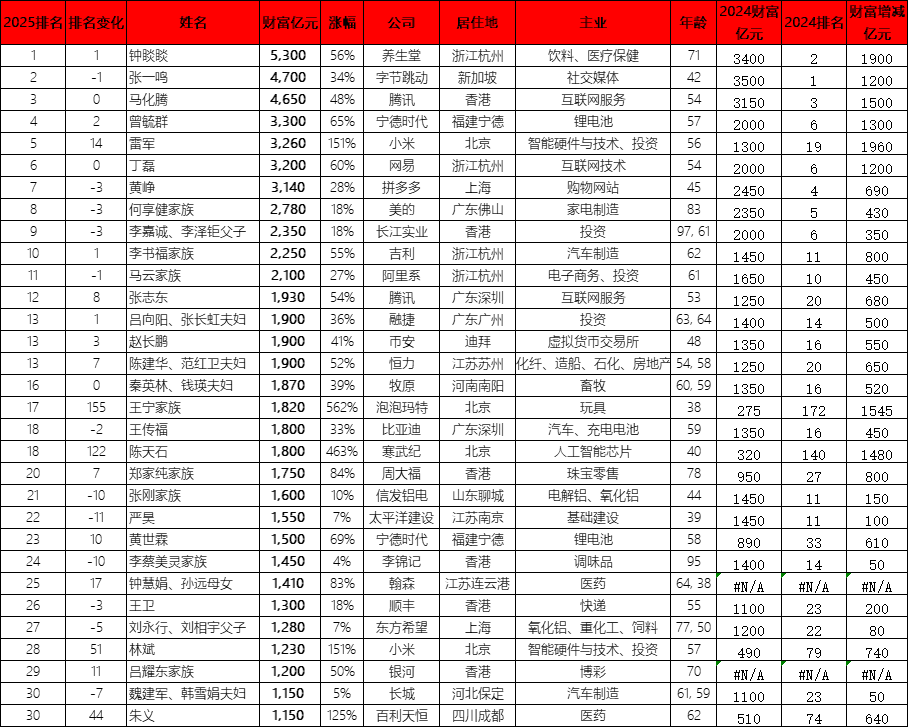
Core Insights - The 2025 Hurun Rich List was released, featuring 1,434 entrepreneurs with personal wealth exceeding 5 billion RMB, marking a 31% increase from last year (+340 individuals) [1] - The total wealth of these individuals approached 30 trillion RMB, reflecting a 42% growth from the previous year (+9 trillion RMB) [1] Group 1: Notable Wealth Increases - Zhong Shanshan, founder of Nongfu Spring, saw his wealth increase by 190 billion RMB, reaching 530 billion RMB, making him the richest person in China for the fourth time and setting a new record for wealth in the country [1] - Zhang Yiming, founder of ByteDance, experienced a wealth increase of 120 billion RMB, driven by advancements in AI, although he fell to second place with a total of 470 billion RMB [1][3] - Ma Huateng, founder of Tencent, had a wealth increase of 150 billion RMB, maintaining third place with a total of 465 billion RMB [1][5] Group 2: Fastest Growing Entrepreneurs - Lei Jun of Xiaomi was named the "growth king," with a wealth increase of 196 billion RMB, attributed to explosive growth in Xiaomi's automotive business and breakthroughs in high-end smartphone profitability [1] - Wang Ning of Pop Mart, aged 38, saw his wealth grow by 154.5 billion RMB, thanks to the global popularity of Labubu [1] - Chen Tian Shi of Cambricon experienced a wealth increase of 148 billion RMB, driven by rapid performance growth following the rollout of AI chips [1]







54岁丁磊财富达3200亿元,年增1200亿元涨幅60%,网易掌门排名稳居第六
Xin Lang Zheng Quan· 2025-10-28 07:24
Core Insights - The 2025 Hurun Rich List reveals that NetEase founder Ding Lei's wealth has reached 320 billion RMB, an increase of 120 billion RMB or 60% from the previous year, maintaining his position at 6th place [1][2] Company Performance - NetEase's net revenue for the previous year was 105.3 billion RMB, showing a year-on-year growth of 1.7% [1] - The net profit for NetEase was 29.7 billion RMB, remaining stable compared to the previous year [1] - The gaming business continues to be the primary revenue source for NetEase, accounting for nearly 80% of total revenue [1] Investment and Dividends - NetEase's investment in research and development reached a record high of 17.5 billion RMB, marking a 6% increase year-on-year, and has exceeded 10 billion RMB for five consecutive years [1] - Ding Lei distributed approximately 6 billion RMB in dividends over the past year [1]
农夫山泉创始人钟睒睒成中国首富,字节跳动创始人张一鸣退居第二,2025胡润百富榜发布→
Sou Hu Cai Jing· 2025-10-28 05:08
Core Insights - The 2025 Hurun Rich List was released, marking the 27th consecutive year of publication, with the wealth calculation deadline set for September 1, 2025. Zhong Shanshan, founder of Nongfu Spring, became the richest person in China for the fourth time with a wealth of 530 billion RMB [1][5]. Summary by Category Wealth Rankings - Zhong Shanshan's wealth increased by 190 billion RMB, reaching 530 billion RMB, setting a new record for the richest person in China [5][11]. - Zhang Yiming, founder of ByteDance, ranked second with a wealth of 470 billion RMB, an increase of 120 billion RMB, driven by advancements in AI [6][11]. - Ma Huateng, founder of Tencent, maintained third place with a wealth of 465 billion RMB, growing by 150 billion RMB due to performance in gaming, advertising, and fintech [6][11]. Overall Wealth Growth - The total wealth of listed entrepreneurs reached nearly 30 trillion RMB, a 42% increase from the previous year, adding 9 trillion RMB [3][12]. - A total of 1,434 individuals with wealth exceeding 5 billion RMB made the list, a 31% increase from last year [2][3]. Market Performance - As of September 1, 2025, major stock indices showed significant growth: Shenzhen Composite Index up 54%, Shanghai Composite Index up 36%, and Hang Seng Index up 42% [3][12]. - The rise in wealth among entrepreneurs is attributed to a recovery in the stock market and the realization of undervalued companies, leading to a re-evaluation of their market value [3][12]. New Entrants - The list featured 376 new faces, a sevenfold increase from the previous year, with notable newcomers including Xu Gaoming and Xu Dongbo from Laopu Gold, and Li Qibin and Qi Yan from Card Game [9][12]. - The top new entrants include founders of popular tea brands and other emerging companies, reflecting a diverse range of industries [9][12]. Geographic Distribution - The distribution of listed entrepreneurs shows a "3+2+3" pattern, with Shanghai, Shenzhen, and Beijing leading in density. Shanghai topped the list with 152 individuals, followed by Shenzhen with 147 and Beijing with 146 [12]. - The increase in the number of entrepreneurs in Shanghai and Shenzhen is primarily due to the recovery of the A-share market and the concentration of industries such as semiconductors and biomedicine in these regions [12].
钟睒睒,再次登顶!雷军,时隔十年闯进前五!2025胡润百富榜揭晓→
证券时报· 2025-10-28 04:59
Core Insights - The 2025 Hurun Rich List reveals a total of 1434 individuals with wealth exceeding 5 billion RMB, an increase of 340 from the previous year, with total wealth nearing 30 trillion RMB, marking a 42% growth compared to last year [1][3]. Group 1: Wealth Rankings - Zhong Shanshan, founder of Nongfu Spring, tops the list with a wealth of 530 billion RMB, marking his fourth time as China's richest person and setting a new record for wealth [1][4]. - Zhang Yiming, founder of ByteDance, ranks second with 470 billion RMB, having seen a wealth increase of 120 billion RMB, or 34% [5]. - Ma Huateng of Tencent holds the third position with 465 billion RMB, reflecting a 48% increase in wealth [5]. - Zeng Yuqun of CATL ranks fourth with 330 billion RMB, a 65% increase [5]. - Lei Jun of Xiaomi, with a wealth of 326 billion RMB, experienced the highest growth rate of 151%, marking his return to the top five after ten years [5]. Group 2: Newcomers and Growth Sectors - A total of 376 newcomers made the list, a sevenfold increase from last year, with the top newcomer being Xu Gaoming of Laopu Gold, with a wealth of 69.5 billion RMB [8]. - The sectors showing significant performance include new energy vehicles, consumer electronics, new consumption, computing power, and biomedicine [9][11]. - In the new energy vehicle sector, both Lei Jun and Zeng Yuqun saw substantial wealth increases, driven by favorable policies and global market demand [9]. Group 3: Regional Distribution - The top ten cities account for 60% of the total number of listed entrepreneurs, with the Yangtze River Delta region having 483 individuals, representing 34% of the total [12]. - Shenzhen has 147 entrepreneurs on the list, with a combined wealth of 2.9 trillion RMB, while Beijing has 146 individuals with a total wealth of 3.1 trillion RMB [12].

中国游戏与娱乐行业_2025 年三季度财报季思考_网易、哔哩哔哩、快手、腾讯音乐、爱奇艺的核心争议点China Games & Entertainment_ Thoughts into 3Q25 earnings season_ key debates for NTES, BILI, Kuaishou, TME and IQ
2025-10-28 03:06
Summary of Earnings Call for China Games & Entertainment Sector Industry Overview - The Games & Entertainment sector has shown strong year-to-date (YTD) performance, with most companies experiencing growth between 60-100% [1][2] - Recent performance has diverged since the second quarter results, indicating potential volatility [1] - Future growth is expected to depend on earnings delivery, upward revisions in earnings per share (EPS), and new growth engines, particularly in AI initiatives [1] Key Companies Discussed NetEase (NTES) - **Rating**: Buy - **YTD Performance**: +69% - **3Q Metrics**: Game revenue increased by 18% year-over-year (YoY), operating profit up 23% YoY, and deferred revenue up 22% YoY [4][17] - **Catalysts**: 1. Progress in AI integration into existing and new games [4][17] 2. New game testing and launch timelines [4][17] 3. Potential primary listing in Hong Kong [4][17] - **Outlook**: Expected to enter a new product cycle with two blockbuster titles targeted for launch in 2026, which could significantly impact revenue and market perception [21] Bilibili (BILI) - **Rating**: Buy - **YTD Performance**: +63% - **3Q Metrics**: Advertising sales up 20% YoY, game revenue down 16% YoY, operating profit at RMB646 million, up 137% YoY [8][32] - **Catalysts**: 1. New game "Sanguo Ncard" testing in late October with a launch expected by Chinese New Year 2026 [8][33] 2. AI initiatives rolling out in the Bili community [8][33] - **Outlook**: Anticipated reversal of game revenue decline and integration of AI to enhance advertising and user engagement, with operating profit margin expected to reach 10% by 4Q25 and 15%+ in 2026-27 [38][36] Kuaishou - **Rating**: Buy - **YTD Performance**: +86% - **3Q Metrics**: Advertising revenue up 13% YoY, GMV up 15% YoY [9][51] - **Catalysts**: 1. Updates on Kling revenue guidance and monthly grossing trends [9][51] 2. Capex and AI revenue outlook for 2026 [9][51] - **Outlook**: Expected to deliver in-line results for 3Q25, with focus on AI integration and eCommerce growth despite competition [56][52] Tencent Music (TME) - **Rating**: Buy - **YTD Performance**: +100% - **3Q Metrics**: Music service revenue up 23% YoY, average revenue per user (ARPU) up 11% YoY [9][10] - **Catalysts**: 1. Completion of Ximalaya deal and business consolidation [10] 2. Upside potential from SVIP and enhanced content offerings [10] - **Outlook**: Continued growth expected from the proliferation of the fans economy and K-pop resurgence in China [10] iQIYI - **Rating**: Neutral - **YTD Performance**: +8% - **3Q Metrics**: Subscription revenue down 3% YoY, adjusted operating profit at -RMB22 million [10][11] - **Catalysts**: 1. Details on new drama policy and potential regulatory tailwinds [11] 2. Updates on secondary listing in Hong Kong [11] - **Outlook**: Challenges remain with subscription growth and profitability, requiring close monitoring of policy impacts [11] Additional Insights - The gaming industry is projected to grow at a low teens percentage YoY in 2025, driven by a loosening of game supply regulations [3] - AI initiatives are expected to enhance advertising effectiveness and user engagement across platforms, particularly for Bili and Kuaishou [3][36] - The easing of content regulations is anticipated to positively impact companies like IQ and TME, potentially fostering a more supportive environment for international artists [3] Conclusion The China Games & Entertainment sector is poised for continued growth, driven by strategic initiatives in AI, new game launches, and regulatory support. Companies like NetEase, Bilibili, and Kuaishou are expected to leverage these opportunities to enhance their market positions and financial performance in the coming quarters.


港股高开 汽车股、稀土概念股普涨 金价走低黄金股弱势
Ge Long Hui· 2025-10-28 01:36
Core Viewpoint - The easing of trade tensions has led to new highs in U.S. stock indices, with the Chinese concept index rising by 1.59% [1] Group 1: Stock Market Performance - U.S. stock indices reached new highs overnight, reflecting a positive market sentiment [1] - The Hong Kong stock market opened higher, with the Hang Seng Index up by 0.28%, the National Index up by 0.24%, and the Hang Seng Tech Index up by 0.45% [1] - Technology stocks showed mixed performance, with Baidu and Alibaba gaining, while Xiaomi and NetEase experienced slight declines [1] Group 2: Sector Performance - Automotive stocks, rare earth concept stocks, and photovoltaic stocks generally saw increases [1] - Spot gold prices fell by 3.05%, dropping below $3,990, leading to declines in gold stocks and non-ferrous metal stocks, with China Gold International down nearly 4% [1] Group 3: New Listings - Two new stocks were listed in the Hong Kong market, with Dipo Technology opening over 111% higher and Bama Tea opening over 60% higher on their first trading day [1]


盘前必读丨美股再创历史新高;现货黄金跌破4000美元
Di Yi Cai Jing Zi Xun· 2025-10-28 00:05
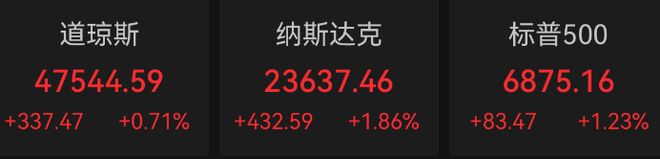
Market Performance - Major US stock indices reached historical highs, with the Dow Jones up 337.47 points (0.71%) closing at 47,544.59, Nasdaq up 1.86% at 23,637.46, and S&P 500 up 1.23% at 6,875.16, marking its first close above 6,800 points [1] - The Philadelphia Semiconductor Index hit a record high, driven by trade negotiation news, with Nvidia rising 2.8%, Intel up 3.3%, and Qualcomm surging over 11% after launching two AI chips for data centers expected to be commercially available next year [1] - Chinese tech stocks also performed well, with the Nasdaq Golden Dragon China Index up 1.6%, Baidu rising 4.8%, JD up 3.0%, Pinduoduo up 2.8%, Alibaba up 2.7%, while NetEase fell 0.4% [1] Commodity Prices - International oil prices slightly declined, with WTI crude oil down 0.31% at $61.31 per barrel and Brent crude oil down 0.49% at $65.62 per barrel [1] - Gold prices fell significantly, with COMEX gold futures for October delivery dropping 2.83% to $4,001.90 per ounce, marking the first time spot gold fell below the $4,000 mark since the beginning of the month [2] Regulatory Developments - The People's Bank of China announced the resumption of open market government bond trading and a supportive monetary policy stance, while also planning to optimize the positioning of the digital RMB [3] - The China Securities Regulatory Commission (CSRC) is set to implement reforms for the Growth Enterprise Market and has launched an optimization plan for the Qualified Foreign Institutional Investor (QFII) system, enhancing access and operational efficiency for foreign investors [4][5] Corporate Earnings - Notable corporate earnings include: - Xinyi Technology reported a net profit of 4.01 billion yuan for Q3, up 1,143.72% year-on-year - Shenxin Technology reported a net profit of 1.47 billion yuan for Q3, up 1,097.40% year-on-year - Shenghong Technology reported a net profit of 11.02 billion yuan for Q3, up 260.52% year-on-year - Other companies like Henglian Petrochemical and Northern Rare Earth also reported significant year-on-year profit increases [5]




网易首批机器人员工上岗,或将正式引入AI劳工?
Sou Hu Cai Jing· 2025-10-27 08:21
Core Insights - NetEase has officially announced the onboarding of its first batch of "robot employees," which has garnered significant attention in the industry [1] - The humanoid robots represent a new form of "high-tech labor force" [3] Group 1: Robot Functionality and Role - The robots will work alongside humanoid robots and robotic dogs in the popular mobile game "Nirvana in Fire," operating under a "996" work schedule [4] - These robots can perform complex martial arts movements and dance routines with a fluidity that surpasses professional dancers, making them ideal for motion capture tasks [6] - The primary responsibility of the robots is to assist motion capture actors in executing high-risk movements, reducing the likelihood of injuries that human actors face [11] Group 2: Industry Impact and Concerns - The introduction of robots has raised concerns among motion capture professionals about potential job displacement; however, the game developers clarified that robots are intended as "specialized support" rather than replacements [8] - The game "Nirvana in Fire" relies heavily on human actors for emotional expression, which robots currently cannot replicate, emphasizing the importance of human involvement in conveying emotional depth [10][12] Group 3: Future Implications - While there is no immediate threat to jobs requiring emotional intelligence and creativity, the integration of robots could signify progress in the industry by taking on labor-intensive tasks [14] - The robots are not seen as job stealers but rather as "assistants" that can handle high-risk tasks, while robotic dogs will also serve a role in enhancing player experience as in-game pets [15]


李在明的游戏国策:从成瘾物质到核心产业
3 6 Ke· 2025-10-27 01:44
Core Viewpoint - The South Korean gaming industry is experiencing a renaissance following President Lee Jae-myung's remarks that redefine gaming as a cultural industry rather than an addictive substance, criticizing past government policies that categorized gaming alongside drugs and alcohol [1][2]. Group 1: Historical Context - The South Korean gaming industry faced significant challenges starting in 2011 due to the implementation of the "Cinderella Law," which restricted gaming access for minors, leading to a decline in industry growth and innovation [3][4]. - The gap between the Chinese and South Korean gaming industries began to widen after 2011, with China's market growing significantly faster, particularly in mobile gaming, while South Korea struggled under regulatory burdens [4][5]. Group 2: Regulatory Changes - In 2021, the "Cinderella Law" was abolished, replaced by a "parental choice system," allowing families to manage minors' gaming time, reflecting a shift in regulatory approach [10]. - Concurrently, China's gaming regulations became stricter, limiting minors' gaming time significantly, which led to a downturn in the Chinese gaming market [12][13]. Group 3: Current Industry Dynamics - Despite regulatory changes, South Korea's gaming industry has not seen a resurgence comparable to China's recovery, with growth rates lagging behind [17][20]. - The South Korean government has introduced various support policies for the gaming industry, including talent development and financial incentives, but these have not yet translated into significant market growth [16][19]. Group 4: Future Outlook - The South Korean government aims to elevate the gaming industry to a national strategic level, emphasizing its cultural value and potential for economic contribution, particularly in exports [20][21]. - The competitive landscape suggests that while South Korea is attempting to leverage policy advantages, the inherent entrepreneurial spirit and innovation in China's gaming sector remain formidable challenges [19][22].