XPENG(XPEV)

Search documents
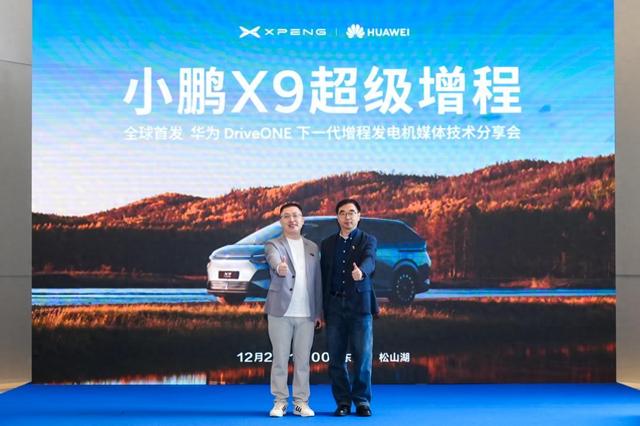
携手华为,小鹏X9增程版首发DriveONE增程发电机
Guan Cha Zhe Wang· 2025-12-05 13:35
Core Viewpoint - The collaboration between Xiaopeng Motors and Huawei marks a significant advancement in the domestic smart electric vehicle industry, exemplified by the launch of the Xiaopeng X9 extended-range version featuring Huawei's DriveONE integrated high-voltage oil-cooled generator [1][12]. Group 1: Product Launch and Specifications - The Xiaopeng X9 extended-range version was officially launched on November 20, and it is the first extended-range product from Xiaopeng Motors [3]. - The vehicle features a "large battery + large fuel tank" design, equipped with a 63.3 kWh lithium iron phosphate battery and a 1.5T range extender, achieving a pure electric range of 452 km and a comprehensive range of 1602 km under CLTC conditions [3][11]. Group 2: Technical Challenges and Solutions - Traditional range extender systems were found inadequate for the performance requirements of the next-generation large seven-seater, leading to a collaboration between Xiaopeng and Huawei to develop the DriveONE generator, which addresses issues such as energy efficiency, electric range, and noise, vibration, and harshness (NVH) performance [5][11]. - The DriveONE generator boasts the highest power density in the industry, achieving a continuous power density of 1.88 kW/kg, and can provide a maximum power output of 85 kW when paired with the 1.5T range extender [7][11]. Group 3: Innovations in Noise and Vibration Control - The collaboration has led to the development of "precise active cylinder stop technology," which reduces noise and vibration by over 60% during engine start-stop events [9]. - Additional software features, such as "de-rotation control strategy," ensure stable and smooth operation across various driving conditions, enhancing the extended-range experience to closely resemble that of pure electric vehicles [9][11]. Group 4: Industry Implications - The successful launch of the Xiaopeng X9 extended-range version and the innovative partnership with Huawei provide a new model for collaboration in the domestic smart electric vehicle sector, showcasing advancements in electric drive systems, generators, and other components [12].


小鹏汽车盘前涨超2%,小鹏汇天飞行汽车在广州知识城完成首飞
Jin Rong Jie· 2025-12-05 09:59
本文源自:格隆汇 小鹏汽车(XPEV.US)盘前涨超2%,报19.94美元。消息面上,近日,广州开发区交投·汇天量产试验试飞 项目合作启动仪式在中新广州知识城低空产业装备智造园举行,小鹏汇天飞行汽车完成园区配套跑道首 次试飞。小鹏汇天"陆地航母"分体式飞行汽车11月3日在黄埔工厂试产下线首台飞行器,规划年产能1万 台,目标2026年量产交付。 ...
小鹏汽车业绩不错 三季度营收翻倍增长 已经提前完成销售目标
Xin Lang Cai Jing· 2025-12-05 09:52
Core Viewpoint - Xiaopeng Motors reported strong financial performance for Q3 2025, achieving record revenue and significantly reduced losses, indicating a positive trend in the company's growth and operational efficiency [3][4]. Financial Performance - In Q3 2025, Xiaopeng Motors achieved revenue of 20.38 billion yuan, representing a year-on-year increase of 101.8% and a quarter-on-quarter increase of 11.5%, marking the highest quarterly revenue in the company's history [3]. - The company's loss narrowed to 380 million yuan, down from a loss of 480 million yuan in Q2 and 1.81 billion yuan in the same period last year, showcasing improved financial health [3]. Cash Reserves - As of the end of Q3 2025, Xiaopeng Motors' cash reserves increased to 48.33 billion yuan, up approximately 760 million yuan from Q2 [4]. Sales Performance - Xiaopeng Motors delivered a total of 116,000 vehicles in Q3 2025, a year-on-year increase of 149.3%. Monthly sales figures were as follows: July at 36,717 vehicles (up 229%), August at 37,709 vehicles (up 169%), and September at 41,581 vehicles (up 95%) [5]. - By the end of October, the cumulative sales for the year reached 355,000 vehicles, surpassing the initial target of 350,000 vehicles [5]. Future Projections - For Q4 2025, Xiaopeng Motors anticipates vehicle deliveries between 125,000 and 132,000, with a monthly average of 41,600 to 44,000 vehicles, representing a year-on-year growth of approximately 36.6% to 44.3%. Total revenue is projected to be between 21.5 billion and 23 billion yuan, reflecting a year-on-year increase of about 33.5% to 42.8% [5].
美股异动丨小鹏汽车盘前涨超2%,小鹏汇天飞行汽车在广州知识城完成首飞
Ge Long Hui· 2025-12-05 09:33
小鹏汽车(XPEV.US)盘前涨超2%,报19.94美元。消息面上,近日,广州开发区交投·汇天量产试验试飞 项目合作启动仪式在中新广州知识城低空产业装备智造园举行,小鹏汇天飞行汽车完成园区配套跑道首 次试飞。小鹏汇天"陆地航母"分体式飞行汽车11月3日在黄埔工厂试产下线首台飞行器,规划年产能1万 台,目标2026年量产交付。(格隆汇) ...
任正非点赞小鹏机器人,双方近期加深合作
Nan Fang Du Shi Bao· 2025-12-05 09:26
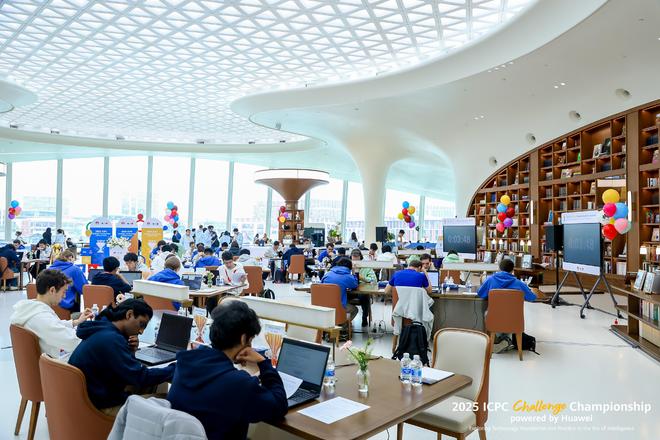
12月5日,ICPC(国际大学生程序设计竞赛)官方公布了华为创始人任正非与全球参赛选手、教练的座 谈会纪要,任正非大谈其对AI时代到来的看法,并点名了物理AI领域"新星"——小鹏汽车自主研发的人 形机器人Iron,点赞以小鹏汽车为代表的公司"代表了未来的世界"。 任正非表示,小鹏机器人走"猫步"太像真人引发社会质疑,最终迫使小鹏在发布会现场剪开机器人外皮 露出内部"钢铁"以自证,这说明机器人产业发生了很大进步,这些公司对外展示了一个未来的世 界。"这个世界总要有人向未来探索,人类社会就是从一次又一次的失败中成功起来的。中国三、五年 后会有较大的进步。中国强大了,有利于世界繁荣的。"任正非认为。 图片源自ICPC官网。 值得一提的是,在"五界两境"之外,目前,小鹏汽车也与华为建立了"暧昧关系"。公开信息显示,今年 2月,小鹏汽车董事长、CEO何小鹏就曾亲自拜访任正非,向其请教"科技、企业、文化、治理"方面的 思考和建议。今年6月,小鹏汽车与华为首次就AR-HUD技术达成战略合作。 谈及双方未来合作更多可能性,顾捷表示,双方的合作是没有上限和边界的,未来会在共同理念、共同 路线、共同认知的情况下不断加强合作,最终 ...

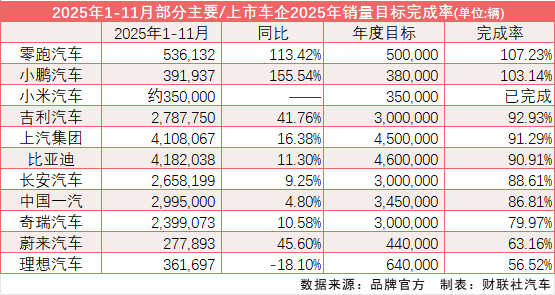
9家主流车企年度销量目标完成率超八成 零跑、小鹏、小米提前达成KPI
Xin Lang Cai Jing· 2025-12-05 08:40
Core Viewpoint - The Chinese automotive market is experiencing a year-end "sprint" driven by the approaching policy window, pressure to meet annual sales targets, and a surge in consumer demand [1] Group 1: Sales Performance - As of November, major domestic car manufacturers have varying completion rates for their 2025 sales targets, with Leap Motor, Xpeng, and Xiaomi having already met their goals, while NIO and Li Auto are below 70% completion [1] - Leap Motor achieved 536,132 vehicle deliveries from January to November, a year-on-year increase of 113.42%, exceeding its annual target of 500,000 vehicles by 7.23% [2] - Xpeng delivered 391,937 vehicles in the same period, marking a 155.54% year-on-year growth and successfully meeting its annual target of 380,000 vehicles [3] - Xiaomi's total sales reached approximately 350,000 vehicles, also achieving its annual target [3] - Geely, SAIC Group, and BYD have completion rates of 92.93%, 91.29%, and 90.91% respectively, with Geely's sales reaching 2.787 million vehicles, a 41.76% increase year-on-year [2][4] - NIO and Li Auto reported significantly lower completion rates, with NIO at 63.16% and Li Auto at 56.52% [2][6] Group 2: Market Trends and Strategies - Leap Motor aims to reach a sales target of 1 million vehicles in 2026, supported by the launch of new models like the A10 and Lafa5 [3] - Xpeng's overseas market performance has been a highlight, with 39,773 vehicles delivered internationally, a 95% increase year-on-year [3] - Geely's growth is driven by its strong performance in the new energy sector, with 153.4 million new energy vehicles sold, a 97% increase [4] - SAIC Group's sales have shown resilience, with a total of 4.108 million vehicles sold, a 16.4% increase year-on-year [5] - BYD's sales reached 4.182 million vehicles, but it has faced a decline in monthly performance since September, attributed to increased competition and market saturation [5] Group 3: Challenges and Outlook - NIO's performance has been inconsistent, with a total of 277,893 vehicles delivered, and it faces a challenging target of 43,000 deliveries in December to meet its quarterly guidance [6] - Li Auto has experienced a decline in deliveries for six consecutive months, with a focus on resolving supply issues for its i6 model [6] - The overall passenger car market in China saw a wholesale increase of 11% year-on-year, but consumer sentiment is cautious due to tightening policies on trade-in and scrappage subsidies [6]





任正非谈及小鹏机器人:机器人的产业也发生了很大的进步
Ge Long Hui· 2025-12-05 04:59
Core Viewpoint - The dialogue led by Ren Zhengfei at Huawei's research center emphasizes the advancements in robotics and AI, highlighting the potential for significant progress in China over the next few years, which could contribute to global prosperity [1] Group 1: Robotics and AI Advancements - Ren Zhengfei discussed the recent developments in robotics, specifically mentioning the impressive capabilities of companies like Xiaopeng, which showcased a robot that appeared lifelike, leading to public skepticism about its authenticity [1] - The demonstration involved Xiaopeng cutting open the robot to reveal its metallic structure, indicating substantial progress in the robotics industry [1] - The conversation underscored the challenges that remain in creating truly human-like robots, particularly in terms of energy consumption and sensory complexity [1] Group 2: Future Outlook - Ren Zhengfei expressed optimism about China's advancements in technology, predicting significant improvements within the next three to five years [1] - He articulated that a stronger China would be beneficial for global prosperity, suggesting a positive outlook for international collaboration and development [1]
小鹏汽车(XPEV)盘前涨超3% 机构指公司多款新车预期上市持续增强销量周期
Xin Lang Cai Jing· 2025-12-05 03:23
金吾财讯 | 小鹏汽车(XPEV)盘前涨超3%,截至发稿,报19.55美元。 消息面上,长江证券表示,强新车+强AI周期,AI科技日成果"涌现",AI时代有望迎来估值重估。2025 年公司处于新车大年,多款新车预期上市持续增强销量周期。规模提升、平台和技术降本效果将进一步 体现,叠加软件盈利的商业模式拓展以及出海持续增长,公司未来盈利具备较大弹性。AI定义汽车, 智驾进展持续领先构筑AI时代核心护城河,智驾VLA升级有望带来飞跃,加速Robotaxi落地扩展智驾变 现方式,下一代机器人发布在即,有望迎来新催化,叠加包括飞行汽车在内的三大AI体系,2026年迎 来量产,AI应用全面起势。 来源:金吾财讯 ...
汽车企业,压力来了!年终行情悬而未决,淘汰赛鸣笛!|人民智行
Zheng Quan Shi Bao Wang· 2025-12-05 03:01
Core Viewpoint - The Chinese automotive market faces significant uncertainty as it transitions into the "post-subsidy era," with many companies expressing concerns about market conditions and competition intensifying [1][2][5]. Group 1: Market Conditions - By the end of 2025, the anticipated "tail effect" in the automotive market remains uncertain, with many companies unprepared for year-end sales targets [2][5]. - The withdrawal of local replacement subsidies and the adjustment of the new energy vehicle purchase tax from full exemption to a 50% reduction are expected to increase purchase costs for consumers [2][5]. - The overall automotive sales in China from January to October reached 27.687 million units, reflecting a year-on-year growth of 12.4% [5]. Group 2: Competitive Landscape - Companies are increasingly adopting "bottom-line" subsidy strategies to boost year-end sales, which may raise sales costs and challenge smaller brands with limited profit margins [3][4]. - The competition is expected to become more transparent and brutal, focusing on product strength, cost control, and user experience as the market moves away from policy-driven growth [5][9]. - The market is predicted to see a significant divide, with leading companies leveraging scale advantages and brand influence, while smaller brands may struggle with cash flow and product iteration [8][10]. Group 3: Future Outlook - The automotive industry is entering a phase where only a few strong brands are likely to survive, with predictions suggesting that in the future, only five dominant brands will remain in the market [10][11]. - The shift away from policy reliance is expected to allow companies to focus on technological innovation and service upgrades, fostering healthier industry development [10][11].
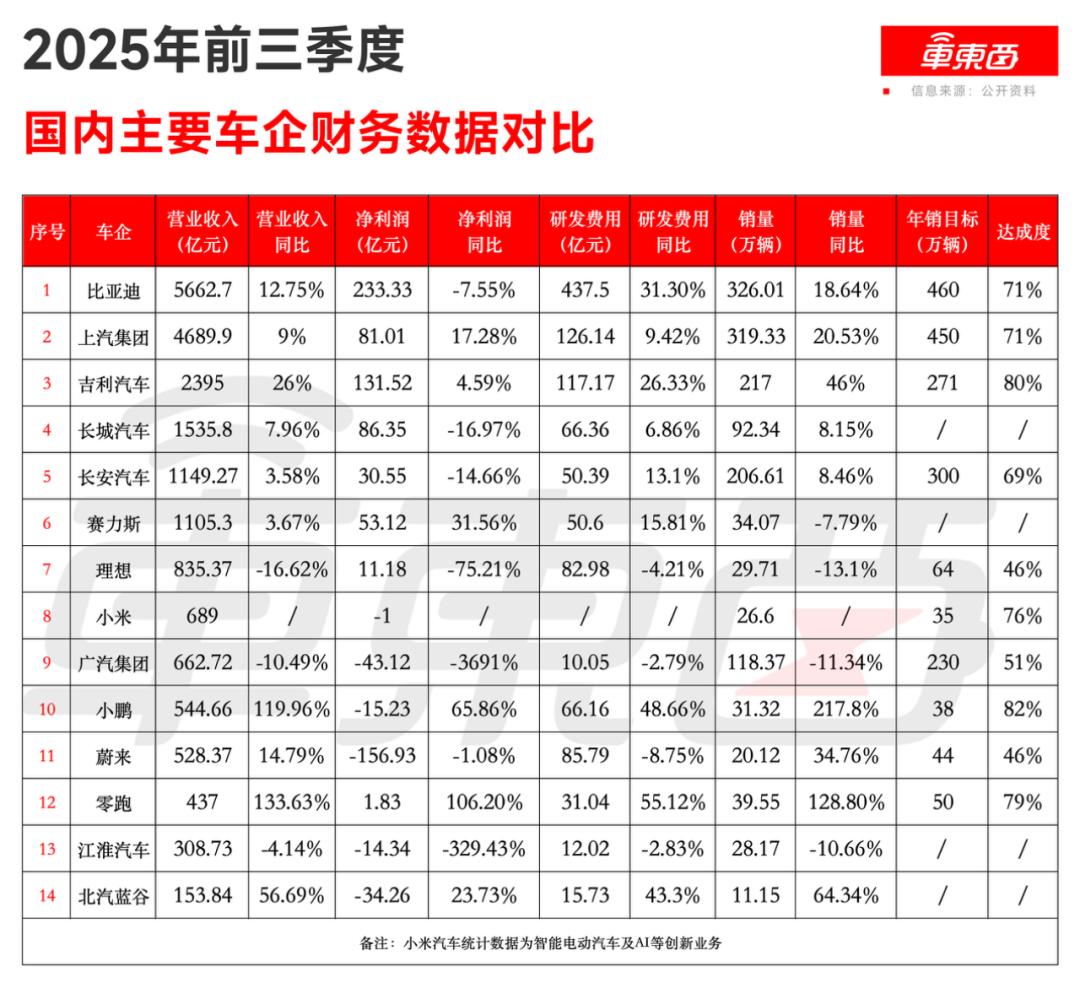
比亚迪赚走6成利润,6家新势力亏掉107亿,14大车企前三季度业绩锐评
3 6 Ke· 2025-12-05 02:56
Core Insights - The financial reports of 14 major domestic car manufacturers for the first three quarters of 2025 show a total revenue of 2.07 trillion yuan and a net profit of 364 billion yuan, resulting in a net profit margin of only 1.76% [2][6][22]. Group 1: Financial Performance - Among the traditional car manufacturers, eight companies reported a combined net profit exceeding 471 billion yuan, with BYD leading with a net profit of 233 billion yuan, accounting for 64% of the total net profit of the 14 companies [4][8]. - Geely's revenue reached 239.5 billion yuan, a 26% increase year-on-year, with a net profit of 131.52 billion yuan, benefiting from its accelerated transition to new energy vehicles [8][22]. - The new energy vehicle sector is experiencing significant losses, with six new entrants collectively losing 107 billion yuan, while only Seres, Li Auto, and Leap Motor reported profits [4][6][22]. Group 2: Revenue and Profit Comparison - BYD's revenue was 566.27 billion yuan, a 12.75% increase, while its net profit decreased by 7.55% [5][7]. - SAIC Group reported a revenue of 468.99 billion yuan and a net profit of 81.01 billion yuan, both showing growth [11][22]. - NIO's revenue was 528.37 billion yuan, with a significant net loss of 156.93 billion yuan, highlighting the challenges faced by the company [22][24]. Group 3: R&D Investment - BYD led in R&D investment with 437.5 billion yuan, a 31.3% increase, indicating a commitment to technological expansion despite a slight decline in net profit [25][29]. - Geely's R&D expenditure was 117 billion yuan, up 26%, reflecting its focus on innovation [29][32]. - NIO, despite its losses, invested 85.79 billion yuan in R&D, maintaining a strong commitment to technology development [32][36]. Group 4: Sales Performance - The total sales volume for the 14 companies reached 15 million units, with BYD, SAIC, Geely, and others achieving significant growth [37][41]. - BYD sold 3.26 million vehicles, a year-on-year increase of 18.64%, while SAIC's sales reached 3.19 million units, growing by 20.53% [38][45]. - New entrants like Leap Motor and Xpeng saw substantial sales increases, with Leap Motor's sales up 128.8% and Xpeng's up 217.8% [49][50]. Group 5: Market Dynamics - The competitive landscape in the automotive industry is intensifying, with companies facing pressures from supply chain costs, rapid technological changes, and the need for substantial R&D investments [52]. - The performance of these 14 companies reflects a growing divide in profitability, with only a few achieving a balance between revenue growth and profit margins [22][52].