XPENG(XPEV)

Search documents
何小鹏:和大众合作的电子电气架构落地,首搭车型与众07正式下线
Xin Lang Cai Jing· 2026-01-29 06:02
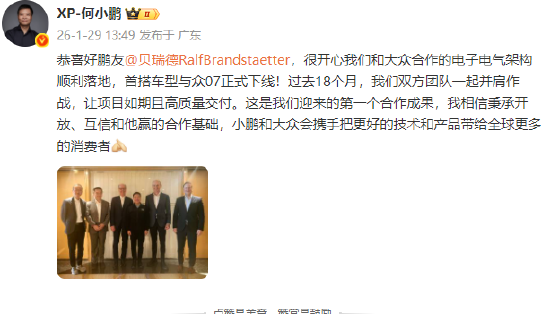
1月29日消息,小鹏汽车董事长 CEO何小鹏发微博表示,恭喜好鹏友@贝瑞德RalfBrandstaetter(大众汽 车集团(中国)董事长兼首席执行官),很开心和大众合作的电子电气架构顺利落地,首搭车型与众07 正式下线! 责任编辑:李思阳 1月29日消息,小鹏汽车董事长 CEO何小鹏发微博表示,恭喜好鹏友@贝瑞德RalfBrandstaetter(大众汽 车集团(中国)董事长兼首席执行官),很开心和大众合作的电子电气架构顺利落地,首搭车型与众07 正式下线! 他表示,过去18个月,双方团队一起并肩作战,让项目如期且高质量交付。 "这是我们迎来的第一个合作成果,我相信秉承开放、互信和他赢的合作基础,小鹏和大众会携手把更 好的技术和产品带给全球更多的消费者。" 他表示,过去18个月,双方团队一起并肩作战,让项目如期且高质量交付。 "这是我们迎来的第一个合作成果,我相信秉承开放、互信和他赢的合作基础,小鹏和大众会携手把更 好的技术和产品带给全球更多的消费者。" 责任编辑:李思阳 ...


2026款小鹏X9开启预定:全球续航最长5C纯电大七座
Xin Lang Cai Jing· 2026-01-29 03:01
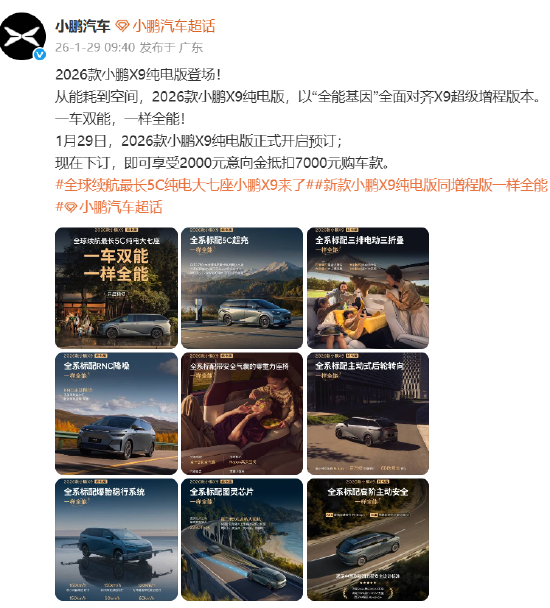
据了解,2026款小鹏X9一车双能,纯电版全系标配800V高压平台和5C超充AI电池,CLTC续航750km, 是全球续航最长的5C纯电大七座车型;百公里能耗15.9kWh,同级领先。 舒适性配置上,新车全系标配三排电动三折叠,支持四、五、六、七座模式,可自由设置露营大床房、 移动骑行房、豪华大平层等场景。全系标配RNC主动降噪,有效消除路噪、风噪等噪音;同时,车辆 全系标配带安全气囊的零重力座椅,有效提升侧躺状态下,零重力座椅的安全性。 1月29日,小鹏汽车宣布,2026款小鹏X9纯电版正式开启预定,新车共推出5款版型,现在下订,即可 享受2000元意向金抵扣7000元购车款。 底盘部分,全系标配主动式后轮转向系统,最小转弯半径5.4米;百万级底盘硬件配置,标配智能双腔 空气悬架和6液压衬套;全系支持爆胎稳行系统,积水路面爆胎稳行最高支持160km/h的速度。 辅助驾驶方面,全系标配图灵芯片,最高有效算力2250Tops,第二代VLA私人司机上车,AI辅助驾驶 能力上限将提高超过10倍。 辅助驾驶方面,全系标配图灵芯片,最高有效算力2250Tops,第二代VLA私人司机上车,AI辅助驾驶 能力上限将提高超过 ...
7年低息、超低首付提车! 车企开打“金融战”
Sou Hu Cai Jing· 2026-01-28 13:17
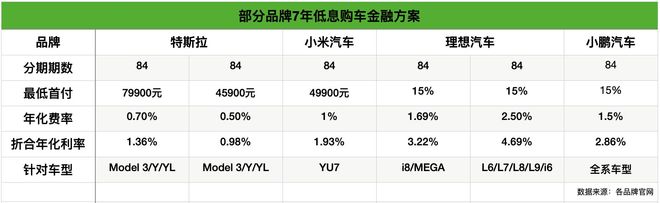
Core Viewpoint - The introduction of 7-year low-interest financing plans by various electric vehicle manufacturers aims to stimulate market demand amid a competitive landscape and inventory pressure, but the actual effectiveness of these plans remains to be seen [1][9]. Financing Plans Overview - Major brands like Tesla, Xiaomi, Li Auto, and Xpeng have launched or enhanced 7-year low-interest financing options since January 2026, extending traditional auto loan periods by 2 to 3 years [1]. - Monthly payments have significantly decreased due to longer loan terms, with Xiaomi's YU7 starting at 2,593 yuan, Xpeng's models at 1,355 yuan, Li Auto at 2,578 yuan, and Tesla's Model 3/Y/Y L at 1,918 yuan [1]. Tesla's Financing Options - Tesla offers two different 7-year financing plans based on down payment amounts, with annualized rates of 0.7% for a 15% down payment and 0.5% for a 30% down payment, translating to effective annual rates of 1.36% and 0.98% respectively [2][4]. - The minimum down payment for Tesla's plans is 79,900 yuan for the high down payment option and 45,900 yuan for the low down payment option [2]. Xiaomi's Financing Details - Xiaomi's 7-year low-interest plan requires a minimum down payment of 20%, with an annualized rate of 1% and an effective annual rate of 1.93% [3]. - For the YU7 standard version priced at 253,500 yuan, the minimum down payment is 49,900 yuan, with a monthly payment of 2,593.48 yuan and total interest over 7 years amounting to 14,252.28 yuan [3]. Li Auto and Xpeng Financing Plans - Li Auto's financing plan varies by model, with the i8 and MEGA models offering 3 years of interest-free payments followed by a 2.5% annualized rate, while other models have a 2.5% rate as well [3]. - Xpeng offers a 7-year financing option with a minimum down payment of 15% and an annualized rate of 1.5%, resulting in an effective annual rate of 2.86% [3]. Market Dynamics and Consumer Behavior - Sales personnel from various brands express differing opinions on the 7-year financing plans, with some recommending 5-year plans due to lower total interest payments [6][7]. - The overall sentiment among sales staff is that the 7-year low-interest plans are designed to lower the barrier to vehicle ownership, although they acknowledge that the effectiveness of these plans may be limited by consumer credit qualifications [8][9]. Industry Trends and Predictions - The automotive market is experiencing a significant decline, with retail sales down 28% year-on-year and wholesale sales down 35% in early January 2026 [8]. - Analysts predict a continued downturn in the Chinese passenger vehicle market, with potential sales dropping to 28.5 million units in 2026, a 5% decrease from the previous year [8].



为什么L3还没正式上路,汽车公司却要直接跳过?
3 6 Ke· 2026-01-28 12:04
Group 1 - The automotive industry is divided on the approach to L3 and L4 autonomous driving, with some companies advocating for skipping L3 and moving directly to L4, while others are focused on accelerating the implementation of L3 [2][3] - Companies like Xiaopeng and Mercedes-Benz have expressed skepticism about L3, with Xiaopeng's founder stating that true fully autonomous driving will arrive by 2026, skipping L3 altogether [2][3] - In contrast, the Ministry of Industry and Information Technology in China has issued licenses for L3 vehicles, indicating a push towards practical implementation, with companies like BYD and Hongmeng already conducting extensive testing [2][8] Group 2 - The distinction between L3 and L4 is primarily based on legal and responsibility frameworks rather than clear technological differences, with L3 being seen as a limited version of L4 [4][6] - The current classification system for autonomous driving levels may not accurately reflect the technological capabilities, as many experts believe that the future will categorize driving into two main scenarios: driver assistance and true autonomous driving [4][6] - Despite the push for L3, regulatory hurdles remain significant, with companies facing lengthy approval processes and strict operational limitations even after receiving licenses [9][11] Group 3 - The market demand for L3 systems is currently insufficient, as evidenced by Mercedes-Benz's decision to pause its L3 rollout due to high costs and low consumer interest [13][14] - Tesla's Full Self-Driving (FSD) option has seen low adoption rates, prompting the company to shift to a subscription model to increase accessibility [14] - The timeline for mass production of L3 vehicles remains uncertain, with various interpretations of what "mass production" entails, leading to discrepancies between technical capabilities and regulatory approvals [15][16]



汽车和汽车零部件行业周报:特斯拉计划2027年销售机器人 关注机器人板块
Xin Lang Cai Jing· 2026-01-28 10:37
零部件: 1)智能化:推荐智能驾驶-【伯特利、地平线机器人、科博达】,智能座舱-【继峰股份】; 2)新势力产业链:推荐H 链-【星宇股份、沪光股份】;推荐T 链-【拓普集团、新泉股份、双环传 动】;3)出海链:推荐【爱柯迪、中鼎股份】。 机器人:推荐汽配机器人标的【拓普集团、新泉股份、伯特利、银轮股份、均胜电子、沪光股份、豪能 股份、爱柯迪、双环传动、隆盛科技】,汽车机器人主机厂【小鹏汽车】。 摩托车:推荐中大排量龙头车企【春风动力、隆鑫通用】。 轮胎:推荐【赛轮轮胎、森麒麟】。 本周行情:汽车板块本周表现优于市场。汽车板块本周表现优于市场。本周(1 月19 日-1 月25 日)A 股汽车板块上涨2.6%,在申万子行业中排名第14 位,表现优于沪深300(-0.6pct)。细分板块中,汽车 服务、商用载货车、汽车零部件、摩托车及其他、商用载客车分别上涨6.9%、4.8%、4.0%、1.4%、 0.7%,乘用车-1.4%。 本周观点:本月建议关注核心组合【吉利汽车、小鹏汽车、比亚迪、伯特利、拓普集团、新泉股份、春 风动力】。 特斯拉计划2027 年面向公众销售机器人,关注机器人板块。智通财经1 月22 日报道, ...


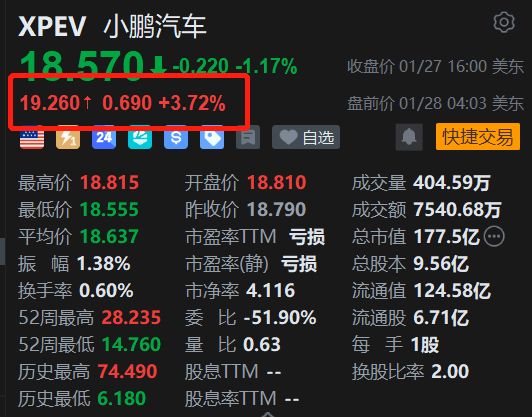
美股异动丨小鹏汽车盘前涨近4% 副董事长顾宏地预计今年将实现“非常强劲”增长
Ge Long Hui· 2026-01-28 09:21
小鹏汽车(XPEV.US)盘前涨约4%报19.26美元。消息上,小鹏汽车副董事长兼联席总裁顾宏地在接受媒 体采访时表示,预计小鹏今年将实现"非常强劲"的增长。顾宏地称,海外市场的销售增长速度可能会超 过国内。此外据悉,小鹏汇天传出IPO动向。1月12日,据多家媒体消息,小鹏汇天已秘密向港交所提 交IPO申请,摩根大通、摩根士丹利两家投行被选为联席保荐人,上市进程有望最快于今年内完成。 | XPEV 小鹏汽车 | | | | --- | --- | --- | | 18 570 J -0.220 -1.17% | | 收盘价 01/27 16:00 美东 | | 19.260 + 0.690 +3.72% | | 盘前价 01/28 04:03 美东 | | 一 7 24 4 8 8 8 日 9 白 2 | | ● 快捷交易 | | 最高价 18.815 | 开盘价 18.810 | 成交量 404.59万 | | 最低价 18.555 | 昨收价 18.790 | 成交额 7540.68万 | | 平均价 18.637 | 市盈率TIM 亏损 | 总市值 177.5亿 (--) | | 振 幅 1.38% | ...
美股中概股盘前涨跌互现,哔哩哔哩涨4%
Jin Rong Jie· 2026-01-28 09:21
Group 1 - U.S. Chinese concept stocks showed mixed performance in pre-market trading, with Bilibili rising by 4% [1] - Xpeng Motors, Li Auto, and NIO each increased by 3% [1] - Alibaba's stock saw a 2% increase [1]


2026年汽车投资策略
2026-01-28 03:01
Summary of the Conference Call Industry Overview - The conference focused on the automotive industry, specifically strategies and forecasts for 2026, with a review of the automotive market from 2005 to 2025 [1][2]. Key Insights and Arguments 1. **Sales Growth and Valuation**: - Sales growth is a sufficient but not necessary condition for the valuation of the automotive sector to increase. Historical data shows that years with sales growth corresponded with rising valuations, but there were exceptions in years like 2012 and post-2020 [3]. - The automotive sector's valuation tends to respond approximately three months ahead of sales growth before 2020, and this response time has shortened to about one month post-2020 [3]. 2. **Comparison with 2018**: - The year 2026 is expected to mirror 2018, which also faced declining sales due to policy changes. In 2018, the automotive sector began to decline three months before sales dropped significantly [4][5]. 3. **Impact of Policy Changes**: - The introduction of a 5% purchase tax on new energy vehicles in 2026 and changes in subsidy structures are expected to impact demand negatively [1][2]. 4. **Investment Opportunities**: - The focus for 2026 is on new growth areas, particularly in smart driving technologies. Companies in this sector are seen as undervalued, with many trading below 30x P/E ratios while maintaining decent growth rates [7][8]. 5. **Low Valuation and High Growth Stocks**: - Several companies were highlighted as having strong growth potential while being undervalued, including: - **Mastec**: Estimated 20% growth in 2026 with a P/E of 15-16x [10]. - **Yatong**: Expected 30% growth with a P/E of around 20x [10]. - **Fuyou Glass**: Anticipated 15% growth with a P/E of about 15x [11]. - **Weichai Power**: Projected 15% growth with a similar P/E [11]. 6. **Sector-Specific Insights**: - Companies like **Desay SV** and **Kobota** are expected to see significant revenue growth due to their involvement with major clients like Li Auto and NIO, with projected revenues of 90 billion and 21 billion respectively for Q4 [17][21]. - **Huayang Group** is expected to maintain a growth rate of over 20% in 2026, driven by high-margin products [24]. Other Important but Overlooked Content - The conference also discussed the potential risks associated with rising raw material costs, particularly for companies in the forging sector, which could impact earnings realization [13]. - The importance of technological cycles, including the shift towards electric and smart vehicles, was emphasized as a key driver for future growth in the automotive sector [6][7]. - The discussion included a focus on the competitive landscape, with companies like Fuyou Glass expected to benefit from a more favorable market position as competitors exit [30][31]. Conclusion - The automotive industry is facing challenges due to policy changes and market dynamics, but there are significant investment opportunities in undervalued companies with strong growth potential, particularly in the smart driving and electric vehicle segments. The insights from the conference provide a comprehensive overview of the current state and future outlook of the automotive sector.


汽车早餐 | 春节假期免收7座及以下小型客车通行费;比亚迪与埃克森美孚签署战略合作备忘录;欧盟公布印欧贸易协议
Zhong Guo Qi Che Bao Wang· 2026-01-28 01:32
Domestic News - The Ministry of Transport has implemented a policy to waive toll fees for small passenger vehicles (7 seats or fewer) during the Spring Festival holiday [2] - The Ministry's notice emphasizes the need to enhance charging infrastructure for electric vehicles, proposing tailored strategies for busy service areas to reduce long wait times for charging [2] Industry Insights - In 2025, profits for large-scale high-tech manufacturing industries are expected to grow by 13.3% year-on-year, surpassing the overall industrial profit growth of 12.7% [3] - The smart electronics sector is driving significant profit increases, with profits in the smart consumer device manufacturing sector rising by 48%, and specific industries like smart drones and smart vehicle equipment seeing profits increase by 102% and 88.8%, respectively [3] - The automotive industry is projected to generate profits of 461 billion yuan in 2025, reflecting a modest year-on-year increase of 0.6% [4] - The automotive sector's revenue is expected to reach 1,117.96 billion yuan, with production figures at 34.78 million vehicles, marking a 10% increase year-on-year [4] International News - The EU has announced a trade agreement with India, granting EU service providers preferential access in key sectors such as finance and maritime services, while gradually reducing automotive tariffs to 10% with an annual quota of 250,000 vehicles [5] - Stellantis Group reported that despite a sluggish market, it expects to sell over 2.42 million new vehicles in Europe in 2025, achieving a market share of 16% [6] - The company leads the hybrid vehicle market with a 15% share and holds a 28.6% share in the commercial vehicle sector [6] - The European new car registration is projected to grow by 2.4% in 2025, reaching 13.3 million units, with electric vehicle registrations surging by 30% [7] - In Vietnam, the automotive market is expected to grow by 22% in 2025, although major players like Hyundai and Kia are experiencing declining sales for the third consecutive year [8] - South Africa's electric vehicle sales are projected to decline by 17% in 2025, accounting for only 0.17% of total new car sales, despite overall new car sales reaching a decade-high of 596,818 units [9] Corporate News - BYD has signed a long-term strategic cooperation memorandum with ExxonMobil, focusing on innovation in new energy hybrid technology and collaborative product development [10] - Li Auto plans to close a small number of underperforming stores as part of normal operational adjustments, clarifying that rumors of closing 100 stores are unfounded [11] - Didi plans to enhance the experience of its ride-hailing services in 2026, focusing on improving driver service levels and optimizing vehicle offerings [12] - DeepWay has completed a Pre-IPO financing round of 1.177 billion yuan, marking the largest single financing in the autonomous driving new energy heavy truck sector [13] - XPeng Motors anticipates "very strong" growth this year, with overseas sales growth potentially outpacing domestic sales [14]

一线调查|7年低息、超低首付提车!车企开打“金融战”,专家预警:超长分期暗藏风险
Mei Ri Jing Ji Xin Wen· 2026-01-28 01:12
Core Viewpoint - The introduction of 7-year low-interest financing plans by various electric vehicle manufacturers aims to stimulate market demand amid a competitive landscape and inventory pressure, but the actual effectiveness and implications of these plans remain to be validated by the market [1][10]. Group 1: Financing Plans Overview - Major brands like Tesla, Xiaomi, Li Auto, and Xpeng have launched or enhanced 7-year low-interest financing options, extending traditional auto loan periods by 2 to 3 years [1]. - Monthly payments have significantly decreased due to longer loan terms, with Xiaomi's YU7 starting at 2,593 yuan, Xpeng's models at 1,355 yuan, Li Auto at 2,578 yuan, and Tesla's Model 3/Y/Y L at 1,918 yuan [1]. - Tesla offers two different 7-year financing plans with varying down payment requirements, resulting in different annualized rates [2][3]. Group 2: Comparative Analysis of Financing Options - Tesla's financing plans are noted for their flexibility, with lower annualized rates for higher down payments, while other brands have higher rates [3][6]. - Xiaomi's plan requires a minimum down payment of 20%, with an annualized rate of 1% and an effective annualized rate of 1.93% [4]. - Li Auto's financing is categorized by model, with some models offering interest-free periods, while Xpeng's plan applies to all models with a minimum down payment of 15% and an annualized rate of 1.5% [5][6]. Group 3: Market Dynamics and Consumer Behavior - Sales personnel from various brands express differing opinions on the 7-year financing plans, with some recommending shorter terms due to higher interest costs associated with longer loans [7][8]. - The overall market for passenger vehicles has seen a significant decline, with retail sales down 28% year-on-year and wholesale volumes down 35% [9][10]. - Investment firms predict a continued downturn in the Chinese passenger vehicle market, with potential sales declines of 2% to 5% in 2026 [10]. Group 4: Implications of Financing Strategies - The 7-year low-interest financing plans are seen as a strategy to lower the purchase threshold for consumers, but the effectiveness may be limited by high qualification requirements for consumers [9][10]. - Concerns are raised about the long-term implications of extended financing terms, including potential risks of negative equity and the sustainability of demand post-incentive [12].