
中国重工

Search documents
中国船舶(600150):重组落地有望驱动业绩持续提升
HTSC· 2025-10-30 06:41
Investment Rating - The report maintains a "Buy" rating for the company [7] Core Views - The company reported a significant increase in revenue and net profit for Q1-Q3 2025, with revenue reaching 107.40 billion RMB, up 17.96% year-on-year, and net profit of 5.85 billion RMB, up 115.41% year-on-year [1] - The successful completion of the merger and restructuring is expected to enhance the company's competitive advantage and order-taking capability, driving continuous performance growth [1][4] - The global shipbuilding industry is showing resilience despite short-term pressures, with the company maintaining a leading market share in China [3] Summary by Sections Financial Performance - For Q1-Q3 2025, the company achieved a gross margin of 12.56%, an increase of 1.94 percentage points year-on-year, attributed to improved delivery of civil ship products and effective cost control [2] - The total operating income for Q3 2025 was 34.76 billion RMB, a year-on-year increase of 4.76%, with net profit reaching 2.07 billion RMB, up 97.56% year-on-year [1] Industry Outlook - The global shipbuilding industry is facing short-term capacity release and order rhythm pressures due to geopolitical uncertainties, but the long-term growth potential remains promising as demand gradually recovers [3] - As of September 2025, China's shipbuilding completion volume accounted for 55.00% of the global total, indicating a strong market position [3] Strategic Developments - The merger with China Shipbuilding Industry Corporation has been successfully completed, enhancing the company's technological and production capacity, which is expected to lead to cost advantages and improved bargaining power in the global market [4] - The company is well-positioned to capitalize on the industry's shift towards high-end, green, and intelligent shipbuilding [4] Earnings Forecast and Valuation - The earnings forecast for 2025-2027 has been adjusted, with net profit estimates raised to 11.82 billion RMB, 16.67 billion RMB, and 22.01 billion RMB respectively, reflecting the integration of China Shipbuilding Industry Corporation [5] - The target price for the company is set at 48.62 RMB, based on a projected PE ratio of 22 times for 2026 [5]

官方定调!十五五规划出炉,A股四大板块或将迎结构性爆发
Ge Long Hui· 2025-10-30 02:32
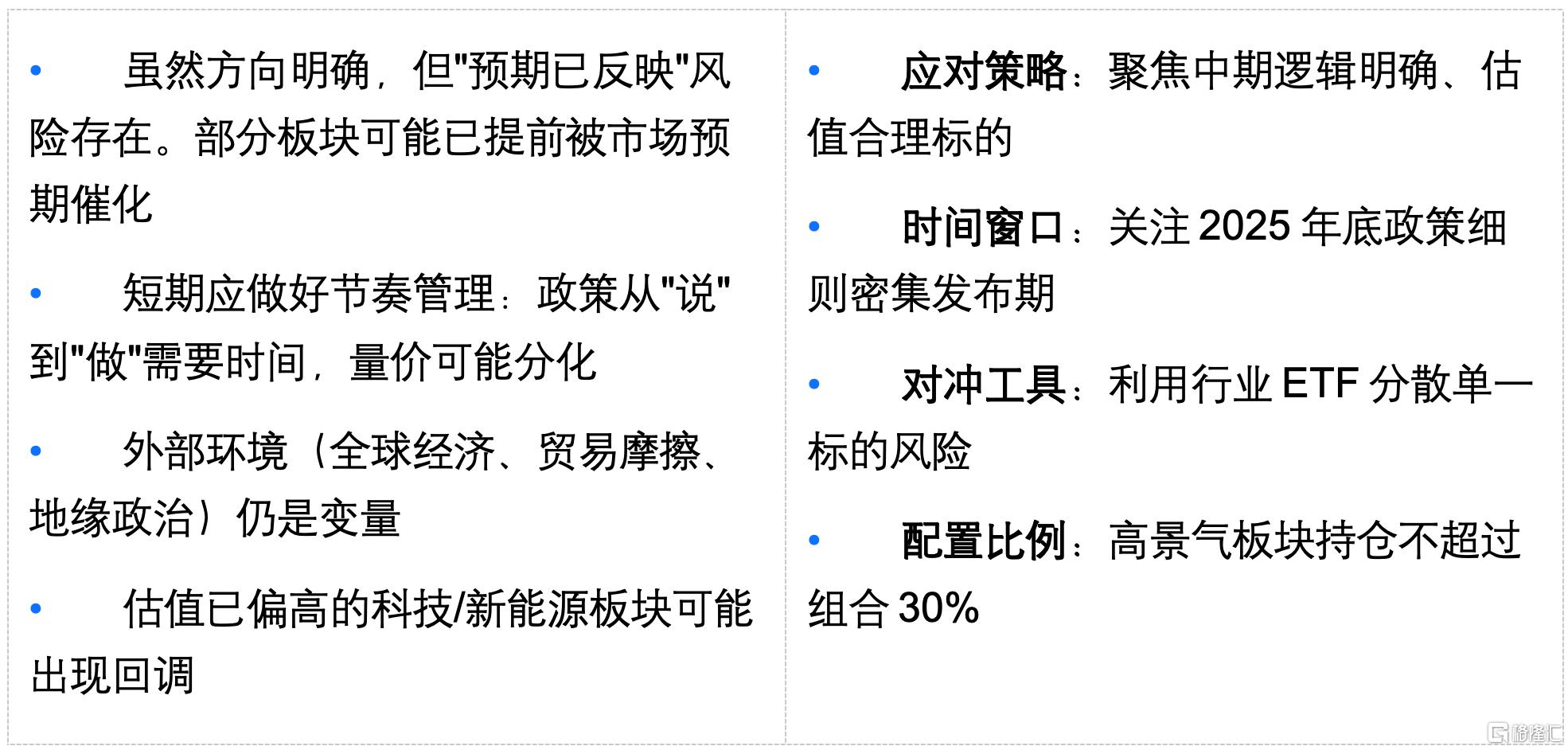
Core Insights - The recent Fourth Plenary Session of the 20th Central Committee of the Communist Party of China has approved the main goals for economic and social development during the 14th Five-Year Plan period (2026-2030), marking a significant transition from the 14th to the 15th Five-Year Plan [1] Major Policy Signals - Emphasis on high-quality development, focusing on "qualitative effective improvement and reasonable quantitative growth" [2] - Promotion of technological self-reliance and the establishment of a modern industrial system [2] - Expansion of domestic demand and promotion of common prosperity with a people-centered development approach [2] - Commitment to green and low-carbon transformation, aiming to build a "Beautiful China" [2] - Balance between development and security, advancing supply-side structural reforms, and enhancing the modernization of industrial and supply chains [2] Short-term Impact on A-shares - The 15th Five-Year Plan is expected to create structural opportunities rather than a broad market rally in the short term (next 6-12 months) [3] - The technology and advanced manufacturing sectors are likely to benefit first, with strong policy expectations for "new quality productivity" sectors such as semiconductors, industrial software, smart equipment, robotics, AI applications, and high-end manufacturing [3] - The AI industry chain is projected to maintain a compound annual growth rate of over 30% in the next three years, with significant demand in AI servers and optical modules [3] Sector Observations - **Technology/Advanced Manufacturing**: Companies with self-innovation capabilities in smart equipment, industrial software, and semiconductor equipment are recommended for observation [4] - **Domestic Consumption/Service Upgrade**: The focus on people-centered development and service industry expansion suggests potential in consumption upgrades, health care, tourism, education, and quality home goods [5] - **Green New Energy/Environmental Protection**: The green transition is a key component of the 15th Five-Year Plan, with ongoing support for new energy, energy storage, hydrogen energy, and environmental protection [7] - **Reform Beneficiary Sectors**: Traditional industries that can enhance efficiency and profitability through reforms are worth monitoring [9] Recommended Sectors and Observed Stocks - **Technology/Advanced Manufacturing**: Companies like Zhongwei Company, Dazhu Laser, and Sany Heavy Industry are highlighted due to their alignment with technological self-reliance and policy support [11] - **Consumption/Service**: Stocks such as Jiu Gui Jiu, Aier Eye Hospital, and Sanfu Outdoor are noted for their potential in consumption upgrades and service expansion [11] - **Green New Energy/Environmental Protection**: Companies like CATL and Sungrow Power are recognized for their roles in the green transition and ongoing policy support [11] - **Reform/Traditional Industries**: China CNR, Baosteel, and China Shipbuilding Industry are identified as beneficiaries of state-owned enterprise reforms and structural improvements [12]

4000点后会怎么走?
Zheng Quan Ri Bao Wang· 2025-10-29 12:16
Core Insights - The article discusses the historical context of the A-share market's performance after breaking the 4000-point mark, highlighting past instances and their outcomes [1][4]. Historical Performance Analysis - In the history of A-shares, there have been 16 instances of breaking the 4000-point threshold, with seven instances based on closing prices. Notably, in 2007, there were five instances, while in 2015, there were two [1][2]. - The maximum increase after breaking 4000 points in 2007 was 51.8%, taking 160 days, while in 2015, the maximum increase was 28.06%, achieved in just 63 days [2][6]. Market Characteristics in 2007 and 2015 - The 2007 bull market was driven by resources and financial real estate, with significant gains in various sectors: non-ferrous metals (250%), coal (220%), and financials (190%) [5][6]. - The macroeconomic environment in 2007 supported the bull market, with GDP growth at 11.4%, fixed asset investment growth at 24.8%, and a significant increase in M2 money supply [5][6]. - The 2015 bull market was characterized by excessive leverage and speculative investments, with a peak in margin financing reaching 2.27 trillion yuan [6][7]. Current Market Context - The current A-share market exhibits characteristics of a "water bull," with structural features in both the economy and capital markets. Emerging industries are now based on tangible technological advancements rather than mere speculation [7]. - Despite a still-weak economic backdrop, there is a shift in fiscal spending towards more sustainable projects, indicating a potential for long-term growth [7]. - The article suggests that while the market may be influenced by policies, the underlying trend is expected to remain stable and progressive, indicating a more cautious and sustainable approach moving forward [7].

2025年航运业转型融资研究报告解读(32页附下载)
Sou Hu Cai Jing· 2025-10-28 12:07
Core Viewpoint - The report emphasizes the importance of green shipping as a core element in the maritime industry's transition towards sustainability, highlighting the critical role of financial support in promoting the development of green ships and addressing the challenges faced in this transition [4][13][15]. Group 1: Background and Purpose - The global shipping industry is a significant contributor to greenhouse gas emissions, necessitating a transition towards greener practices due to increasing international focus on climate change [1]. - The report aims to analyze the current state of financial support for green ship development in China and internationally, explore pathways and models for such support, identify challenges, and propose recommendations to facilitate the green transition in the shipping industry [1]. Group 2: Overview of the Green Shipping Industry - China's green shipping industry is primarily located in provinces such as Jiangsu, Liaoning, Shandong, Zhejiang, Fujian, Guangdong, and Shanghai, each developing differentiated paths based on regional advantages [2]. - The international community, through organizations like the IMO, has set clear emission reduction targets, including achieving net-zero greenhouse gas emissions by 2050 [3]. - China has also released policies like the "Green Development Action Plan for Shipbuilding Industry (2024-2030)" to outline specific goals and technological pathways for green ship development [3]. Group 3: Financial Support for Green Shipping - Financial support for green shipping in China includes various debt instruments such as medium to long-term loans, supply chain finance, green bonds, and leasing, aimed at supporting the manufacturing of green ships and related infrastructure [3][51]. - Internationally, financial support mechanisms include green bonds, sustainable development-linked loans, and leasing financing, with a more mature green financing system compared to China [15]. - The report identifies a need for diversified financial products and innovative financing mechanisms to effectively support the green shipping sector [6][17]. Group 4: Challenges and Recommendations - Key challenges include insufficient market mechanisms and policy incentives, comprehensive risks in green ship financing, and a lack of adaptability in financial markets [6]. - Recommendations include enhancing policy and market mechanisms, developing blended financing solutions, expanding financial product types, and increasing investment in supporting ecological infrastructure [6][17]. Group 5: Shanghai's Practices in Supporting Green Shipping - Shanghai is positioning itself as a global hub for green shipping and marine engineering, accelerating the development of the green shipping industry and forming a concentrated industrial cluster [16]. - The city has integrated shipping companies into a local pilot carbon trading market to stimulate emission reduction efforts through market mechanisms [16].

突破4000点后A股怎么走?
雪球· 2025-10-28 08:38
Core Viewpoint - The article discusses the historical context and implications of the A-share market breaking through the 4000-point mark, analyzing past bull markets in 2007 and 2015 to draw insights for the current market situation [2][4][9]. Historical Analysis - In the history of A-shares, there have been 16 instances of breaking through 4000 points, with seven instances based on closing prices, notably five times in 2007 and two times in 2015 [2][3]. - The maximum increase after breaking 4000 points in 2007 was 51.8%, taking 160 days, while in 2015, the maximum increase was 28.06%, occurring in just 63 days [4][6]. 2007 Bull Market - The 2007 bull market was driven by resource and financial real estate sectors, with significant gains in non-ferrous metals (250%), coal (220%), and financial sectors (190%) [6]. - Macroeconomic indicators supported this bull market, including a GDP growth rate of 11.4%, fixed asset investment growth of 24.8%, and a trade surplus of $262.2 billion [6]. 2015 Bull Market - The 2015 bull market was characterized by the "Internet+" policy and the rise of new industries, with notable stock performances from companies like Dongfang Finance (600% increase) and China CNR (500% increase) [7][8]. - However, this market was marked by excessive leverage and regulatory shortcomings, leading to a peak in margin financing of 2.27 trillion yuan in June 2015 [8]. Current Market Context - The current A-share market exhibits characteristics of a "water bull," with structural features in both the economy and capital markets, indicating a shift towards high-end manufacturing [9]. - Despite economic challenges, there is a noticeable change in fiscal spending towards long-term projects, suggesting a more sustainable growth trajectory compared to previous bull markets [9].

前三季度中船集团经济指标持续向好
Zhong Guo Jing Ji Wang· 2025-10-28 07:37
Core Insights - China Shipbuilding Group has shown positive economic indicators in the first three quarters of the year, enhancing technological innovation and maintaining progress in the marine engineering industry, laying a solid foundation for the successful completion of the 14th Five-Year Plan and a good start to the 15th Five-Year Plan [1] Group 1 - In the first three quarters, the company delivered several significant vessels, including the world's first self-propelled closed salmon farming vessel and China's first ocean-class intelligent scientific research vessel [1] - The company has also signed contracts for a batch of 9,000 TEU container ships using cross-border RMB settlement, showcasing its commitment to "dual high" green ship types [1] - The merger of China Shipbuilding and China Shipbuilding Industry Corporation aims to enhance scale advantages, release production capacity, and improve the resilience of the industrial and supply chains [1] Group 2 - The first complete shipboard carbon capture system has successfully completed the world's first ship-to-ship liquid carbon dioxide unloading operation, establishing a complete ecological closed loop for carbon capture, liquefaction storage, and ship-to-ship unloading and reuse [1] - The "Aida. Magic City" cruise ship has successfully operated 151 voyages since its maiden voyage on January 1, 2024, serving over 586,000 domestic and international guests [2] - The second domestically produced large cruise ship has completed floating in the dock and is expected to be delivered by the end of 2026 [2]
2025年航运业转型融资研究报告
Sou Hu Cai Jing· 2025-10-28 03:19
Core Insights - The shipping industry is undergoing a significant transformation driven by the global carbon neutrality wave, with the implementation of the IMO's "Net Zero Framework" in 2025 marking a critical phase for emission reduction [13][18] - Green ships are becoming a strategic focus for capital investment, with various clean energy technologies such as LNG, methanol, ammonia, hydrogen, and fuel cells emerging as key players in this transition [12][14] Industry Overview - The shipping industry is expected to require an investment of approximately $1-1.9 trillion to achieve net-zero emissions by 2050, highlighting the urgent need for financial support [15] - China's green ship manufacturing sector has made significant progress, with a focus on high-end, autonomous, and international development [14][22] - The industry is characterized by a high concentration of major players in the midstream segment, while the downstream market remains fragmented [38][39] Technology Landscape - Clean energy technologies are categorized into three main types: clean energy technologies, energy efficiency improvement technologies, and carbon capture technologies, each with varying levels of maturity and application potential [24][33] - LNG technology is currently the mainstream choice for the transition period, while methanol is gaining traction due to its high energy density and ease of refueling [12][28] - Hydrogen and ammonia have zero-carbon potential but face challenges related to toxicity, storage costs, and technological maturity [12][29][32] Financial Support Mechanisms - Green finance is emerging as a core engine for driving technology implementation, with leading international shipping companies raising billions through green bonds and sustainable development-linked bonds [2][15] - Innovative financing models, such as "rent and carbon emissions linkage" and "energy-saving revenue sharing," are reshaping the financing logic within the industry [2][12] - China's financial support for green shipping includes long-term loans, supply chain finance, and transformation loans, with a focus on expanding the range of financial products available [54][56] Regional Development - Key regions in China, such as Shanghai, Jiangsu, Shandong, Fujian, and Liaoning, are developing distinctive paths for green ship development, supported by favorable policies and regional characteristics [51][52] - Shanghai is positioning itself as a global leader in green and intelligent shipbuilding, while Jiangsu focuses on LNG-powered ship design and construction [51][52]




前三季度中船集团主要经济指标持续向好 一大批“国之重器”交付
Xin Lang Cai Jing· 2025-10-27 09:27
Core Insights - China Shipbuilding Group has reported strong economic performance in the first three quarters of this year, with significant advancements in technological innovation and a solid foundation for the "14th Five-Year Plan" and a good start for the "15th Five-Year Plan" [1] Group 1: Economic Performance - The company delivered several notable vessels, including the world's first self-propelled closed-type salmon farming vessel and China's first ocean-class intelligent research vessel [1] - The group signed contracts for a batch of 9,000 TEU container ships using cross-border RMB settlement, showcasing its commitment to green ship types [1] Group 2: Strategic Developments - China Shipbuilding has merged with China Shipbuilding Industry Corporation to enhance scale advantages, release production capacity, and improve supply chain resilience [2] - The first global ship-to-ship liquid carbon dioxide unloading operation was successfully completed, establishing a complete ecological closed loop for carbon capture and reuse [2] Group 3: Industry Recognition - The group has been recognized for its contributions to the navy's main combat equipment research and production, supporting the development of a world-class navy [3] - China Shipbuilding has consistently achieved an A-grade in performance assessments since 2019, reflecting continuous improvement in operational performance [3]
2025年航运业转型融资研究报告-汇丰&IIGF
Sou Hu Cai Jing· 2025-10-26 09:00
Core Insights - The report highlights the urgent need for diverse financial support in the green shipping sector, estimating that global shipping must invest between $1 trillion to $1.9 trillion to achieve net-zero emissions by 2050 [1][17]. Group 1: Current State of the Green Shipping Industry - Internationally, the IMO's "Net Zero Framework" establishes mandatory emission reduction and carbon pricing mechanisms effective from 2028, while the EU has included the shipping industry in its carbon trading system [2]. - Domestically, China has introduced the "Green Development Action Plan for Shipbuilding Industry (2024-2030)," outlining development goals for 2025 and 2030 [2]. - Technologically, the industry focuses on three main areas: clean energy, energy efficiency improvement, and carbon capture, with LNG and methanol fuel ships already in large-scale use [2]. - The industry chain shows characteristics of "upstream concentration, midstream leadership, and downstream dispersion," with coastal provinces like Shanghai, Jiangsu, and Shandong forming industrial clusters [2]. Group 2: Financial Support Pathways and Comparisons - Domestic financial support encompasses three main areas: debt, equity, and insurance, with a focus on medium to long-term loans and green bonds [3]. - Internationally, a mature financing system has emerged, centered around the "Poseidon Principles," with widespread use of green bonds and sustainable development-linked loans [3]. - Compared to international markets, domestic funding sources are less diverse, relying heavily on policy guidance, with a need for improved environmental benefit quantification and market mechanisms [3]. Group 3: Shanghai's Practices and National Challenges - Shanghai has developed a three-pronged model of technological clusters, market-based emission reductions, and financial innovation, including integrating 31 shipping companies into the local carbon market [4]. - Nationally, challenges include insufficient market incentives, the absence of shipping in the national carbon market, and low participation from social capital in green shipping financing [4]. Group 4: Development Recommendations - The report suggests enhancing policy and market coordination, developing composite financing, enriching financial products, and increasing infrastructure investment to support the green shipping ecosystem [5].

造船行业近况梳理:造船板块负面因素全面反转,利空松动新一轮上行趋势开启-20251023
Shenwan Hongyuan Securities· 2025-10-23 08:50
Investment Rating - The report indicates a positive investment outlook for the shipbuilding industry, highlighting a reversal of negative factors and the initiation of a new upward trend [2]. Core Insights - The shipbuilding sector has experienced a comprehensive reversal of three major negative factors: policy, exchange rates, and ship prices, which have shifted from negative to positive influences [4][9]. - The performance of China Shipbuilding Industry Co., Ltd. (CSIC) for Q3 2025 shows a significant increase in net profit, with a reported range of CNY 5.55 billion to CNY 6.15 billion, reflecting a year-on-year growth of 104% to 126% [4][12]. - The report emphasizes the potential for a recovery in the market, with the current market value of Chinese shipbuilding companies at historical lows, suggesting a possible restoration to historical averages [12]. Summary by Sections 1. Shipbuilding Industry Chain Core Changes - The report outlines the core changes in the shipbuilding industry chain, indicating a shift in market dynamics and pricing structures [8]. 2. September Shipbuilding Market Update - As of September 2025, the newbuilding price index decreased by 0.37%, while the secondhand price index increased by 0.72%, indicating a divergence in market trends [42][46]. - The global shipbuilding order book remains stable at 400 million DWT, with container ships leading in new orders [52][53]. 3. High-Value Orders and CSIC Order Overview - High-value orders are being delivered, and the report provides a detailed overview of orders from CSIC, highlighting the company's strong market position [8][37]. 4. Impact of U.S. Port Fees - The report discusses the implications of U.S. port fees on Chinese shipowners, noting that the fees are significantly higher than current freight rates, making it challenging for affected vessels to absorb these costs [25][26]. - The analysis includes a breakdown of the types of vessels affected by the U.S. port fee policies, emphasizing the limited number of U.S.-owned and U.S.-flagged vessels in the global fleet [21][24]. 5. Future Outlook - The report anticipates a potential surge in new shipbuilding orders as secondhand prices rise, encouraging shipowners to invest in new vessels [37][38]. - The report highlights the importance of monitoring the ongoing negotiations between China and the U.S. regarding shipping policies and fees, which could significantly impact the industry [31][32].