中航产融

Search documents
A股常态化退市节奏加快,年内23家公司摘牌
Di Yi Cai Jing Zi Xun· 2025-08-04 12:28
Core Viewpoint - The pace of delisting in A-shares has significantly accelerated in the past month, reflecting a more stringent market mechanism for eliminating underperforming companies and enhancing overall quality [1][6]. Group 1: Delisting Statistics - As of August 4, 2023, a total of 23 A-share companies have been delisted this year, with 10 of those occurring in the last month, accounting for over 40% of the total [1][2]. - The reasons for delisting include major violations and financial issues, with a notable decrease in the number of companies delisted for face value reasons compared to the previous year [4][5]. Group 2: Reasons for Delisting - Companies such as退市锦港 (Jin Gang) were delisted due to major violations related to financial fraud, including inflated profits through false trade activities [2][3]. - Other companies like中程退 (Zhong Cheng) and退市九有 (Jiu You) were delisted for failing to meet financial standards, with negative net assets and adverse audit opinions on their financial reports [2][3]. Group 3: Regulatory Changes - New regulations implemented in April 2023 have made it more difficult for companies to reverse delisting warnings, leading to a more rigorous enforcement of delisting standards [5][6]. - The trend towards a normalized delisting mechanism aligns with the "14th Five-Year Plan" for capital market development, emphasizing timely removal of underperforming companies [6]. Group 4: Future Outlook - Experts suggest that the delisting system needs continuous optimization, including clearer processes and enhanced regulatory oversight to protect investors and ensure compliance [6][7].


【债券季报】2025年二季度信用观察季报:房企境内债重组落地,建工民企新增展期
Huachuang Securities· 2025-07-28 15:37
Report Industry Investment Rating No relevant content provided. Report's Core View - In Q2 2025, the overall default rate of credit bonds showed a downward trend, with a new first - time defaulting entity. The default repayment rate was stable with a slight increase, mainly driven by Sunac's repayment. There were 20 newly - added default bonds, mostly in the real - estate industry with many secondary extensions. The number of urban investment non - standard risk events decreased, while the number of commercial paper overdue entities remained high. Two hot credit events were the failure of AVIC Industry Finance's off - site repayment plan and the extension of a Zhejiang construction private enterprise's debt [2][4][14]. Summary According to the Table of Contents 1. Q2 2025: Overall Default Rate Continued to Decline, Repayment Rate Showed No Obvious Increase (1) Bond Default Rate - The overall default rate of credit bonds declined. There was one new first - time defaulting entity, Xinjie Investment Holding Group Co., Ltd. The default scale in Q2 was 5.938 billion yuan, and the default rates from April to June were 1.02%, 1.02%, and 1.00% respectively, showing a downward trend. The default rate of private - enterprise credit bonds also decreased, with the default amounts from April to June being 4.588 billion yuan, 1.35 billion yuan, and 0 yuan respectively, and the default rates being 9.02%, 9.00%, and 8.92% respectively, lower than that in Q1 [14]. (2) Default Repayment Rate - The cumulative default repayment rate in Q2 2025 was stable with a slight increase. The repayment rate in April was higher than that in the previous quarter, mainly due to Sunac's repayment. The principal repayment scale in Q2 increased compared with the previous quarter, with the repayment amounts from April to June being 3.561 billion yuan, 0.266 billion yuan, and 0.016 billion yuan respectively. Sunac had the largest repayment amount, reaching 3.247 billion yuan in Q2, with a repayment progress of 29%. Many real - estate enterprises were promoting debt restructuring, but the cash repayment for investors was limited [20][24][25]. (3) Credit Event Statistics - In Q2 2025, there were 20 newly - added default bonds in domestic bonds, with a total balance of 14.049 billion yuan. Among them, 18 bonds reached extensions, mostly secondary extensions of real - estate industry bonds, and 2 bonds had substantial defaults. Other industries involved included communication equipment, non - bank finance, and medical [28]. (4) Urban Investment舆情 - The number of urban investment non - standard risk events decreased by 12 from Q1 to Q2 2025, mainly distributed in Shandong. In terms of administrative levels, district - level and prefecture - level entities accounted for 86% and 14% respectively. The number of urban investment commercial paper overdue entities remained high, with 57, 55, and 56 entities in April, May, and June respectively, mainly distributed in Shandong and Yunnan [31][33]. 2. Hotspot Analysis: AVIC Industry Finance's Off - site Repayment Plan Rejected, Zhejiang Construction Private Enterprise's Debt Extension (1) AVIC Industry Finance - AVIC Industry Finance planned to transfer off - site for orderly repayment but was not approved by the bondholders' meeting. Its stock was delisted, and it failed to disclose its 2024 annual report. As of July 23, 2025, it had 19 outstanding bonds, with a domestic bond balance of 20.47 billion yuan and overseas bonds of 300 million US dollars. With the support of AVIC Industry Group and its own equity assets that can be realized, the bond default risk was relatively controllable [39][40][49]. (2) Xinjie Holdings - Xinjie Holdings is a Zhejiang private construction enterprise. Its only outstanding bond, "23 Xinjie 01", with a balance of 350 million yuan, had its interest payment and maturity dates extended. The company's construction business income has been declining for three years, and it faces risks such as shrinking housing construction business, large asset restrictions, concentrated short - term debt repayment pressure, and increased guarantee compensation pressure [53][58][59].

大盘行情中航资本:预计A股市场仍以震荡偏强运行为主
Sou Hu Cai Jing· 2025-07-18 03:47
Market Overview - A-shares saw all three major indices rise, with the ChiNext Index showing strong performance, particularly in sectors like computing hardware and innovative pharmaceuticals [1] - The market is currently in a trend of steady upward movement, with trading volume stabilizing around 1.5 trillion yuan, indicating a shift from "large-cap stocks" to "thematic plays" [1][3] - Long-term capital inflow is accelerating, with ETF sizes steadily increasing and insurance funds continuing to flow in, providing significant support to the market [3] Economic Indicators - No significant negative macroeconomic factors are present before August, suggesting a new bullish window for the market [1] - The domestic economy is stabilizing, and potential liquidity release from interest rate cuts could further enhance market activity in both A-shares and Hong Kong stocks [3] Sector Performance - Strong performance was noted in electronic components, software development, communication equipment, and aerospace industries, while banking, insurance, precious metals, and real estate sectors lagged [3] - The "anti-involution" policy, if effectively implemented, could alleviate the challenges of "increasing revenue without increasing profit" for companies, potentially leading to a new phase of market growth [1] Policy Impact - The new regulations in the securities industry may lead to revenue growth for brokerage firms, while long-term insurance fund assessment policies could improve investment returns and valuations [3] - The potential for the Federal Reserve to signal interest rate cuts could significantly boost global risk appetite, benefiting the A-share market [3]


债市阿尔法追踪:6月:债市普遍上涨,超长债涨势突出
Guoxin Securities· 2025-07-13 05:10
Report Investment Rating No investment rating information is provided in the report. Core Viewpoints - In June, the bond market generally rose, with ultra-long bonds showing prominent gains. Without considering coupon income, from an industry perspective, bonds in the transportation industry had a relatively high net price increase, with a monthly increase of 0.12%, indicating a certain alpha. In terms of maturity, there was positive alpha in government bonds and local government bonds with a maturity of over 10 years in June. From a subordinated perspective, commercial bank subordinated bonds had obvious alpha in June [1][10]. Summary by Directory 1. Overview of Yields of Various Bond Types - In June, the bond market generally rose. For interest rate bonds, the yields of all interest rate bonds declined. The average yields of government bonds, policy bank bonds, and local government bonds declined by 7BP, 5BP, and 5BP respectively. For credit bonds, the yields of almost all credit bond types declined. Among them, the 20-year urban construction investment bonds with an implied rating of AA+ had the largest decline in yield, with an average decline of 17BP [1][11]. - As of June 30, the historical percentile levels of interest rate bond yields were relatively high, with most interest rate bond types having a three-year historical percentile level of over 6%. The 30-year policy bank bond had the highest three-year historical percentile level of 9.6%. For credit bonds, the historical percentile levels of most credit bond yields were low, below 3%. However, some credit bond types had relatively high historical percentile levels, such as the 7-year AA- second-tier capital bonds and 7-year AA securities company bonds, with historical percentiles of 15.2% and 14.7% respectively [14]. 2. Industry Alpha Tracking - In June, all industry credit bonds rose, with an average net price increase of 0.07%. Among them, bonds in the transportation industry had a relatively high net price increase, with a monthly increase of 0.12%, indicating a certain alpha. Urban construction investment bonds and real estate bonds had an average net price increase of 0.03%, which were relatively small increases [1][15]. - In the real estate bond sector, in June, AAA-rated and public enterprise real estate bonds had obvious positive alpha, while AA+-rated real estate bonds had negative alpha. Specifically, the average net price increase of AAA real estate bonds was 0.04%, significantly higher than other real estate bond types. Public enterprise bonds had an average increase of 0.12%, higher than real estate bonds of other enterprise types. AA+ real estate bonds had an average net price decline of 0.01%, the only declining real estate bond type. In terms of specific bonds, the bonds of Longfor Group had a net price increase of over 2%, while the bond H20 Hejing 6 had a net price decline of 3.79% [19]. - For urban construction investment bonds, in June, different types of urban construction investment bonds had different price movements. Regionally, urban construction investment bonds in Guangxi declined by 0.07% in a single month, the most significant decline, indicating obvious negative alpha. Urban construction investment bonds in Hebei and Xinjiang had relatively high increases, with an average increase of 0.14%. In terms of ratings, AA- urban construction investment bonds had negative alpha, with an average net price decline of 0.13%, significantly lower than other rated urban construction investment bonds [26]. - In the financial bond sector, in June, private enterprise financial bonds had a relatively significant net price decline, with an average monthly decline of 0.03%, the only declining financial bond type, indicating negative alpha. The bonds with relatively high increases in June were 24 Kunpeng Investment MTN003, 25 Kunpeng Investment MTN001B, and 23 CATIC Finance 08, with net price increases of 3.06%, 3.06%, and 2.36% respectively. The bonds with relatively high declines were 21 Shenzhen Jusheng 01 and 20 Shenzhen Jusheng 01, with net price declines of 7.2% and 10.59% respectively [28]. 3. Maturity Alpha Tracking - In June, government bonds and local government bonds with a maturity of over 10 years had positive alpha. Data showed that government bonds with a maturity of over 10 years rose by 1.1% and local government bonds rose by 0.93%, significantly higher than other interest rate bond types. The main reason was that ultra-long interest rate bonds had the advantage of duration leverage, and the decline in yields led to a more significant increase in prices [2][33]. - Among long-term representative bonds, the ultra-long credit bond 24 Chengtong Holdings MTN009B had the highest monthly increase of 3.63% [37]. 4. Subordinated Alpha Tracking - In June, commercial bank subordinated bonds had positive alpha. Data showed that commercial bank subordinated bonds had an average increase of 0.05%, higher than commercial bank ordinary bonds and subordinated bonds. The alpha of commercial bank subordinated bonds mainly came from the significant decline in the yields of 7-year and 10-year commercial bank second-tier capital bonds and perpetual bonds. Although the yields of 20-year and 30-year commercial bank ordinary bonds declined more significantly, due to the small scale of ultra-long commercial bank bonds, the decline in yields had little impact on the overall price movement [2][39]. 5. June Public Bond Fund Ranking - In June, hybrid bond funds of the second category had the highest average increase among public bond funds. The average increase of hybrid bond funds of the second category was 1.04%, followed by hybrid bond funds of the first category with an average increase of 0.57%, medium- and long-term pure bond funds with an average increase of 0.29%, and short-term pure bond funds with an average increase of 0.18% [2][40]. - The top five medium- and long-term pure bond funds in terms of increase in June were Huarun Yuanda Runxiang Three-Month Fixed-Term Open A, Pengyang Chunxi One-Year Fixed-Term Open, Huataibaoxing Zunyi Interest Rate Bond 6-Month Holding A, Pengyang Chunli Regularly Open A, and Minsheng Jiayin Hengyu [46]. - The top five short-term pure bond funds in terms of increase in June were Tianhong Yueyuebao 30-Day Holding A, Baoying Ansheng Medium- and Short-Term Bond A, Zheshang Huijin Shuangyuexin 60-Day Rolling Medium- and Short-Term Bond A, Great Wall Short-Term Bond A, and Zheshang Huijin Yuexiang 30-Day Rolling Holding A [47]. - The top five hybrid bond funds of the first category in terms of increase in June were Great Wall Active Income Enhancement A, Everbright Medium- and High-Grade A, Tianhong Tianli E, Golden Eagle Add Interest Medium- and Long-Term Credit Bond A, and Minsheng Jiayin Xinxiang A [48]. - The top five hybrid bond funds of the second category in terms of increase in June were Golden Eagle Yuanfeng C, Huabao Enhanced Income A, China Merchants Anrui Enterprising C, Caitong Income Enhancement C, and Minsheng Jiayin Enhanced Income A [49].
这家券商主要股东将变动!
券商中国· 2025-07-11 08:08
Core Viewpoint - The article discusses the recent developments regarding China Aviation Securities, including changes in major shareholders and the impact of the freezing of shares held by its second-largest shareholder, AVIC Financial Holdings. Group 1: Shareholder Changes - China Aviation Securities has two shareholders: AVIC Investment Holding Co., Ltd. holds 71.71% and AVIC Financial Holdings holds 28.29% [2][3] - AVIC Financial Holdings' 28.29% stake in China Aviation Securities was frozen in April 2023, with the total frozen equity amounting to 2.073 billion yuan [3] - The application for changes in major shareholders or actual controllers was accepted by the China Securities Regulatory Commission on July 8, 2023 [1] Group 2: Financial Performance and Challenges - AVIC Financial Holdings has faced declining revenue and performance, with total operating income from 2020 to 2023 reported as 18.341 billion yuan, 19.084 billion yuan, 18.155 billion yuan, and 16.939 billion yuan respectively [4] - The net profit attributable to the parent company for the same period was 3.274 billion yuan, 4.471 billion yuan, 1.680 billion yuan, and 290 million yuan [4] - AVIC Financial Holdings announced its voluntary delisting, becoming the first central enterprise financial holding company to do so, citing significant operational uncertainties [3][4] Group 3: Asset Adjustments - China Aviation Securities has also made adjustments to its assets, including the transfer of a 10% stake in AVIC Fund [6][7] - The stake in AVIC Fund is being offered for transfer at a base price of 71.7 million yuan, which would reduce China Aviation Securities' holding from 55% to 45% if the transfer is successful [7] - Despite the reduction in stake, China Aviation Securities maintains control over the fund [7] Group 4: Future Business Plans - For 2025, China Aviation Securities plans to focus on investment research in the military industry, enhance wealth management, and expand its investment banking and asset management services [8] - The company reported a revenue of 1.511 billion yuan in 2024, a 36% increase year-on-year, and a net profit of 421 million yuan, a 462.97% increase [8] - Total assets reached 37.82 billion yuan by the end of 2024, an 18.82% increase from the previous year [8]

中航证券主要股东变更获受理
news flash· 2025-07-11 01:12
Group 1 - The application for the change of major shareholders or actual controllers of AVIC Securities has been accepted on July 8 [1] - The market is speculating about the potential changes in the shareholding structure, particularly regarding the 28.29% stake held by the recently delisted second shareholder AVIC Capital and the 71.71% stake held by the controlling shareholder AVIC Investment [1] - Speculations regarding the change in the frozen shares held by AVIC Capital have been denied by informed sources, shifting the market's focus to the shareholding situation of AVIC Investment [1]
这家券商拟变更股东!
中国基金报· 2025-07-10 15:22
Core Viewpoint - China Aviation Securities has applied for a change in its major shareholder or actual controller, which has been accepted by the China Securities Regulatory Commission on July 8 [2]. Group 1: Shareholder Structure and Changes - China Aviation Securities currently has two major shareholders: China Aviation Investment holding 71.71% and China Aviation Industry Finance holding 28.29%, with respective contributions of 5.255 billion and 2.073 billion [2]. - China Aviation Industry Finance has seen a continuous decline in revenue and net profit, leading to its delisting in May 2023, becoming the first central enterprise financial holding company to do so [3]. - The shares held by China Aviation Industry Finance in China Aviation Securities have been judicially frozen twice, each for three years [3]. Group 2: Financial Performance - From 2020 to 2023, China Aviation Industry Finance's total revenue was 18.341 billion, 19.084 billion, 18.155 billion, and 16.939 billion respectively, while net profit figures were 3.274 billion, 4.471 billion, 1.680 billion, and 290 million [4]. - In 2024, the company is expected to report a further decline in performance, with net profit projected to be a loss due to multiple unexpected factors, including business restructuring and external economic pressures [4]. - In contrast, China Aviation Securities reported a revenue of 1.511 billion in 2024, a 36% increase year-on-year, and a net profit of 421 million, marking a 462.97% increase [4]. - As of the end of 2024, China Aviation Securities had total assets of 37.82 billion, an 18.82% increase from the previous year [4].

7月挖掘机会在“小众”
Orient Securities· 2025-07-07 02:45
Group 1 - The core viewpoint of the report emphasizes that investment opportunities in the credit bond market for July are hidden in niche varieties, durations, and issuers [6][9]. - The report indicates that the short-end strategy remains stable, with high-grade bonds showing limited excess returns while low-grade bonds continue to be explored [6][9]. - The report notes that the market sentiment in the first week of July is positive, with mid-to-long-term spreads continuing to compress, indicating a market still seeking duration for yield [6][9]. Group 2 - The report highlights that the issuance of credit bonds has significantly decreased, but net financing has increased due to a faster reduction in repayment amounts [22][23]. - It mentions that the average coupon rates for newly issued AAA and AA+ bonds have shown a slight decline, while the issuance costs for mid-to-low grade bonds have increased [22][23]. - The report states that the valuation of credit bonds across various grades and maturities has declined, with mid-to-long-term yields decreasing more significantly than short-term yields [22][26]. Group 3 - The report suggests that the main strategy for urban investment bonds in July is to focus on short-end bonds within a 3-year duration, while extending duration to 5 years where possible [14][19]. - It indicates that the absolute yield gap has narrowed significantly, making further short-end exploration challenging, and emphasizes the need for a balanced approach in duration management [14][19]. - The report identifies specific regions such as Shandong, Sichuan, Tianjin, and Henan as areas for potential exploration in the short-end segment [14][19]. Group 4 - The report notes that credit spreads for urban investment bonds have generally narrowed by about 4 basis points across most provinces, with minimal differentiation between regions [29][30]. - It highlights that the credit spreads for various industries have also contracted by 3 to 4 basis points, indicating a consistent trend across sectors [29][30]. - The report points out that the real estate sector continues to experience significant valuation volatility, reflecting ongoing market challenges [29][30].
信用债2025年半年度报告:供给分化,择木而栖
Ping An Securities· 2025-07-03 05:21
Group 1 - The report indicates that in the first half of 2025, the market saw an increase in government bond yields, while credit bond yields fluctuated, leading to a compression of credit spreads, particularly in lower-rated bonds [2][8][11] - The overall strategy for credit bonds in the second half of 2025 suggests that yields may follow government bonds downward, but supply could increase while demand weakens, posing a risk of widening credit spreads [2][30][35] - The report recommends focusing on city investment bonds with weakening supply, followed by financial bonds, as potential investment opportunities [2][30][39] Group 2 - For city investment bonds, the report highlights opportunities for spread compression in high-quality regional bonds, supported by policies aimed at alleviating credit risks [3][43][54] - In the industrial bond sector, the report suggests monitoring the recovery of spreads following the resolution of risk events related to state-owned enterprise bonds, as well as opportunities arising from debt collection policies [3][58][63] - The financial bond segment is expected to see a decrease in supply pressure for perpetual bonds, particularly due to the consolidation of rural commercial banks, which may present structural opportunities [3][67][76] Group 3 - The report notes that the supply of credit bonds is expected to increase in the second half of 2025, with government bond net financing projected to be lower than the previous year, while industrial bonds may see a rise in supply [30][32][35] - Demand for credit bonds may weaken, leading to a potential widening of credit spreads, as the report anticipates a decrease in the attractiveness of bank deposits compared to bonds [33][35][36] - Historical data suggests that during periods of widening credit spreads, extending duration and focusing on lower-rated bonds have been effective strategies [36][37][39] Group 4 - The report emphasizes that the city investment bond market is under strict regulatory scrutiny, particularly for lower-rated bonds, which may limit their issuance [54][57] - The industrial bond sector is expected to benefit from government policies aimed at supporting state-owned enterprises, particularly in real estate and construction [63][66] - The financial bond market is likely to experience a shift towards stronger credit profiles, especially in regions undergoing consolidation of rural commercial banks [72][76]
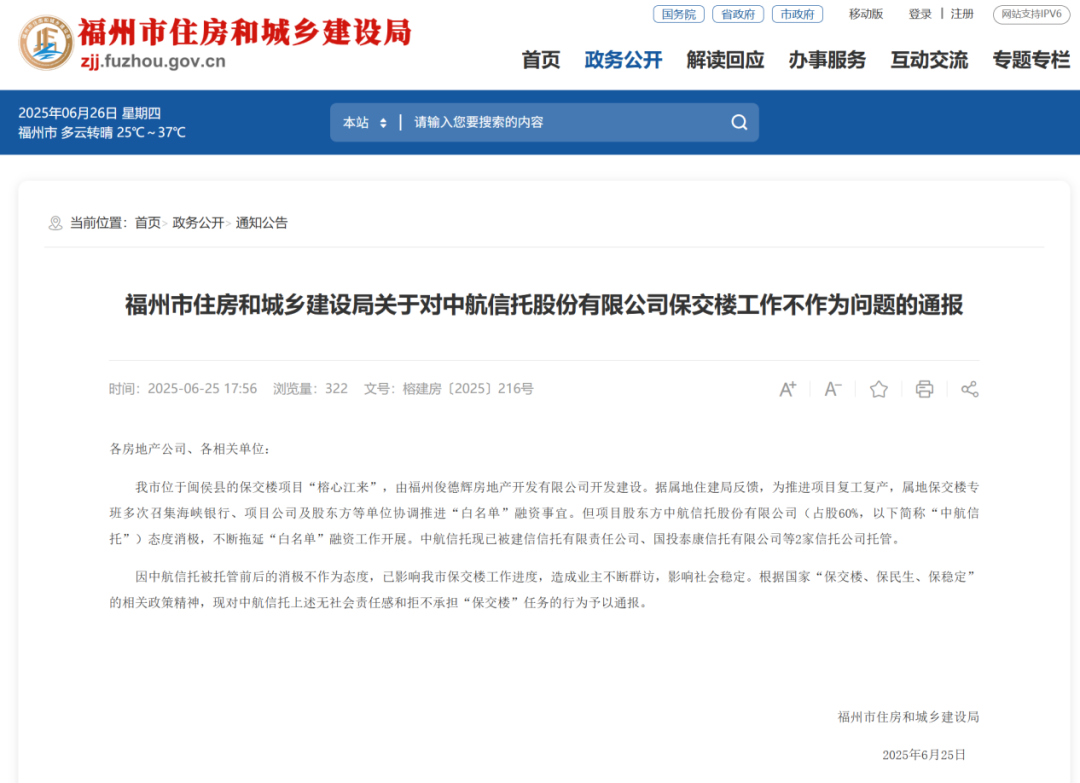
事关“保交楼”!最新通报来了
Zhong Guo Ji Jin Bao· 2025-06-26 11:47
Group 1 - Fuzhou Housing and Urban-Rural Development Bureau issued a notice regarding China Aviation Trust's inaction on the "guarantee delivery" project, impacting project progress and social stability [1] - The project "Rongxin Jianglai" in Fuzhou is developed by Fuzhou Junde Hui Real Estate Development Co., Ltd., with China Aviation Trust holding a 60% stake, which has been uncooperative in financing efforts [1] - Fuzhou Junde Hui Real Estate Development Co., Ltd. was established in 2021 with a registered capital of 410 million RMB and has multiple risk indicators, including operational anomalies and restrictions on high consumption [1][4] Group 2 - China Aviation Trust was established as a non-bank financial institution approved by the former China Banking Regulatory Commission, with a registered capital of 6.466 billion RMB [7] - In April, China Aviation Trust announced a management service agreement with Jianxin Trust and Guotou Taikang Trust to enhance operational efficiency, starting from April 18, 2025 [7] - China Aviation Trust's parent company, AVIC Capital, announced the termination of its stock listing due to significant operational uncertainties [7] Group 3 - Fuzhou Housing and Urban-Rural Development Bureau also issued a notice to China Merchants Bank's Fuzhou branch for inadequate supervision of pre-sale fund accounts related to the "guarantee delivery" project, leading to social stability issues [8] - The project "Shimao Yunpu Mansion" faced difficulties in fund disbursement due to the bank's actions, prompting the bureau to suspend the bank's new pre-sale fund supervision business in the city [8]