比亚迪

Search documents
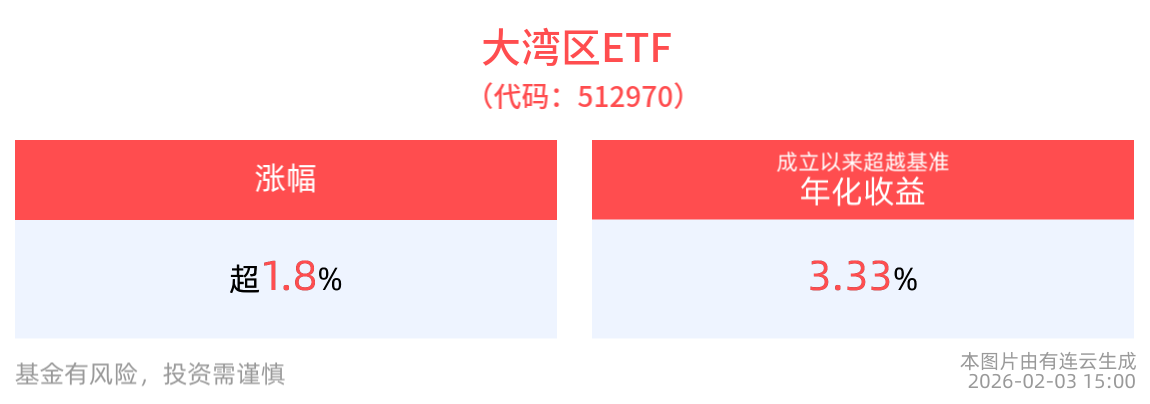
涨超1.8%,大湾区ETF(512970)成立以来超越基准年化收益达3.33%
Xin Lang Cai Jing· 2026-02-04 01:55
Core Viewpoint - The performance of the Zhuhai-Hong Kong-Macao Greater Bay Area Development Theme Index and its related ETF indicates a strong upward trend, reflecting positive market sentiment towards companies benefiting from the Greater Bay Area development [2][3]. Group 1: Index Performance - As of February 3, 2026, the Zhuhai-Hong Kong-Macao Greater Bay Area Development Theme Index (931000) increased by 1.50%, with notable gains from component stocks such as XW Communication (up 13.12%) and Mingyang Smart Energy (up 7.63%) [2]. - The Greater Bay Area ETF (512970) rose by 1.83%, with a latest price of 1.5 yuan, and has accumulated a 16.77% increase over the past six months [2]. - The ETF's trading volume showed a turnover rate of 1.59% with a transaction value of 1.3822 million yuan, and an average daily transaction of 1.0538 million yuan over the past week [2]. Group 2: Risk and Return Metrics - The Greater Bay Area ETF recorded a Sharpe ratio of 1.51 over the past year as of January 30, 2026, indicating a favorable risk-adjusted return [2]. - The maximum drawdown for the ETF this year was 5.52%, with a relative benchmark drawdown of 0.02% [2]. - The management fee for the ETF is set at 0.15%, while the custody fee is 0.05% [2]. Group 3: Index Composition - The index closely tracks companies that benefit from the Greater Bay Area development, including a selection of up to 50 Hong Kong market securities, 300 companies from the Shanghai-Hong Kong-Shenzhen markets, and 100 mainland market securities [3]. - As of January 30, 2026, the top ten weighted stocks in the index accounted for 44.55% of the total, with major companies including Ping An Insurance, Luxshare Precision, and BYD [3][4].

东吴证券晨会纪要2026-02-04-20260204
Soochow Securities· 2026-02-04 01:53
Group 1: Micro Fund Development - The return logic of micro funds is primarily based on the valuation repair of low-attention assets and capital games, with a systematic selection of underpriced micro stocks to capture valuation recovery as attention increases [10][10][10] - Micro funds can be categorized into three types based on strategy implementation: active gaming type, flexible allocation type, and stable participation type, each differing in exposure, return elasticity, and drawdown characteristics [10][10][10] - The micro fund style is expected to have a phase of recovery and structural allocation value, benefiting from a friendly policy and liquidity environment under the "14th Five-Year Plan" [10][10][10] Group 2: Fixed Income Opportunities - The report recommends focusing on bond issuers within key supported industries under the "14th Five-Year Plan," using a qualitative and quantitative assessment method to identify the top 25% of issuers based on bond performance and fundamentals [3][3][3] - The analysis highlights that the majority of recommended issuers have bond balances of 2 billion yuan or more, with ratings predominantly at AAA and AA+ levels, indicating strong credit quality [3][3][3] - The report emphasizes the importance of monitoring macroeconomic conditions and industry policies, as well as the potential tightening of credit environments [3][3][3] Group 3: Company-Specific Insights - Jingdong Group's revenue is projected to reach 350.8 billion yuan in Q4 2025, with a slight year-on-year increase, while the retail business is expected to face pressure due to reduced government subsidies [20][20][20] - The company "Mingming Hen Mang" is positioned as a leading player in the snack retail sector, with projected revenues of 645 billion yuan in 2025, reflecting a significant growth trajectory [19][19][19] - The report anticipates that the company "Jiyuan Group" will maintain a strong market position in the health supplement industry, with a projected revenue of 10 billion yuan in 2024, driven by its innovative product offerings [17][17][17]
2.4犀牛财经早报:黄金进入“未知领域” 投资者心态极限拉扯
Xi Niu Cai Jing· 2026-02-04 01:37
Group 1: Public Fund Industry - In 2026, public fund companies showed strong enthusiasm for self-purchase, with 24 companies implementing self-purchases totaling 406 million yuan, over 80% of which was directed towards equity funds [1] - Among the self-purchases, stock funds received 100 million yuan and mixed funds received 248 million yuan, while bond funds received 30 million yuan [1] - Ruifeng Fund led the self-purchase with 100 million yuan, while several other companies, including GF Fund and China Merchants Fund, each self-purchased 20 million yuan [1] Group 2: Payment Industry - The number of third-party payment licenses is continuously decreasing, with the first company, Henan Jubao Payment, exiting the market in 2026 [2] - The decline in payment institutions is attributed to structural reshuffling and regulatory upgrades within the industry [2] - Traditional payment businesses are under pressure, with many companies reporting declines in net profit after excluding non-recurring gains, prompting a need for transformation towards cross-border payments and AI integration [2] Group 3: Refrigerant Industry - The refrigerant market remains strong despite being in the traditional off-season, with prices for R32 and R134a increasing by approximately 45% and 32% year-on-year, respectively [2] - The industry is expected to see long-term price increases due to strict global supply constraints and growing downstream demand [2] - Major companies are primarily executing long-term contracts, but market prices are expected to exceed contract prices, indicating a robust pricing environment [2] Group 4: Smartphone Market in India - The Indian smartphone market saw a 1% year-on-year increase in shipments in 2025, with sales revenue growing by 8% due to a shift towards high-end devices [3] - However, a single-digit decline in shipments is anticipated for 2026, particularly in the segment priced below 15,000 Indian Rupees, due to rising costs of components [3] - The average selling price (ASP) is expected to increase by 5%-7% as major OEMs focus on high-end strategies [3] Group 5: Nanobody Research - Research indicates that nanobodies extracted from llamas show potential in treating various diseases, including depression, prompting significant investment from pharmaceutical companies [4] - The development of next-generation nanobody drugs is seen as a breakthrough in precision medicine [4] Group 6: Cancer Burden Quantification - The IARC and WHO quantified the global burden of preventable cancers, revealing that nearly 40% of new cancer cases in 2022 were linked to modifiable risk factors [4] - The findings emphasize the importance of reducing smoking, infections, and alcohol consumption in cancer prevention efforts [4] Group 7: PayPal's Financial Performance - PayPal's fourth-quarter earnings and revenue fell short of expectations, leading to a significant drop in stock price and a change in CEO [5] - The company reported earnings of $1.23 per share and total revenue of $8.68 billion, both below analyst forecasts [5] Group 8: Tianqi Lithium Industry - Tianqi Lithium suspended trading in Hong Kong as it plans to dispose of part of its stake in SQM, with a maximum of 3.566 million A shares to be sold [6] - The company has already disposed of 748,500 B shares, and as of the announcement date, it holds 62.556 million A shares, representing 21.90% of SQM's total shares [6] Group 9: Corporate Governance Issues - Gaoxin Retail announced difficulties in contacting its CEO, but the board believes this will not significantly impact operations [7] - The Shanghai Stock Exchange issued a regulatory warning to Pengxin Resources for failing to appoint a board secretary, which has been vacant since January 2022 [8]
比亚迪2月3日获融资买入2.22亿元,融资余额127.71亿元
Xin Lang Cai Jing· 2026-02-04 01:27
Group 1 - BYD's stock price increased by 0.37% on February 3, with a trading volume of 3.276 billion yuan. The financing buy amount was 222 million yuan, while the financing repayment was 307 million yuan, resulting in a net financing buy of -84.82 million yuan. The total financing and securities balance reached 12.823 billion yuan [1] - As of February 3, BYD's financing balance was 12.771 billion yuan, accounting for 2.69% of its circulating market value, which is below the 50th percentile level over the past year, indicating a low position [1] - On the same day, BYD's securities lending saw a repayment of 34,600 shares and a sale of 32,900 shares, with a selling amount of 2.8745 million yuan. The remaining securities lending volume was 601,400 shares, with a balance of 52.5446 million yuan, exceeding the 70th percentile level over the past year, indicating a high position [1] Group 2 - As of September 30, BYD had 642,600 shareholders, an increase of 98.37% compared to the previous period. The average circulating shares per person were 5,427, an increase of 51.21% [2] - For the period from January to September 2025, BYD achieved an operating income of 566.266 billion yuan, a year-on-year increase of 12.75%. However, the net profit attributable to shareholders decreased by 7.55% to 23.333 billion yuan [2] - BYD has distributed a total of 27.859 billion yuan in dividends since its A-share listing, with 24.414 billion yuan distributed in the last three years [3]

研判2026!中国低碳经济行业发展历程、相关政策、市场规模、重点企业及未来展望:低碳经济加速崛起,引领绿色发展新范式[图]
Chan Ye Xin Xi Wang· 2026-02-04 01:24
Core Viewpoint - China, as the largest developing country and greenhouse gas emitter, has made significant progress in low-carbon economic development, aiming to peak carbon emissions by 2030 and achieve carbon neutrality by 2060 through green energy and clean technology initiatives [1][12]. Low-Carbon Economy Overview - The low-carbon economy is based on low energy consumption, low emissions, and low pollution, focusing on technological innovation, institutional reform, industrial transformation, and renewable energy development [3][4]. Industry Development History - The concept of a low-carbon economy emerged in the UK in 2003, with significant milestones including the 2006 Stern Report advocating for global transition to low-carbon economies and China's first national climate change assessment report [4][6]. Industry Policies - A series of policies have been implemented to promote low-carbon economic development, including the 2025 government work report emphasizing the acceleration of green low-carbon economy development and the establishment of a national carbon market [7][8]. Industry Chain - The low-carbon economy industry chain includes upstream low-carbon energy supply and technology research, midstream low-carbon enterprises, and downstream applications such as green buildings and renewable energy generation [8]. Current Industry Status - The national carbon trading market is a key component of the low-carbon economy, with significant growth in trading volume and value, reaching a cumulative transaction volume of 865 million tons and a transaction value of 57.663 billion yuan by the end of 2025 [9][10]. Key Enterprises - Major companies in China's low-carbon economy include Dongjiang Environmental Protection, Ningde Times, BYD, and others, each focusing on various aspects of environmental services, clean energy, and technology innovation [14][15]. Industry Development Trends - Technological innovation is crucial for low-carbon economic growth, with advancements in renewable energy and storage technologies driving down costs and improving efficiency [17]. - Government support through policies and funding will continue to encourage research and development in low-carbon technologies [18]. - Increasing market demand for low-carbon products, driven by consumer awareness and global climate governance, will further stimulate growth in the low-carbon economy [18].





比亚迪(002594):批发销量节奏调整,静待后续产品周期:比亚迪(002594):2026年1月销量点评
Huachuang Securities· 2026-02-04 01:21
证 券 研 究 报 告 批发销量节奏调整,静待后续产品周期 目标价:113.8 元、116.3 港元 乘用车Ⅲ 2026 年 02 月 04 日 比亚迪(002594)2026 年 1 月销量点评 强推(维持) 当前价:87.37 元、90.00 港元 华创证券研究所 证券分析师:张程航 电话:021-20572543 邮箱:zhangchenghang@hcyjs.com 执业编号:S0360519070003 证券分析师:夏凉 事项: 评论: [ReportFinancialIndex] 主要财务指标 | | 2024A | 2025E | 2026E | 2027E | | --- | --- | --- | --- | --- | | 营业总收入(百万) | 777,102 | 805,565 | 943,584 | 1,070,539 | | 同比增速(%) | 29.0% | 3.7% | 17.1% | 13.5% | | 归母净利润(百万) | 40,254 | 35,214 | 47,042 | 59,979 | | 同比增速(%) | 34.0% | -12.5% | 33.6% | 27 ...
上交+清华团队做端侧AI:连续两轮融资过亿、服务苹果比亚迪宁德丨早起看早期
3 6 Ke· 2026-02-04 00:52
Core Insights - Shanghai Xinmi Technology Co., Ltd. has successfully completed A and A+ rounds of financing, raising over 100 million yuan, with investments from Guotai Junan Innovation Investment, Guojing Capital, and Tongxin Capital [3][4] - The funding will be used for the development of next-generation integrated sensing and computing chip architecture, global commercialization, and expansion of high-end production capacity [3][4] - Xinmi Technology's core product is based on the "integrated sensing and computing" technology, offering a full-stack product matrix that includes AI SoC chips, intelligent modules, and integrated hardware-software solutions [4][5] Company Background - Founded in 2019 and headquartered in Shanghai, the company has a core team with strong academic and industry backgrounds, including experience in robotics and AI [4] - The founder and CEO, Dr. Yang Minglun, has over ten years of experience in industrial robotics, while the CTO, Cheng Yuan, has published extensively in top academic journals and achieved significant breakthroughs in chip architecture [4] Technology and Product Application - The company has developed a new paradigm of "integrated sensing and computing," which eliminates data transmission bottlenecks and enhances efficiency in processing complex multimodal data [4][9] - Xinmi Technology's products are widely used in smart manufacturing, embodied intelligent robots, automotive, new energy, smart cities, and precision instrument monitoring [5] Market Trends and Growth - The shift towards "high-efficiency specialized intelligence" marks a transition from large models to deep integration with physical devices, indicating a growing market for industrial IoT applications [7][9] - Xinmi Technology has experienced rapid revenue growth, with a reported annual doubling of revenue and a gross margin maintained at a high level [7] - The company's overseas business is expected to grow over 400% annually, with international revenue projected to account for over 40% of total income this year [7] Future Development Plans - The company aims to deepen its focus on industrial agent systems and expand into "embodied intelligence" and "precision sensing" sectors [10] - Long-term goals include integrating advanced technologies like neuromorphic computing and photonic computing to significantly enhance AI capabilities [10] Investor Perspectives - Investors highlight the importance of efficiency, energy consumption, and speed in AI applications, with Xinmi Technology's architecture seen as a key player in the future of intelligent infrastructure [12][13] - The company's unique approach to edge AI and integrated computing is expected to create significant competitive advantages and establish strong data and technology barriers [13][14]

中央一号文件发布,关注“乡村消费”“农民增收”相关机会
Mei Ri Jing Ji Xin Wen· 2026-02-04 00:47
Core Viewpoint - The central document emphasizes multiple measures to promote dairy product consumption and expand rural consumption, highlighting the importance of increasing farmers' income through operational and wage income strategies [1] Group 1: Dairy Industry - The document supports initiatives to boost dairy consumption, indicating a favorable environment for dairy companies [1] - Companies like Yili (伊利股份, 600887) are expected to benefit from the increase in basic consumer income [1] Group 2: Agricultural Sector - The document outlines support for agricultural innovation, including the application of drones, IoT, and robotics, which may create investment opportunities in agricultural technology [1] - The focus on agricultural bio-manufacturing technology innovation suggests potential growth for companies involved in these sectors [1] Group 3: Consumer Sector - The document encourages the development of a recycling system for old household appliances, which may benefit companies in the home appliance sector [1] - The optional consumption ETF (562580.SH) includes companies like Midea (美的集团, 000333) and BYD (比亚迪, 002594), which are likely to gain from the new "trade-in" subsidy policies and rural initiatives for smart appliances and electric vehicles [1]
风云T11:上市后带动客流上涨,对比最多的是银河M9
车fans· 2026-02-04 00:30
Sales Performance - The T11 model has seen a significant increase in foot traffic at dealerships, with daily visits rising from about 4 groups to 10-12 groups on weekends [2] - Sales for the T11 reached over 20 units in November and December, but experienced a slowdown in January due to the introduction of purchase tax [3] - The most popular configurations are the 220 rear-drive and four-wheel drive dual IMAX cinema versions, priced at ¥209,900 and ¥229,900 respectively, with preferred colors being Aurora Green and Obsidian Black [4] Customer Demographics - The typical customer age ranges from 35 to 60 years, including teachers, state-owned enterprise employees, civil servants, and small business owners [5] - A notable portion of buyers are existing Chery owners looking to upgrade [5] Consumer Preferences - Key reasons for purchasing the T11 include Chery's strong technical foundation and the vehicle's spacious, aesthetically pleasing design at a competitive price [10] - The most frequently compared model is the Geely Galaxy M9, with customers favoring the latter for its brand recognition and superior driver assistance features [13] Customer Feedback - Common complaints from customers include concerns about the electric range being too short and the vehicle's infotainment and voice control systems lacking intelligence [19] Promotional Offers - Current promotional offers include a ¥10,000 purchase tax subsidy and various limited-time benefits such as free upgrades and financing options [22][23]

【汽车】1月新能源车表现疲软,各车企购车优惠加码——新势力1月销量跟踪报告(倪昱婧/邢萍)
光大证券研究· 2026-02-03 23:07
Core Viewpoint - The performance of new energy vehicles (NEVs) in January was weak, with varying delivery numbers among major manufacturers, indicating potential challenges in the market [4]. Group 1: January NEV Performance - Li Auto's delivery volume decreased by 7.5% year-on-year and 37.5% month-on-month to 27,668 units [4] - NIO's delivery volume increased by 96.1% year-on-year but decreased by 43.5% month-on-month to 27,182 units, with the NIO brand up by 162.8% year-on-year [4] - Xpeng's delivery volume fell by 34.1% year-on-year and 46.6% month-on-month to 20,011 units [4] Group 2: New Model Launches - BYD announced new long-range versions of its models on January 7, 2026, to enhance product competitiveness [5] - Xpeng officially launched several new models on January 8, 2026, focusing on cost-effectiveness and intelligence [5] - Aito's M7 extended-range version was launched on January 13, 2026, and Leado's L60 model was launched on January 16, 2026 [5] Group 3: Purchase Incentives - Tesla is offering various financial incentives and reduced delivery times for its Model 3 and Model Y vehicles [6] - Li Auto has shortened delivery times for several models and extended purchase subsidies into February [6] - NIO and Xpeng have also adjusted delivery times and introduced low-interest financing options across their vehicle ranges [6][7] Group 4: AI Transformation and Material Cost Pressures - New energy vehicle companies are actively transitioning towards AI, with plans for humanoid robot production lines [8] - The prices of upstream materials such as copper, aluminum, and lithium carbonate have been rising since the end of 2025, which may pressure vehicle gross margins [8]