三星

Search documents
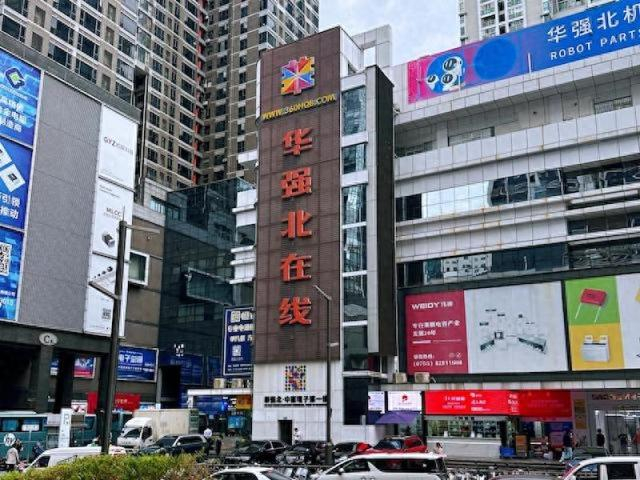
一盒近600万元,堪比一套房!记者实探深圳华强北存储市场,涨价预计将持续至2026年底
Hua Xia Shi Bao· 2026-01-21 11:39
Core Viewpoint - The surge in prices of memory and storage hardware, driven by the explosive growth of AI technology, has led to significant market disruptions, with some products' prices reaching levels comparable to real estate in major cities [2][4]. Group 1: Price Surge and Market Impact - The price of a single 256G DDR5 server memory stick has approached 60,000 yuan, with a box of 100 sticks costing nearly 6 million yuan, equivalent to the price of a house in certain cities [2][4]. - Prices for memory products, including DDR4 and DDR5, have reportedly increased by three to four times over the past two months, with SSD prices also nearly doubling [3][4]. - The consumer market is feeling the impact, with users reporting significant price increases for memory sticks, such as a 16G DDR5 stick rising from 100 yuan to over 600 yuan [3][4]. Group 2: AI Demand and Hardware Requirements - The current surge in server memory prices is attributed to a historic upward cycle in the global server memory market, with DDR5 prices increasing over 300% since September 2025 [4][6]. - AI's demand for hardware has shifted from training to inference, requiring higher memory capacities and bandwidth, which has transformed memory into a critical resource for AI systems [6][10]. - AI servers require 8 to 10 times more memory than standard servers, leading to a prioritization of high-end production for AI applications, while traditional consumer electronics face significant pressure [6][10]. Group 3: Industry Dynamics and Future Outlook - The structural changes in demand are redistributing value and risk across the supply chain, with profits concentrating upstream and risks accumulating downstream [7][10]. - The high prices are creating a divide in the industry, where large AI companies can absorb costs while smaller firms struggle, accelerating internal industry differentiation [7][10]. - The price surge driven by AI demand is expected to continue until the end of 2026, with key indicators for a turning point including inventory turnover rates and advancements in production capabilities [9][10]. Group 4: Strategic Responses and Industry Evolution - Companies are advised to focus on "technical throttling" and "organizational open-source" strategies to mitigate costs, such as optimizing inference efficiency and building shared computing resources [9][10]. - Chinese storage companies like Changxin Storage are positioned to capitalize on the global supply chain shift, aiming to increase production capacity significantly by 2026 [10]. - The memory market is evolving into a critical component of AI infrastructure, with the potential for significant technological and market shifts as companies strive for efficiency and innovation [10].


存储行业跟踪报告:26Q1价格涨幅超市场预期,关注即将到来的密集财报催化
CMS· 2026-01-21 11:25
存储行业跟踪报告 TMT 及中小盘/电子 全球存储价格从 25H1 复苏上涨以来,25Q3-Q4 现货/合约价格加速上涨,近期 逐步发现 26Q1 各品类存储价格环比涨幅超预期,我们预计 2026 年全年全球存 储供给整体维持偏紧状态,AI 需求增长持续高于产能扩张速度,其他消费类存 储和利基型存储受到产能挤压和下游恐慌备货等因素,价格涨幅也远超常规水 平,我们认为今年国内存储产业链多环节都将受益于缺货涨价浪潮,核心建议 关注存储原厂+存储模组/芯片公司+存储封测/代工等环节。 ❑ AI 存储引发更多需求增量,多级存储体系优化补充急剧增多的 KV 缓存空间。 推荐(维持) 证券研究报告 | 行业点评报告 2026 年 01 月 21 日 26Q1 价格涨幅超市场预期,关注即将到来的密集财报催化 英伟达在CES 2026主题演讲上发布最新Inference Context Memory Storage Platform (推理上下文存储平台),利用 BlueField-4 DPU 构建在 Pod 级别 运行的专用上下文记忆层,在计算节点层面,KV 分层涵盖 GPU HBM、主机 内存、本地 SSD、ICMS 和 ...




上网本,为何消失了?
3 6 Ke· 2026-01-21 11:02
Core Viewpoint - The rise and fall of the ASUS Eee PC, which pioneered the netbook category, illustrates the rapid evolution of consumer electronics and the impact of market dynamics on product lifecycle [1][10][43] Group 1: Rise of the Netbook - In 2006, ASUS became the world's second-largest OEM, primarily manufacturing computers and servers for Dell and HP, but faced anxiety over its heavy reliance on OEM business [1] - The launch of the ASUS Eee PC in 2007 marked a significant shift, creating a new product category known as netbooks, which peaked at nearly 40 million units sold globally [1][10] - The Eee PC was priced at $299, significantly lower than traditional laptops, which contributed to its rapid adoption [4][10] - By 2008, netbook sales reached 10.8 million units, and by 2010, they exceeded 39 million units, capturing over 10% of the PC market [3][10] Group 2: Market Dynamics - The global financial crisis in 2007 led to decreased consumer spending, further enhancing the appeal of low-cost netbooks as alternatives to traditional laptops [7] - The entry of various manufacturers, including Acer and numerous smaller companies, drove down production costs and increased competition in the netbook market [6][10] - Netbooks found a niche in the education sector, particularly in developing countries, where their affordability made them an attractive option for governments looking to enhance educational resources [9][10] Group 3: Decline of the Netbook - Despite initial success, netbook sales began to decline sharply after 2010, with sales dropping to 2.94 million units in 2011 and further to 1.41 million in 2012 [10][12] - The rapid evolution of technology and consumer preferences, including the rise of tablets and smartphones, contributed to the decline of netbooks, as these devices offered better performance and portability [30][34] - By 2013, major manufacturers, including ASUS and Acer, ceased production of new netbook models, marking the end of the product category [12][13] Group 4: Legacy and Impact - The netbook's brief existence highlighted the importance of price, portability, and internet connectivity in consumer electronics, influencing the design and marketing of future devices [41][43] - Innovations inspired by the netbook, such as ultrabooks and Chromebooks, emerged as manufacturers sought to fill the gaps left by the decline of netbooks [43] - The netbook phenomenon serves as a case study in how market needs and technological advancements can rapidly change the landscape of consumer electronics [43]

中国贸促会副会长聂文慧会见三星公司高管
Bei Jing Ri Bao Ke Hu Duan· 2026-01-21 10:24
Group 1 - The meeting took place on January 21, where the Vice President of China Council for the Promotion of International Trade, Nie Wenhui, met with Zhang Daijun, the Senior Vice President of Samsung (China) Investment Co., Ltd. [1][2] - The discussion focused on supporting Samsung's development in China and promoting international cooperation in the supply chain and industrial chain [1][2]
【招商电子】存储行业跟踪报告:26Q1价格涨幅超市场预期,关注即将到来的密集财报催化
招商电子· 2026-01-21 10:16
26Q1存储合约/现货价格涨幅超预期,涨价逐步蔓延至代工和封测等环节。 TrendForce预计常规DRAM 26Q1价格环比增长55%-60%,主要系26Q1原厂大规模转移产能至服务器和HBM应用,带来其他市场供应吃紧。NAND预计环 比增长33%-38%,原厂管控整体产能,且同样受到服务器的排挤效应。海外NAND 大厂闪迪此前曾向多家客户提出 100%现金预付的长期锁量方案,最长 或涉及3年合约,同时闪迪26Q1合约价格最高或有近翻倍增长,高于市场30%-40%的预期。存储产业链方面,以台系为例,随着美光等大客户的需求持续 增长,委外订单比重持续增加,力成、南茂等近期稼动率持续提升,叠加成本增加等因素传2026 年陆续给客户涨价,我们从国内存储代工和封测等渠道 了解到,都普遍存在产能吃紧和价格上调的现象。 全球存储价格从25H1复苏上涨以来,25Q3-Q4现货/合约价格加速上涨,近期逐步发现26Q1各品类存储价格环比涨幅超预期,我们预计2026年全年全球存 储供给整体维持偏紧状态,AI需求增长持续高于产能扩张速度,其他消费类存储和利基型存储受到产能挤压和下游恐慌备货等因素,价格涨幅也远超常 规水平,我们认 ...
芯片散热,三星有新招
半导体芯闻· 2026-01-21 10:13
Core Viewpoint - The introduction of Heat Pass Block (HPB) technology by Samsung in the Exynos 2600 represents a significant advancement in mobile SoC thermal management, addressing the challenges posed by high-performance computing and the need for efficient heat dissipation [1][4]. Group 1: HPB Technology Overview - HPB is a metal thermal conduction structure integrated within the chip packaging, designed to shorten the distance for heat transfer from the chip core to the external cooling module [2]. - The primary material used for HPB is copper, which offers excellent thermal conductivity and performance among metals [2]. Group 2: Advantages and Challenges of HPB - The implementation of HPB establishes a more direct thermal pathway between the die and the external cooling system, effectively reducing thermal resistance, which is crucial for high-power chips [4]. - Despite its advantages, HPB introduces new constraints in engineering and product design, including increased volume and height, complexity in packaging design, and higher costs [4]. - The increased Z-axis height of HPB may limit space for other components like batteries or camera modules in slim phone designs [4]. - The complexity of HPB, being a multi-material structure, requires careful management of thermal expansion differences, impacting manufacturing yield and reliability [4]. - The cost implications of HPB packaging necessitate its initial application in flagship or Pro-level SoCs, making it less accessible for mid-range markets [4]. Group 3: Industry Comparison - In contrast, TSMC continues to utilize existing packaging and thermal design strategies without incorporating internal heat conduction structures like HPB, focusing instead on wafer-level multi-chip module (WMCM) packaging to mitigate localized heat concentration [5]. - This indicates a shift in thermal management strategies as mobile SoCs transition into high-power and high-density computing, evolving from single-path solutions to more integrated packaging and system design considerations [5].

清华博士烧掉几十亿,靠手写的二百页文档做出百亿芯片巨头丨36氪专访
36氪· 2026-01-21 10:01
Core Viewpoint - The article discusses the journey and vision of Yang Zuoxing, founder of Bit Micro, focusing on his innovative approach to AI chip design and the development of low-power, wireless AI cameras under the brand "CINMOORE" [5][10][15]. Group 1: Company Background and Development - Yang Zuoxing, a PhD graduate from Tsinghua University, transitioned from a microelectronics designer to a successful entrepreneur in the chip industry, notably contributing to the design of Bitcoin mining chips [6][11][13]. - After leaving Bitmain due to equity disputes, Yang founded Bit Micro, achieving sales of 1.3 billion yuan within two years with a team of over 50 people [13][14]. - Yang's ambition to create AI chips led to the establishment of Yanjing Microelectronics in 2020, with an investment plan of 5 billion yuan, of which 2.2 billion yuan has already been spent [15][25]. Group 2: Product Innovation and Market Strategy - The main product, CINMOORE, features low-power AI cameras that eliminate the need for power cables, significantly reducing installation costs and complexity [16][25]. - The company aims to revolutionize the security camera market, predicting that if wireless cameras reach a 90% market share, the industry could grow from a hundred billion to a trillion yuan market [16][39]. - Yang emphasizes the importance of reducing power consumption to enable AI functionalities in edge devices, achieving a performance of 40-50T of computing power per watt, compared to competitors' several T per watt [22][23]. Group 3: Competitive Landscape and Future Outlook - Despite facing competition from established giants like Hikvision and Dahua, Yang believes in differentiating through innovation rather than direct confrontation [32][39]. - The company has set ambitious growth targets, aiming for a tenfold increase in sales annually, with expectations of reaching a market share of around 5% by 2025 [44][37]. - Yang's vision includes expanding into B2B markets after establishing a strong presence in the consumer sector, leveraging the advantages of low-cost, wireless solutions [42][36].

封测涨价30%,国产算力产业链持续看好
East Money Securities· 2026-01-21 09:47
Investment Rating - The report maintains a rating of "Outperform" for the electronic industry, indicating a positive outlook compared to the broader market [2]. Core Insights - The report emphasizes that AI inference is driving innovation, with a focus on demand-driven Opex-related sectors, particularly in storage, power, ASIC, and supernodes [2][30]. - The semiconductor packaging industry is experiencing a significant price increase of 30%, driven by supply-demand imbalances and rising costs of raw materials [23][24][27]. - The report highlights the expected growth in the domestic computing power supply chain, particularly in storage and ASIC sectors, as companies like Yangtze Memory Technologies and ChangXin Memory Technologies expand production [2][30]. Summary by Sections Market Review - The Shanghai Composite Index decreased by 0.45%, while the Shenzhen Component Index increased by 1.14%. The Shenwan Electronics Index rose by 3.77%, ranking second among 31 Shenwan industries [1][13]. Weekly Focus - TSMC reported a 35% increase in profits, driven by strong demand for AI chips, with expected capital expenditures of $52 billion to $56 billion in 2026 [23]. - The packaging industry is benefiting from a recovery in demand, with companies like Li Cheng and Hua Dong Technology seeing increased capacity utilization and order visibility [23][24]. Storage Sector - The report anticipates a significant expansion year for NAND and DRAM production, driven by rising demand for SSDs and HBM products [30]. - Key players in the NAND and DRAM semiconductor supply chain include companies like Zhongwei Technology and Tuo Jing Technology [30]. Power Sector - The report identifies growth opportunities in the power sector, focusing on new technologies in both generation and consumption [31]. ASIC and Supernodes - The report expresses optimism regarding the full-stack model of ASIC inference, predicting an increase in market share for ASICs [31]. - It also notes the anticipated evolution of cabinet models, with growth expected in high-speed interconnects, cabinet manufacturing, and liquid cooling technologies [31]. Domestic Supply Chain - The report highlights improvements in domestic advanced process yields and capacity, which are expected to enhance the supply of domestic computing power chips [30][32].


重磅突围!长鑫295亿募资上市在即,中国芯片打破西方恶意垄断
Sou Hu Cai Jing· 2026-01-21 08:48
Core Viewpoint - The article discusses the unprecedented IPO of Changxin Technology in China's semiconductor industry, highlighting the unique "secret passage" for its listing process, which aims to protect its key technologies and financial data from international competitors [1][3][9]. Group 1: IPO Process and Regulatory Environment - Changxin Technology's IPO process is characterized by a rare "pre-review" mechanism, allowing for confidential assessments before public disclosure, which is a significant shift in China's IPO regulatory framework [7][9]. - This new approach is designed to safeguard core technologies and prevent early exposure of sensitive information during the listing process, reflecting a strong commitment to supporting domestic chip manufacturing [3][9]. Group 2: Market Position and Competition - The global memory market, valued at approximately $160 billion annually, has been dominated by three major players: Samsung, SK Hynix, and Micron, creating a highly monopolized environment [13][15]. - Changxin Technology has managed to capture a market share of 8% by 2025, demonstrating its ability to challenge these established giants and break through significant barriers in the memory chip sector [15][17]. Group 3: Funding and Investment Strategy - The IPO aims to raise 29.5 billion RMB, setting a record for China's semiconductor industry, with clear allocations for enhancing production capacity and advancing core technology [23][25]. - Specific funding allocations include 7.5 billion RMB for upgrading existing wafer manufacturing lines, 13 billion RMB for DRAM technology upgrades, and 9 billion RMB for research into next-generation storage technologies [25]. Group 4: Industry Outlook and National Strategy - The rise of Changxin Technology signifies a broader trend of increasing competitiveness within China's semiconductor industry, countering the narrative of complete dependency on foreign technology [27][31]. - The article emphasizes the importance of supporting companies like Changxin Technology as they represent critical steps toward achieving technological self-sufficiency and enhancing national security in the semiconductor sector [33][37].
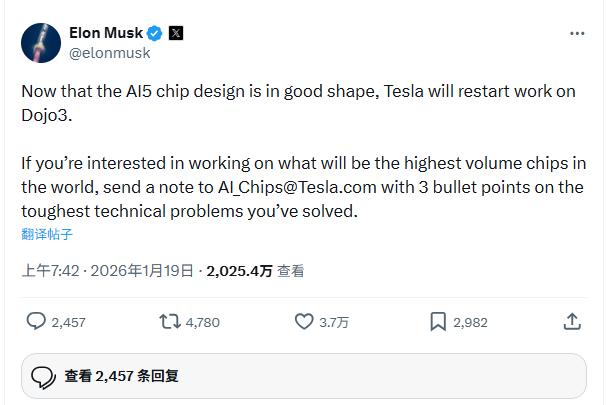
马斯克高调“复活”特斯拉Dojo3芯片项目
3 6 Ke· 2026-01-21 07:45
Core Insights - Tesla's CEO Elon Musk announced the revival of the previously shelved supercomputer project Dojo 3, marking a significant shift in Tesla's chip strategy [1][2] - The new mission of Dojo 3 will expand beyond training autonomous driving models on Earth to include "space artificial intelligence (AI) computing" [1][6] Group 1: Dojo 3 Project Overview - Dojo 3 was initially designed as a supercomputer for machine learning training, first introduced during Tesla's AI Day in 2021 [4] - The project aims to restructure its architecture and optimize costs, moving away from the complex paths of previous generations that relied on in-house D1 chips [4] - Musk hinted that the future of Dojo will involve a cluster architecture integrating numerous AI6 chips rather than developing dedicated training systems [4] Group 2: Strategic Shifts and Partnerships - Five months prior, Tesla halted the Dojo 3 project, disbanded its core team, and shifted focus to AI5, AI6, and subsequent chips, which can handle both efficient inference and core training tasks [2] - Tesla plans to increase reliance on Nvidia and other partners like AMD for computing, as well as on Samsung for chip manufacturing, rather than continuing to develop custom chips [2][5] - The AI5 chip is manufactured by TSMC and is intended to power Tesla's autonomous driving features and the Optimus humanoid robot [5] Group 3: Space AI Vision - Musk's latest statements indicate a vision for deploying AI computing centers in space, which he believes will be more cost-effective than terrestrial systems within four to five years [6][7] - The rationale includes the availability of "free" solar energy and relatively easier cooling technologies in space [6] - Musk's involvement in xAI, SpaceX, and Tesla creates a synergistic potential for these ventures, positioning Tesla as a major beneficiary if successful [6] Group 4: Challenges Ahead - Despite the ambitious goals, significant obstacles remain for establishing space-based AI data centers, including orbital debris, regulatory approvals, and international space policies [9] - Cooling high-power computing devices in a vacuum presents challenges, as temperature fluctuations in space can be extreme [9][10] - Constructing large AI data centers in geostationary orbit will require massive heat dissipation structures, which pose logistical and cost challenges [10]