通富微电

Search documents
通富微电(002156) - 002156通富微电投资者关系管理信息20250916
2025-09-16 09:08
Company Overview - Tongfu Microelectronics is an integrated circuit packaging and testing service provider, offering one-stop services from design simulation to packaging testing for global clients [2][3] - The company covers various fields including AI, high-performance computing, big data storage, 5G, IoT, automotive electronics, and industrial control [2][3] - Major shareholder is Nantong Huada Microelectronics Group, with stable equity structure [2] Financial Performance - Revenue for 2022, 2023, 2024, and the first half of 2025: CNY 21.429 billion, CNY 22.269 billion, CNY 23.882 billion, and CNY 13.038 billion respectively [3] - Net profit for the same periods: CNY 0.502 billion, CNY 0.169 billion, CNY 0.678 billion, and CNY 0.412 billion [3] - 2024 revenue growth of 7.24% and net profit growth of 299.90% [6] - 2025 H1 revenue growth of 17.67% and net profit growth of 27.72% [6] Industry Situation - Global semiconductor market reached USD 346 billion in H1 2025, a year-on-year growth of 18.9% [4] - Forecast for 2025 global semiconductor market size is USD 728 billion, up 15.4% from 2024 [4] - Expected market size for 2026 is USD 800 billion, with a further growth of 9.9% [4] Key Trends in Semiconductor Market - AI-driven growth continues; Asia-Pacific IC design market expected to grow by 15% in 2025 [5] - TSMC maintains dominance in wafer foundry; strong demand for advanced processes [5] - 2025 is a critical year for 2nm wafer manufacturing technology [5] Business Performance in Specific Fields - In H1 2025, the company increased market share in mobile, home appliance, and automotive sectors [9] - Focus on AI and high-performance products, with successful integration of Suzhou and Penang factories [9] Technology Development - Significant progress in large-size FCBGA development, with mass production initiated [11] - Breakthroughs in optical-electrical hybrid packaging technology [11] - Over 1,700 patent applications, with nearly 70% being invention patents [8] Future Outlook - Continued growth expected in AI and new energy vehicle sectors in H2 2025 [10] - Chinese IC packaging and testing industry is anticipated to transition from "catching up" to "keeping pace" and potentially "leading" [10]

一家VC创始人深度复盘“合肥现象”
投中网· 2025-09-16 03:48
Core Viewpoint - Hefei has rapidly transformed from a second-tier city to a "trillion club" and "new first-tier city," driven by government-led initiatives and strategic investments in key industries, which is better described as the "Hefei phenomenon" rather than a mere "Hefei model" [4][21]. Group 1: Government Strategy and Investment - The success of Hefei is attributed to a combination of proactive government decision-making, effective use of equity capital, selection of industry leaders, and the incubation of industrial clusters [4][19]. - Hefei's government has played a crucial role as a "operator," exemplified by significant investments in key enterprises through strategic decisions, such as delaying metro construction to invest in BOE Technology Group [10][12]. - The government’s approach to investment has included deep involvement in strategic planning and operational management of companies, showcasing a model of capital operation combined with industrial cultivation [13][20]. Group 2: Key Investments and Outcomes - The investment in BOE Technology in 2008, which involved a significant allocation of funds, led to the establishment of a complete display industry chain in Hefei, generating over 180 related enterprises and achieving a scale exceeding 100 billion yuan [10][12]. - The establishment of Changxin Storage in 2017 filled a critical gap in the storage chip industry, with the company quickly rising to become one of the top four global storage chip manufacturers, significantly contributing to China's chip industry [13][15]. - The strategic investment in NIO in 2020 during a challenging market phase helped the company recover and thrive, leading to a production output of over 400,000 vehicles by 2023 and generating substantial returns for Hefei [16][17]. Group 3: Unique Ecosystem and Replicability - The "Hefei phenomenon" is characterized by a unique and sustainable industrial ecosystem that is difficult for other cities to replicate, built on deep industry analysis and strategic timing [18][21]. - Hefei's geographical advantages as a central hub in China facilitate industrial transfer and regional economic cooperation, enhancing its attractiveness for investment and development [20][21]. - The city's success is not only reflected in rapid economic growth but also in the establishment of advanced manufacturing clusters in sectors like new displays, chips, and electric vehicles, which are critical for sustainable urban development [18][21].




方建华:合肥模式还是合肥现象?
2 1 Shi Ji Jing Ji Bao Dao· 2025-09-15 12:28
Core Insights - Hefei has rapidly emerged as a "trillion club" city and a "new first-tier city" in recent years, attributed to a unique development model that is more accurately described as the "Hefei phenomenon" rather than a replicable "Hefei model" [1] - The success of Hefei is driven by a combination of proactive government decision-making, effective use of equity capital, selection of industry leaders, and the incubation of industrial clusters [1][13] - The city has established a distinctive development path characterized by government-led innovation and strategic investments in key industries, setting a benchmark for other second and third-tier cities [1][15] Innovation and Education - The establishment of the University of Science and Technology of China (USTC) in Hefei has laid a strong foundation for innovation, contributing significantly to the city's development [2] - USTC's relocation to Hefei in the late 1960s marked the beginning of a long-term partnership that has fueled the city's technological advancements and talent pool [2][3] Strategic Investments - Hefei's government has made three significant strategic investments, referred to as "century gambles," which have successfully nurtured multiple trillion-level industrial clusters [4] - The first major investment was in BOE Technology Group in 2008, where Hefei invested approximately 6 billion yuan to establish a domestic LCD panel production line, leading to a thriving display industry [6][7] - The second investment was in Changxin Storage in 2017, where Hefei partnered with a private firm to create a leading domestic memory chip manufacturer, significantly impacting the semiconductor industry [8][9][10] - The third investment was in NIO Inc. in 2020, where Hefei provided 7 billion yuan to support the electric vehicle manufacturer during a critical phase, resulting in substantial returns for the city [11][12] Economic Impact - The display industry, supported by BOE, has attracted over 180 related enterprises, creating a complete industrial chain and generating revenues exceeding 100 billion yuan [7] - Changxin Storage's success has led to the establishment of a new trillion-level integrated circuit industry cluster in Hefei, with significant contributions to the domestic semiconductor market [9][10] - The electric vehicle sector, bolstered by NIO, has seen rapid growth, with production surpassing 400,000 units in Hefei alone by 2023, contributing to a robust automotive ecosystem [11][12] Unique Ecosystem - The "Hefei phenomenon" is characterized by a unique industrial ecosystem that is difficult for other cities to replicate, involving deep government engagement and strategic use of equity capital [13][14] - Hefei's geographical advantages as a central transportation hub in China have facilitated industrial transfer and regional economic cooperation, enhancing its attractiveness for investment [14][15]
2025年A股中报业绩分析及行业景气展望:实体盈利缓增,新质亮点突出
Ping An Securities· 2025-09-15 07:32
Overall Performance - A-share listed companies reported a 2.4% year-on-year profit growth in Q2 2025, with market sentiment remaining optimistic[4] - The cumulative net profit growth rates for all A-shares and non-financial A-shares were 2.4% and 1.0%, respectively, showing a decline of 1.2 percentage points and 3.5 percentage points compared to Q1 2025[9] - Non-financial A-shares' overseas business revenue grew by 3.9%, contributing 15.3% to total revenue[9] Sector Analysis - The Sci-Tech Innovation Board showed a significant profit recovery with a net profit growth rate of 38.0% in Q2 2025, contrasting with a decline of 14.3% in the same period for the ChiNext Board[12] - Large-cap stocks demonstrated relative resilience, with the cumulative net profit growth rates for the CSI 500, CSI 800, and CSI 300 at 6.9%, 2.8%, and 2.4%, respectively[12] - AI technology continues to lead high prosperity, with the TMT sector maintaining strong growth, particularly in AI computing hardware[15] Consumer Trends - High-end new energy vehicles and innovative pharmaceuticals showed improved market conditions, with the automotive sector experiencing unexpected domestic sales growth[4] - The food and beverage sector saw a mixed performance, with liquor industry profits stabilizing while beverage and snack segments remained high in demand[4] Market Outlook - The equity market is expected to continue high-level fluctuations, with recommendations to focus on sectors with upward trends in industrial prosperity and superior performance[4] - Key sectors to watch include technology growth (AI, semiconductors, innovative pharmaceuticals), advanced manufacturing (new energy, automotive), and traditional cyclical sectors benefiting from price increases[4] Risk Factors - Potential risks include macroeconomic fluctuations, lower-than-expected profit growth for listed companies, and unexpected disturbances from overseas policies and geopolitical tensions[4]
大基金三期出手了!4.5亿元精准投向集成电路设备领域
Sou Hu Cai Jing· 2025-09-15 06:31
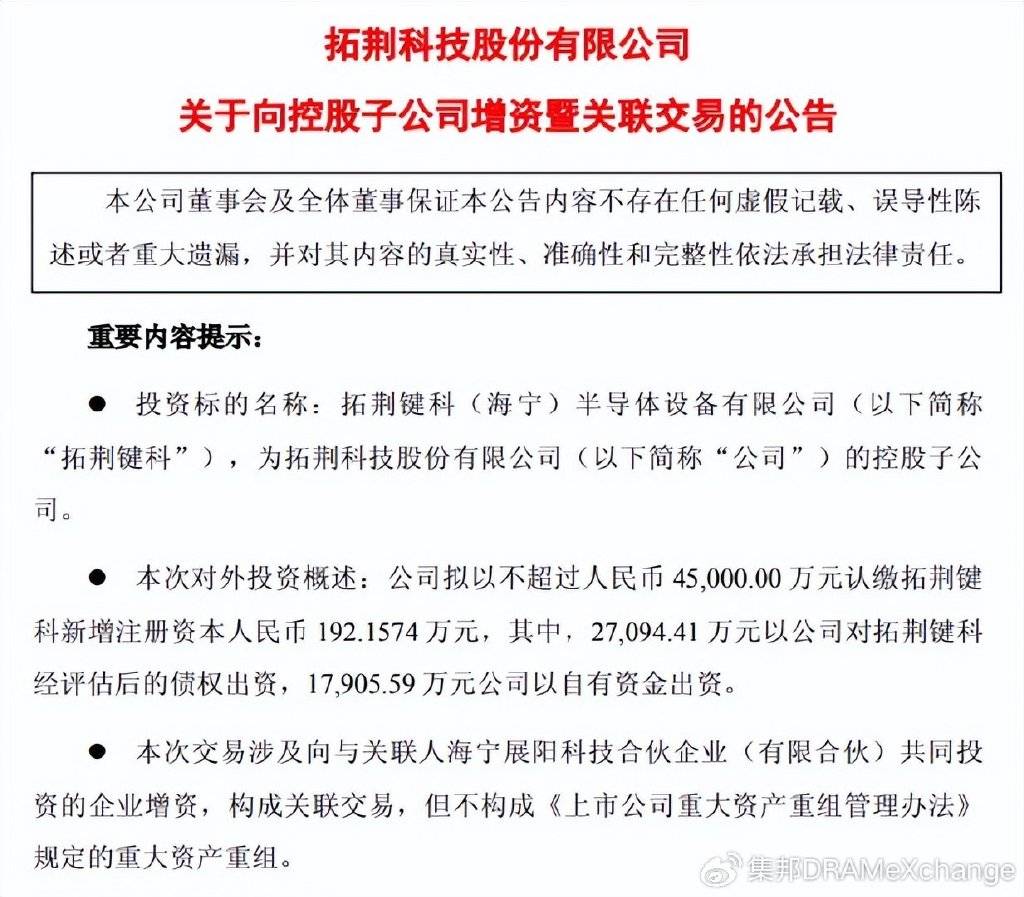
Core Viewpoint -拓荆 Technology announced a financing plan for its subsidiary,拓荆 Jian Ke, with a pre-investment valuation of 2.5 billion yuan, aiming to raise no more than 1.0395 billion yuan, attracting significant attention from the market due to the participation of Guotou Jixin [1][4] Group 1: Financing Details -拓荆 Technology plans to contribute up to 450 million yuan to the new registered capital of 19.216 million yuan for拓荆 Jian Ke, maintaining a 53.5719% stake post-financing [4] -Guotou Jixin intends to invest up to 450 million yuan, acquiring a 12.7137% stake in the company after the financing [4] -Other investors include Huahong Chuantou and Haining Rongchuang, planning to contribute 30 million yuan and 9.5 million yuan respectively [4] Group 2: Industry Context -3D integration technology is emerging as a new path for China's semiconductor industry, addressing the limitations of traditional 2D chip miniaturization [5][6] -3D-IC technology enhances system performance and reduces power consumption by vertically stacking multiple chips [5] -The demand for high-performance computing chips is surging due to the growth of the global AI server market, with advanced packaging equipment sales expected to grow over 20% by 2025 [6] Group 3: Strategic Shift -Guotou Jixin's investment in拓荆 Jian Ke marks a strategic shift in the National Integrated Circuit Industry Investment Fund's approach, focusing on critical areas with low domestic production rates [8][9] -The investment strategy has evolved from broad-based funding to targeted investments in sectors with high technical barriers and significant international competition [9] -Despite the support from Guotou Jixin,拓荆 Jian Ke faces competition from international giants like EV Group and Applied Materials in the semiconductor equipment market [10]

中国半导体供应链:二季度无晶圆厂库存下降,但三季度芯片供需更趋动态-China Semis Supply Chain_ 2Q saw lower fabless inventory, but 3Q chip supply_demand turning more dynamic
2025-09-15 01:49
Summary of the Conference Call on China's Semiconductor Supply Chain Industry Overview - In 2Q25, China semiconductor chipmakers (fabless, IDM, foundry, OSAT) reported a revenue growth of 16-21% YoY, indicating a mild recovery in net profit margins (NPM) with fabless/IDM companies' average NPM increasing from 12% in 1Q25 to 13% in 2Q25. Foundry and OSAT suppliers' average NPM improved slightly from 4% to 5% [1][8] - Semiconductor equipment companies experienced a slowdown in sales growth from 42% YoY in 1Q25 to 28% in 2Q25, although their average NPM improved from 16% to 19% [1] - Silicon wafer suppliers, such as NSIG and Lion Electronics, continued to report losses in 2Q25 with NPM at -18% and -5%, respectively [1] Inventory Management - Notable inventory reduction was observed among Chinese semiconductor fabless companies in 2Q25, with inventory turnover periods for MCU, analog, and power discrete segments decreasing by 16-48 days QoQ [2] - Overall inventory levels in the China market remain higher than pre-2022 levels but are healthier compared to 2023-24, where days of inventory (DoI) were between 200-300 days [2] Demand and Supply Dynamics - The integrated circuit (IC) billing volume in China was reported at 12.6 billion units in July, reflecting a 10% YoY increase. This demand growth rebounded from a -1% contraction in June [3] - China's IC import volume grew by 12% YoY, while domestic manufacturing volume increased by 25% YoY. The netting off of a 17% export growth suggests a supply volume increase of 15% YoY on a 3-month moving average basis [3] - The trend of inventory digestion among Chinese chipmakers observed in 2Q25 may be moderating as supply growth has outpaced demand for two consecutive months since June [3] Pricing Trends - The global average unit price for NOR flash was reported at US$0.39 in July, down 6% MoM and 28% YoY, indicating continued price softness [4] - However, major Taiwan and China NOR flash suppliers reported normalized inventory levels, which may support price stabilization [4] - Specialty DRAM contract prices have seen significant increases in 3Q25, with DDR4 prices rising approximately 70% in July and 10% in August, while 4Gb DDR3 prices increased by 20% in July and 50% in August [4] Financial Performance Overview - In 2Q25, the fabless and IDM sectors saw over 20% YoY sales growth, while foundry, OSAT, and silicon wafer sectors grew in the mid to high teens [8] - Despite improvements in net profit margins across sectors, silicon wafer companies like NSIG and Lion Electronics continued to post net losses [8] Future Outlook - Consensus forecasts predict 15%-26% YoY sales growth for the semiconductor industry in 2026, with expectations for further improvement in net profit margins [9] - Specific companies such as SMIC and JCET are projected to see significant sales growth, with SMIC's sales expected to reach US$78.3 billion by 2026, reflecting a 16% YoY increase [9] Additional Insights - The semiconductor supply chain is experiencing a dynamic shift in supply and demand, with potential implications for inventory management and pricing strategies moving forward [3][4] - The recovery in profitability and sales growth across various segments indicates a positive trend for the semiconductor industry in China, despite ongoing challenges in specific areas such as silicon wafer production [1][8]



大基金三期出手!4.5亿元投向三维集成设备领域
Zheng Quan Shi Bao Wang· 2025-09-15 00:17
Core Viewpoint -拓荆科技 announced a series of financing plans, including a capital increase to its subsidiary拓荆键科, aiming to raise up to 4.6 billion yuan to support the rapid development of three-dimensional integration equipment [1][4] Group 1: Financing Details - The financing plan includes a total of no more than 10.4 billion yuan for拓荆键科, with a pre-investment valuation of 2.5 billion yuan [1] - 大基金三期 plans to participate in the capital increase with no more than 450 million yuan, marking its first public investment since its establishment in May 2024 [1][2] - 国投集新 also intends to invest up to 450 million yuan, resulting in a 12.71% stake in拓荆键科 after the capital increase [1][2] Group 2: Company Overview - 拓荆键科, established in September 2020, focuses on the research and industrial application of advanced bonding equipment for three-dimensional integration [2] - The company has launched various products, including wafer-to-wafer bonding equipment and measurement devices, serving clients in advanced storage, logic, and image sensor sectors [2] Group 3: Market Context - Three-dimensional integration aims to overcome the physical limitations of traditional two-dimensional integration by stacking chips vertically, enhancing packaging efficiency and transistor density [3] - The technology is essential for maintaining the momentum of Moore's Law and addressing increasing market demands [3] Group 4: Financial Performance - In 2024, 拓荆键科 reported revenues of 97.3 million yuan and a net loss of 2.1 million yuan [4] - The company has experienced rapid revenue growth, with revenues of 1.706 billion yuan, 2.705 billion yuan, and 4.103 billion yuan in 2022, 2023, and 2024, respectively, reflecting a compound annual growth rate of 55.08% [4] Group 5: Project Implementation - The implementation of the projects will significantly enhance the production capacity of high-end semiconductor equipment and improve production efficiency through intelligent facilities [5] - The company plans to allocate 20 billion yuan for the construction of a cutting-edge technology research and development center, focusing on advanced thin film deposition equipment [6]
世界第三、国内第一的高分子龙头收购案,获通过!
DT新材料· 2025-09-14 16:05
Core Viewpoint - The article discusses the acquisition of 70% equity in Hengsuo Huawei Electronics Co., Ltd. by Huahai Chengke, which is a significant move in the semiconductor materials industry, particularly in the epoxy molding compound sector [2][3]. Group 1: Acquisition Details - Huahai Chengke plans to acquire 70% of Hengsuo Huawei for 1.12 billion yuan, valuing the company at 1.658 billion yuan, with the transaction approved by the Shanghai Stock Exchange's M&A review committee [2]. - The acquisition follows a previous agreement where Huahai Chengke acquired 30% of Hengsuo Huawei for 480 million yuan, using approximately 287 million yuan of over-raised funds [2]. - This acquisition is seen as a major milestone in the polymer materials sector, especially as it was nearly taken over by another leading company, Debang Technology [2]. Group 2: Company Overview - Hengsuo Huawei is recognized as the third-largest global producer of epoxy molding compounds and the leading domestic supplier, with a projected revenue of 460 million yuan in 2024 [3]. - The company specializes in various epoxy molding compounds used in semiconductor packaging, including black, gold, and transparent types, with advanced packaging products priced at approximately 251,000 yuan per ton [3][4]. - Huahai Chengke, established in December 2010, is a national-level "specialized and innovative" small giant enterprise, listed on the STAR Market with a market capitalization of 7.489 billion yuan [8]. Group 3: Financial Performance - In 2024, Huahai Chengke reported a revenue of 332 million yuan, a year-on-year increase of 17.21%, and a net profit of 40.803 million yuan, up 28.97% [9]. - The company experienced a decline in net profit in the first half of 2025, with a revenue of 179.076 million yuan, reflecting a year-on-year growth of 15.30%, but a net profit drop of 44.67% [9]. Group 4: Production Capacity - Hengsuo Huawei's production capacity for 2024 is projected at 12,959.10 tons, with a utilization rate of 96.93% and a sales volume of 12,463.17 tons [7]. - Huahai Chengke's acquisition is expected to boost its annual production capacity to over 25,000 tons, solidifying its position as a leader in the domestic market and the second-largest globally [6].


聊一聊Memory--被低估的万亿赛道
傅里叶的猫· 2025-09-14 13:42
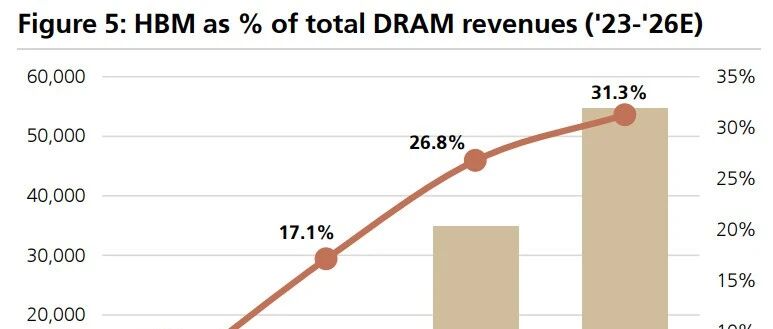
Core Viewpoint - The semiconductor storage market is expected to reach a historical high of $167 billion in 2024, driven by demand recovery in mobile phones, PCs, and servers, with NAND Flash and DRAM markets projected at $69.6 billion and $97.3 billion respectively [4][12]. Summary by Sections Overview of Storage Chips - Storage chips are essential components in modern electronic devices, categorized into volatile and non-volatile types. Volatile storage loses data when power is off, while non-volatile storage retains data [5]. Types of Volatile Storage - Static Random Access Memory (SRAM) is fast but costly, used in high-speed applications like CPU caches [6]. - Dynamic Random Access Memory (DRAM) is widely used in smartphones, PCs, and servers, requiring constant refreshing to maintain data [7]. - High Bandwidth Memory (HBM) offers high speed and bandwidth, suitable for AI accelerators, but is also expensive [7]. Non-Volatile Storage - NAND Flash is the mainstream large-capacity storage, known for its low cost and high capacity, but has slower write speeds and limited write cycles [8]. - NOR Flash is used for storing programmable code, offering fast random read speeds but with smaller capacity and higher costs [8]. AI Device Storage Requirements - AI devices require high-capacity, high-bandwidth, and low-power storage solutions, with LPDDR5 or LPDDR5X being the mainstream choices [9]. - The cost of storage in AI devices may account for 10-20% of overall hardware costs, reflecting its high priority in these applications [9]. Market Trends - The storage market experienced significant price increases in 2021, followed by a period of inventory digestion in 2023-2024, with prices expected to rebound starting late 2023 [12][14]. - HBM revenue is projected to double from $17 billion in 2024 to $34 billion in 2025, driven by strong demand [14]. 3D Stacking Technology - 3D stacking technology is crucial for meeting the high capacity, bandwidth, and low power requirements of AI storage chips, with ongoing developments in both packaging and wafer levels [19]. Industry Chain - The storage chip industry chain consists of upstream materials and equipment, midstream design and manufacturing, and downstream applications [20][23]. - The design segment has the highest profit margins due to high technical barriers, while packaging and testing have lower margins due to intense competition [23]. Recent Price Movements - Micron has paused pricing due to AI SSD demand shortages, with planned price increases of 20-30% for AI-related products [25].

2025异质异构集成年会持续报名中(HHIC 2025)
势银芯链· 2025-09-13 01:02
Core Viewpoint - The article emphasizes the importance of heterogeneous integration technology in the semiconductor industry, particularly in the context of new demands from artificial intelligence, smart driving, and high-performance computing applications. It highlights the upcoming 2025 Heterogeneous Integration Annual Conference organized by TrendBank and Yongjiang Laboratory to address these challenges and promote collaboration between industry and academia [2][19]. Meeting Background - The semiconductor industry is facing new stringent requirements for chip design and manufacturing due to advancements in AI and high-performance computing. Key issues such as power consumption, performance, area, and cost are driving the acceleration of emerging semiconductor technologies [2]. - Heterogeneous integration has emerged as a significant and promising direction in the semiconductor field, especially as traditional Moore's Law approaches physical limits. The conference aims to tackle challenges in 2.5D/3D heterogeneous integration, optoelectronic co-packaging, wafer-level bonding, and glass-based packaging [2]. - Ningbo is positioned as a core port city in China with a strong foundation in advanced manufacturing, making it an ideal location for this conference. The Yongjiang Laboratory is a provincial-level innovation platform focusing on electronic information materials and micro-nano device preparation [2]. Meeting Content - The conference will focus on core technologies such as multi-material heterogeneous integration and optoelectronic integration, covering advanced packaging technologies like 3D heterogeneous integration, optoelectronic co-packaging, wafer-level bonding, and semiconductor materials and equipment [3]. Basic Information - The 2025 Heterogeneous Integration Annual Conference will be held from November 17-19, 2025, in Ningbo, organized by TrendBank and Yongjiang Laboratory, with an expected attendance of 200-500 participants [4]. Proposed Agenda - The agenda includes closed-door meetings, technical discussions on micro-nano devices, and various forums focusing on advanced packaging technologies and materials [7][9][10]. Conference Features - The conference aims to integrate resources across the heterogeneous integration industry chain, involving all stakeholders from upstream to downstream, and will feature a combination of large and small meetings to facilitate both broad discussions and targeted interactions [8]. - A live supply-demand matching platform will be set up to allow participants to directly engage with cutting-edge technologies and products [8]. Registration and Fees - The registration fee for the conference is RMB 2500 per person, with early bird discounts available. Special rates are offered for students [12].