阳光电源

Search documents
尾盘主力资金抢筹6只个股
Zheng Quan Shi Bao Wang· 2025-12-19 11:45
Group 1 - The core point of the article highlights that the main funds in the two markets experienced a net outflow of 1.283 billion yuan at the end of the trading day on December 19 [1] - The industries that saw significant net inflows of main funds exceeding 100 million yuan include non-ferrous metals, basic chemicals, and national defense and military industry [1] - Specific stocks that attracted over 100 million yuan in net inflow of main funds during the closing period include Ganfeng Lithium, Luoyang Molybdenum, N Uxin, Salt Lake Industry, Sungrow Power Supply, and Northern Rare Earth [1]





主力资金丨尾盘主力资金抢筹6股
Zheng Quan Shi Bao Wang· 2025-12-19 11:12
(原标题:主力资金丨尾盘主力资金抢筹6股) 汽车、机械设备行业主力资金净流入均超20亿元。 A股三大指数今日(12月19日)集体上涨,行业板块呈现普涨态势,房地产服务、商业百货、包装材 料、食品饮料、纺织服装、家用轻工、汽车服务、房地产开发板块涨幅居前,贵金属、半导体板块跌幅 居前。 据证券时报·数据宝统计,今日沪深两市主力资金净流出44.44亿元。从行业来看,申万一级行业中有12 个行业主力资金净流入,其中汽车、机械设备行业主力资金净流入均超20亿元,居前;有色金属、传 媒、商贸零售、基础化工等行业主力资金净流入金额均超3亿元。 19个主力资金净流出的行业中,电子、医药生物、交通运输行业主力资金净流出金额居前,分别为 29.79亿元、25.45亿元、10.31亿元;食品饮料、国防军工、轻工制造、非银金融、通信行业主力资金净 流出金额均超5亿元。 据数据宝统计,中际旭创、胜宏科技、新易盛、美年健康、德明利等个股尾盘主力资金净流出居前。 山子高科主力资金净流入10.59亿元,该股今日也涨停,龙虎榜数据显示,上榜营业部席位全天成交7.25 亿元,合计净买入2.08亿元。具体来看,机构合计净买入5811.53万元; ...


东莞证券财富通每周策略-20251219
Dongguan Securities· 2025-12-19 10:34
Market Overview - The market experienced a rebound this week, with the Shanghai Composite Index slightly rising by 0.03%, while the Shenzhen Component Index and ChiNext Index both fell by 0.89% and 2.26% respectively. The market initially declined due to weak domestic economic data and expectations of interest rate hikes by the Bank of Japan, but later stabilized and briefly surpassed 3900 points before retreating [1][3][14]. Economic Data Analysis - Economic data for November showed a general slowdown, indicating weak internal growth momentum. The industrial value added for November grew by 4.8% year-on-year, down 0.9 percentage points from the previous value. Fixed asset investment from January to November decreased by 2.6% year-on-year, with manufacturing investment growing by only 1.9% [10][11]. - Retail sales for November increased by only 1.3% year-on-year, a decline of 1.6 percentage points from the previous value, primarily affected by weak commodity retail performance [10][11]. Financial Indicators - The total social financing in November was 2.49 trillion yuan, an increase of 160 billion yuan year-on-year, but new RMB loans amounted to only 390 billion yuan, a decrease of 190 billion yuan year-on-year, marking the fifth consecutive month of decline [11][12]. - The M2 money supply grew by 8% year-on-year, while the M1 money supply increased by 4.9%, indicating a decrease in the liquidity of funds and weak demand for real financing [12]. Policy Outlook - The report anticipates that expanding domestic demand and promoting consumption will be key focuses of future policies, especially in light of the ongoing economic transition and external uncertainties. The necessity and possibility of "timely strengthening" monetary policy have increased, with expectations for further easing measures such as reserve requirement ratio cuts and interest rate reductions [10][12][14]. Investment Recommendations - The report suggests focusing on sectors such as finance, non-ferrous metals, food and beverage, machinery, and TMT (Technology, Media, and Telecommunications) for potential investment opportunities [15].
「数据看盘」平潭发展龙虎榜现外资与量化博弈 多家实力游资集体出逃华人健康
Sou Hu Cai Jing· 2025-12-19 10:08
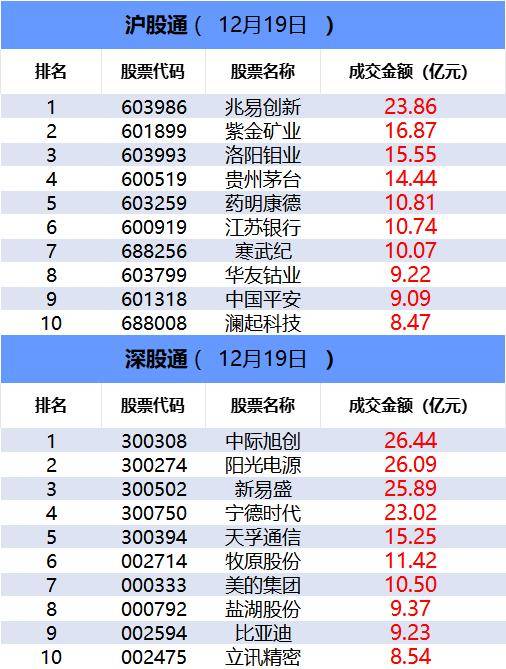
Group 1: Market Overview - The total trading amount for the Shanghai Stock Connect was 940.49 billion, while the Shenzhen Stock Connect reached 1,048.92 billion [2] - The top traded stocks on the Shanghai Stock Connect included Zhaoyi Innovation with 23.86 billion, followed by Sanfang Qianhe and Luoyang Copper with 16.87 billion and 15.55 billion respectively [3] - On the Shenzhen Stock Connect, the leading stock was Zhongji Xuchuang with 26.44 billion, followed by Sunshine Power and New Yisheng with 26.09 billion and 25.89 billion respectively [3] Group 2: Sector Performance - Sectors such as Hainan, dairy, and retail showed significant gains, while precious metals and semiconductors experienced declines [4] - The mechanical equipment sector led in net inflow of funds with 38.67 billion, followed by non-ferrous metals and transportation equipment with 35.32 billion and 31.28 billion respectively [5] - The electronic sector had the highest net outflow of funds at -57.70 billion, followed by semiconductors and pharmaceuticals with -30.20 billion and -17.73 billion respectively [6] Group 3: Individual Stock Activity - The top stocks with net inflow included Xue Ren Group with 13.84 billion, followed by N Youxun and Shanzi Gaoke with 13.69 billion and 10.55 billion respectively [7] - The stocks with the highest net outflow were Meinian Health at -9.05 billion, followed by Shenwei Electronics and C Muxi-U with -6.98 billion and -6.81 billion respectively [8] Group 4: ETF Trading - The top ETFs by trading amount included A500 ETF Huatai Baichuan with 133.655 billion, and Hong Kong Securities ETF with 104.353 billion, showing increases of 7.50% and 18.61% respectively [9] - The ETFs with the highest growth in trading amount compared to the previous trading day included Hengsheng Dividend Low Volatility ETF with 183.92% increase and Industrial Nonferrous ETF with 140.82% increase [10] Group 5: Futures Market - In the futures market, all four major index contracts (IH, IF, IC, IM) saw both long and short positions increase, with IF and IM contracts showing a higher number of short position increases [11] Group 6: Institutional and Retail Activity - Institutional activity showed a decrease compared to the previous day, with notable purchases in Aerospace Intelligence and Shanzi Gaoke, while significant sales were observed in Meinian Health and Xue Ren Group [12][13] - Retail investors were active, with significant buying in Xue Ren Group and Shanzi Gaoke, while selling was noted in Huaren Health and other stocks [14][15]




光伏行业请来“拆卷”专家宋志平,他给出了四招
Tai Mei Ti A P P· 2025-12-19 09:12
Core Insights - The photovoltaic industry is facing a severe crisis characterized by overcapacity and price wars, leading to a "prisoner's dilemma" situation where companies are reluctant to reduce production despite losses [2][10] - Song Zhiping, a notable figure in the industry, proposes a comprehensive strategy called "拆卷心法" (Disassembly Methodology) consisting of differentiation, segmentation, high-end positioning, and branding to navigate the current challenges [1][4][5] Industry Overview - The production capacity of photovoltaic components in China is expected to exceed 1000 GW by 2024, while global demand is projected to be around 500 GW, resulting in a utilization rate below 60% [1] - The industry is experiencing a significant decline in profitability, with over 30% of companies reportedly selling at a loss to maintain cash flow and market share [2][10] Key Strategies Proposed by Song Zhiping - **Differentiation**: Emphasizes the need for a fundamental shift in value creation rather than merely adding product variations. Companies should focus on customized solutions that can command a premium price [5][6] - **Segmentation**: Encourages companies to explore niche markets that have been overlooked, such as specialized components for extreme environments or integrated solutions for specific industries [6][7] - **High-end Positioning**: Advocates for a shift from cost advantages to technological innovations that define new standards and create new demands, highlighting the potential of emerging technologies like perovskite [7][8] - **Branding**: Stresses the importance of building brand recognition and trust, especially in a market where products are increasingly commoditized. Successful brands can survive price wars by offering superior value [8][9] Challenges to Implementation - The industry is currently plagued by a lack of trust among companies, making collaboration difficult in a highly competitive environment [10][11] - Companies face significant cash flow pressures, hindering their ability to invest in the long-term strategies proposed by Song Zhiping [11][12] - The regulatory environment remains uncertain, complicating strategic planning for companies in the photovoltaic sector [11][12] Conclusion - The future of the photovoltaic industry hinges on the willingness of companies to adopt the proposed strategies and move away from destructive competition towards value creation and collaboration [13][14]
2025年A股市场融资净买入超6000亿元 电子行业最受青睐
Xin Hua Cai Jing· 2025-12-19 09:06
Core Viewpoint - In 2025, the A-share market is experiencing a significant influx of leveraged funds, with the total financing balance reaching 24,748 billion yuan as of December 18, and a net purchase of 6,244.35 billion yuan for the year, marking a substantial growth in the financing balance since the launch of margin trading in 2010 [1][2]. Financing Balance Growth - The financing balance in the A-share market has increased nearly 195 times from 127 billion yuan at the end of 2010 to 24,748 billion yuan in 2025 [4]. - The net purchase amount for 2025 is expected to surpass 6,674.5 billion yuan recorded in 2014, as there are still eight trading days left in the year [1][2]. Industry Preferences - The electronic industry has emerged as the most favored sector for leveraged funds, with a financing balance of 36,894.99 million yuan and a net purchase of 1,531.3 million yuan, making it the only industry to exceed 1,000 million yuan in net purchases for the year [6][7]. - Other industries with significant net purchases include electric power equipment (898.4 million yuan), non-bank financials (171.6 million yuan), and several others exceeding 400 million yuan [8]. Individual Stock Highlights - Among individual stocks, Dongfang Caifu leads with a financing balance of 274.23 billion yuan, despite recording a net sell of 6.54 billion yuan [9]. - New Yi Sheng is the most favored stock by leveraged funds, with a net purchase of 179.26 billion yuan, followed by Ningde Times with 154.27 billion yuan [9][10]. ETF Market Activity - The ETF market has also seen significant activity, with the top-performing ETF being the E Fund CSI Hong Kong Securities Investment Theme ETF, which recorded a net purchase of 2.241 billion yuan [11][12]. - QDII ETFs linked to Hong Kong and U.S. stocks have gained popularity among investors, reflecting a broader interest in international markets [11].

破“内卷”、立标准、向未来,光伏行业领袖共话行业生态重塑之道
中国能源报· 2025-12-19 08:42
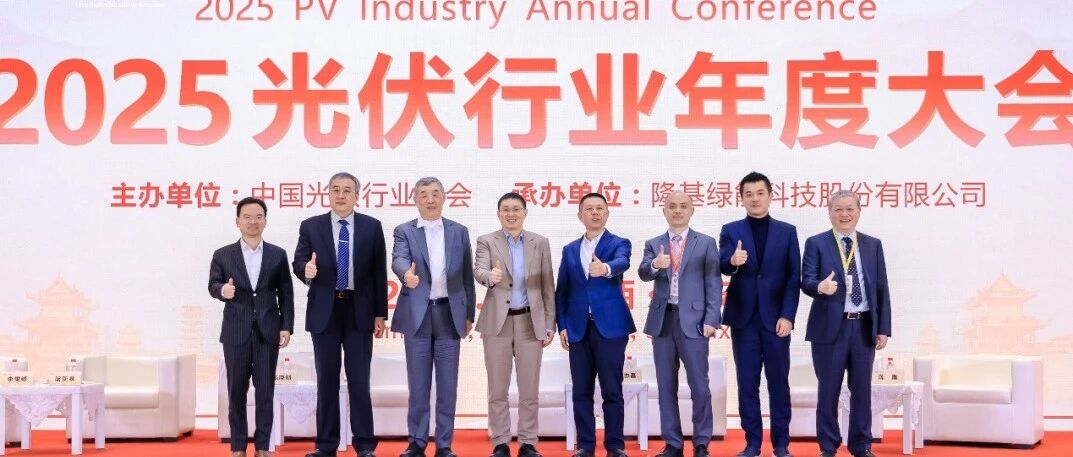
Core Viewpoint - The keyword "breaking the cycle" has become the strongest theme for the 2025 photovoltaic industry annual conference, emphasizing the need for high-quality development and the rejection of vicious competition in the industry [1][3]. Group 1: Industry Transformation - The photovoltaic industry is urged to move away from "involution" and focus on high-quality development, requiring collaboration among industry authorities, local governments, associations, media, and financial institutions [3]. - The essence of addressing "involution" is to promote competition based on technology and quality rather than price wars, as highlighted by industry leaders [3][4]. - There is a consensus that companies must rely on independent innovation and original technology to enhance product standards and quality, while the market should raise entry barriers to support advanced products [4][7]. Group 2: Global Supply Chain Resilience - The global trade environment is becoming increasingly complex, posing new challenges for Chinese photovoltaic companies as they seek to expand internationally [6]. - Companies are encouraged to shift from simple product output to creating value, building a more resilient global supply chain [6]. - Key agreements among industry leaders include raising export standards for photovoltaic products, integrating advanced technology and ESG performance into financial assessments, and establishing stricter quality standards with international recognition [7]. Group 3: Future Growth and Market Dynamics - The photovoltaic industry is transitioning from a phase of rapid installation to one focused on high-quality consumption and market-driven growth [9]. - The role of photovoltaic energy is becoming more prominent in the new power system, necessitating solutions for intermittency and demand-side response through "photovoltaic + energy storage" models [9]. - Despite current challenges, industry leaders maintain an optimistic outlook for the future, anticipating breakthroughs in quality and sustainability supported by policy and market forces [10].




调整时间快“熬到头了”!下行趋势中的反弹,还有哪些投资机会?
Sou Hu Cai Jing· 2025-12-19 07:54
Group 1 - The A-share market has limited valuation upside after two consecutive years of growth, with future index increases expected to come from earnings and the continuation of "anti-involution" policies, which may support profit growth due to a low base in the first half of the year [1] - Key sectors for investment include technology growth and high dividend strategies, focusing on domestic support policies under the backdrop of US-China competition, internet technology companies with independent growth, and high dividend low volatility sectors such as telecommunications, utilities, and banking [1] - The top five sectors for net inflow include new energy vehicles, auto parts, military industry, non-ferrous metals, and pharmaceuticals, while the top five concepts are state-owned enterprise reform, Belt and Road Initiative, energy storage, and free trade zones [1] Group 2 - The panel industry is expected to see a positive long-term outlook due to improved competition dynamics, with profit release logic shifting from price increases to value creation, driven by large-size demand, cost reduction through domestic production, and recovery of minority shareholder rights [3] - The aviation sector is facing capacity constraints due to low new aircraft introductions and maintenance issues, but there is a recovery in business travel demand, with expectations for profitability to return by 2025 [4] - The Federal Reserve is anticipated to lower interest rates by 25 basis points, with mixed opinions among policymakers regarding the impact on inflation and the labor market, while the macro environment remains favorable for gold [6] Group 3 - The Shanghai Composite Index has been fluctuating around 3900 points for an extended period, indicating a transition phase rather than a clear bull or bear market, with a focus on domestic economic circulation and sustainable growth [10] - The communication equipment industry is seeing increased demand due to the launch of satellite IoT business trials and advancements in technology, although current valuations are high, requiring sustained industry performance [10]

创业板指估值回落,资金持续加仓,创业板ETF(159915)昨日净流入近20亿元
Mei Ri Jing Ji Xin Wen· 2025-12-19 07:21
从行业分布来看,创业板指聚焦高端制造业、新能源等新质生产力核心赛道,产业结构持续优化,长期 增长动能充足。创业板ETF(159915)最新规模约1000亿元,在所有创业板相关ETF中位居第一,截至 12月17日,该产品今年以来年化跟踪误差仅为0.46%,且相对指数有2.17%的超额收益,可助力投资者 便捷布局创新成长赛道。 (文章来源:每日经济新闻) 截至14:40,创业板指数上涨0.5%,新诺威领涨成分股,安克创新涨超5%,新易盛涨超2%,阳光电源 涨超1%。相关产品资金布局信号明显,继昨日"吸金"近20亿元后,创业板ETF(159915)今日盘中再获 超1.6亿份净申购。 有分析称,当前创业板指估值已回落至低位,投资安全边际高于同类成长风格指数,创业板指目前滚动 市盈率为39倍,处于近10年37%分位。同时盈利增长确定性较强,市场一致预期显示,2025-2027年创 业板指归母净利润增长率分别为38%、30%、23%。随着年报发布临近,若指数点位保持稳定,业绩落 地后市盈率将进一步回落,有望进入历史相对低估区间。 ...

融资融券每日观察(2025年12月18日)
申万宏源证券上海北京西路营业部· 2025-12-19 02:05
Market Overview - The total margin balance in the two markets is 24,993.7 billion, showing a week-on-week decrease of 0.14% [1] - The financing purchase amount is 1,712.2 billion, reflecting a week-on-week decline of 7.13% [1] Industry Insights - The top 20 industries by margin balance are as follows: - Semiconductor: 1,779.3 billion - Securities: 1,400.6 billion - Communication Equipment: 994.5 billion - Battery: 812.7 billion - Banking: 764.0 billion - Software Development: 723.4 billion - Automotive Parts: 613.4 billion - Consumer Electronics: 611.8 billion - Military Equipment: 586.1 billion - IT Services: 570.2 billion - Photovoltaic Equipment: 555.8 billion - Components: 552.1 billion - Complete Vehicles: 524.9 billion - Chemical Pharmaceuticals: 493.6 billion - Electric Power: 490.7 billion - Industrial Metals: 457.8 billion - General Equipment: 448.7 billion - Computer Equipment: 427.2 billion [4] Individual Stock Insights - The top five stocks by financing purchase amount are: - Xinyi Technology: 3.27 billion, with a financing purchase ratio of 18.85%, and a price change of -4.62% [7] - Zhongji Xuchuang: 2.22 billion, with a financing purchase ratio of 16.04%, and a price change of -3.18% [7] - Aerospace Electronics: 1.73 billion, with a financing purchase ratio of 16.19%, and a price change of 1.65% [7] - Shenghong Technology: 1.64 billion, with a financing purchase ratio of 18.73%, and a price change of -4.56% [7] - Sunshine Power: 1.28 billion, with a financing purchase ratio of 14.15%, and a price change of -4.83% [7]