
三星

Search documents
台积电不相信AI有泡沫
远川研究所· 2026-01-20 13:16
Core Viewpoint - TSMC's recent financial report has provided strong validation for the AI industry, showcasing significant growth and robust capital expenditure plans that signal future demand for chip manufacturing [5][8]. Financial Performance - TSMC's Q4 2025 financial results exceeded expectations, with revenue growth for eight consecutive quarters and a gross margin surpassing 60%, comparable to software giants [5][12]. - The company projected capital expenditures of $52 billion to $56 billion for 2026, a substantial increase from $40.9 billion in 2025, indicating confidence in future orders from clients like NVIDIA and AMD [8][27]. Market Dynamics - TSMC's dominance is attributed to its advanced 3nm process technology, which accounted for 28% of revenue in Q4, driving a 20% increase in average wafer prices over two years [12][16]. - The demand for AI computing chips has surged, leading to a shortage of 3nm capacity, with reports indicating that TSMC has stopped accepting new orders for this process due to full capacity bookings [16][24]. Competitive Landscape - TSMC's competitors, particularly Samsung and Intel, have struggled to keep pace with its advancements in process technology, allowing TSMC to maintain a significant competitive edge [16][19]. - The advanced packaging technology, CoWoS, has become critical for AI chips, with TSMC holding a dominant position in this area, further solidifying its market leadership [17][20]. Client Relationships - TSMC's collaboration with NVIDIA has evolved from design to system-level integration, with NVIDIA expected to surpass Apple as TSMC's largest client by 2026 [22][24]. - The company has successfully diversified its client base, reducing reliance on any single customer, which is crucial for sustaining growth in advanced process technologies [23][26]. Future Outlook - TSMC's capital expenditure plans reflect a strong forecast for the semiconductor industry, with anticipated revenue growth rates of 25% from 2024 to 2029, driven by increasing demand for advanced chips [27].



迎行业高景气 洁美科技核心产品满产满销
Zhong Zheng Wang· 2026-01-20 13:14
Core Viewpoint - The electronic components industry remains at a high level of prosperity, with the company's core product, electronic packaging materials, achieving full production and sales. The company is also making significant progress in its release film and composite current collector businesses, poised to benefit from the growing demand in downstream markets such as 5G, AI, and new energy [1] Industry Demand and Growth - The acceleration of global digitalization, coupled with policies like "new infrastructure" and "old-for-new" electronic product exchanges, is driving strong demand in emerging application areas such as 5G networks, cloud computing, data centers, and new energy vehicles. This trend provides solid support for the company's business development [2] - The company's core product, electronic packaging materials, is currently in a state of full production and sales. Key downstream customers have begun to raise product prices, prompting the company to consider adjusting its product prices based on industry conditions and raw material price fluctuations [2] Product Development and Market Expansion - The release film business, a key focus for the company, has achieved stable bulk supply to major domestic clients and has completed the transition to self-manufactured base film products. The company has also successfully supplied its release film products to international clients such as Samsung and Murata, with ongoing volume ramp-up [2] - The company is developing a new growth area through its subsidiary, focusing on polymer metal composite film materials, which can replace traditional aluminum and copper foils in lithium-ion batteries, enhancing energy density and safety [4] Production Capacity and Strategic Positioning - The company's Tianjin production base is currently in the equipment debugging phase and is expected to start trial production in the first quarter of 2026. This facility will enhance the company's ability to supply strategic customers in North China, improving supply chain responsiveness and increasing market share among Korean clients [3] Competitive Advantage and Market Leadership - As a global leader in electronic packaging materials, the company has achieved a leading market share in the field. Through vertical integration, it has built a comprehensive capability in the electronic-grade film materials industry chain, expanding its business scope to include production process materials, optoelectronic display materials, and new energy materials [5] - With the continuous increase in downstream demand and steady progress in various businesses, the company is expected to further expand its market share and consolidate its leading position in the industry [5]

索尼委身TCL,日企时代终落幕了
Feng Huang Wang· 2026-01-20 13:07
Core Viewpoint - The collaboration between Sony and TCL marks a significant shift in the consumer electronics industry, highlighting the transition from traditional Japanese brands to Chinese manufacturers as key players in the market [1][21]. Group 1: Partnership Details - TCL announced a memorandum of understanding with Sony to establish a joint venture focused on Sony's home entertainment business, which will operate globally in an integrated manner [2][11]. - The joint venture will have TCL holding a 51% stake and Sony holding 49%, indicating that a Chinese company will lead the future of Sony's once-iconic television brand [5][12]. - The partnership aims to combine Sony's high-quality audio-visual technology and brand value with TCL's advanced display technology and cost efficiency [11][12]. Group 2: Historical Context - Sony was once a dominant player in the television market, with its Trinitron technology setting quality standards in the 1980s and 1990s, but has since faced challenges from emerging Chinese brands [6][9]. - The rise of Chinese brands like TCL and Hisense began in the early 2000s, leveraging lower costs and innovative technologies to capture market share from Japanese manufacturers [6][18]. - By 2025, Sony's television shipments had significantly declined, ranking tenth globally, while TCL and other Chinese brands surged ahead in market share [15][19]. Group 3: Industry Transformation - The collaboration reflects a broader trend in the consumer electronics industry, where traditional vertical integration models are being replaced by more flexible cooperative networks [12][16]. - As Chinese brands evolve from being price competitors to technology innovators, the dynamics of global competition are shifting, with a focus on collaboration rather than direct competition [16][20]. - The partnership symbolizes a strategic pivot for Sony, allowing it to concentrate on higher-margin businesses while leveraging TCL's manufacturing capabilities to sustain its legacy in the consumer electronics space [15][16].

TCL拟控股索尼电视业务,中国企业将拿下更多全球份额
Di Yi Cai Jing· 2026-01-20 11:36
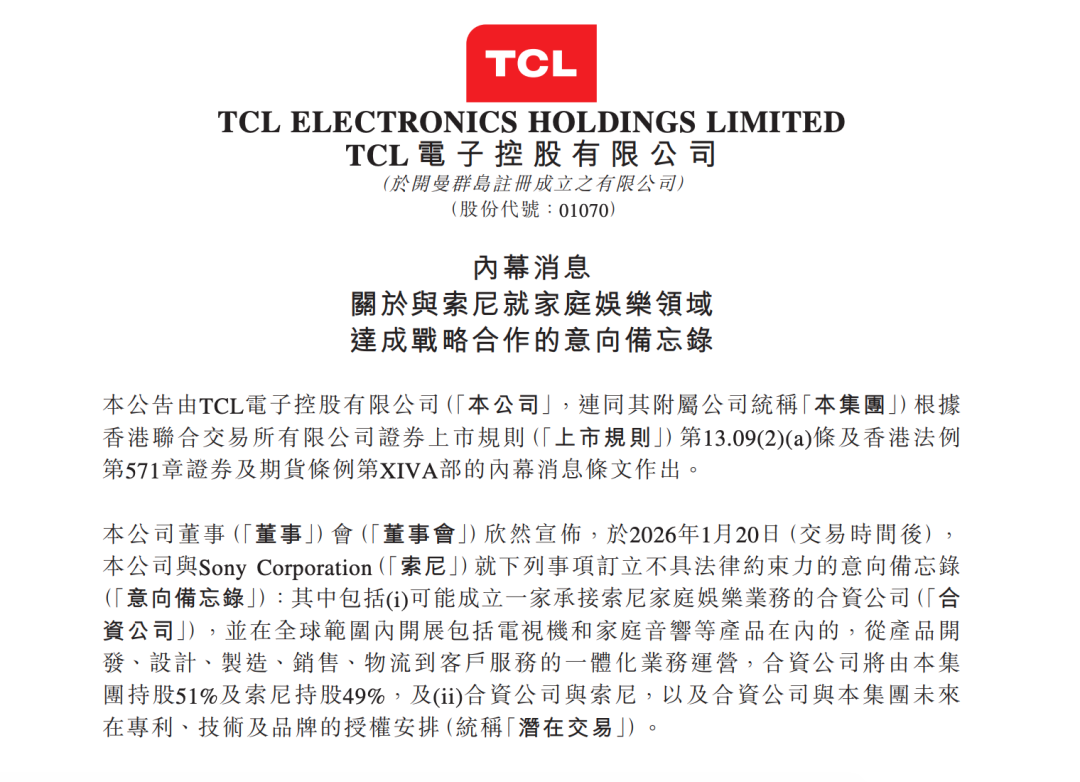
TCL与索尼战略合作。预计2026年-2027年,中国头部电视品牌有望冲击全球电视市场第一的宝座。 1月20日,索尼公司(下称"索尼")与TCL电子控股有限公司(01070.HK,下称TCL)签署意向备忘录,TCL将控股索尼的电视和音响业务。TCL去年全球 彩电出货量居行业第二,与三星的差距缩小,一旦控股索尼电视业务,将向行业首位更进一步。 此次并非中国企业与日本企业在品牌电视业务上的首次战略合作,之前海信电视收购了东芝电视业务。去年,创维接替船井电机,承接了飞利浦电视在北美 市场的运营权。目前,中国面板厂占全球液晶电视面板出货量的七成,中国电视品牌借势加快技术创新,在全球的份额不断提升。 根据备忘录,双方拟设立一家承接索尼家庭娱乐业务、由TCL持股51%、索尼持股49%的合资公司(下称"新公司"),并在全球范围内开展包括电视机和家 庭音响等产品在内的,从产品开发、设计、制造、销售、物流到客户服务的一体化业务运营。 电视观看场景多元化、智能功能迭代带来用户体验升级,高分辨率与大尺寸显示成为趋势,全球大屏电视市场规模持续扩大。在此市场环境下,新公司致力 于打造创新产品,实现业务的进一步增长。索尼和TCL将为新公 ...
拓斯达冲刺港股:业绩萎缩,上市前证监局下警示函要求整改营收、成本、坏账计提不准确等问题
Sou Hu Cai Jing· 2026-01-20 10:52
Core Viewpoint - Guangdong Tosstar Technology Co., Ltd. has submitted its prospectus for an IPO on the Hong Kong Stock Exchange, aiming to establish an "A+H" dual capital market layout to enhance its global business expansion and technological research and development [2] Group 1: Company Overview - Founded in 2007, the company has nearly two decades of experience in the intelligent equipment sector, focusing on core intelligent equipment such as embodied intelligence, industrial robots, CNC machine tools, and injection molding machines [2] - The company has developed a diversified product matrix including Cartesian robots, articulated robots, collaborative robots, and humanoid robots, leveraging core technologies in control, servo, and vision [2] - Tosstar has created a commercial closed loop of "scene + robot + data + AI," steadily expanding from single injection scenarios to multiple industrial and commercial scenarios [2] Group 2: Market Presence - The company has reached over 200,000 customers and served more than 15,000 enterprises, including industry leaders like BYD Optical, Luxshare Precision, Foxconn, CATL, Samsung, and Corning [4] - Its business spans multiple core application scenarios, including home appliances, automotive parts, consumer electronics, plastic products, daily chemicals, and packaging, indicating a solid market foundation [4] Group 3: Financial Performance - The company has faced performance volatility in recent years, with projected revenues of 4.553 billion yuan and 2.872 billion yuan for 2023 and 2024, respectively, representing a 36.9% year-on-year decline in 2024 [4] - Profits for the same years are expected to be 106 million yuan and -239 million yuan, indicating pressure on profitability [4] - For the first nine months of 2025, revenue was 1.688 billion yuan, a 24.5% decrease from 2.235 billion yuan in the same period last year, but the company achieved a profit of 47.29 million yuan, showing signs of recovery [4] - As of September 30, 2025, the company held 780 million yuan in cash and cash equivalents, providing a financial buffer for future business development [4] Group 4: Regulatory Compliance - Prior to the IPO, the company received a warning letter from the Guangdong Securities Regulatory Bureau regarding issues such as inaccurate revenue and cost accounting, improper provision for bad debts, and non-compliance in the use of raised funds [4] - The company has completed the required rectifications to clear compliance obstacles for capital market operations [4] Group 5: Research and Development - The company emphasizes technological research and development, with R&D expenditures of 138 million yuan, 85 million yuan, and 85 million yuan for 2023, 2024, and the first nine months of 2025, respectively [5] - Continuous R&D investment supports core technology iteration and product innovation [5]


洁美科技(002859) - 2026年1月16日至1月20日投资者关系活动记录表
2026-01-20 09:48
Group 1: Company Overview - The company aims to become a one-stop service provider for electronic component packaging materials and solutions, focusing on electronic-grade film materials and related fields [4] - The company has developed proprietary production technology for thin carrier paper, breaking the market monopoly held by foreign companies, and currently leads the global market share for paper carrier tape [4] - The company is expanding its product range to include electronic-grade film materials and has achieved mass production of products such as release films and composite conductive fluids [4] Group 2: Industry Insights - The current industry climate is favorable, with core products in electronic packaging materials operating at full capacity, and the utilization rate of electronic-grade film materials is gradually increasing [4] - The demand for electronic components is driven by the acceleration of global digitalization, "new infrastructure" policies, and the growing markets for 5G, cloud computing, and electric vehicles [4][5] - Recent price increases from downstream clients indicate a robust demand for electronic components, prompting the company to consider adjusting its product prices accordingly [5] Group 3: Product Development and Client Engagement - The company has successfully transitioned to stable bulk supply of release films for MLCC to major clients, including Yageo and Walsin Technology, and has completed product validation for Korean clients [6] - The Tianjin production base is currently in the equipment debugging phase, with trial production expected to start in the first quarter of 2026, enhancing supply capabilities for strategic clients [6] - The company is actively developing high-end release films and has established strategic supply agreements with multiple clients in the polarizer film sector [6] Group 4: Technological Advancements - The company has expertise in the preparation of ultra-thin film materials, which positions it well for producing HVLP copper foil and PCB carrier copper foil [8] - The design capacity for copper foil products is set at 5 million square meters annually, with a short delivery cycle for production equipment, allowing for rapid expansion [8]
马斯克AI军备赛加速
Hua Er Jie Jian Wen· 2026-01-20 09:07
Core Insights - Musk is aggressively pushing Tesla's AI chip development, aiming to disrupt the semiconductor market dominated by companies like NVIDIA and AMD with a series of new chips: AI5, AI6, and AI7 [2][3] - The AI5 chip, designed for both vehicles and robots, is expected to outperform its predecessor by 50 times and is a key component in Tesla's strategy to unify its hardware and software across different applications [4][5][6] - The AI6 chip aims to revolutionize the AI infrastructure by combining training and inference capabilities on a single chip, potentially transforming Tesla vehicles into distributed computing nodes [7][8] - The AI7 chip is targeted for space applications, indicating Musk's ambition to extend AI capabilities beyond Earth, particularly for SpaceX's Starship and Starlink [8] - Tesla plans to establish its own semiconductor fabrication facility, TeraFab, to gain control over its chip supply chain and reduce reliance on external suppliers like NVIDIA [13][16] Group 1: Chip Development - Musk announced the completion of the AI5 chip design, which will connect Tesla's smart vehicles and robots [3] - The AI5 chip is expected to have performance comparable to NVIDIA's Hopper architecture at a lower cost and power consumption [3][4] - The AI6 chip is designed to break the traditional separation between training and inference chips, allowing for more versatile applications [7][9] Group 2: Strategic Implications - The rapid iteration cycle of nine months for new chips is driven by the need to keep pace with the fast-evolving AI algorithms that outstrip current hardware capabilities [10][11] - Musk's vision includes a significant increase in annual AI chip demand, projecting between 100 million to 200 billion chips needed to support Tesla's growth [11][12] - The establishment of TeraFab aims to address supply chain vulnerabilities exposed during the global chip shortage, allowing Tesla to optimize production and costs [16][17] Group 3: Ecosystem and Future Vision - Tesla's AI ecosystem is designed to create a feedback loop where data collected from vehicles and robots continuously improves AI models [18][19] - The integration of AI7 with Starlink aims to provide global connectivity and computational power, enhancing the capabilities of Tesla's products in remote areas [19][20] - Musk's overarching goal is to secure control over AI computing power, positioning Tesla as a leader in the race towards artificial general intelligence (AGI) [20]


2026年,滨州将着力塑强“6638N”现代产业集群优势
Qi Lu Wan Bao· 2026-01-20 09:00
Group 1 - The core focus of Binzhou's development strategy is to strengthen the real economy by enhancing the "6638N" modern industrial cluster and building a more recognizable modern industrial system by 2026 [1] Group 2 - Traditional industries will be upgraded through high-quality development actions in key manufacturing sectors, with a focus on 45 major projects to establish a world-leading aluminum lightweight materials manufacturing base [3] - The chemical industry will be supported by 48 key projects to create a fine chemical industry base in the Bohai Rim, leveraging companies like Jingbo and Binhua [3] - The textile industry aims to enhance international influence through 30 key projects, supporting companies such as Weiqiao Textile and Yuyue [3] - The food processing and aquaculture sectors will target high-end value chains, with 16 key projects aimed at establishing a national food industry base and high-quality livestock and aquatic product bases [3] Group 3 - Emerging industries will be promoted, with a focus on the Bohai Bay Future Technology Power Industry City and 29 projects in the new energy and new materials sector, targeting over 10% revenue growth [3] - A low-altitude intelligent network platform will be developed, with 20 key projects including a drone processing center to create a low-altitude economic cluster in the Bohai Rim [3] - The scale of emerging industries such as equipment manufacturing, health care, and digital economy will be expanded, with a focus on future industries like advanced materials and hydrogen energy [3] Group 4 - The industrial ecosystem will be optimized through the implementation of over 400 key technological transformation projects, promoting "smart transformation" with 20 intelligent factories [4] - The service industry will be enhanced, with 15 new projects in smart logistics and over 60 large-scale exhibitions planned [4] - The financial sector will see an 8% increase in credit investment, supporting the transformation of financial pilot cities [4] - The technology service industry will be accelerated, with the establishment of 10 service innovation centers to provide full lifecycle services for manufacturing [4]
耳机插孔取消十年后用户集体请愿,苹果2016版iPhone SE成绝唱经典
Huan Qiu Wang Zi Xun· 2026-01-20 09:00
Group 1 - The article discusses the nostalgia for the iPhone SE (2016), which featured a 3.5 mm headphone jack, highlighting its popularity among users who preferred smaller devices and traditional audio connections [3][4] - The removal of the headphone jack by Apple in 2017 with the iPhone 7 marked a significant shift towards wireless audio, but it also sparked controversy regarding user choice and accessibility for those relying on assistive listening devices [3][5] - Despite the upcoming EU regulations in 2024 mandating USB-C ports, the user experience has not fully returned to the convenience of the past, as USB-C headphones have limited options and quality is dependent on built-in DACs [4][5] Group 2 - Competitors like Samsung initially criticized Apple's decision to remove the headphone jack but later adopted similar designs, accelerating the trend towards portless and integrated smartphone designs, which sacrifices some repairability and universality [5] - Wired headphones still demonstrate durability advantages, with many users reporting that their 3.5 mm headphones purchased in 2013 remain functional, while most wireless headphones fail within two to three years due to battery aging [5] - The article emphasizes that the simplicity of purchasing affordable, plug-and-play headphones has diminished, reflecting a shift in consumer experience since the era of the iPhone SE [4][5]


闪德资讯存储市场洞察报告 2025年5月
闪德资讯· 2026-01-20 08:45
Investment Rating - The report indicates a positive outlook for the storage industry, particularly in DRAM and NAND sectors, with expectations of price increases and demand recovery in the coming quarters [6][20][44]. Core Insights - The report highlights a significant transition in the memory market, with major manufacturers like Samsung, SK Hynix, and Micron phasing out DDR4 production in favor of DDR5 and HBM technologies, which is expected to tighten supply and drive prices up [6][23][24]. - DRAM prices have surged, leading to increased activity in the spot market, while NAND prices have stabilized after a period of volatility [6][47]. - The rise of AI PCs is anticipated to boost demand for high-performance memory solutions, with projections indicating a 37% penetration rate by 2025 [6][21][22]. - ODM manufacturers are cautious about demand in the second half of the year, anticipating a slowdown due to earlier stockpiling and market uncertainties [6][20]. - Ongoing geopolitical tensions and tariff adjustments are influencing supply chain dynamics and market stability, with potential long-term implications for pricing and availability [6][7][20]. Summary by Sections Macro Economy - In May, China's manufacturing PMI rose to 49.5%, indicating improved manufacturing activity, while the U.S. PMI remained below expansion levels at 48.5% [7][9]. - The report notes a 10.8% year-on-year growth in China's electronic information manufacturing sector from January to April [12][13]. Upstream Market - Global laptop shipments are expected to increase by 5.8% in Q2, driven by preemptive stockpiling and seasonal demand [20][21]. - Major manufacturers are transitioning away from DDR4, with supply constraints expected to impact pricing significantly [23][24]. Storage Market Dynamics - The report details a notable increase in DRAM prices, with DDR4 prices rising from $2.4 to $3.95, a 64% increase [23]. - NAND flash market dynamics are shifting, with Samsung's exit from the MLC market expected to create supply shortages and price increases [28][29]. Application Market - The PC market is experiencing fluctuations, with major manufacturers reporting mixed results in shipments and revenues due to seasonal effects and tariff uncertainties [71][72]. - AI server-related revenues are projected to grow significantly, while traditional PC demand remains uncertain [72][74].


