中国银河

Search documents
中国银河策略:地缘风险叠加关税风险,港股节后行情怎么看?
Jin Rong Jie· 2026-02-23 07:57
Market Performance - During the week from February 16 to February 20, the Hong Kong stock market experienced fluctuations with the Hang Seng Index declining by 0.58% to 26,413.25 points, the Hang Seng Tech Index falling by 2.78% to 511.50 points, and the Hang Seng China Enterprises Index decreasing by 0.81% to 8,959.56 points [1][6][30] - Among the primary sectors, 8 sectors saw gains while 3 sectors experienced losses. The energy, materials, and industrial sectors had the highest increases, rising by 3.65%, 2.27%, and 1.03% respectively. Conversely, the consumer discretionary, consumer staples, and communication services sectors faced the largest declines, dropping by 1.86%, 1.50%, and 0.13% respectively [1][7][30] Market Liquidity - Due to the Spring Festival holiday, the Hong Kong stock market only operated for half a day on February 16, with a trading volume of HKD 850.56 billion. On February 20, the trading volume was HKD 1,654.61 billion, which is lower than the previous week's average daily trading volume of HKD 2,406.43 billion. The short-selling amount was HKD 237.27 billion, accounting for 14.43%, significantly higher than the previous week's average of 12.56% [2][13][15] Valuation and Risk Premium - As of February 20, 2026, the PE and PB ratios of the Hang Seng Index were 12.09 times and 1.23 times, respectively, placing them at the 79% and 55% percentiles since 2010. The Hang Seng Tech Index had PE and PB ratios of 21.51 times and 2.83 times, respectively, at the 18% and 49% percentiles since 2010 [3][17][22] - The risk premium of the Hang Seng Index was calculated at 4.19%, which is at the 5% percentile since 2010, while the risk premium based on the 10-year Chinese government bond yield was 6.48%, at the 42% percentile since 2010 [3][19][21] Investment Outlook - The geopolitical risks in the Middle East are rising, which may lead to increased volatility in energy and precious metals sectors. The U.S. is exerting pressure on Iran, with potential military actions being considered [4][9][30] - The consumer sector is currently valued relatively low, and with increasing consumer promotion policies, there is potential for growth in this sector [4][30] - The technology sector remains a long-term investment focus, with reduced valuation pressure following recent corrections, and is expected to rebound due to accelerated AI model updates and applications [4][30]


非银金融行业投资策略周报:开年政策及资金延续向好,看好板块补涨机遇-20260223
GF SECURITIES· 2026-02-23 07:54
Core Viewpoints - The report highlights a positive outlook for the non-bank financial sector, driven by favorable policies and continued capital inflow, suggesting potential for sector rebound [1][6]. - The report maintains a "Buy" rating for the sector, indicating expected strong performance relative to the market [2]. Market Performance - As of February 14, 2026, the Shanghai Composite Index rose by 0.41%, while the Shenzhen Component Index increased by 1.39%. The CSI 300 Index saw a modest gain of 0.36% [12]. - The average daily trading volume in the Shanghai and Shenzhen markets was 2.11 trillion yuan, reflecting a 12.3% decrease week-on-week [6]. Industry Dynamics and Weekly Commentary Insurance Sector - The report indicates that listed insurance companies are expected to maintain high growth, with a marginal improvement in long-term interest margins. The insurance fund utilization scale reached 38.5 trillion yuan in Q4 2025, up 15.7% year-on-year [18]. - The report suggests that the upcoming spring market rally may drive better-than-expected performance for insurance companies in Q1 2026, supported by a stable long-term interest rate and an upward trend in the equity market [18]. Securities Sector - The report discusses the recent optimization measures for refinancing announced by the three major exchanges, which aim to enhance financing efficiency and support high-quality enterprises [19]. - The new refinancing rules are expected to create structural opportunities for securities firms, shifting the focus from compliance to the ability to identify and serve quality clients [20]. - The report emphasizes that the optimization of refinancing will lead to a more differentiated regulatory system, benefiting quality companies while tightening controls on weaker entities [22]. Key Company Valuations and Financial Analysis - The report provides detailed valuations for several key companies in the sector, including: - China Ping An (601318.SH) with a target price of 85.17 yuan and a "Buy" rating [7]. - New China Life (601336.SH) with a target price of 94.21 yuan and a "Buy" rating [7]. - China Life (601628.SH) with a target price of 55.47 yuan and a "Buy" rating [7]. - The report also highlights the expected earnings per share (EPS) growth for these companies, indicating a positive outlook for their financial performance in 2025 and 2026 [7].



春节人民币强势升值至6.89区间 股债汇三市迎来正面支撑 大类资产如何配置?
Hua Xia Shi Bao· 2026-02-23 02:08
春节期间,人民币汇率走出强势拉升行情。2月21日,人民币汇率稳守6.89区间;2月19日,离岸人民币 最低触及6.88,在岸人民币同步升至6.885,双双刷新2023年4月以来高点。进入2月以来,人民币汇率升 值幅度接近1.3%。 尽管春节长假期间国内股市、债市、汇市三大市场均不开市,但是人民币汇率大涨仍是利好。 "人民币汇率大涨,直白说就是人民币国际购买力变强。假期内换外汇、出境游、留学缴费、海淘代购 金额能省一笔;进口奶粉、化妆品、汽车、燃油成本下降,物价更稳。而从更宏观的层面来说,人民币 这波走强,源于经济预期向好、外资持续流入、贸易支撑有力,市场对人民币资产信心大增。汇率稳、 资产稳,对股市、债市都是正面支撑。"嘉盛集团外汇市场专家陈恪对《华夏时报》记者表示。 利好股债汇三市 人民币在春节期间升值背后主要受美元指数走弱、美联储降息预期升温、国内经济稳步恢复以及外贸顺 差保持高位四因素推动。 从数据上看,截至今年1月末,我国外汇储备规模达到33991亿美元,环比增加412亿美元,连续六个月 稳定在3.3万亿元以上;1月银行结汇规模达到2.04万亿元,同样也创下历史新高。 "人民币为什么会在春节前后突然涨 ...
券商马年投资展望:这些板块不能错过
Zhong Guo Zheng Quan Bao· 2026-02-21 04:37
Market Outlook - The A-share market is expected to experience a low-volatility trend with a long-term decline in market volatility [2] - The upward trend in the stock market is not yet over, indicating further potential for growth [2] - A-shares are anticipated to maintain a fluctuating upward trend, with the importance of fundamentals increasing after a valuation adjustment [2][3] Capital Flow - The demand for asset allocation among domestic residents has been activated by profit effects, with various medium- to long-term funds entering the market, suggesting an active capital flow in 2026 [2][3] - Incremental capital is expected to cover a broader range, driven by increasing motivation among individual investors to enter the market [3] - Public funds and insurance capital are likely to continue increasing their allocation to equity assets, reshaping global capital flow logic [4] Key Investment Sectors - Key sectors to focus on include: - Non-ferrous metals, chemicals, and new energy [2] - Technology growth, manufacturing expansion, cyclical consumption transformation, and U.S. stocks [2] - New energy, non-ferrous metals, basic chemicals, oil and petrochemicals, non-bank financials, military industry, and machinery [3] - AI, new energy, military industry, innovative pharmaceuticals, price increase chains, and overseas expansion chains [4] - Technology innovation themes and consumption sectors [4] - TMT and advanced manufacturing sectors, with potential shifts towards cyclical and financial sectors [4]

抓50万亿存款到期机遇 多家券商加速推进应对方案
智通财经网· 2026-02-20 07:26
超50万亿定期存款将到期,谁将承接这"泼天的财富"?券商自然不会放过任何一次增收机会。在行业近 期密集召开年度经营部署会期间,智通财经就了解到,不少券商财富管理条线就谈到了2026年如何应对 存款到期潮带来的机遇,目前券商在加速推出应对方案。 "我们今年开经营会的时候就讨论了这个,要怎么能获得一些增量的收入。"一位分管财富管理业务的券 商副总裁在受访时提到。不少券商更是表示2025年就预判大量到期资金在利率下行背景下将引发一场大 规模的"存款搬家",所以一进入2026年就着手搭建应对方案了。 市场机构较多预测居民定期存款规模将达到50万亿元以上,且存在重新配置需求,这一部分或将流到黄 金、基金、股市、保险等。这一迁移体量下,券商有共识,打法却又不一样。综合智通财经调研的情 况,让行业在承接50万亿定存到期资金时,形成了多元化、专业化的服务体系。 其中包括以固收 + 为核心构建分层级、全场景的稳健型产品矩阵,搭配类存款替代工具与创新品类精 准适配不同资金配置需求;联动银行、保险等多机构构建大财富生态,部分券商聚焦核心区域深耕细分 客群打造差异化竞争优势等。 打法一:固收+成核心承接抓手 固收+成为核心承接抓手, ...
牛市未央,但逻辑已换
Jing Ji Guan Cha Bao· 2026-02-20 02:04
Group 1 - The core viewpoint of the articles highlights a significant shift in investment behavior among residents, moving from traditional bank deposits to diversified financial products such as bank wealth management, stocks, and gold, driven by declining deposit rates [1][2][3] - In 2025, gold emerged as a standout asset, achieving a price of over $4,300 per ounce with a 65% annual increase, while silver also performed well, rising by 129.83% due to demand in green energy sectors [5][6] - The A-share market experienced a notable recovery, with the Shanghai Composite Index rising from a low of 3,096 points to over 4,000 points by October 2025, driven by technological advancements and institutional support [6][15] Group 2 - The global economic landscape in 2025 was characterized by a slowdown in growth and geopolitical tensions, yet capital markets saw a bull run in commodities, particularly in gold and silver, while the bond market remained stable [2][3] - Institutions surveyed indicated a strong preference for equities, with 70.80% believing stocks would be the most valuable asset in 2025, a significant increase from 46.15% in 2024 [1] - The investment strategy for 2026 is expected to focus on managing uncertainty, with a continued emphasis on A-shares and gold as primary assets [2][10] Group 3 - The outlook for 2026 suggests that the bull market may continue, with expectations of a weaker dollar and ongoing demand for precious metals, particularly gold and silver, which are projected to reach prices of $6,300 to $6,600 per ounce by the end of 2026 [9][10] - The anticipated increase in the Chinese yuan's value may influence foreign investment behavior, with a gradual appreciation expected to support market liquidity [10][12] - Analysts predict that the investment landscape will shift towards a more balanced approach, focusing on corporate earnings recovery and technological advancements as key drivers for market performance in 2026 [13][14]
牛市进行时
Jing Ji Guan Cha Wang· 2026-02-20 01:32
Group 1 - The core viewpoint of the article highlights the significant shift in investment behavior among residents due to declining bank deposit rates, leading to increased interest in financial products, stock markets, and commodities like gold [2][6][10] - In 2025, 40% of investors reported substantial returns, with some achieving over 140% annual gains through diversified financial strategies [3][5] - The article notes that despite global economic slowdowns and geopolitical tensions, capital markets experienced a transformation driven by factors such as interest rate cuts by the Federal Reserve and deep industry changes, resulting in a bull market for commodities like gold and silver [6][8][10] Group 2 - The performance of gold was particularly notable in 2025, with prices reaching over $4,300 per ounce, marking a 65% increase, and gold ETFs doubling in size [10] - The A-share market also saw significant movements, with the Shanghai Composite Index rising from 3,096 points to over 4,000 points during the year, driven by technological advancements and demand for industrial metals [11] - Looking ahead to 2026, institutions predict continued investment in A-shares and gold, with a focus on managing uncertainty and adapting to changing market conditions [7][12][14] Group 3 - The article discusses the anticipated trends for 2026, including a potential continued bull market for gold and silver, with forecasts suggesting gold could reach $6,300 to $6,600 per ounce by the end of 2026 [13] - Analysts expect the Chinese yuan to appreciate steadily, influenced by the Federal Reserve's policies and domestic economic conditions, which may alter foreign investment behaviors [14] - The investment landscape for 2026 is expected to focus on technology and domestic demand, with a balanced market style anticipated, emphasizing the importance of corporate earnings recovery [16][17][18]

春节以来人民币汇率延续升值 大类资产怎么配?
Xin Lang Cai Jing· 2026-02-19 07:37
Core Viewpoint - The recent appreciation of the Renminbi (RMB) against the US dollar is driven by factors such as a weakening dollar index, expectations of interest rate cuts by the Federal Reserve, steady recovery of the domestic economy, and sustained high trade surpluses [1] Group 1: RMB Appreciation and Market Impact - The RMB has appreciated approximately 1.3% since early February, breaking the 6.89 mark and reaching a three-year high [1] - Analysts from Huatai Securities and Galaxy Securities predict a prolonged appreciation cycle for the RMB, with the current phase marking the beginning of this trend [1][2] - The appreciation of the RMB is expected to enhance the attractiveness of RMB-denominated assets, particularly benefiting the A-share and H-share markets [2] Group 2: Equity Market Insights - The equity market is anticipated to perform well during the RMB appreciation cycle, with Hong Kong stocks being the primary beneficiaries due to higher foreign capital participation [2][4] - A-share market performance is expected to be more differentiated, with growth-oriented sectors likely to outperform [2][3] - Key sectors benefiting from RMB appreciation include real estate, advanced manufacturing, and non-bank financials, which are expected to see improved market risk preferences [2][3] Group 3: Sector-Specific Opportunities - Industries with high foreign debt exposure, such as motorcycles, automotive parts, and photovoltaic equipment, will benefit from reduced debt pressure and exchange rate gains [2][3] - Sectors with high import dependency, like electronic chemicals and steel raw materials, will see improved profit margins due to lower costs from RMB appreciation [2][3] - The technology sector, particularly in Hong Kong, is expected to experience a rebound as foreign capital flows increase [4] Group 4: Bond Market Dynamics - The bond market is experiencing mixed influences from RMB appreciation, with downward pressure on short-term yields and upward pressure on long-term yields due to increased risk appetite in the equity market [5] - Analysts predict that the 10-year government bond yield will fluctuate within a narrow range of 1.7% to 2.1% [5] Group 5: Commodity Market Trends - The commodity market is showing significant differentiation, with industrial metals like copper being highlighted as having strong upward potential [6] - Other commodities lack clear trends, and their future performance will depend on the recovery of domestic demand [6] Group 6: Strategic Asset Allocation - Analysts recommend focusing on high-probability sectors during the current weak appreciation phase of the RMB, emphasizing growth-oriented industries such as technology and communication [7][9] - Key investment themes include sectors benefiting from foreign capital inflows, cost improvements, and holding quality RMB-denominated assets like A-shares and government bonds [9]
刚刚,破6亿!
Zhong Guo Ji Jin Bao· 2026-02-16 12:59
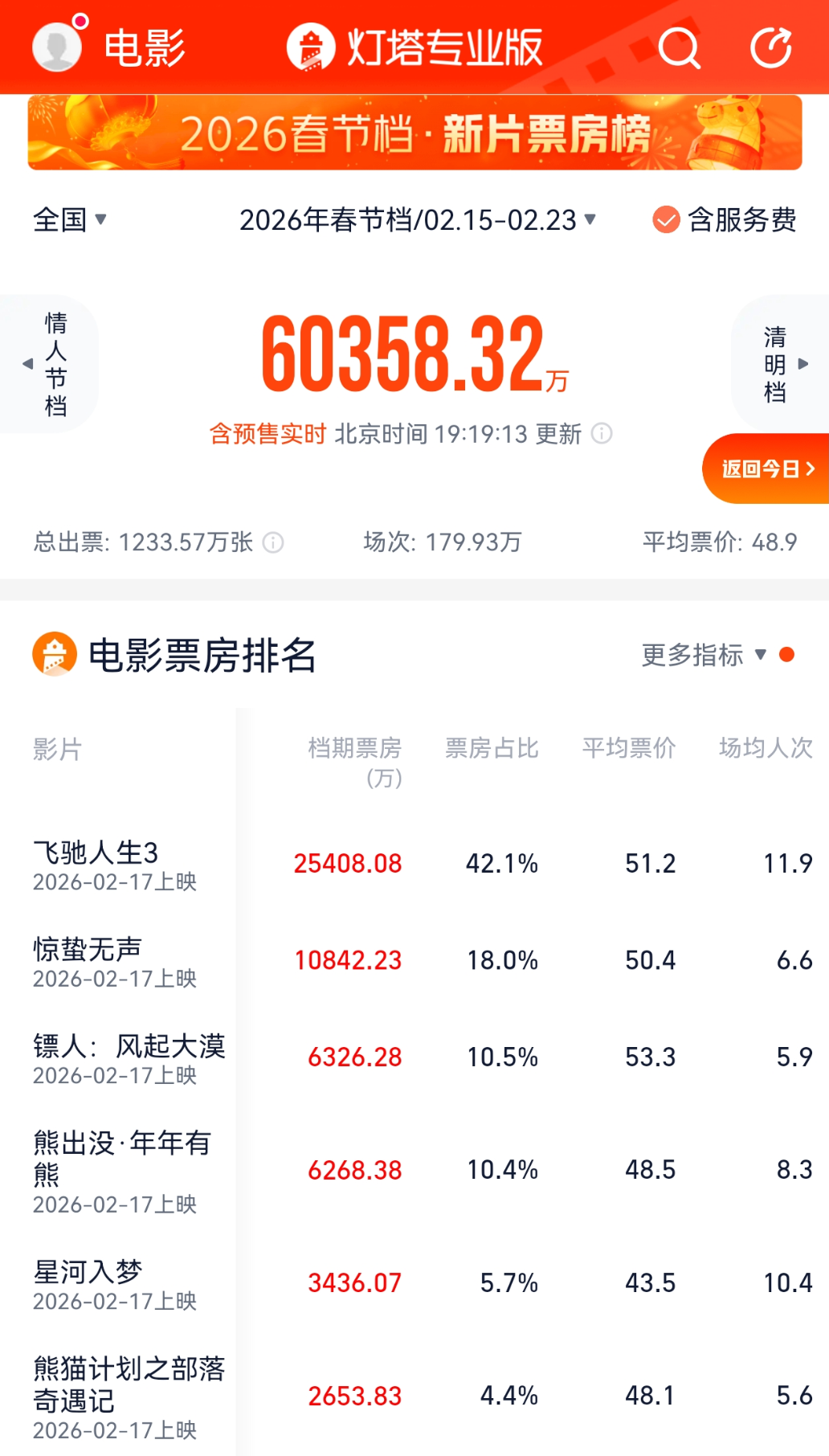
Core Insights - The total box office for the 2026 Spring Festival has surpassed 600 million yuan, with significant contributions from major films [1] - "Fast and Furious 3" has achieved over 250 million yuan in pre-sales, indicating strong audience interest [3] - "Silent Awakening," directed by Zhang Yimou, has also performed well with pre-sales exceeding 100 million yuan [6] Box Office Performance - "Fast and Furious 3" is leading the pre-sale box office with over 250 million yuan, featuring a storyline about a racer facing new challenges [3] - "Silent Awakening," featuring a star-studded cast, has garnered over 100 million yuan in pre-sales, showcasing Shenzhen's urban narrative [6][9] - "Biao Ren: Wind Rises in the Desert," based on a popular comic, has achieved over 63 million yuan in pre-sales [9][11] - "Boonie Bears: Year of the Bear" has also performed well, with pre-sales exceeding 62 million yuan, continuing the franchise's success [12] Market Trends - The 2026 Spring Festival box office is primarily driven by domestic films, with several high-value IP movies contributing to the strong performance [14] - The extended holiday period of nine days is expected to provide ample opportunity for box office growth [15] - The recognition of high-value IPs and the emergence of new consumer products related to films are anticipated to further energize the industry [15]
存款搬家加速?1月非银存款同比多增2.56万亿 最新解读来了
天天基金网· 2026-02-16 07:30
Core Viewpoint - The article highlights a significant trend of residents shifting their savings from traditional bank deposits to asset management products, driven by recent financial data and changing market conditions [2][6]. Group 1: Financial Data Overview - In January, household deposits increased by 2.13 trillion yuan, non-financial enterprise deposits rose by 2.61 trillion yuan, and non-bank financial institution deposits grew by 1.45 trillion yuan [2][3]. - The broad money supply (M2) reached 347.19 trillion yuan, with a year-on-year growth of 9%, while the narrow money supply (M1) was 117.97 trillion yuan, growing by 4.9% [3][4]. - Compared to the same period in 2025, non-bank deposits increased significantly by 2.56 trillion yuan, while household deposits saw a decrease of 3.39 trillion yuan [4][5]. Group 2: Analysis of Deposit Trends - Analysts note that the acceleration of household deposit migration is evident, with the growth rate of household deposits turning negative for the first time in 7.5 years [5]. - The difference between household deposit growth and M2 growth is -1.82 percentage points, indicating a significant shift in savings behavior [5]. - The trend of residents moving their savings to non-bank financial institutions reflects a broader movement towards asset management products [6][7]. Group 3: Future Implications - The upcoming maturity of a large volume of household fixed-term deposits, estimated between 30 trillion to 70 trillion yuan, is expected to influence where these funds will be allocated, particularly towards equity markets [6][7]. - Analysts suggest that while there may be a flow of funds into low-risk assets, the actual movement into riskier assets like equities will depend on market conditions [7][8]. - The potential for continued adjustment in asset allocation between stocks and bonds is anticipated, especially in light of fixed asset investment trends and economic growth expectations [8].