
隆基绿能

Search documents
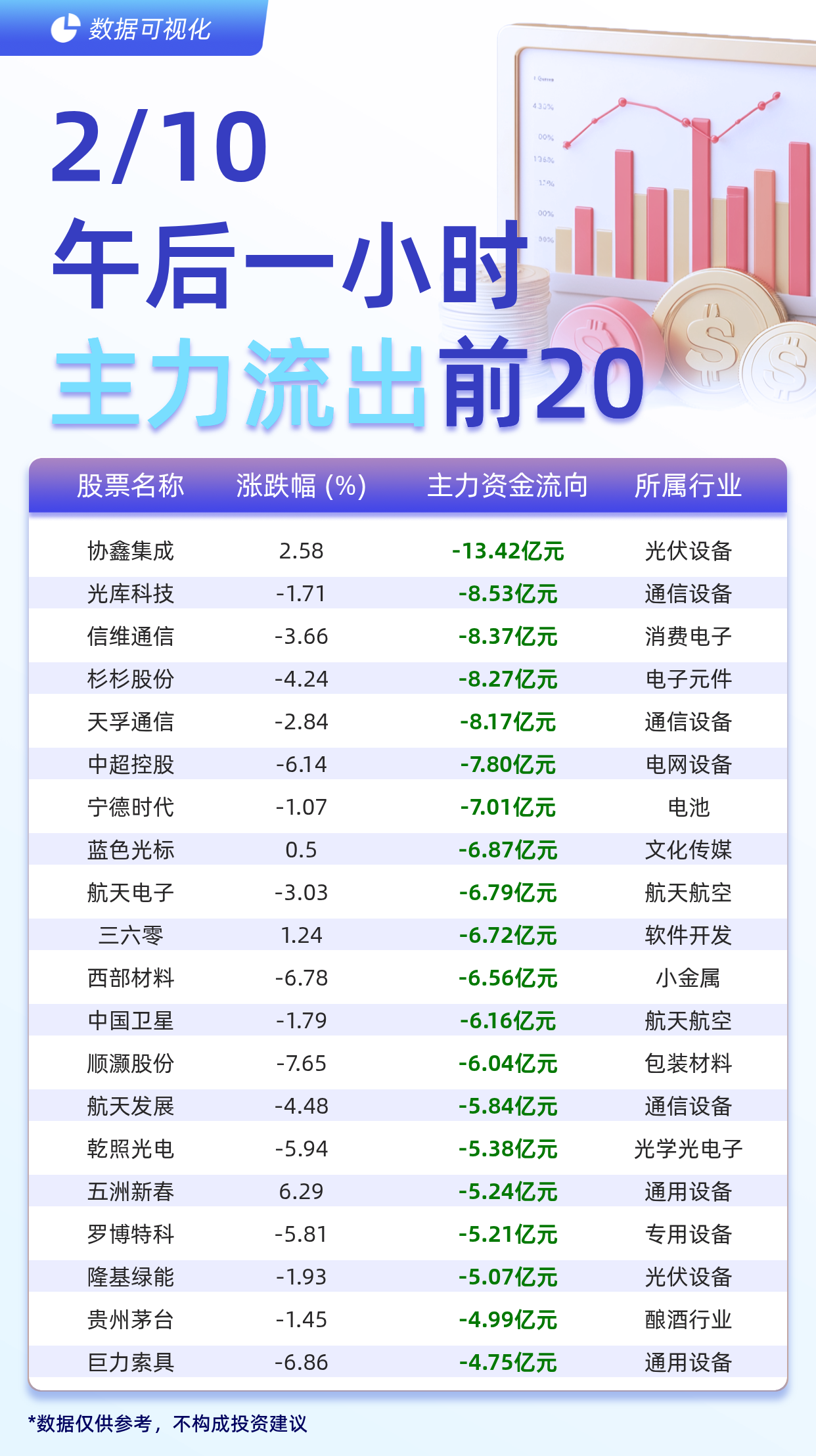
主力个股资金流出前20:协鑫集成流出13.42亿元、光库科技流出8.53亿元
Jin Rong Jie· 2026-02-10 06:35
Core Viewpoint - The data indicates significant outflows of capital from various stocks, with the top 20 stocks experiencing substantial withdrawals, highlighting potential concerns in the respective sectors [1][2][3] Group 1: Stock Performance and Capital Outflow - GCL-Poly Energy saw a capital outflow of 1.342 billion yuan, despite a price increase of 2.58% [2] - Lightway Technology experienced a capital outflow of 853 million yuan, with a decline of 1.71% [2] - Xinwei Communication had a capital outflow of 837 million yuan, with a drop of 3.66% [2] - Shanshan Co. faced an outflow of 827 million yuan, down 4.24% [2] - Tianfu Communication saw an outflow of 817 million yuan, with a decrease of 2.84% [2] - Zhongchao Holdings had a significant outflow of 780 million yuan, down 6.14% [2] - Contemporary Amperex Technology experienced a capital outflow of 701 million yuan, with a slight decline of 1.07% [2] - BlueFocus Communication saw an outflow of 687 million yuan, with a minor increase of 0.5% [2] - Aerospace Electronics faced an outflow of 679 million yuan, down 3.03% [2] - 360 Security Technology had a capital outflow of 672 million yuan, with a rise of 1.24% [2] - Western Materials experienced an outflow of 656 million yuan, down 6.78% [3] Group 2: Additional Stock Details - China Satellite had a capital outflow of 616 million yuan, with a decline of 1.79% [3] - Shunhao Co. faced an outflow of 604 million yuan, down 7.65% [3] - Aerospace Development saw an outflow of 584 million yuan, with a decrease of 4.48% [3] - Qianzhao Optoelectronics experienced an outflow of 538 million yuan, down 5.94% [3] - Wuzhou New Spring had a capital outflow of 524 million yuan, with an increase of 6.29% [3] - Robot Technology faced an outflow of 521 million yuan, down 5.81% [3] - Longi Green Energy saw an outflow of 507 million yuan, with a decline of 1.93% [3] - Kweichow Moutai experienced a capital outflow of 499 million yuan, down 1.45% [3] - JuLi Rigging faced an outflow of 475 million yuan, down 6.86% [3]




沪深北交易所同日“亮剑”:再融资新政对A股影响(附精选股票)
Sou Hu Cai Jing· 2026-02-10 06:14
Core Viewpoint - The simultaneous release of refinancing optimization measures by Shanghai, Shenzhen, and Beijing stock exchanges marks a significant transformation in China's capital market, aimed at enhancing capital allocation efficiency and reshaping the A-share market landscape [1]. Group 1: Policy Framework and Differences - The policy frameworks of the three exchanges are highly similar, focusing on "supporting the strong, limiting the weak, promoting innovation, and enhancing convenience and regulation" [2]. - Shanghai Stock Exchange emphasizes "main board" characteristics, tailoring financing rules for large, mature technology companies [2]. - Shenzhen Stock Exchange adopts a bolder stance on supporting technology innovation, easing fundraising restrictions for growth-oriented enterprises [2]. - Beijing Stock Exchange focuses on "innovative small and medium-sized enterprises," addressing their financing challenges with flexible policies [2]. Group 2: Strategic Insights on Separate Announcements - The decision to release policies on the same day rather than a joint announcement reflects the nuanced wisdom of tiered regulation in China's capital market [3]. - Different market positioning allows each exchange to cater to the unique characteristics and needs of the enterprises they serve, avoiding a one-size-fits-all approach [3]. - The simultaneous release creates a strong policy resonance, reinforcing market perception of deepening capital market reforms while maintaining the distinct identities of each exchange [3]. Group 3: Deep Impacts on Market Perception - The new measures aim to shift the long-standing fear of "blood-sucking" effects of refinancing, which was believed to drain market funds and destabilize the market [4]. - The principle of "supporting the strong, limiting the weak" will act as a catalyst for market differentiation, favoring quality companies, especially in hard technology, while raising barriers for poorly performing firms [4]. - The policy directs resources towards "new productive forces," providing strong support for leading companies in sectors like semiconductors, AI, biomedicine, and high-end manufacturing [5]. - Allowing companies that have experienced stock price declines to raise funds through methods like private placements and convertible bonds offers a lifeline to solid businesses facing temporary challenges [6]. - A complete regulatory loop is established, tightening post-fundraising supervision while relaxing initial approvals, transforming refinancing from a mere "money-raising tool" to an "engine" for corporate development [7]. Group 4: Implications for Investors - The coordinated actions of the three exchanges signify the entry of China's refinancing mechanism into a "precise drip irrigation" era, providing tailored financing support for different types of enterprises [8]. - Investors are advised to focus on genuinely innovative and well-governed companies while avoiding those that merely chase trends without substance [8]. - The transformation of refinancing from a "blood-sucking machine" to a "blood-producing pump" is expected to enhance the value discovery function of the A-share market, leading to a healthier and more vibrant capital market [8].







马斯克宣布干法电极技术突破,BC头部企业完成专利许可
Ping An Securities· 2026-02-10 06:11
Investment Rating - The report maintains an "Outperform" rating for the industry [1] Core Insights - The report highlights significant developments in the wind and solar sectors, including a breakthrough in dry electrode technology by Elon Musk, which is crucial for reducing costs in liquid batteries and mass production of solid-state batteries [6] - The report notes that the wind power index decreased by 1.04%, outperforming the CSI 300 index by 0.30 percentage points, with a current PE_TTM valuation of approximately 27.71 times [4][11] - The solar sector saw a 3.36% increase in the photovoltaic equipment index, with the photovoltaic battery component index rising by 8.10% [4] Summary by Sections Wind Power - The European Commission has initiated an in-depth investigation into Goldwind Technology under the Foreign Subsidies Regulation (FSR), focusing on whether the company benefits from foreign subsidies in the EU market [5][10] - The report indicates that the impact of this investigation on China's wind turbine exports to Europe is limited in the short term, but it introduces uncertainty for future market entries [10] - The report maintains a positive outlook on China's competitive advantage in the wind power industry and its opportunities for international expansion [5][10] Solar Power - A major BC company, Aiko Solar, has signed a patent licensing agreement with Maxeon Solar, allowing Aiko to access all BC battery and component patents outside the U.S. for the next five years [5] - The total patent licensing fee amounts to RMB 1.65 billion, with the first-year payment set at RMB 250 million [5] - This agreement is expected to eliminate a significant barrier to Aiko's overseas sales and indicates high technical barriers in the BC technology sector [5] Energy Storage & Hydrogen - The report emphasizes the high demand for new energy storage solutions, recommending investments in domestic and international large-scale storage companies such as Sungrow Power, Haibo Shichuang, and Shuneng Electric [6] - In the lithium battery sector, the report suggests that the industry is emerging from a price decline cycle, with strong demand driving both volume and profit growth [6] - The report highlights the potential of dry electrode technology to significantly reduce costs and improve battery performance, which could create new opportunities in related equipment and materials [6]


深市规模最大的光伏ETF(159857)盘中申购超7000万份,换手率深市同标的第一
Mei Ri Jing Ji Xin Wen· 2026-02-10 05:31
Group 1 - The photovoltaic sector is experiencing a decline, with the photovoltaic ETF (159857) index dropping by 1.67% during trading, and key stocks such as Aotewi, Robotech, and Maiwei falling over 5% [1] - The photovoltaic ETF (159857) has seen a net inflow of 144 million yuan over the last ten trading days, reaching a new high of 2.41 billion yuan as of February 9, 2026, making it the largest in the Shenzhen market [1] - The ETF tracks the photovoltaic industry index, covering the entire industry chain from silicon materials to solar power station operations, reflecting the core competitiveness of China's photovoltaic industry [1] Group 2 - Elon Musk announced that SpaceX and Tesla will each establish 100 GW of annual photovoltaic capacity, with some dedicated to space data centers and Starlink satellites [2] - The cancellation of export tax rebates for photovoltaic products in April is expected to trigger a rush in exports, with component production in February projected to increase by nearly 30% month-on-month [2] - Leading companies like Trina Solar have raised component prices to 0.88-0.92 yuan/W, indicating price stabilization in the industry [2]
马斯克引爆光伏,产业链市值"回血"!太空光伏前景几何
Bei Jing Shang Bao· 2026-02-10 04:56
Core Viewpoint - The capital market is experiencing a surge in interest in the photovoltaic sector, particularly driven by Elon Musk's support for space photovoltaic technology, which has led to significant stock price increases in related companies [1][5][15]. Group 1: Market Dynamics - The photovoltaic sector saw a market capitalization recovery of over 200 billion yuan from January 23 to February 9, with leading companies like GCL-Poly and TCL Zhonghuan hitting their daily price limits [4][9]. - Following Musk's endorsement of space photovoltaic technology at the World Economic Forum on January 22, the A-share photovoltaic sector collectively surged [5][7]. - The market is witnessing a rotation of interest from traditional AI and chip sectors to the photovoltaic sector, particularly space photovoltaic concepts [1][2]. Group 2: Industry Challenges - The photovoltaic industry is currently facing an oversupply situation, with the China Photovoltaic Industry Association predicting a decline in new installed capacity in 2026 by 23.81% to 42.86% year-on-year [1][14]. - Many leading photovoltaic companies have reported significant expected losses for 2025, with 73.47% of the 49 companies that disclosed earnings forecasts predicting net losses [13]. - The industry is undergoing a deep adjustment phase, with many companies expressing concerns about the sustainability of stock price increases without corresponding performance improvements [12][13]. Group 3: Space Photovoltaic Technology - Space photovoltaic technology involves deploying large solar power stations in space to convert solar energy into electricity, which can then be transmitted back to Earth or used to power satellites and space stations [6][15]. - While space photovoltaic technology presents significant advantages over ground-based systems, such as uninterrupted sunlight and higher light intensity, it is still in the early stages of technological exploration and faces various challenges [2][15]. - The potential for space photovoltaic technology to become a new growth driver for the photovoltaic industry is acknowledged, but its realization will depend on overcoming technical, cost, and industry chain challenges [17].

【价值发现】建信基金经理陶灿业绩优异,精准的投资策略与行业配置,旗下基金收益率高达473.70%
Sou Hu Cai Jing· 2026-02-10 03:27
文|天峰 来源|财富独角兽 2025年至今,沪深股指持续上涨,主要源于政策支持、产业转型、资金面改善与市场信心修复等多重因素共振。人工智能、半导体、新能源等高景气赛道 轮番表现,反映出市场对"新质生产力"的高度认可。资金结构也发生深刻变化,外资回流加速,北向资金单月净买入创历史新高。 沪深股指大幅上涨,公募基金加仓高端制造与数字经济,尤其是权益类基金业绩因此受益。陶灿作为建信基金权益投资部总经理,深耕行业十余年,其管 理的基金以长期稳健著称。核心策略是"3+3"框架:自上而下优选行业,聚焦商业模式、竞争格局与景气趋势;自下而上精选个股,考察企业家格局、管 理层执行力与研发效率。 这种双维度方法显著提升了组合的抗风险能力。例如,在新能源行业波动中,陶灿通过动态调仓,规避产能过剩风险,同时锁定高成长赛道,使基金在行 业轮动中保持超额收益。其代表产品建信改革红利股票基金,凭借均衡配置和严格止盈止损机制,长期跑赢基准,成为同类产品中的标杆。 01 陶灿旗下基金收益率高达473.70% 精准把握改革红利宏观策略布局 据天天基金网显示,陶灿于2007年7月加入建信基金管理公司,历任研究员、基金经理助理、基金经理、资深基金 ...

太空算力时代-太空光伏万亿蓝海
2026-02-10 03:24
Summary of Key Points from the Conference Call on Space Photovoltaics Industry Overview - The focus is on the space photovoltaic (PV) industry, which is expected to grow significantly due to increasing demand for space-based computing power and advancements in solar technology [1][10][23]. Core Technologies and Companies - **Gallium Arsenide (GaAs) Solar Cells**: - Highest efficiency (31.5%-34.5%) but very high cost (RMB 200,000-300,000 per square meter) [1][2][12]. - Leading companies: GanZhao Photovoltaics and Sanan Optoelectronics [2][5]. - **P-Type Heterojunction (HJT) Solar Cells**: - Efficiency of 26%-27% (up to 30% when stacked) with lower costs (a few thousand RMB per square meter) [1][2][4]. - Notable progress by Dongfang Risheng in ultra-thin HJT technology [2][5]. - **Perovskite Solar Cells**: - Single-layer efficiency around 20%, can exceed 35% when stacked; lower raw material costs but complex manufacturing [1][2][4]. - Companies like GCL-Poly and Shanghai Gangwan are making significant advancements [2][5]. Cost and Efficiency Challenges - GaAs cells face limited cost reduction potential due to material scarcity and complex manufacturing processes [3][11]. - HJT is seen as a promising short-term technology due to its lower manufacturing costs and reliability [4]. - Perovskite technology has great potential if stability issues can be resolved [4]. Special Requirements for Space Applications - Space PV materials must withstand extreme temperature variations (from -180°C to +120°C) and UV radiation [16]. - Low-temperature silver paste and light conversion technologies are critical for performance in space [16]. Packaging and Materials - Space PV packaging uses CPI or UTG films instead of traditional glass, with UTG offering better performance but at a higher cost (RMB 6,000-8,000 per square meter) [20][21]. - The cost structure of packaging materials is influenced by raw materials (40%-50%), core processes (25%-35%), and yield losses (10%-15%) [22]. Market Dynamics and Future Outlook - The space PV market is expected to expand significantly in the next 3-5 years, driven by satellite launches and technological advancements [23]. - The demand for PV components will increase as more satellites are deployed, potentially leading to explosive market growth [23]. Risks and Challenges - Key risks include the ability of companies to survive until the market matures and the adaptability of technologies to space environments [29]. - Companies must address challenges related to UV resistance and thermal shock to succeed in the space PV market [29]. Conclusion - The space photovoltaic industry is poised for growth, with various technologies and companies leading the charge. However, significant challenges remain in terms of cost, efficiency, and material stability in the harsh space environment.

行业利好催化不断,光伏ETF基金(516180)交投活跃
Xin Lang Cai Jing· 2026-02-10 02:12
截至2026年2月10日 09:46,中证光伏产业指数(931151)成分股方面涨跌互现,阳光电源领涨3.37%,协 鑫集成上涨2.78%,德业股份上涨1.90%;奥特维领跌。光伏ETF基金(516180)最新报价0.93元。 光伏板块今日震荡调整,资金持续关注,光伏ETF基金盘中换手3.6%,成交342.38万元。拉长时间看, 截至2月9日,光伏ETF基金近1周日均成交1561.53万元。 中信证券研报称,太空光伏需求有望迎来指数级增长。马斯克下注光伏制造,为轨道算力和AI供电铺 路。中国头部光伏设备厂商具备极强的高效迭代和快速响应能力,有望跻身特斯拉和SpaceX等相关设 备供应链,并收获高额订单,打开全新成长空间。此外,太空光伏设备或具备明显通胀效应,价值量或 将实现跃迁式提升。重点推荐具备技术、产品和份额优势的光伏各环节设备龙头厂商。 风险提示:基金有风险,投资需谨慎。基金管理人承诺以诚实信用、勤勉尽责的原则管理和运用基金资 产,但不保证本基金一定盈利,也不保证最低收益。基金管理人提醒投资人基金投资的"买者自负"原 则,在做出投资决策后,基金运营状况与基金净值变化引致的投资风险,由投资人自行负担。基金 ...

今年,哪些行业能过上好日子?
虎嗅APP· 2026-02-10 00:25
A股这7大板块,勾勒出中 国经济全貌 出品 | 妙投APP 作者 | 妙投团队 编辑 | 丁萍 头图 | AI制图 幸福的人大致相同,不幸的人各有各的不幸。 银河证券研报显示,截至1月31日,2956家A股上市公司已披露2025年年报业绩预告,披露率为54%。其中 电机、地面兵装、个护用品、风电设备预喜率 (包括扭亏、续盈、略增、预增等情形) 超过70%,汽车行 业超过50%,受益于AI算力需求的电子和通信行业,预喜率分别达到45%和37%。这些大体上属于科技、高 端制造、新消费等领域。 而传统行业,大多较为一般。 煤炭、房地产、轻工制造、建筑装饰、食品饮料、社会服务、石油石化等行业预喜率较低,均低于25%; 焦炭、体育、林业、农业综合、厨卫电器、油气开采、白酒行业预喜率更是均为0%;传统行业中预喜率较 高的,主要是非银金融、有色金属、钢铁、公用事业等少数行业。 展望2026年,有些业绩不错的行业,有望继续保持成长。而有些2025年经营惨淡的行业,也有边际复苏的 机会,或者有复苏的预期。 这句话放到宏观经济各个层面中来看,也是如此。有的行业经历着良好的增长,有的行业在期待着复苏的 曙光。 2025年到现在,无 ...

探索“光伏+交通”新范本
Xin Lang Cai Jing· 2026-02-09 23:28
Core Viewpoint - A new integrated energy project, the NIO Battery Swap Station at the Longi Green Energy Global Distributed R&D Center, has commenced operations, combining photovoltaic power generation, energy storage, and smart energy management to create a sustainable energy ecosystem [1]. Group 1: Project Overview - The NIO Battery Swap Station features three photovoltaic integration facilities: photovoltaic carports, walls, and noise barriers, which collectively enhance energy generation and reduce carbon emissions [2]. - The project aims to alleviate grid pressure and meet user energy demands efficiently, with a focus on creating a low-carbon energy supply structure [2]. - The photovoltaic walls utilize Longi's Hi-MO X10 series components, designed for durability and low glare, transforming traditional barriers into valuable energy assets [3]. Group 2: Technological Innovations - The photovoltaic carports incorporate patented installation technology and dual-layer waterproofing, ensuring safety during extreme weather while providing shade for vehicles [3]. - The battery swap station is equipped with Longi's customized Hi-MO X10 components, achieving a conversion efficiency of 24.3%, ensuring a green and efficient power supply for the battery swap network [4]. Group 3: Strategic Collaboration - The project represents a significant step in NIO's long-term strategy to build a nationwide clean energy network, emphasizing the importance of collaboration with Longi to explore a green transportation energy system [5]. - NIO aims to promote similar "photovoltaic storage and charging" demonstration projects to enhance user experiences and contribute to carbon neutrality in the transportation sector [5].

