宝马

Search documents
智能车产业跟踪:威肯西科技获A轮融资,加速自动驾驶线控底盘研发
GUOTAI HAITONG SECURITIES· 2025-07-29 11:44
Investment Rating - The report does not explicitly state an investment rating for the automotive industry Core Insights - The automotive industry is experiencing significant growth, with Chinese brand passenger cars selling 9.27 million units in the first half of 2025, a year-on-year increase of 25% [15] - New energy vehicle sales are expected to stabilize due to government policies aimed at improving product quality and optimizing supply chain processes [11] - Recent trends indicate a shift towards smart driving technologies, with various companies receiving funding to enhance their capabilities in this area [31][30] Information Dispatch - **Weekly Sales Rankings**: In the third week of July, the top three new energy vehicle brands by sales were BYD (51,400 units, +5.3%), Wuling (12,700 units, +14.4%), and Tesla (9,900 units, -19.5%) [9] - **New Car Releases**: Several new models were launched, including BYD's Hai Si 06 EV and DM-i, and the Wuling Zhi Guang EV [10] - **Policy and Hot Events**: Guangdong and Anhui provinces are taking steps to regulate competition in the new energy vehicle sector, promoting quality management and industry self-discipline [11] Technology Dynamics - **Chip Development**: MediaTek's C-X1 cockpit chip is gaining traction among luxury car manufacturers in China, expected to see large-scale shipments in 2026 [18] - **Battery Innovations**: Honeycomb Energy's second-generation Dragon Scale battery pack has been launched, featuring a capacity of 65 kWh and supporting 5C fast charging [20] Lithium Battery Insights - The price of battery-grade lithium carbonate has surged to 72,940 yuan per ton as of July 25, 2025, reflecting a significant increase of 9.4% from the previous week [22][23] - The report highlights fluctuations in the prices of various lithium battery materials, with lithium iron phosphate prices rising by 7.22% [23] Investment and Financing Events - **Zero One Automotive**: Completed a 500 million yuan Series A financing round to advance its autonomous driving technology [30] - **Weikensi Technology**: Secured Series A funding to accelerate the development of its drive-by-wire chassis [31] - **Jinmao Smart Transportation**: Raised several hundred million yuan in Series A financing to support its zero-carbon transportation solutions [32]





无人区卫星SOS+洪灾自动逃生,“技术+体系”构建车企公益新路径
Hua Xia Shi Bao· 2025-07-29 11:21
Core Insights - Recent rescue incidents have redefined the value boundaries of automobiles, showcasing their life-saving capabilities and the innovative practices of car companies in the public welfare sector [1][2][3] Group 1: Rescue Events - The first incident involved a Wanjie M9 in Qinghai's Delingha area, where the owner used the vehicle's satellite communication system to call for help after a tire burst in a signal-dead zone, marking the first industry case of satellite rescue [2] - The rescue team responded promptly, maintaining communication with the car owner for 61 minutes and successfully reaching the site after 3.5 hours of travel [2] - The second incident occurred in Hebei, where a Fangcheng Leopard 5 owner was swept away by a flash flood while participating in a rescue operation, but managed to escape thanks to the vehicle's automatic sunroof [3] Group 2: Corporate Social Responsibility - The incidents highlight the shift in corporate social responsibility from reactive measures to systematic support, as seen in the actions of Wanjie and Fangcheng [3][4] - Wanjie has processed over 20 million vehicle status data points and issued 45,000 proactive alerts for extreme weather and road conditions, indicating a transition from passive fault response to active risk anticipation [2] - Fangcheng's response included gifting a new Leopard 5 and launching a 1 million yuan public welfare fund to support existing and future rescue efforts [3] Group 3: Industry Trends - Analysts note that these events illustrate the combination of technological preparedness and corporate responsibility in the automotive industry, with vehicles evolving into "mobile safety fortresses" [4] - Many automotive companies are engaging in public welfare initiatives, such as BMW's cultural projects and Toyota's long-term traffic safety efforts, reflecting a broader trend in the industry [5][6] - The automotive sector is increasingly adopting innovative paths for social responsibility, including technology empowerment, ecological co-construction, and model upgrades, demonstrating a commitment to societal progress [6]
华宝新能跌1.12%,成交额1.25亿元,后市是否有机会?
Xin Lang Cai Jing· 2025-07-29 09:29
Core Viewpoint - The company, Shenzhen Huabao New Energy Co., Ltd., focuses on lithium battery energy storage products and has established strategic partnerships to enhance its technological capabilities and market reach [2][3][4]. Group 1: Company Overview - The company was founded in 2011 and has been dedicated to the lithium battery energy storage sector, initially starting with ODM business for power banks [2][3]. - The main business revenue composition includes portable energy storage products (77.30%), photovoltaic solar panels (21.43%), and others (1.27%) [8]. - As of March 31, 2025, the company reported a revenue of 714 million yuan, representing a year-on-year growth of 22.60%, and a net profit of 85.07 million yuan, with a significant increase of 193.36% [9][10]. Group 2: Strategic Partnerships and Innovations - On July 11, 2023, the company announced a strategic cooperation with Zhongbi New Energy to jointly develop sodium-ion batteries, leveraging both parties' technological strengths [2][4]. - The company has built a robust supply chain with high-quality suppliers such as Panasonic, LG Chem, and others, and has expanded its client base to include notable companies like Tesla and BMW [2][3]. Group 3: Market Performance and Financials - As of July 29, 2023, the company's stock price decreased by 1.12%, with a trading volume of 125 million yuan and a market capitalization of 9.866 billion yuan [1]. - The company benefits from a high overseas revenue ratio of 95.09%, which is positively impacted by the depreciation of the Chinese yuan [4].
汽车视点丨降价超四成,进口豪车承压下行,本土高端品牌迎来机会?
Xin Hua Cai Jing· 2025-07-29 07:56
Core Viewpoint - The recent adjustment of the luxury car consumption tax in China has led to significant changes in the pricing and sales strategies of luxury car brands, particularly affecting high-end imported brands like Porsche and Land Rover, while also providing opportunities for domestic luxury brands to gain market share [1][2][3]. Group 1: Impact of Tax Policy - The luxury car tax threshold has been lowered from 1.3 million yuan to 900,000 yuan, primarily affecting models priced between 1.02 million and 1.45 million yuan, which constitute about 0.1% of the overall car market [2][3]. - Major luxury brands such as Porsche and Land Rover are implementing "full tax subsidy" policies to stimulate sales, with Porsche reporting an increase in orders due to these incentives [1][2]. Group 2: Sales Performance and Market Trends - Porsche's global deliveries fell by 6% in the first half of the year, with a 28.4% decline in the Chinese market from January to May 2023 [4][5]. - Other luxury brands, including Maserati and Mercedes-Benz, also experienced significant sales declines, with Maserati's domestic sales dropping by 43.6% [4][5]. Group 3: Competitive Landscape - Domestic luxury brands are increasingly entering the high-end market, with models like the Hongqi "Guo" series and the Zeekr 009 positioned to avoid the new tax impact due to their pricing strategies [8][9]. - Analysts suggest that the new tax policy may benefit domestic luxury brands more than traditional imported brands, as domestic brands have greater flexibility in pricing and configuration adjustments [8][9]. Group 4: Future Outlook - The luxury car market is undergoing a transformation, with domestic brands like BYD's Yangwang planning to enter the European market, indicating a potential reshaping of the global luxury automotive landscape [9][10].
内幕揭晓:欧盟砸1.35万亿?特朗普胜了,欧洲也会失去三十年
Sou Hu Cai Jing· 2025-07-29 04:50
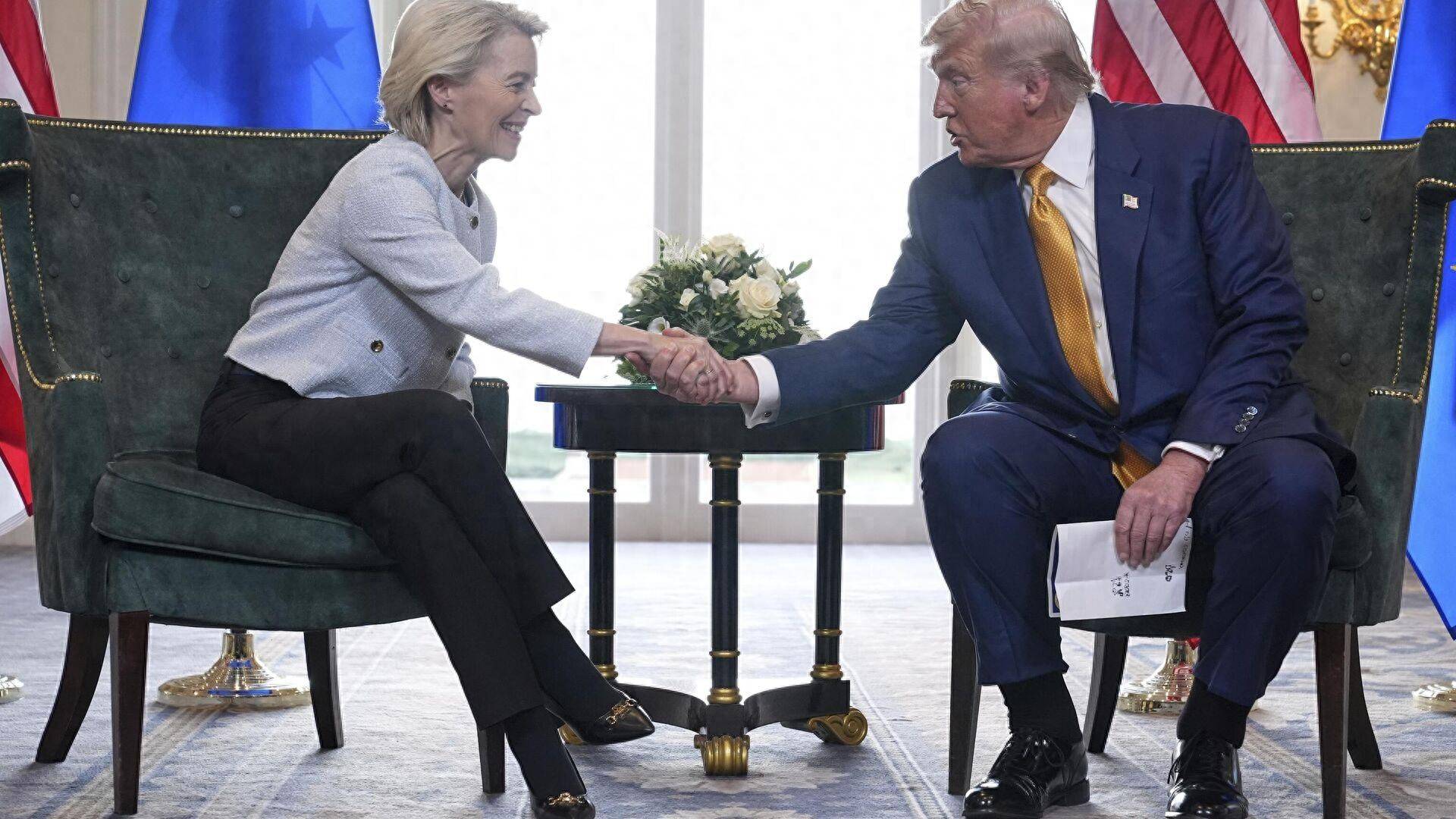
Core Points - The article discusses a significant economic agreement between the European Union and the United States, highlighting the implications of a $1.35 trillion deal that involves a 15% tariff reduction in exchange for substantial European investments in U.S. energy and military products [1][4][11]. Group 1: Economic Agreement Details - The EU agreed to purchase $750 billion worth of U.S. energy products and invest an additional $600 billion, while also allowing U.S. goods to enter the European market with zero tariffs [4][6]. - The agreement is perceived as a modern version of an unequal treaty, where Europe is seen as conceding to U.S. demands, akin to a robbery scenario where the U.S. reduces tariffs from 30% to 15% in exchange for significant financial commitments from Europe [4][6]. Group 2: Historical Context - The article draws parallels between this agreement and the Marshall Plan, suggesting that the U.S. is once again exerting influence over Europe, but this time for its own economic recovery rather than altruistic reasons [10][11]. - The historical dependency of Europe on U.S. support is emphasized, indicating that this relationship has evolved into one of subservience, particularly in the face of economic threats [13][31]. Group 3: Impact on European Industry - Major European automotive companies, which account for 18% of EU exports to the U.S., face significant profit losses due to the imposed tariffs, amounting to approximately €9.7 billion annually [6][14]. - The acceptance of U.S. industrial standards by the EU is highlighted as a critical aspect of the agreement, which could lead to a loss of control over European industrial production and standards [6][18]. Group 4: Global Economic Implications - The agreement signals a shift in international economic rules, with the U.S. moving away from its previously advocated free trade principles, potentially destabilizing the global economic order [18][20]. - The article notes a trend of companies relocating to countries like Vietnam and Mexico in response to the new tariff environment, indicating a significant shift in global supply chains [20][22]. Group 5: China's Position - The article suggests that as Europe compromises, China has the opportunity to assert its independent development model, contrasting sharply with Europe's dependency on the U.S. [29][34]. - China's approach to trade and development is presented as a viable alternative for countries seeking to avoid U.S. economic pressures, emphasizing cooperation over confrontation [33][34].

中美对话前夜,中国正在推进脱钩,猛烈冲击特朗普铁杆选民和重要金主
Sou Hu Cai Jing· 2025-07-29 04:09
Group 1 - In June, China's imports of crude oil and liquefied natural gas from the U.S. dropped to zero, indicating a significant strategic shift in energy sourcing [1][3][7] - The U.S. imposed high tariffs on oil (94%) and natural gas (99%), making imports economically unfeasible for China [7][9] - China's energy imports from the U.S. had already seen drastic declines in the first quarter of the year, with crude oil imports plummeting by 54%, 76%, and 70% in consecutive months [3][5] Group 2 - The shift in energy sourcing reflects a broader trend of supply chain diversification, with China successfully finding alternative suppliers in Brazil, the Middle East, and Russia [11][25] - The reduction in U.S. energy exports to China is expected to have significant economic repercussions for U.S. states reliant on these exports, particularly Texas and Louisiana [5][18] - China's strategic adjustments in energy procurement are part of a larger trend of reducing reliance on U.S. goods, as evidenced by a significant increase in imports from Brazil, which rose from 46% to 74% of China's soybean imports [20][22] Group 3 - The ongoing trade tensions have led to a reconfiguration of global supply chains, with countries increasingly seeking to diversify their trade partnerships away from the U.S. [28][30] - China's reduction of U.S. Treasury holdings by $57.3 billion to $759 billion marks a significant shift in financial strategy, indicating a move towards de-dollarization [22][24] - The international landscape is evolving towards a multi-polar and regionalized economy, diminishing the U.S.'s role as a primary trade partner [33][35]
倒计时下的墨西哥:新逻辑与潜规则
芯世相· 2025-07-29 04:03
Core Viewpoint - The article discusses the impact of US-China trade tensions on Chinese companies operating in Mexico, highlighting the challenges and opportunities in the current geopolitical landscape. Group 1: Trade Relations and Economic Impact - The upcoming US-China trade talks in Sweden are seen as a significant indicator of the future of bilateral economic relations [5] - Mexico has become a crucial trade partner for China in Latin America, with bilateral trade growing steadily, particularly in the automotive sector [7][8] - The IMF has downgraded Mexico's economic growth forecast for this year from 1.4% to -0.3%, making it the only G20 country expected to experience negative growth [8] Group 2: Business Environment in Mexico - Many Chinese companies are reconsidering their investments in Mexico due to the uncertainty created by US tariffs, with some halting projects entirely [12][13] - The perception that relocating to Mexico may not shield companies from US tariffs has dampened investment enthusiasm [13] - Despite the challenges, there is still a significant interest in consulting about business opportunities in Mexico, indicating a complex and evolving market [14] Group 3: Future Opportunities and Strategies - Companies are urged to adapt to new trade rules and enhance their international capabilities, as the external environment is unlikely to change significantly [20] - The article emphasizes the importance of localizing operations and hiring local talent to navigate the unique challenges of the Mexican market [45][46] - The potential for investment in consumer goods supply chains in Mexico is highlighted as a promising opportunity for Chinese manufacturers [34] Group 4: E-commerce and Market Dynamics - Mexico's e-commerce market is characterized by low penetration and high growth potential, making it an attractive target for Chinese platforms [21][22] - Despite recent tariff changes, Chinese goods remain competitive in Mexico due to their cost advantages [30][32] - The article notes that the high margins in the Mexican market have allowed e-commerce platforms to absorb some of the tariff costs without significant drops in sales [31] Group 5: Renewable Energy Sector Challenges - The article outlines the decline of the renewable energy sector in Mexico due to policy shifts favoring state-owned enterprises, leading to stalled projects [35][36] - Future opportunities in the renewable sector may lie in energy storage and transmission rather than large-scale solar projects [37]

懂车帝被撇清关系,推翻德国P3结论,到底是谁不懂车?
3 6 Ke· 2025-07-29 02:24
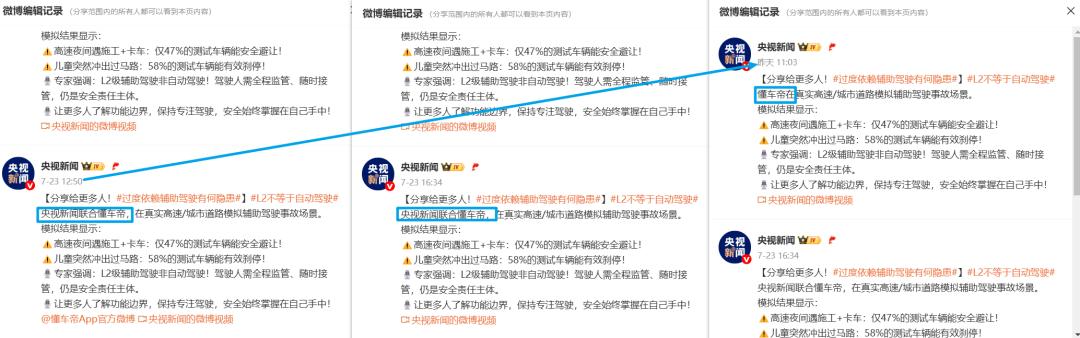
Core Viewpoint - The evaluation video by "CCTV News" and "Dongche Di" ranks Tesla's assisted driving system first, while other domestic models, including the AITO Wenjie, lag behind, leading to public scrutiny and allegations of testing bias [1][18]. Group 1: Evaluation and Public Reaction - The evaluation video has sparked significant public debate, with many questioning the integrity of the testing process, including claims of manipulated footage and inconsistent testing distances [1][3][4]. - A notable critic, "怼怼姐," suggested that "Dongche Di" should release backend data from Huawei to address the concerns raised by car owners [7]. - The "第一智驾" blogger and others replicated the evaluation conditions at night, demonstrating that the AITO Wenjie’s AEB system functioned correctly, contrasting with the original evaluation results [8]. Group 2: Industry Perspectives - The controversy highlights broader concerns regarding the reliability of domestic assisted driving systems, with the evaluation suggesting that many systems perform poorly in high-stress scenarios [18][21]. - The Shanghai Jiao Tong University professor emphasized the importance of multi-sensor integration for safety in autonomous driving, arguing that relying solely on visual data is insufficient [11][17]. - The evaluation results from the German consulting firm P3, which ranked the AITO Wenjie M9 first, further complicate the narrative around the credibility of domestic systems compared to Tesla [21][23]. Group 3: Market Implications - The ongoing debate over assisted driving technology may influence consumer perceptions and purchasing decisions, as potential buyers are encouraged to seek diverse information sources before making a decision [10][34]. - The collaboration between BMW and Momenta to develop a dedicated intelligent driving solution indicates a trend towards enhancing safety features in new models, reflecting the industry's response to current challenges [24][28].
传哈雷戴维森(HOG.US)接近向太平洋投资管理公司、KKR出售金融子公司部分股权
Zhi Tong Cai Jing· 2025-07-29 02:21
Group 1 - Harley-Davidson is in advanced negotiations with Pimco and KKR to sell a stake in its financial subsidiary and existing motorcycle loan portfolio, with a potential deal size of $5 billion [1] - The financial services subsidiary, Harley-Davidson Financial Services (HDFS), provides inventory financing for dealers and loans for consumers purchasing Harley-Davidson and LiveWire motorcycles [1] - The transaction may be announced in the coming weeks, although details and scale could change as negotiations are ongoing [1] Group 2 - Harley-Davidson is facing challenges with sluggish sales growth and intense competition from rivals like Honda and BMW, with its stock price down approximately 22% this year [2] - The CEO, Jochen Zeitz, indicated in May that the HDFS transaction is progressing, with multiple institutions expressing interest [2] - The private credit market, valued at $5.2 trillion, is expanding, with firms acquiring stakes in consumer loan issuing entities and purchasing the loans they issue [2]


理想汽车CEO李想:从没说过「臭搞技术的」这五个字;周鸿祎谈AI大战:苹果彻头彻尾败了,谷歌被蚕食;小米AI眼镜由雷军亲自拍板
雷峰网· 2025-07-29 00:30
Key Points - Xiaomi's AI glasses project, initiated by CEO Lei Jun, aims for an annual shipment of 5 million units within three years, capitalizing on the large near-sighted population in China [4] - BYD's Fangchengbao vehicle was involved in a rescue operation during severe flooding, showcasing its durability and safety features [6] - Zhou Hongyi, founder of 360 Group, commented on the AI competition, stating that Apple has failed, Google is being eroded, and Meta is the most anxious player in the market [8] - Li Xiang, CEO of Li Auto, clarified that he never used the phrase "stupid technology" and emphasized the importance of valuable technology for users [9] - Alibaba Cloud founder Wang Jian predicted that 90% of current AI applications may disappear within the next decade, urging developers to focus on innovative applications [10] - Yingshi announced its first panoramic drone product, set to enter public testing next month [11] - Samsung and Tesla have signed a $16.5 billion chip supply agreement, with plans to produce AI6 chips in the U.S. [34][35] - Tesla executives confirmed that the Roadster project is still in development, with a significant demonstration planned for the end of this year [38] - Faraday Future's MPV model has received over 10,000 pre-orders since its launch [14][15] - Xpeng Motors' VP denied rumors of product line consolidation and emphasized the company's commitment to pure vision technology [16][17] - Leap Motor's D series SUV is positioned as a flagship product targeting the 300,000 RMB price segment [20] - The first three-fold smartphone battle is set to occur with the launch of Huawei's Mate XTs and Samsung's Galaxy Z TriFold [22][23] - China Changan Automobile Group has been officially established with a registered capital of 20 billion RMB [25] - JD.com announced a campus recruitment plan for 2026, offering 35,000 positions and investing 7 billion RMB in youth apartments [28] - Tencent has taken action against 3.2 million QQ accounts in a crackdown on online fraud and harmful content [30]