
荣耀

Search documents
智能硬件公司觉得自己无所不能|TMT年度盘点
Jing Ji Guan Cha Wang· 2026-02-13 12:40
Core Insights - The technology and internet sectors are experiencing rapid changes in 2025, with companies aggressively competing in computing power and large model applications, while e-commerce is reshaping its foundations amidst regulatory pressures [2][3] - The era of easy financing through simple presentations is over; companies must demonstrate technological, commercial, and ecological advantages to survive in the TMT industry [3] Industry Dynamics - The smart hardware industry is characterized by a collective confidence among manufacturers, leading to innovations such as multifunctional cleaning robots and cross-industry expansions by companies like DJI and others [4][6] - The underlying logic for the explosive growth in the smart hardware sector is the urgent need for AI to find physical world applications, prompting a re-evaluation of all product categories in the AI era [5][6] Strategic Shifts - Major hardware companies are increasingly diversifying their product lines, with firms like DJI and others venturing into new markets, including automotive and robotics, reflecting a trend of "not sticking to one's main business" [6][7] - The competitive landscape is marked by a rush to establish ecosystems, with companies striving to integrate their core technologies into various electronic devices [6][7] Investment Trends - The influx of capital into the smart hardware sector is driven by a belief that hardware is essential for AI applications, leading to a surge in investments from various funding sources [8][9] - Startups emerging from established companies are attracting significant investment, with former employees of leading firms being particularly sought after for their experience and potential [8][9] Competitive Environment - The competition in the smart hardware industry has intensified, with companies employing unconventional strategies, including aggressive marketing tactics and patent disputes [10][11] - The market for smart rings and AI glasses has become saturated, leading to fierce price wars and diminishing profit margins, with some products seeing prices drop significantly [11]





华为前高管遭批捕!
国芯网· 2026-02-13 11:44
Group 1 - The article discusses a corruption case involving a former Huawei executive, Deng, who was arrested for accepting bribes while serving in key technical positions at Huawei and later at Honor [2][4]. - Deng worked at Huawei for 13 years, holding significant roles such as Camera Department Manager and Multimedia Technology Department Head, where he allegedly used his position to benefit suppliers and received substantial kickbacks [4]. - After leaving Huawei in 2020, Deng became the Chairman of a wholly-owned subsidiary of Honor and the President of Honor's R&D Management Department, overseeing research and development [4]. Group 2 - The corruption case spans both Huawei and Honor, with Deng being expelled from Honor in May 2024 for violating the company's business conduct guidelines [4]. - The legal proceedings culminated in Deng's criminal detention by the Shenzhen Longgang District People's Procuratorate, marking a significant conclusion to the case [4]. - As of the article's publication, Huawei has not publicly responded to the situation [4].
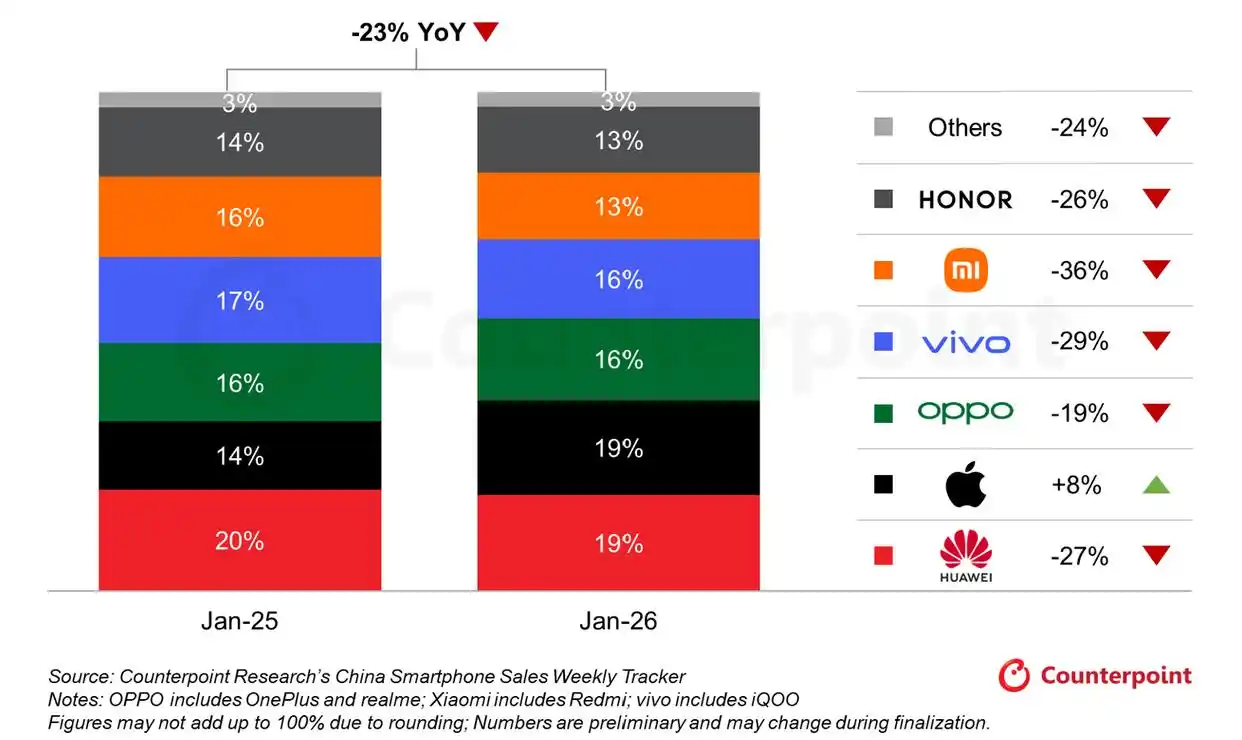
1月中国智能手机销量排名:华为/苹果/OPPO前三
Ju Chao Zi Xun· 2026-02-13 08:10
Core Insights - The overall smartphone market in China is projected to decline by 23% year-on-year in January 2026, primarily due to the high base effect from subsidy policies in early 2025, reduced subsidy intensity in 2026, and the impact of the Lunar New Year on consumer spending [1][3] Group 1: Market Performance - Huawei leads the market with a 19% share but faces a 27% year-on-year decline in sales, influenced by high base effects and underperformance of the Nova series [1] - Apple is the only major brand to achieve growth, with an 8% increase in sales and market share reaching its highest level in nearly five years, driven by the popularity of the iPhone 17 series [3] - Other domestic brands experienced significant declines: Xiaomi (including Redmi) down 36%, vivo (including iQOO) down 29%, OPPO (including OnePlus and realme) down 19%, and Honor down 26% [3] Group 2: Market Dynamics - The decline in sales for many brands is attributed to the "overdraft effect" of the subsidy policy from early 2025, which pulled forward demand due to the timing of the Lunar New Year promotions [3] - Despite the January market slump, there is an optimistic forecast for February, as seasonal consumption during the Lunar New Year is expected to boost sales, providing a critical window for inventory clearance and performance improvement for manufacturers [3]

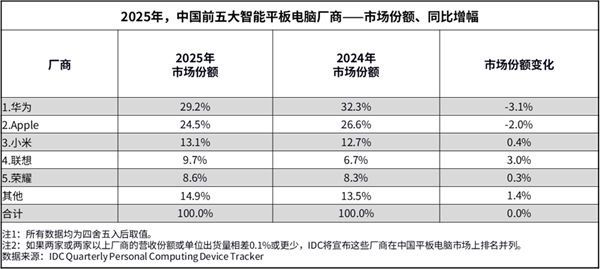
2025年中国平板电脑出货量排名:华为稳居第一 苹果、小米紧随
Ju Chao Zi Xun· 2026-02-13 07:30
Core Insights - The Chinese tablet market is projected to reach a shipment volume of 33.76 million units in Q4 2025, reflecting a year-on-year growth of 13.1%, with a 7.2% increase in Q4 alone [1] - The "National Subsidy" policy has positively influenced consumer confidence and purchasing decisions, leading to an improved willingness to upgrade devices [1] - Market growth is transitioning from being policy-driven to being driven by product features and consumer demand as the "National Subsidy" policy begins to tighten in some regions [1] Market Performance - In Q4 2025, the Chinese tablet market experienced a year-on-year shipment growth of 7.2%, supported by an ongoing device upgrade cycle and continuous product feature enhancements by manufacturers [1] - Huawei maintained its leading position with a market share of 29.2%, despite a decline of 3.1% from the previous year [2] - Apple ranked second with a market share of 24.5%, showing a year-on-year increase in shipment volume [3] Manufacturer Analysis - Xiaomi held the third position with a market share of 13.1%, achieving double-digit growth in annual shipments [3] - Lenovo and Honor ranked fourth and fifth, with market shares of 9.7% and 8.6% respectively, with Lenovo experiencing a notable increase of 3.0% year-on-year [2] - Huawei's new product, the MatePad Edge, integrates PC-level systems and enhances the tablet's positioning for office and multi-scenario use, maintaining high market attention [2] Future Outlook - The expansion of the user base provides a solid foundation for device upgrades, although rising costs are increasing market uncertainties [3] - There is an urgent need for deeper exploration of AI and scenario-based upgrade paths in the industry [3]

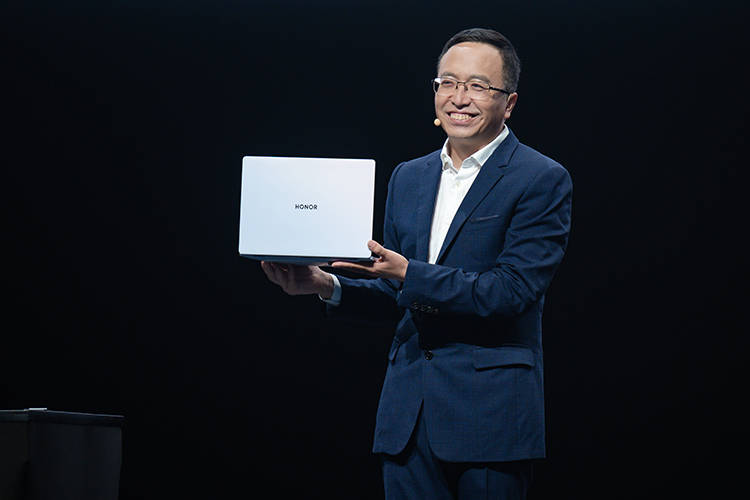
“船新”版本?爆料称荣耀前CEO赵明将加入AI公司千里科技
Sou Hu Cai Jing· 2026-02-13 05:54
Group 1 - Zhao Ming, former CEO of Honor, is set to join AI company Qianli Technology as co-chairman after a year of speculation about his next move [1][3] - Qianli Technology, previously known as Lifan Technology, is undergoing a critical transformation and business integration phase, with shareholders including Geely, Mercedes-Benz, and the Chongqing government [5] - The collaboration between Qianli's chairman, Yin Qi, who has a strong grasp of AI technology trends, and Zhao Ming, who has extensive consumer-facing experience, is expected to enhance the application of technology in business and drive revenue [8] Group 2 - Zhao Ming believes that AI represents a significant opportunity for investment over the next 20 years, indicating his commitment to long-term projects [3] - Qianli Technology aims to establish a brand strategy focused on AI, emphasizing the development of edge AI and platform-level AI to reconstruct operating systems [6]

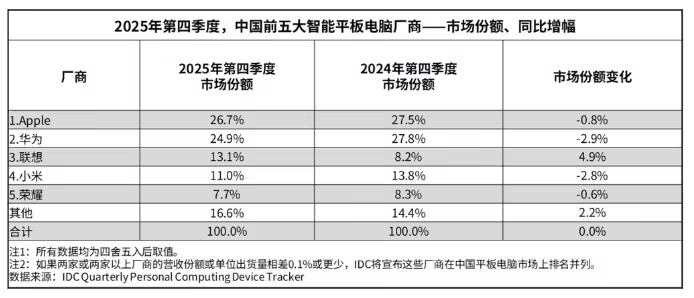
IDC报告:2025年中国平板电脑市场出货量3376万台同比增长13.1%,华为、苹果、小米前三
Sou Hu Cai Jing· 2026-02-13 05:10
Core Insights - The Chinese tablet market is projected to reach a shipment volume of 33.76 million units in Q4 2025, reflecting a year-on-year growth of 13.1% driven by the "national subsidy" policy and an increased willingness among users to upgrade their devices [1] - In Q4 2025, the market experienced a year-on-year growth of 7.2%, although the growth rate slowed compared to the first three quarters due to the gradual tightening of the "national subsidy" policy [1] Market Share Analysis - In Q4 2025, the top five tablet manufacturers in China and their market shares are as follows: - Apple: 26.7%, down 0.8% from Q4 2024 - Huawei: 24.9%, down 2.9% from Q4 2024 - Lenovo: 13.1%, up 4.9% from Q4 2024 - Xiaomi: 11.0%, down 2.8% from Q4 2024 - Honor: 7.7%, down 0.6% from Q4 2024 - Others: 16.6%, up 2.2% from Q4 2024 [1][2] Annual Market Share Overview - For the entire year of 2025, the market shares of the top five manufacturers are: - Huawei: 29.2%, down 3.1% from 2024 - Apple: 24.5%, down 2.0% from 2024 - Xiaomi: 13.1%, up 0.4% from 2024 - Lenovo: 9.7%, up 3.0% from 2024 - Honor: 8.6%, up 0.3% from 2024 - Others: 14.9%, up 1.4% from 2024 [3][4]
网易云音乐,营收为何下滑?丨消费参考
2 1 Shi Ji Jing Ji Bao Dao· 2026-02-13 05:10
Group 1 - The core viewpoint of the article is that NetEase Cloud Music is currently navigating challenges, with a decline in revenue but an increase in adjusted net profit due to tax asset recognition [2][3][4] Group 2 - In 2025, NetEase Cloud Music's revenue decreased by 2.4% year-on-year to 77.59 billion yuan, while adjusted net profit increased by 68.2% to 28.60 billion yuan, primarily due to the recognition of deferred tax assets [2] - The decline in revenue is attributed to a restructuring of the business, with online music service revenue growing by 12.0% to 59.94 billion yuan, driven by a 13.3% increase in subscription revenue [3] - The social entertainment services and other revenue fell by 32.0% to 17.65 billion yuan, mainly due to the closure of the live streaming feature after a version update in late 2024 [3] Group 3 - Cost-cutting measures contributed to the increase in net profit, with sales expenses decreasing by 33.2% to 4.09 billion yuan, reflecting a more cautious approach to advertising and promotion [4] - Management expenses decreased by 4.4%, and R&D expenses fell by 2.3% due to improved resource utilization and a focus on core products and AI capabilities [4] Group 4 - NetEase Cloud Music maintains a relatively stable market position, having introduced K-POP labels and expanded its content library, with over 1 million registered independent musicians and more than 5.6 million uploaded tracks by the end of 2025 [5] - The platform's user scale and activity increased, with a DAU/MAU ratio above 30% and an increase in average daily listening time on mobile [5]

字节芯片团队已隐秘扩充;影石回应年会送房送车丨新鲜早科技
2 1 Shi Ji Jing Ji Bao Dao· 2026-02-13 03:52
Group 1: Technology Developments - ByteDance's chip team has expanded to over 1,000 members, with more than 500 focused on AI chips and around 200 on CPU development, indicating a strong emphasis on chip business due to increasing demand for computing power [2] - JD Technology has launched "JD AI Payment," which utilizes the JoyAI model for various hardware and software applications, enabling AI-assisted payment processes [4] - Baidu has officially launched OpenClaw, an e-commerce plugin that integrates its product knowledge graph with CPS supply chain capabilities, allowing for a streamlined shopping experience [5] - Gaode is set to release its self-developed embodied navigation base model, which has made significant advancements in handling complex tasks in open physical environments [6] Group 2: Corporate Announcements and Events - YingShi Innovation held an annual meeting where it rewarded employees with real estate and cars, showcasing the importance of material incentives alongside personal achievements [3] - Former Honor CEO Zhao Ming announced his new role at Qianli Technology, expressing excitement about contributing to AI business development [9] - Anthropic has completed a funding round at a valuation of $380 billion, raising $30 billion to enhance its enterprise products and models, with annual revenue now at $14 billion [11] - RoboScience has secured several hundred million in Pre-A financing, led by PwC Capital, indicating strong investor interest in machine science [12] Group 3: Product Launches and Innovations - Xiaomi has open-sourced its first-generation robot VLA model, which features 4.7 billion parameters and capabilities in visual language understanding and real-time execution [13] - MiniMax has launched its latest programming model, MiniMaxM2.5, which is positioned as a leading solution in various productivity scenarios, boasting a parameter count of only 10 billion for efficiency [14]
字节芯片团队已隐秘扩充;影石回应年会送房送车丨科技风向标
2 1 Shi Ji Jing Ji Bao Dao· 2026-02-13 03:49
Group 1: Technology Developments - ByteDance's chip team has expanded to over 1,000 members, with more than 500 focused on AI chips and around 200 on CPU development, indicating a strong emphasis on chip business amid increasing demand for computing power [2] - JD Technology has launched "JD AI Payment," which utilizes the JoyAI model for various hardware and software applications, enabling AI-assisted payment processes [4] - Baidu has officially launched OpenClaw, an e-commerce plugin that integrates its product knowledge graph with CPS supply chain capabilities, allowing for a streamlined shopping experience [5] - Gaode is set to release its self-developed embodied navigation base model, claiming to have built the largest embodied navigation data engine in the industry [6] - Xiaomi has announced the open-sourcing of its first-generation robot VLA model, which features 4.7 billion parameters and capabilities in visual language understanding [13] Group 2: Corporate Actions and Investments - Anthropic has completed a funding round, raising $30 billion at a valuation of $380 billion, nearly doubling its previous valuation and positioning it among the most valuable private tech companies globally [11] - RoboScience has announced the completion of a Pre-A round financing, raising several hundred million yuan, with participation from multiple investment firms [12] - Former Honor CEO Zhao Ming has joined Qianli Technology, expressing a long-term commitment to AI as a significant area for future investment [9] Group 3: Market Trends and Consumer Behavior - Taobao's flash sale platform reported that nearly half of the orders from its AI assistant, Qianwen, came from county-level cities, highlighting the growing adoption of AI in e-commerce [7] - Xiaohongshu has announced that AI-generated content must be clearly labeled, aiming to maintain user trust and transparency within the community [8] Group 4: Product Launches and Innovations - Insta360's CEO showcased the "Luna," a handheld gimbal camera set to launch in mid-2026, which is expected to be the first in the market with telephoto capabilities [3] - Samsung Electronics has begun mass production of HBM4 memory, anticipating a threefold increase in sales by 2025 and planning to expand HBM4 production capacity [10]
内存价格翻倍上涨,涨价还是减配,手机行业进退两难
3 6 Ke· 2026-02-13 03:33
Core Insights - The rapid increase in memory prices since Q4 2025 has significantly raised costs for smartphone manufacturers, leading to a potential retreat in the industry as companies face tough choices between raising prices or reducing specifications [1][5][8] - Counterpoint research indicates that memory prices may rise by approximately 40% before Q2 2026, further increasing material costs for manufacturers [2] - The smartphone market is experiencing a shift, with manufacturers adjusting their strategies to cope with rising costs, leading to a potential decline in overall market volume and increased competition among brands [8][10] Price Increases and Cost Management - Recent statistics show that new models from brands like Xiaomi, OPPO, and vivo have seen price increases ranging from 100 to 600 yuan compared to previous models, with mid-range models experiencing a price gap increase from 300 to between 400 and 600 yuan [3] - Memory typically accounts for 15% of a smartphone's Bill of Materials (BoM), rising to 20% in mid-range models, while most Chinese smartphone brands have hardware gross margins between 10% and 20% [4] - The price of the mainstream "12GB+256GB" memory configuration has surged by 75% over the past year, raising concerns about consumer willingness to absorb these costs [5] Market Dynamics and Manufacturer Strategies - The pressure from rising memory costs is affecting upstream suppliers, with manufacturers reluctant to pass on costs to consumers for fear of reduced sales, leading to downward adjustments in business plans for 2026 [6][7] - Manufacturers are increasingly focusing on structural adjustments to manage costs, such as changing suppliers or reducing specifications in less noticeable areas [5][7] - The competition is intensifying, with leading brands like Apple and Samsung having more leverage due to their financial stability and long-term supply agreements, while smaller brands face greater challenges [7][8] Market Outlook and Future Trends - The smartphone market in China is projected to see a slight decline in shipments, with major brands like Xiaomi and OPPO reducing their 2026 order quantities by over 20% [8][10] - The trend of "flagship-ifying" mid-range models is reversing, as manufacturers face supply pressures and must focus on high-end models and overseas markets for growth [10] - The global smartphone market is expected to enter a phase of "scale contraction and price increase," with IDC and Counterpoint predicting at least a 2% decline in global smartphone sales this year [10]
