Neuralink

Search documents
博拓生物:青石永隽聚焦于垂直医疗领域
Zheng Quan Ri Bao Wang· 2026-01-23 12:40
Core Viewpoint - Both Neuralink and Qingstone Yongjun are focused on invasive brain-machine interface technology, but they have distinct core objectives and approaches [1] Group 1: Company Comparison - Neuralink aims to create a comprehensive "whole-brain interface" that integrates multiple functions such as movement, language, and vision, with the ultimate goal of deep integration with artificial intelligence and achieving human-AI coexistence [1] - Qingstone Yongjun, on the other hand, concentrates on the vertical medical field, specifically targeting the treatment of treatment-resistant severe depression with its first product, which offers personalized treatment plans through a closed-loop control system [1] - The technological approach of Neuralink is characterized by platformization and generalization, while Qingstone Yongjun seeks to excel in specific brain disease treatment scenarios [1]

疯了!马斯克放大招了
Sou Hu Cai Jing· 2026-01-23 07:01
Core Insights - The article emphasizes the significant influence of Elon Musk on the capital market, particularly through his various ventures, which are seen as investment opportunities. Group 1: Investment Themes - The article identifies five main concepts associated with Elon Musk: electric vehicles (primarily Tesla), robotics (Optimus humanoid robot), commercial space (SpaceX), brain-machine interfaces (Neuralink), and artificial intelligence (xAI) [1][2]. - Tesla's Full Self-Driving (FSD) version 14.2 has achieved "zero takeover" capability across the U.S., and the Austin Robotaxi is currently in testing [1]. - SpaceX is preparing for an IPO with Starlink, which has over 10 million global users and a target valuation of $1.5 trillion [2]. Group 2: Commercial Space Developments - SpaceX plans to launch a second-generation Starlink satellite communication system in 2027, which will enhance capacity by over 100 times and increase data throughput by more than 20 times [3]. - Competitor Blue Origin, led by Jeff Bezos, announced plans to deploy over 5,400 satellites to create a new communication network [3]. - In China, Blue Arrow Aerospace is preparing for an IPO and aims to develop a fully reusable commercial crewed spacecraft, with plans to reduce ticket prices significantly [4]. Group 3: Market Sentiment and Volatility - The commercial space and robotics sectors are characterized as non-profitable and highly volatile, where market movements are driven more by news and developments than by financial performance [4]. - Recent announcements in the commercial space sector have led to a strong rebound in the market, indicating the importance of positive news flow in these industries [4].

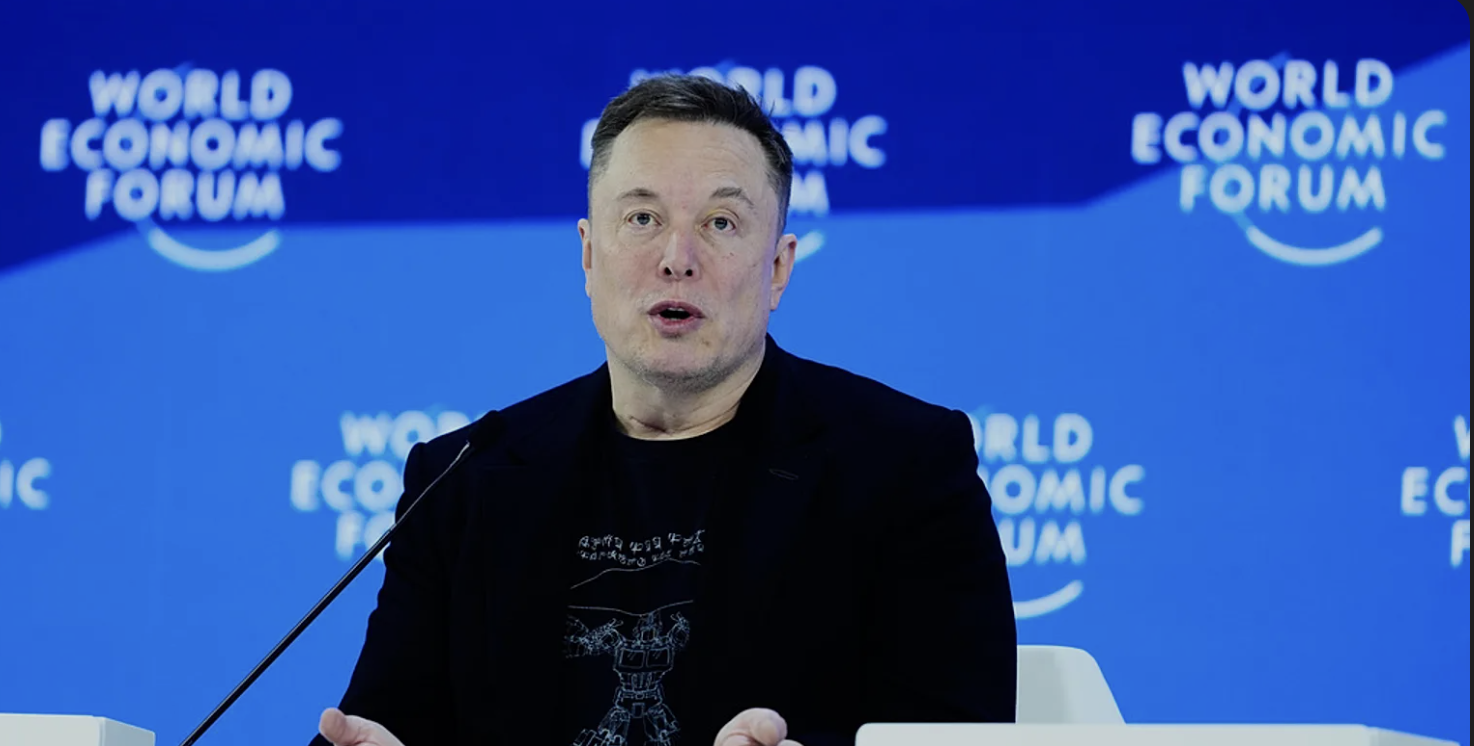
马斯克在达沃斯放出2026时间表:AI超人类、机器人开售、自动驾驶普及
Xin Lang Cai Jing· 2026-01-23 04:26
Core Insights - Elon Musk emphasizes the importance of optimism in predictions, acknowledging his history of missed deadlines while holding significant stakes in companies like Tesla and SpaceX [2][3] AI Development - Musk predicts that AI systems may surpass human intelligence by 2026, with a possibility of achieving this by 2027, and that by 2030, AI's overall capabilities could exceed that of all humanity combined [4] - The development of the Optimus humanoid robot is progressing, with expectations to complete complex tasks by the end of 2026 and to be available for public sale by 2027, contingent on meeting high safety standards [4] - Musk introduces a formula for economic output based on robot productivity and quantity, forecasting that humanoid robots will outnumber humans within 3-5 years, potentially addressing labor shortages due to aging populations [4] Risks and Economic Impact - Musk warns of potential risks associated with AI and robotics, stressing the need to avoid dystopian scenarios while highlighting the potential for a significant economic expansion if AI becomes widely accessible and affordable [5] Energy Supply Challenges - Musk identifies energy supply as a critical bottleneck for AI expansion, noting that global electricity supply growth rates (4%-10%) lag behind the exponential growth of chip production [6] - He highlights China's advancements in renewable energy, particularly solar power, and contrasts it with the slower energy transition in the U.S. due to tariffs on Chinese solar components [6] - Tesla and SpaceX are collaborating on solar projects aiming for an annual production capacity of 100 gigawatts in the U.S. within three years to alleviate energy constraints [6] - Musk discusses a space-based solar energy initiative that could achieve five times the efficiency of ground-based systems, with a goal to realize this within 2-3 years [6] Autonomous Driving - The rollout of autonomous taxis in Austin is set for June 2025, with widespread deployment expected by the end of 2026, as regulatory approvals in Europe and China progress [7] - Tesla's autonomous driving technology has received high safety ratings from multiple insurance companies, which will also benefit the Optimus robot's commercialization [7] Space Exploration - SpaceX aims to achieve fully reusable rockets by 2026, with the Starship project expected to validate this capability, significantly reducing costs for space exploration and satellite launches [8] - Musk compares the cost of reusable rockets to fuel costs, predicting a 100-fold reduction in space exploration costs, making projects like space solar power feasible [8] Challenges Ahead - Despite Musk's optimistic outlook, Tesla faces challenges, including declining electric vehicle deliveries and slow production rates for the Optimus robot and Cybertruck [9] - Regulatory scrutiny is increasing for Musk's social media platform X and AI assistant Grok due to concerns over inappropriate content generation [9]


马斯克,开年忙落子
财联社· 2026-01-22 13:30
Group 1: SpaceX Developments - SpaceX plans to launch its second-generation Starlink system in 2027, aiming to provide higher-speed internet services, with the FCC approving the deployment of 7,500 satellites [3] - Elon Musk is pushing for SpaceX's IPO, targeting completion by July 2026, with ambitions to establish data centers in space [3] - Musk stated that the launch frequency of Starship will exceed once per hour within three years, with a goal of producing 10,000 Starships annually [3] Group 2: Tesla Innovations - Tesla's Optimus humanoid robot is expected to transform the company into a $25 trillion robotics firm, with its value projected to surpass current business segments [3] - The Dojo3 project, initially focused on machine learning, is being reoriented towards "space AI computing" [4] - Tesla's lithium refining plant has commenced operations, marking it as the largest lithium refining facility in the U.S. [4] Group 3: xAI Initiatives - xAI is forming a "recruitment strike team" with salaries up to $240,000 to attract AI talent [5] - The company plans to invest over $20 billion in building a data center in Mississippi, expected to start operations in February [5] - xAI will upgrade Grok Code to support complex programming tasks [5] Group 4: Neuralink Progress - Neuralink is set to launch large-scale brain-machine interface outputs this year, with plans to transition to nearly fully automated surgeries [6]

观察 | 马斯克慌了?xAI工程师泄密被火速开除,全网疯传的猛料全在这
未可知人工智能研究院· 2026-01-22 03:02
Core Insights - The podcast revealed that Grok is not merely an AI chatbot but serves as a central nervous system for Musk's business empire, integrating AI capabilities across Tesla, SpaceX, Neuralink, and X platform [5][10] - Musk's strategy involves using AI to optimize operations and decision-making across various sectors, creating a cohesive ecosystem rather than competing in the chatbot space [5][10] - The concept of "MacroHard" was introduced, which refers to AI virtual employees capable of performing complex tasks, potentially distributed across Tesla vehicles to utilize idle computing power [7][8] Group 1: Grok's Positioning and Strategy - Grok's primary goal is to embed AI capabilities into Musk's businesses, enhancing functionalities like Tesla's autonomous driving and SpaceX's rocket control systems [5][10] - The integration of vast amounts of data from Tesla's operations allows Grok to improve its understanding of real-world physics, which can benefit other Musk ventures [5][10] - This approach represents a significant shift from traditional AI competition, focusing on creating a synergistic ecosystem rather than standalone products [5][10] Group 2: Internal Operations of xAI - xAI operates with a highly flat organizational structure, allowing for rapid decision-making and execution, which contrasts sharply with traditional tech companies [11][10] - The team works under intense pressure, often with 24/7 schedules, and Musk's direct involvement accelerates the development process, enabling changes to be implemented within hours [10][11] - Recruitment focuses on practical coding skills rather than formal qualifications, emphasizing the ability to solve real problems quickly [11] Group 3: Musk's Vision for AI - Musk's commitment to AI is driven by a belief that AGI (Artificial General Intelligence) must be controlled by responsible entities to prevent potential negative impacts on humanity [13][14] - There is an internal project aimed at aligning AI with human values, reflecting Musk's broader goals of using technology to address existential challenges [13][14] - Musk's fear is not merely about competition from companies like OpenAI or Google but rather the misuse of powerful AI technologies [14] Group 4: Implications for the Industry - The podcast highlights the importance of transparency and real insights into AI company operations, contrasting with the polished narratives often presented to the public [18] - The execution speed demonstrated by xAI suggests that in uncertain fields, rapid iteration and testing can be more effective than extensive planning [18] - Musk's approach illustrates the significance of having a guiding principle or value system behind business endeavors, which can foster trust and direction [18]

操盘必读:影响股市利好或利空消息_2026年1月22日_财经新闻
Xin Lang Cai Jing· 2026-01-22 00:40
影响股市利好与利空消息 宏观新闻 1、美国贸易代表格里尔在达沃斯表态称,希望与中国进行另一轮的潜在贸易谈判。外交部发言人郭嘉 昆在昨日主持的例行记者会上对此表示,中美双方应该共同落实好两国元首达成的重要共识,为中美经 贸合作与世界经济注入更多的稳定性和确定性。 2、央行召开2026年支付结算工作会议,会议要求,加快建设人民币跨境支付体系,推进跨境支付互联 互通,推动跨境支付体系多元化、多层次发展。严格实施支付机构穿透式监管和支付业务功能监管,充 分发挥行政、自律互补作用,塑造合规致远的行业健康生态。 7、数据显示,由于超大规模云服务商"扫货",英特尔与AMD在2026全年的服务器CPU产能已基本售 罄。为了应对供需极端失衡并确保后续供应稳定,两家公司均计划将服务器CPU价格上调10-15%。 3、财政部等3部门发布《于延续实施创新企业境内发行存托凭证试点阶段有关税收政策的公告》。其中 提到,今明两年对个人投资者转让创新企业CDR取得的差价所得,暂免征收个人所得税。 4、特朗普在达沃斯世界经济论坛年会上表示,美国无意动用过激武力来获取格陵兰岛。特朗普同日还 表示,他将不会实施原定于2月1日生效的对欧洲关税措施。 ...


明日主题前瞻智元拆分灵巧手部门为独立公司,灵巧手赛道已进入精细发展阶段
Xin Lang Cai Jing· 2026-01-21 12:22
Group 1: Robotics and Automation - ZhiYuan Robotics has spun off its dexterous hand division into an independent company, Shanghai Critical Point Innovation Technology Co., Ltd, with an investment of 4 million yuan for an 80% stake, led by former business head Xiong Kun [1][2] - The dexterous hand market in China is expected to exceed 340,000 units by 2030, with a CAGR of approximately 90% from 2024 to 2030, indicating a shift towards specialized development in core components [2] - Companies like Tongyi and Zhaowei have made significant advancements in dexterous hand technology, focusing on control precision and reliability, with products showcased at major events like CES 2026 [3] Group 2: Brain-Computer Interface - Neuralink's first subject has reported that their brain-computer interface can now receive OTA updates wirelessly, marking a significant milestone in the technology [3][4] - The global brain-computer interface market is projected to reach $7.63 billion by 2029, driven by policy support and technological breakthroughs, transitioning from clinical trials to commercial viability [4] - Companies like Beixin Source and Tianqi are actively developing applications for brain-computer interfaces, exploring new modes of human-machine collaboration [4] Group 3: Solar Energy - The price of mainstream photovoltaic components has returned to the "1 yuan era," with recent price adjustments indicating a trend of increasing component prices [5][6] - Major companies like Trina Solar have raised their component prices multiple times in 2026, reflecting a broader industry trend towards price increases due to supply chain dynamics [5] - Companies such as Dongfang Risen and Mingguan New Materials are advancing in high-efficiency solar technologies, contributing to the overall growth of the solar energy sector [6] Group 4: Sodium-Ion Batteries - LG is advancing the construction of a pilot production line for sodium-ion batteries in Nanjing, highlighting the technology's potential for cost reduction and low-temperature performance [7][8] - The sodium-ion battery market is gaining traction as leading manufacturers push for product development and industrialization, indicating a promising growth trajectory [7] - Companies like Zhongke Electric and Ding Sheng New Materials are actively involved in the production and development of materials for sodium-ion batteries, positioning themselves for future opportunities [8] Group 5: Machine Tool Industry - China has surpassed Germany to become the world's largest exporter of machine tools, capturing 21.6% of the global market share, while Germany's share has declined to 16.7% [9] - The growth of China's machine tool exports is attributed to the booming demand in sectors like new energy vehicles and aerospace, providing opportunities for domestic manufacturers to advance in high-end markets [9] - Companies like Huachen Equipment and Huadong CNC are developing high-precision machine tools to support various manufacturing sectors, enhancing their competitive edge [10][11] Group 6: Medical Robotics - The 37th batch of medical service pricing guidelines has introduced a tiered pricing model for surgical robots, linking costs to their clinical value and participation in surgeries [11][12] - The introduction of a pricing framework for robotic-assisted surgeries is expected to drive significant growth in the medical robotics sector, with companies like Tianzhihang leading the market [12]
星辰大海:马斯克六大产业链映射
Huachuang Securities· 2026-01-21 10:07
Group 1: Commercial Space Industry - SpaceX - SpaceX is reshaping the cost structure of space launches through reusable rocket technology, with a potential IPO in 2026 valued at $1.5 trillion, aiming to raise over $30 billion [20] - In 2023, SpaceX achieved breakeven, with projected revenue of $15.5 billion in 2025, and plans to produce 10,000 Starship spacecraft annually, boosting its supply chain [20] Group 2: Autonomous Driving - Tesla's Full Self-Driving (FSD) technology is transitioning from an assistive tool to a reliable autonomous workforce, with the Robotaxi fleet expected to grow from 200 vehicles in 2025 to 1,000 in 2026 [2] - The commercialization of autonomous driving is accelerating as the industry approaches a critical inflection point [2] Group 3: Robotics - The third generation of Tesla's Optimus robot is set to be released in Q1 2026, with mass production expected by the end of the year, presenting significant growth opportunities for core suppliers [3] Group 4: Artificial Intelligence - xAI completed a Series E funding round in January, raising $20 billion from major investors like NVIDIA and Cisco, and is a crucial part of Musk's cross-industry collaborative network [4] - xAI leverages real-time data from social media and Tesla to train large models, with potential support from SpaceX's Starlink for computational needs, creating a closed-loop ecosystem [4] Group 5: Brain-Computer Interface - Neuralink plans to begin large-scale production of brain-computer interface devices within the year, focusing on simplifying surgical procedures to lower application barriers [5] Group 6: Underground Tunnel Network - The Boring Company aims to alleviate urban traffic congestion by constructing extensive underground tunnel networks, reducing construction costs and time, and promoting the development of underground transportation systems [6]
17.6亿种子轮!OpenAI 押注脑机接口
思宇MedTech· 2026-01-21 09:00
Core Viewpoint - OpenAI has confirmed its investment in brain-computer interface (BCI) startup Merge Labs, marking its entry into a cutting-edge technology sector with a significant seed funding of $252 million (approximately 1.76 billion RMB) [2][4]. Group 1: Investment Context - The investment was anticipated in mid-2025 and is notable for its size in the BCI field, indicating OpenAI's strategic interest in the evolution of human-AI interaction [2][4]. - OpenAI's involvement is seen as a long-term bet on the development of higher bandwidth human-AI interfaces, addressing the limitations of current interaction methods [5][14]. Group 2: Merge Labs' Approach - Merge Labs, co-founded by OpenAI's CEO Sam Altman and other tech entrepreneurs, is pursuing a distinct technological path in BCI development [6][9]. - The core direction of Merge Labs includes creating a BCI system that integrates biological, device, and AI attributes, aiming for a user-friendly technology that people are willing to adopt [9][10]. Group 3: Comparison with Neuralink - Merge Labs' philosophy contrasts with Neuralink, which focuses on invasive, high-density electrode systems for clinical applications [10][12]. - Merge Labs aims to explore non-invasive or low-invasiveness methods for long-term interfaces, potentially reducing tissue damage and enhancing user acceptance [13][14]. Group 4: Industry Implications - Merge Labs is currently positioned as a research lab rather than a product-focused medical device company, aligning with OpenAI's long-term vision [14]. - The investment signals a shift in how AI companies view the integration of human neural systems into their technological narratives, suggesting a broader exploration of human-AI connections [16]. Group 5: Market Potential - Analysts have estimated the potential market size for brain-computer interfaces to reach $400 billion, highlighting the significance of this technology in future human-AI interactions [15][16].

Neuralink首例受试者脑机接口已能实现OTA升级,医疗设备ETF(159873)近20日实现规模翻倍,今日盘中获申购500万份
2 1 Shi Ji Jing Ji Bao Dao· 2026-01-21 07:11
Group 1 - The three major indices collectively rose, with the medical equipment sector showing active performance, as evidenced by the CSI All Index Medical Care Equipment and Services Index (H30178) increasing by 0.53% [1] - Notable performers within the index included Tianzhihang, which rose over 14%, Shuoshi Bio, which increased over 9%, and Sanyou Medical, which saw a rise of over 6% [1] - The Medical Equipment ETF (159873) recorded a trading volume exceeding 16 million yuan, with a subscription of 5 million units during the trading session [1] Group 2 - The Medical Equipment ETF has experienced a net inflow of funds for nine consecutive trading days, accumulating a total net inflow of 117 million yuan as of January 20 [1] - The ETF's scale has doubled over the past 20 days, reaching a latest circulating scale of 233 million yuan [1] - The ETF closely tracks the CSI All Index Medical Care Equipment and Services Index, which selects listed companies in the medical care theme to reflect the overall performance of these securities [1] Group 3 - The first human subject implanted with Neuralink's brain-machine interface, Nolan Arbo, reported that the module in his brain can be wirelessly upgraded remotely, similar to Tesla's OTA updates [2] - This marks a historic first where a human brain can be updated without surgery, allowing for performance improvements through software updates [2] - Merge Labs, a Silicon Valley startup, has raised $252 million in seed funding from investors including OpenAI, indicating strong interest in advancements in medical technology [2] Group 4 - Guotai Junan Securities noted that the scale of medical equipment bidding continues to grow, supported by ongoing implementation of equipment upgrade policies, which are expected to drive long-term procurement levels [2] - The report recommends medical equipment companies that are likely to benefit from the performance recovery driven by the implementation of these upgrade policies [2]