成都银行

Search documents
今天,高位股巨震,医药股爆发
新华网财经· 2025-05-30 04:44
今天上午,医药股集体上涨,睿智医药、舒泰神、华纳药厂等个股大涨,恒瑞医药、百济神州、百利天 恒等市值超千亿元的龙头股上涨。 跌幅榜前列,几乎都是近期的高位股。 王子新材(002735)、尚纬股份(603333)等多只个股跌停。 具有防御属性的银行和养殖业板块上午走强。其中,银行板块内个股全部上涨,杭州银行、成都银行盘 中股价创历史新高。养殖业板块中,巨星农牧、神农集团等个股大涨。 截至上午收盘,上证指数下跌0.31%,深证成指下跌0.75%,创业板指下跌0.88%。 | 上证指数 | 深证成指 创业板指 | | --- | --- | | 3353.07 | 10051.62 1994.82 | | -10.38 -0.31% | -75.58 -0.75% - - - 17.73 -0.88% | 高位股集体回调 今天上午, 高位股集体回调 ,王子新材、尚纬股份、国芳集团、永安药业、融发核电等 个股跌停 。另 外,科捷智能、博世科、保龄宝、欢乐家、久盛电气、中洲特材、哈焊华通等 多只高位股也大跌 。 上述个股主要来自三个板块:可控核聚变、大消费、无人驾驶。其中,可控核聚变板块上午大跌。 市场人士表示,可控核 ...


逆市拉升!
Zhong Guo Ji Jin Bao· 2025-05-30 04:23
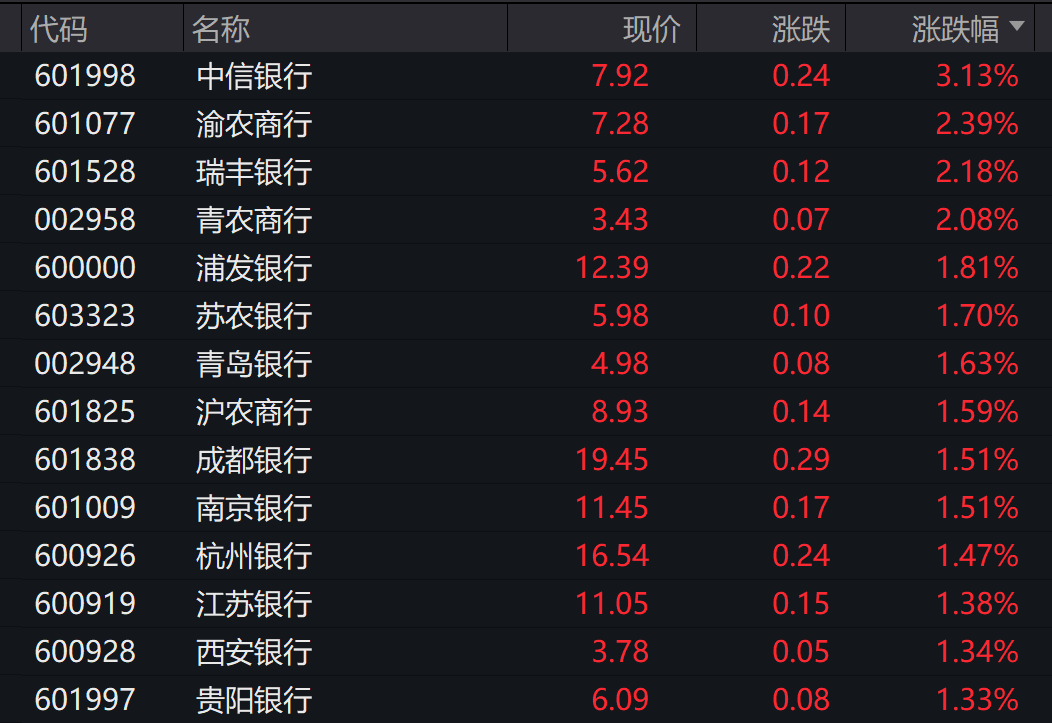
中国基金报记者安曼 端午节前最后一个交易日,美国关税政策反复,亚太市场早盘整体走低。 【导读】银行股逆市拉升,创新药板块批量涨停 消息落地后,银行股逆市拉升。 杭州银行、成都银行双双创下历史新高。 中信银行涨超3%,中小银行涨幅居前。 | 代码 | 名称 | 现价 | 涨跌 | 涨跌幅 ▼ | | --- | --- | --- | --- | --- | | 601998 | 中信银行 | 7.92 | 0.24 | 3.13% | | 601077 | 渝农商行 | 7.28 | 0.17 | 2.39% | | 601528 | 瑞丰银行 | 5.62 | 0.12 | 2.18% | | 002958 | 青农商行 | 3.43 | 0.07 | 2.08% | | 600000 | 浦发银行 | 12.39 | 0.22 | 1.81% | | 603323 | 苏农银行 | 5.98 | 0.10 | 1.70% | | 002948 | 青岛银行 | 4.98 | 0.08 | 1.63% | | 601825 | 沪农商行 | 8.93 | 0.14 | 1.59% | | 601838 | ...





午评:创业板指半日跌0.88% 创新药概念逆势大涨
Xin Hua Cai Jing· 2025-05-30 04:23
Market Overview - The A-share market experienced fluctuations with the ChiNext index dropping over 1% during the morning session, while defensive sectors like pharmaceuticals saw gains [1] - The total trading volume in the Shanghai and Shenzhen markets reached 754.7 billion yuan, an increase of 11 billion yuan compared to the previous trading day [1] - The Shanghai Composite Index closed at 3353.07 points, down 0.31%, while the Shenzhen Component Index closed at 10051.62 points, down 0.75% [1] Sector Performance - Defensive sectors such as pharmaceuticals, agriculture, and banking performed well, with stocks like Kexing Pharmaceutical and Hangzhou Bank reaching historical highs [1] - The controllable nuclear fusion concept and robotics sectors faced significant declines, indicating a shift in market sentiment towards safer investments [1] Institutional Insights - CICC suggests that the micro盘 style may see diminishing advantages, but structural opportunities still exist, with a focus on high-growth small and micro enterprises [2] - Silver Hua Fund emphasizes the importance of monetary policy and economic changes, advocating for a barbell strategy in asset allocation, particularly in technology growth sectors [3] Policy Developments - The People's Bank of China is accelerating policies to support the construction of Shanghai as an international financial center, including initiatives to enhance cross-border financial services [4] - Major financial policies are expected to be announced during the 2025 Lujiazui Forum, indicating a proactive approach to financial regulation and support [5] Financial Tools - There is speculation about the potential re-expansion of the PSL (Pledged Supplementary Lending) as a tool for providing long-term low-cost funding to policy banks, supported by the central bank and fiscal policies [6]

银行板块早盘拉升,300红利低波ETF(515300)小幅上涨,已连续6个交易日获资金净流入
2 1 Shi Ji Jing Ji Bao Dao· 2025-05-30 02:57
Core Viewpoint - The A-share market showed a decline in the morning session on May 30, with the banking sector experiencing a rise, and the 300 Dividend Low Volatility Index increasing by 0.20% at the time of reporting [1] Group 1: Market Performance - The 300 Dividend Low Volatility ETF (515300) rose by 0.07% with a trading volume exceeding 45 million yuan and a premium rate of 0.01%, indicating frequent premium trading during the session [1] - The 300 Dividend Low Volatility ETF (515300) received a net inflow of over 140 million yuan yesterday, marking six consecutive trading days of net inflows, totaling over 260 million yuan [1][2] Group 2: Component Stocks - Among the constituent stocks, Shanghai Port Group, Ningbo Expressway, and Nanjing Bank saw increases of over 1%, while Jiangsu Bank, Hangzhou Bank, and Chengdu Bank also experienced gains [2] Group 3: Investment Insights - Xiangcai Securities noted that high-dividend sectors are favored by institutions, and dividend assets serve as a good alternative to pure bonds. The banking sector is recommended for attention despite performance pressure from narrowing interest margins, as bank convertible bonds are relatively scarce [2] - Caixin Securities indicated that until trading volume expands consistently, the structural market with index fluctuations and sector rotations is likely to continue. Concepts related to export industrial chains, self-sufficiency, domestic demand expansion, high dividend yields, and mergers and acquisitions may remain active [2]
100家银行年报里的中国
虎嗅APP· 2025-05-29 23:59
Core Viewpoint - The article emphasizes the performance of regional banks in China, particularly focusing on city commercial banks and rural commercial banks, highlighting the economic vitality of regions like Jiangsu and Zhejiang compared to others like Guangdong and Shanghai [3][4][10]. Group 1: Regional Bank Performance - Jiangsu and Zhejiang regions are identified as having strong city commercial banks, with institutions like Jiangsu Bank and Ningbo Bank showing robust performance, indicating high economic vitality [8][9]. - In contrast, banks headquartered in Shanghai, such as Shanghai Bank and Hu'nong Bank, have underperformed, attributed to the city's "deposit surplus" characteristic and intense competition [17][21]. - Guangdong, despite being the largest economy, lacks representation in the top city commercial banks, with local banks like Guangzhou Bank showing poor performance and significant declines in revenue and profit [23][25][28]. Group 2: Economic Indicators - Jiangsu and Zhejiang's GDP growth rates are 5.8% and 5.5% respectively, outperforming Guangdong's 3.5%, showcasing their economic competitiveness [9][28]. - The article suggests that examining local bank performance can provide a clearer picture of regional economic health than GDP figures alone [6][10]. Group 3: Specific Bank Analysis - Jiangsu Bank reported a 16.12% growth in asset scale, with a net profit of 31.84 billion yuan, while Ningbo Bank achieved a 15.25% growth with a net profit of 27.12 billion yuan [11]. - Chengdu Bank has shown significant growth, with a 14.56% increase in asset scale and a 10.17% rise in net profit, attributed to its focus on local infrastructure projects [38][40]. - In contrast, Guangzhou Bank's asset scale grew only 2.77%, with a net profit decline of 66%, reflecting its struggles in retail and corporate sectors [25][26]. Group 4: Risk and Asset Quality - The article notes that banks in Jiangsu and Zhejiang maintain non-performing loan ratios below 1%, indicating strong asset quality, while banks in regions like Northeast China face higher non-performing rates [5][14][58]. - The article highlights that many banks in Jiangsu and Zhejiang have high provision coverage ratios, often exceeding 300%, which helps mitigate risks associated with potential loan defaults [14][15]. Group 5: Governance and Management Issues - Governance issues are prevalent in some central region banks, with several high-level executives facing investigations, impacting their performance [70][71]. - In contrast, banks in Jiangsu and Zhejiang have fewer governance issues, contributing to their stronger performance [31][72].




100家银行年报里的中国
Hu Xiu· 2025-05-29 22:12
Core Viewpoint - The banking sector in China serves as a crucial economic barometer, reflecting regional economic conditions more accurately than the stock market, especially in the context of the new normal of slower economic growth [1][2][3]. Group 1: Regional Banking Performance - Over 100 city commercial banks and rural commercial banks released annual reports, revealing that banks in economically vibrant regions like Jiangsu and Zhejiang maintain low non-performing loan (NPL) ratios, often below 1% [2][4]. - Jiangsu and Zhejiang provinces rank second and fourth in GDP size, with growth rates of 5.8% and 5.5% respectively, outperforming Guangdong's 3.5% growth rate [5]. - Jiangsu Bank, Ningbo Bank, Nanjing Bank, and Hangzhou Bank are among the top city commercial banks, demonstrating strong performance despite macroeconomic pressures [4][6]. Group 2: Financial Metrics of Key Banks - Jiangsu Bank reported an asset scale of 3.95 trillion with a growth rate of 16.12%, revenue of 808.15 billion, and a net profit of 318.43 billion, reflecting a net profit growth of 10.76% [6]. - Ningbo Bank's asset scale reached 3.13 trillion, with a revenue of 666.31 billion and a net profit of 271.27 billion, showing a net profit growth of 6.23% [6]. - Hangzhou Bank's net profit growth was notably high at 18.07%, despite a lower net interest margin due to its focus on low-risk local government financing [8]. Group 3: Challenges in Other Regions - In contrast, banks in Guangdong, despite being in the top economic province, show poor performance, with Guangzhou Bank's asset scale growing only 2.77% and a significant drop in revenue and net profit [17][19]. - The performance of banks in the Northeast is hindered by high NPL ratios, often exceeding 2%, and low net interest margins, with some banks like Shengjing Bank reporting as low as 0.8% [56][58]. - The banking sector in the Northwest faces similar challenges, with low growth rates and high NPL ratios, reflecting a lack of quality projects and competition with larger state-owned banks [51][53]. Group 4: Governance Issues - Governance issues are prevalent in the central region, with several banks experiencing high-profile executive investigations, impacting their performance [68][70]. - Despite governance challenges, Huishang Bank has shown significant growth, with revenue increasing over 180% in the past decade, driven by the local economy [69][71]. Group 5: Emerging Opportunities - The banking sector in Fujian is thriving, with banks like Xiamen International Bank showing a 150% growth in asset scale over the past decade, supported by a robust private economy [26][28]. - Chengdu Bank has also seen substantial growth, with a 14.56% increase in asset scale, driven by a focus on local infrastructure projects [38][39].
银行可转债接连触发强赎 核心资本充足率获支撑
Zhong Guo Zheng Quan Bao· 2025-05-29 21:31
Core Viewpoint - Hangzhou Bank has announced the early redemption of its convertible bonds (Hangyin Convertible Bonds) due to the triggering of mandatory redemption conditions, marking the third such instance among bank convertible bonds this year [1][3]. Group 1: Early Redemption Announcement - Hangzhou Bank's convertible bonds have triggered the conditional redemption clause as the stock price has remained above 130% of the conversion price for 15 trading days [1]. - The bank will redeem the bonds at face value plus accrued interest, with investors having the option to convert or trade in the secondary market [1][2]. Group 2: Performance and Market Context - The Hangyin Convertible Bonds were issued in March 2021, with a total issuance of 15 billion yuan and a maturity of six years, featuring a tiered interest rate structure [2]. - The stock price of Hangzhou Bank has increased by over 70% since the beginning of 2024, contributing to the bond's early redemption [2][4]. Group 3: Impact on Capital Structure - The early redemption of convertible bonds allows banks to enhance their core Tier 1 capital without incurring further interest expenses, thus optimizing their financial structure [5]. - Following the conversion of bonds, Hangzhou Bank's core Tier 1 capital adequacy ratio is expected to increase by 0.83 percentage points [5]. Group 4: Broader Market Trends - There are currently 10 outstanding bank convertible bonds in the market, with a total issuance of 191.5 billion yuan, but the overall conversion ratio remains low for many [3][4]. - The banking sector has shown strong performance, with the index for primary banks rising over 40% in 2024, creating favorable conditions for bond conversions [4].
银行优先股、可转债接连赎回,“固收+”还能加什么?
2 1 Shi Ji Jing Ji Bao Dao· 2025-05-29 11:30
Core Viewpoint - The banking sector is facing a "redemption" wave, including preferred shares and convertible bonds, exacerbating the ongoing "asset shortage" in wealth management products, leading to challenges in asset allocation for investors [1][2][3]. Group 1: Wealth Management Products - As of May 23, the total scale of wealth management products reached 31.32 billion, with fixed income and cash management products accounting for 75.03% and 22.65% respectively [1]. - The decline in overall interest rates has intensified the "high-yield asset shortage," making non-risky assets with yields above 2.5% increasingly scarce [1]. - Investors still view wealth management as a "deposit alternative," seeking yields above deposit rates while demanding high safety for product returns [1]. Group 2: Preferred Shares - On May 24, Industrial Bank announced plans to redeem a total of 56 billion in preferred shares, which adds to the pressure on the already limited supply of preferred shares [2]. - The total issuance of bank preferred shares peaked at 837.1 billion in January 2020, but no new issuances have occurred since, leading to a reduction in available options [4]. - The redemption of preferred shares has raised concerns among equity investors, as these shares were previously favored for their high yields and low volatility [3][4]. Group 3: Convertible Bonds - Convertible bonds are becoming an important source for enhancing fixed income investment returns, with banks showing significant interest in this asset class [5]. - The market for convertible bonds has seen increased volatility, with a shift towards higher valuations, necessitating improved active management capabilities [6]. - The redemption of convertible bonds is linked to rising bank stock prices, with the banking sector index increasing over 63.66% since early 2024 [7]. Group 4: Investment Opportunities - In response to the increased redemption of preferred shares, banks are beginning to explore investment opportunities in perpetual bonds, which have seen a slight increase in trading volume [8]. - Other potential investment avenues include public REITs, gold, equity ETFs, and private placements, which are gaining traction due to their favorable characteristics and historical performance [9].
上证380价值指数上涨0.2%,前十大权重包含长沙银行等
Jin Rong Jie· 2025-05-28 09:09
数据统计显示,上证380价值指数近一个月上涨0.48%,近三个月上涨1.43%,年至今下跌1.79%。 据了解,上证380风格指数系列以上证380指数为样本空间,根据成长因子和价值因子计算风格评分,分 别选取成长得分与价值得分最高的120只上市公司证券构成上证380成长指数与上证380价值指数。另 外,上证380成长指数与上证380价值指数分别与样本空间剩余上市公司证券组成上证380相对成长指数 与上证380相对价值指数。上证380成长指数、上证380价值指数、上证380相对成长指数与上证380相对 价值指数构成上证380风格指数系列,从风格特征的角度进一步刻画上证380指数,为投资者提供更具多 元化风险收益特征的投资标的。该指数以2003年12月31日为基日,以1000.0点为基点。 从上证380价值指数持仓的市场板块来看,上海证券交易所占比100.00%。 从上证380价值指数持仓样本的行业来看,工业占比26.33%、金融占比20.30%、原材料占比15.35%、能 源占比9.36%、可选消费占比9.22%、公用事业占比8.01%、医药卫生占比3.37%、主要消费占比3.15%、 通信服务占比2.60%、 ...


煤炭板块午后逆势上行,国企红利ETF涨0.37%
Zheng Quan Zhi Xing· 2025-05-28 06:04
Group 1 - The core viewpoint of the articles highlights the resilience of the state-owned enterprise dividend sector amidst a slight decline in major stock indices, with the National Enterprise Dividend ETF showing a positive performance [1] - The National Climate Center predicts a warmer summer in 2025, with significant regional heatwaves and uneven rainfall distribution, which may alleviate the negative growth trend in domestic thermal power generation since the beginning of 2025 [1] - Coastal provinces have seen a reduction in power plant inventories, which are currently slightly lower than the levels of the same period in 2024, indicating a potential recovery in demand for thermal power [1] Group 2 - Guohai Securities reports that several state-owned coal enterprises are initiating share buybacks and asset injection plans, reflecting confidence in the coal sector's growth and stability [2] - The coal mining industry's supply constraints remain unchanged, while demand may experience fluctuations, leading to price volatility and dynamic rebalancing [2] - The National Enterprise Dividend Index combines themes of state-owned enterprises and dividend strategies, enhancing the effectiveness of investment strategies, particularly as state-owned enterprise reforms progress [2]