小米

Search documents
QuestMobile2025年三季度AI应用行业报告:移动端AI应用规模突破7亿大关,模型升级加速,MCP助推产业开放
3 6 Ke· 2025-10-28 03:26
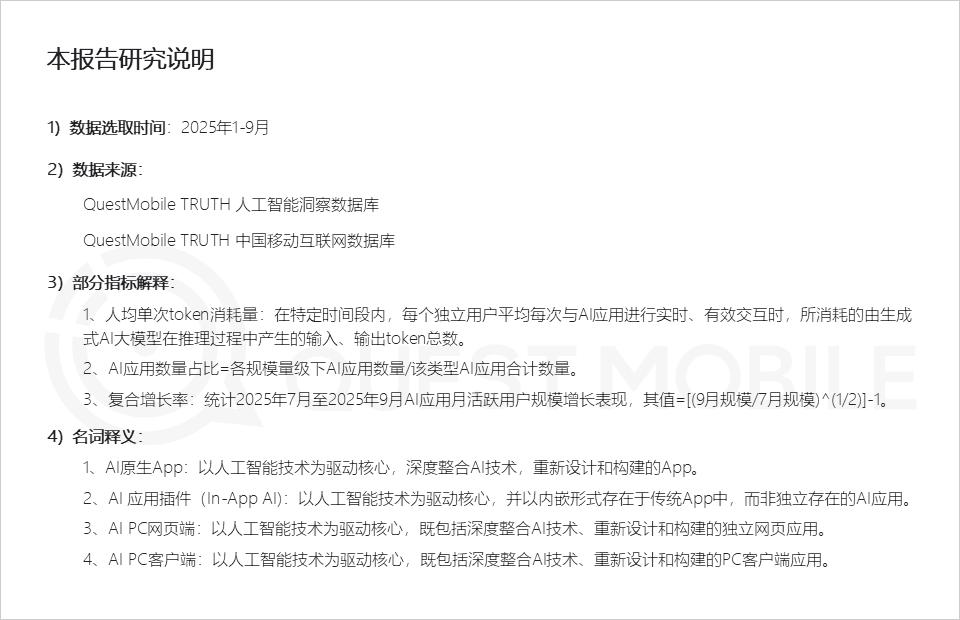
Core Insights - The AI application market is experiencing significant growth, with mobile and PC active user counts reaching 729 million and 200 million respectively by September 2025, driven by a shift towards ecosystem collaboration and model optimization [1][6][14]. Market Overview - As of September 2025, the mobile AI application market includes 287 million users for native apps, 706 million for In-App AI, and 535 million for smartphone manufacturer AI assistants, with respective growth rates of 3.4%, 9.3%, and 1.2% [1][14]. - The overall scale of mobile AI applications has surpassed 700 million, indicating a maturation and commercialization of the industry [6][14]. User Engagement - In-App AI applications dominate the user engagement landscape, with 31 out of the top 50 AI applications being plugins, led by Baidu AI Search, Douyin AI Search, and WeChat AI Search [2][31]. - The average number of In-App AI applications per app in the top 20 has increased to 2.5, while PC web applications and smartphone AI assistants lag behind [2][31]. Competitive Landscape - The competition has shifted from a focus on parameter comparisons to ecosystem collaboration, with major players like Baidu, Alibaba, Tencent, and Douyin updating their models frequently [1][6][14]. - The user engagement time for native AI applications remains the highest at 117.7 minutes, compared to 31 minutes for AI plugins and 5.3 minutes for smartphone AI assistants [2][16]. Trends in AI Applications - The industry is moving towards a "value-driven" model, with pricing strategies becoming more refined and user stickiness increasing, particularly for In-App AI plugins [2][12][18]. - The average single-use token consumption has decreased, indicating improved efficiency and cost control in AI applications [18][20]. Ecosystem Development - The MCP (Model Cloud Platform) services have reached 9,384 by October 20, 2025, facilitating a shift from model development to a service-oriented ecosystem [1][20]. - The integration of AI assistants into smartphones has become standard, with a collective growth of 65 million users across six major manufacturers, reflecting a 13.9% year-on-year increase [40][61]. PC Application Dynamics - The PC application market is undergoing contraction, with over 75% of web applications facing growth challenges, while the client applications are also struggling with 75% showing negative growth [50][57]. - Successful PC applications are primarily in productivity sectors, with notable growth in applications like Xiaoyi and WPS Lingxi, indicating a need for professional value to sustain growth [54][57]. Strategic Focus - Internet companies are focusing on integrating AI with business scenarios to enhance their core offerings, while smartphone manufacturers are building open ecosystems around AI assistants [61][70]. - The evolution of AI applications is characterized by a shift from single-point technology competition to an ecosystem-based collaboration model, with payment capabilities marking a significant milestone in commercialization [74][78].

半年拿下四款旗舰机型,瑞声科技WLG玻塑镜头今年销量超前三年总和
Zhi Tong Cai Jing· 2025-10-28 02:43
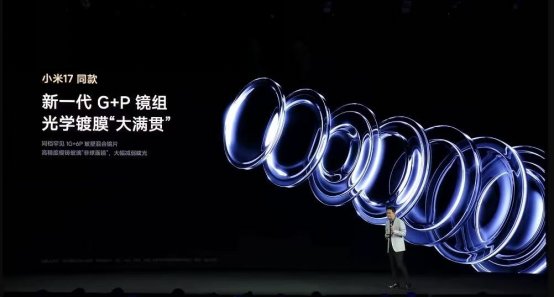
Core Insights - The article highlights the rapid development and adoption of glass-plastic hybrid lens technology in smartphones, particularly with the recent launch of the REDMI K90 Pro Max, which achieved over 130,000 sales on its first day, marking a 120% increase compared to its predecessor [1] - The technology is gaining traction among manufacturers, with significant breakthroughs in imaging quality, module thickness control, and mass production feasibility expected by 2025 [3][5] Group 1: Product Launch and Sales - REDMI's K90 Pro Max is the first Pro Max model, featuring a large 1/1.31-inch main camera and a 1G6P glass-plastic hybrid lens, contributing to its strong sales performance [1] - The K90 series is the fourth flagship model to utilize the WLG glass-plastic hybrid lens technology from AAC Technologies in less than six months, following the launches of Xiaomi MIX Flip 2, Huawei Pura 80 series, and Xiaomi 17 series [1] Group 2: Technical Advantages - The glass-plastic hybrid lens offers superior optical performance with fewer lens elements, reducing the overall length and thickness of the lens module by approximately 10% compared to traditional designs [5] - The high light transmittance of glass lenses enhances overall light intake, improving low-light performance and bokeh effects, while also significantly reducing glare and ghosting artifacts [5] Group 3: Industry Trends and Future Outlook - The glass-plastic hybrid lens technology has transitioned from an observational phase to a rapid development phase, with nearly 20 smartphone models adopting this technology across brands like Xiaomi, Sony, and vivo [7] - AAC Technologies is expected to ship over 10 million WLG lenses in 2025, indicating a substantial increase in production capacity and market acceptance [10] - The technology is also expanding beyond smartphones into automotive applications, particularly in advanced driver-assistance systems (ADAS), where it offers cost and weight advantages while maintaining thermal stability and imaging quality [10]
半年拿下四款旗舰机型,瑞声科技(02018)WLG玻塑镜头今年销量超前三年总和
智通财经网· 2025-10-28 02:28
Core Insights - The article highlights the rapid development and adoption of glass-plastic hybrid lens technology in smartphones, particularly with the recent launch of the REDMI K90 Pro Max, which achieved over 130,000 units sold on its first day, marking a 120% increase compared to its predecessor [1][7] Group 1: Technology Advancements - The glass-plastic hybrid lens technology has gained significant traction among manufacturers, especially as it approaches 2025, due to breakthroughs in imaging quality, module thickness control, and mass production feasibility [3][9] - The hybrid lens structure allows for higher optical performance with fewer lens elements, reducing the overall length and thickness of the lens module by approximately 10% compared to traditional designs [4][9] - The high light transmittance of glass lenses enhances overall light intake, improving low-light performance and bokeh effects, while also significantly reducing glare and ghosting artifacts [4][5] Group 2: Market Trends - REDMI and Xiaomi are recognized as pioneers in the adoption of glass-plastic hybrid lenses, with the REDMI K50 Supreme Edition being the first smartphone globally to feature a 100-megapixel WLG hybrid lens [7][9] - The technology has transitioned from an initial phase of industry skepticism to a rapid development phase, with nearly 20 smartphone models incorporating this technology across various brands, including Xiaomi, Sony, and vivo [7][10] - By 2025, the expected shipment volume of WLG lenses from AAC Technologies is projected to exceed 10 million units, indicating a significant increase in production capacity and market acceptance [10] Group 3: Future Prospects - The glass-plastic hybrid lens technology is not limited to smartphones; it is also penetrating the automotive sector, particularly in advanced driver-assistance systems (ADAS), where it offers advantages in thermal stability, imaging quality, and cost reduction [10] - Analysts predict that over 30% of new flagship smartphones will feature glass-plastic hybrid lenses, with an anticipated annual growth rate exceeding 50% in the ADAS market [10]
中金公司港股晨报-20251028
Xin Da Guo Ji Kong Gu· 2025-10-28 02:20
Market Overview - The Hang Seng Index is expected to hold around 25,000 points, reflecting a forecasted P/E ratio of 12 times over the next 12 months, amid uncertainties in U.S. monetary policy and ongoing U.S.-China trade tensions [2] - The U.S. Federal Reserve's recent hawkish stance on interest rate cuts has led to reduced expectations for future rate reductions, with only one cut anticipated in 2026, which is lower than market expectations [5][10] Corporate News - Anta (2020) reported low single-digit growth in retail sales for its brand products in Q3 [12] - Cansino (6185) benefited from sales of its meningitis vaccine, with net profit increasing 842% year-on-year in Q3 [5] - China Aluminum (2600) achieved a net profit of 3.8 billion RMB in Q3, marking a 90.3% increase [5] - Meituan (3690) announced that its rider social security subsidies will now cover the entire country, becoming the first to establish a comprehensive protection system for all riders [12] - Pony.ai plans to raise over 7.56 billion HKD through its IPO, with a focus on expanding its autonomous driving services [12] - WeRide (0800) aims to raise over 3.09 billion HKD in its IPO, positioning itself as a leader in L4 autonomous driving solutions [12] Macro Focus - In September, profits of large-scale industrial enterprises in China increased by 21.6% year-on-year, with a cumulative growth of 3.2% for the first three quarters [10] - The Chinese government is set to deepen reforms in the ChiNext board to optimize financing and regulatory systems [10][11] - The Hong Kong government reported a 16.1% increase in exports and a 13.6% increase in imports in September, both exceeding market expectations [11] Sector Insights - The insurance sector is expected to benefit from strong A-share performance, leading to improved investment returns in Q3 [8] - AI concept stocks are gaining traction as mainland China accelerates the application of "Artificial Intelligence+" [8] - The report indicates that Alibaba and Baidu hold the top two positions in China's AI cloud market, with market shares of 30.2% and 22.5% respectively [11]
QuestMobile2025年三季度AI应用行业报告:移动端AI应用规模突破7亿大关,模型升级加速,MCP助推产业开放
QuestMobile· 2025-10-28 02:01
Core Insights - The AI application market is experiencing rapid growth, with mobile and PC active user counts reaching 729 million and 200 million respectively by September 2025 [3][4][20] - Major companies are shifting focus from parameter competition to ecosystem collaboration, optimizing models to meet customer needs and expand application scenarios [4][9] - The In-App AI plugin model has become the leading growth driver, with 31 out of the top 50 AI applications being plugins [4][5][24] Market Overview - By September 2025, the mobile AI application market has surpassed 700 million users, with native apps, In-App AI, and mobile manufacturer AI assistants reaching 287 million, 706 million, and 535 million users respectively [20][9] - The growth of mobile applications is supported by a stable head of native apps, while the PC web applications face challenges, with over 75% experiencing growth difficulties [5][60] User Engagement - The average usage time for native AI applications is 117.7 minutes, significantly higher than In-App AI plugins at 31 minutes and mobile manufacturer AI assistants at 5.3 minutes [6][24] - The top AI applications show a stable user base, with notable growth in vertical applications like AQ and Doubao, which have seen substantial increases in active users [6][38] Competitive Landscape - The competitive landscape is solidifying, with nearly 60% of native apps experiencing negative growth, indicating a narrowing window for new entrants [31][34] - Vertical applications are thriving, with AQ, Doubao, and Jimeng AI showing impressive growth rates of 83.4%, 15.7%, and 12.1% respectively [38][40] Ecosystem Development - The MCP services have reached 9,384, facilitating ecosystem collaboration and marking a new phase of commercialization in the AI industry [4][9][80] - Companies are focusing on integrating AI into business scenarios, enhancing user experience through seamless service delivery [70][72] Future Trends - The AI market is transitioning from a focus on broad capabilities to specialized, efficient solutions, with a significant increase in model updates and iterations [16][18] - The integration of payment capabilities is seen as a key milestone for the commercialization of AI applications, paving the way for an "AI as a service" economy [85][87]

小米汽车陷入困境,问题出在哪?
Xin Lang Cai Jing· 2025-10-27 20:11
Core Viewpoint - The article discusses a significant trust collapse regarding Xiaomi's automotive venture, highlighting the overwhelming negative sentiment from users and the failure of the company's approach to car manufacturing compared to its successful smartphone strategy [1][3]. Group 1: Trust and Public Sentiment - The negative public sentiment towards Xiaomi's car has reached 96%, with a net emotional value plummeting to -96%, indicating a severe backlash from users [1]. - Xiaomi's previous reputation for high value and fan culture in the smartphone market has not translated successfully into the automotive sector, leading to a major misstep [1][3]. Group 2: Manufacturing Approach - The company attempted to apply the fast-paced smartphone development model to the automotive industry, which is fundamentally different and requires a longer development cycle of five to seven years for safety and reliability [3]. - Xiaomi's ambitious goals, such as producing 200,000 vehicles by 2024, are unrealistic given the complexities of automotive manufacturing [3]. Group 3: Consumer Expectations - Consumers expect safety and reliability in vehicles, contrasting with the higher tolerance for issues in smartphones, which can be easily replaced or updated [5]. - The company's reliance on OTA updates instead of physical recalls has angered consumers, who prioritize safety over technological convenience [5]. Group 4: Leadership and Crisis Management - The prolonged silence from Xiaomi's leadership during crises has been criticized, with comparisons drawn to other automakers that respond promptly to issues [6][8]. - The concentration of pressure on the founder, Lei Jun, without a broader leadership response has been seen as a significant flaw in crisis management [8]. Group 5: Industry Standards - The article emphasizes that the era of treating automotive manufacturing like a fast-paced tech industry should end, as safety must be the primary standard in the automotive sector [10]. - The expectation is for Xiaomi to shift focus from marketing and public relations to producing genuinely safe and reliable vehicles [10].

芯原股份20251027
2025-10-27 15:22
Summary of Conference Call Notes Company Overview - **Company**: 新元股份 (Xinyuan Co., Ltd.) - **Industry**: Semiconductor and AI Chip Design Key Financial Performance - **Q3 2025 Revenue**: 12.81 billion CNY, a historical high, with a quarter-on-quarter increase of 119.26% and a year-on-year increase of 78.38% [2][5] - **Total Revenue for First Three Quarters**: 22.55 billion CNY, indicating strong growth momentum [2] - **New Orders**: 15.93 billion CNY in Q3 2025, a year-on-year increase of 145.8%, with AI computing-related orders accounting for approximately 65% [4] Order Backlog and Business Model - **Order Backlog**: 32.86 billion CNY at the end of Q3, maintaining high levels for eight consecutive quarters [2][4] - **Business Model**: Focus on semiconductor IP licensing and custom chip design services, helping clients reduce R&D and operational costs [6] - **Revenue Composition**: One-stop chip customization services account for nearly 90% of the backlog, with system manufacturers contributing 83.52% of orders [4][6] Profitability and Margins - **Gross Margins**: - IP licensing service gross margin: 90% - One-stop chip customization service gross margin: approximately 20% - Overall gross margin: 34% [2][11] - **R&D Investment**: Despite a decrease in R&D investment ratio by 9.41 percentage points, the company maintains high profitability due to the high gross margin of its IP business [11] Technological Advancements - **Core Processor IP**: Six categories of core processors, with GPU, NPU, and VPU contributing 70% of revenue [8] - **Process Node Contribution**: - 28nm and below contribute 94% of revenue - 14nm and below contribute 81% of revenue [8] - **Data Processing Revenue**: Increased to 33.14% of total revenue, with a year-on-year growth of 10.36 percentage points [9] Market Trends and Future Outlook - **AI Chip Market**: Expected to see over 70% of chips related to AI by 2035, with significant growth in edge computing [3][17] - **Product Development**: 112 self-developed projects have achieved mass production, with 47 projects in the NRE stage, indicating ongoing revenue growth potential [9] Global Presence and Workforce - **Employee Composition**: Over 2000 employees globally, with 89% in R&D and 88% holding master's degrees or higher [7] - **Sales Distribution**: 32% of sales from overseas markets, 68% from domestic markets [7] Competitive Landscape - **AI NPU Performance**: The new Xiaomi 3nm chip features a GAA architecture with AI NPU performance reaching 40 TOPS, surpassing Microsoft's AI PC standards [12] Additional Insights - **R&D Focus**: Continuous high investment in R&D to build competitive barriers and ensure long-term growth [10] - **Employee Development**: Emphasis on comprehensive talent recruitment and training, with a focus on skills relevant to AI and new technologies [32]

浩物股份连续4个季度盈利 拟使用公积金“补亏”以恢复分红能力
Zheng Quan Shi Bao Wang· 2025-10-27 14:20
Core Viewpoint - The financial performance of Haowu Co., Ltd. continues to improve, with a significant increase in net profit despite a decline in revenue [1] Financial Performance - For the first three quarters of 2025, Haowu Co., Ltd. reported a revenue of 2.183 billion yuan, a year-on-year decrease of 16.98% - The net profit for the same period was 42.7752 million yuan, showing a year-on-year increase of 279.04% - In the third quarter alone, the company achieved a revenue of 726 million yuan, down 18.69% year-on-year, while net profit reached 12.3436 million yuan, up 324.27% year-on-year - The net profit has been positive for four consecutive quarters [1] Business Segments - Haowu Co., Ltd. operates in two main segments: automotive sales and services, and internal combustion engine crankshaft manufacturing - The automotive sales segment includes vehicle sales, maintenance services, and comprehensive services, with key brands such as SAIC Volkswagen, FAW Volkswagen, and various new energy vehicle brands - The crankshaft business focuses on the research, manufacturing, and sales of crankshafts for automotive, engineering machinery, and agricultural machinery, leading in production and sales within the domestic passenger car crankshaft industry [2] Capital Management - On October 27, the company announced plans to use its surplus reserves to cover losses, with a total of 944 million yuan allocated from surplus reserves and capital reserves - This move aims to eliminate the accumulated losses reported in the parent company's financial statements, which stood at -944 million yuan at the end of last year - The implementation of this plan requires approval from the shareholders' meeting [3] Regulatory Context - The use of surplus reserves to cover losses aligns with the new Company Law, which allows companies to utilize capital reserves for loss compensation after exhausting other reserves - This regulatory change is seen as a way to enhance the operational flexibility of listed companies and create conditions for future dividend distributions [3][4] Expert Opinion - Financial experts suggest that using surplus reserves to cover losses can effectively relieve operational constraints and optimize equity structure, potentially restoring cash dividend capabilities and improving key financial metrics - This strategy is expected to enhance market confidence and valuation for the company [4]

卖不动了?保时捷销售利润暴跌99%,一季度亏损80亿元!国人更爱国产科技豪华车【附新能源汽车行业市场分析】
Qian Zhan Wang· 2025-10-27 11:56
Core Viewpoint - Porsche is experiencing a significant decline in sales and profits, particularly in the Chinese market, which has shifted from being its largest market to its biggest burden, leading to a critical moment for the brand [2][3]. Financial Performance - In the first three quarters of 2025, Porsche reported revenues of approximately €26.86 billion, a year-on-year decrease of 6% [2]. - The operating profit plummeted to €40 million, down 99% from €4.035 billion in the same period last year [2]. - The third quarter alone recorded a loss of €966 million, equivalent to about 8 billion RMB [2]. Market Challenges - The decline in the Chinese market is attributed to challenging market conditions and intense competition, with sales dropping 28% from 29,551 units in 2024 to 21,302 units in 2025 [3]. - Porsche's product strategy is lagging in the face of the smart and electric vehicle transition, resulting in a lack of competitiveness in the Chinese market [3][8]. - The company is facing pressure from domestic brands like BYD and NIO, which are offering high-performance, intelligent, and rapidly iterating electric vehicles [3][8]. Strategic Adjustments - To address the downturn, Porsche plans to delay the launch of electric models, terminate its battery production plans, and incur a restructuring cost of €2.7 billion [2]. - The company anticipates a tariff expenditure of €700 million this year and intends to raise prices in the U.S. to cope with these tariffs [2]. Industry Trends - The Chinese electric vehicle market is rapidly growing, with a penetration rate reaching 31.6% in 2023, and expected to rise to 40.3% in 2024 [4]. - The market for smart electric vehicles, AI technology, and digital automotive platforms is identified as key growth areas for the future [6]. - Traditional luxury brands must adapt to the evolving market trends in China, focusing on product and technology innovation to maintain competitiveness [8].
20251027 China TMT Breakout
傅里叶的猫· 2025-10-27 11:07
Global Insights - Ongoing US-China negotiations are expected to delay certain policies [4] - Arkham Intelligence reported that SpaceX transferred a total of 1,215 bitcoins to multiple addresses [4] - Citigroup highlighted Anthropic's agreement with Google to procure up to 1 million TPUs, indicating potential benefits for TSMC, MediaTek, and KYEC due to increased TPU chip shipments [5] China Insights - Alibaba upgraded Qwen deep research with one-click webpage and podcast generation, achieving accuracy on par with Gemini, outperforming ChatGPT and Grok [7] - Goldman Sachs noted the increasing adoption of Horizon Journey 6 platform in new vehicle models, with mass production of J6P and H5D starting in EXEED models [7] - Xiaoma Zhixing announced the mass production of 300 units of the seventh-generation Robotaxi, aiming for a fleet of 1,000 by the end of 2025 [8] - Citigroup reported that GoerTek's Q3 2025 performance met expectations, with revenue growth of 4% year-on-year to 30.6 billion RMB [8] - Xiaomi is expected to announce Q3 2025 results on November 18, with a projected net profit of 1.2 billion RMB, reflecting a year-on-year increase of 64% [9] - Raycus Laser's Q3 2025 revenue grew by 10% year-on-year to 841 million RMB, with a significant net profit increase of 107% to 50 million RMB [10] - Nomura identified Shenghong Technology as a key beneficiary of Nvidia's innovation cycle, projecting a revenue and earnings CAGR of 40% and 45% respectively from FY2025 to FY2027 [11]