东鹏饮料

Search documents
宗馥莉“去娃哈哈”,难以完成的告别
Mei Ri Jing Ji Xin Wen· 2025-09-14 10:41
Core Viewpoint - The internal document leak reveals significant internal issues within the Wahaha Group, indicating a shift towards a new brand "Wah Xiaozong" to replace "Wahaha" starting in 2026, which suggests a brand reconstruction rather than an upgrade [1] Group 1: Brand Transition - The transition to "Wah Xiaozong" is not merely a rebranding but signifies a complete departure from the "Wahaha" brand, which is seen as a liability following the death of founder Zong Qinghou [1][4] - The ownership structure of Wahaha Group complicates the brand transition, as the "Wahaha" trademark belongs to the group and cannot be used without unanimous consent from all shareholders [1][2] Group 2: Legal and Historical Issues - The company faces various historical issues, including disputes over employee stock ownership, stock buyback agreements, and the legality of trademark authorization, alongside ongoing family inheritance disputes [2] - Zong Fuli's attempts to transfer the "Wahaha" trademark to her controlled company were rejected by major shareholders, highlighting her limited control and the high legal risks involved [2] Group 3: Market Challenges - The new brand "Wah Xiaozong" lacks the historical significance, emotional connection, and market recognition that "Wahaha" has built over nearly 40 years, making it unlikely to inherit the brand's estimated value of 90 billion [3] - The current beverage market is highly competitive, with established players like Yuanqi Forest and Nongfu Spring, making it difficult for a new brand without a compelling narrative or differentiation to succeed [3] Group 4: Leadership and Brand Integrity - Zong Fuli's legitimacy as a successor is questioned; her connection to the "Wahaha" brand is seen as a moral obligation to uphold its legacy, which is jeopardized by the shift to "Wah Xiaozong" [4][5] - Abandoning the "Wahaha" brand could lead to a loss of authenticity and consumer trust, positioning Zong Fuli in a precarious situation regarding public perception and brand loyalty [5]
每经热评丨宗馥莉“去娃哈哈”,难以完成的告别
Mei Ri Jing Ji Xin Wen· 2025-09-14 10:26
Core Viewpoint - The internal document leak reveals significant internal conflicts within the Wahaha empire, indicating a shift towards a new brand "Wah Xiaozong" controlled by Zong Fuli, which will replace the existing "Wahaha" brand starting from the 2026 sales year [1] Group 1: Brand Transition - The transition to "Wah Xiaozong" is not merely a brand upgrade but a complete rebranding effort, suggesting a strategic departure from the "Wahaha" identity [1] - Zong Fuli's decision to abandon the "Wahaha" brand is driven by the need to dissociate from the legacy of the late founder, Zong Qinghou, who has become a liability for the brand [1][4] - The "Wahaha" trademark is owned by the Wahaha Group, and any unilateral decision regarding its use requires unanimous consent from all shareholders, complicating Zong Fuli's ability to fully control the brand [1][2] Group 2: Legal and Historical Issues - The company faces complex historical issues, including disputes over employee stock ownership, stock buyback agreements, and the legality of trademark authorization, alongside ongoing family inheritance disputes [2] - Zong Fuli's attempt to transfer the "Wahaha" trademark to her controlled company was rejected by major shareholders, highlighting her limited control over the brand and the associated legal risks [2] Group 3: Market Challenges - The new brand "Wah Xiaozong" lacks the historical significance and emotional connection that "Wahaha" has built over nearly 40 years, making it unlikely to inherit the brand's estimated value of 90 billion [3] - The current beverage market is highly competitive, with established players like Yuanqi Forest and Nongfu Spring, making it difficult for a new brand without a compelling narrative or differentiation to succeed [3] - Unlike the case of Jia Duo Bao, which had a narrative of loss and consumer loyalty, "Wah Xiaozong" does not have a similar backstory to attract consumers or channel support [3] Group 4: Succession and Brand Integrity - Zong Fuli's legitimacy as a successor is questioned if she abandons the "Wahaha" brand, as it would undermine her perceived role as the rightful heir to the brand's legacy [4] - The emotional contract with consumers tied to the "Wahaha" brand is significant, and abandoning it for "Wah Xiaozong" could be seen as a betrayal, risking her reputation and market position [4][5] - The brand "Wahaha" is integral to Zong Fuli's strategy, and losing it could lead to a complete failure of her business ambitions [5]
食品饮料行业周报:白酒报表逐步出清,茅台动销好转-20250914
GUOTAI HAITONG SECURITIES· 2025-09-14 10:08
Investment Rating - The report assigns an "Overweight" rating to the food and beverage industry [1] Core Insights - The food and beverage sector is experiencing cyclical opportunities due to supply and demand clearing, with performance advantages evident in beverages, snacks, and raw materials. The financials of the liquor sector are improving, particularly for Moutai [3][4] Summary by Sections Investment Recommendations - The report suggests increasing holdings in growth stocks within beverages, snacks, and food sectors, highlighting the performance advantages. It recommends overweight positions in elastic liquor stocks such as Hong Kong-listed Zhenjiu Lidu, Shede Liquor, Shanxi Fenjiu, Luzhou Laojiao, and Jiu Gui Jiu. For stable mid-term holdings, it suggests Wuliangye, Guizhou Moutai, Yingjia Gongjiu, Jianshiyuan, and Guqingongjiu. In the beverage sector, it recommends increasing positions in leading companies like Dongpeng Beverage and Chengde Lulou, as well as Hong Kong-listed Nongfu Spring, Master Kong Holdings, and China Resources Beverage. For snacks and food raw materials, it suggests increasing holdings in Bailong Chuangyuan, Yanjinpuzi, Three Squirrels, and Ximai Foods, along with Hong Kong-listed Weilong Delicious. In the beer segment, it recommends increasing positions in Tsingtao Brewery, Zhujiang Brewery, and Bai Run Shares, as well as Hong Kong-listed China Resources Beer. For condiments and livestock, it suggests increasing holdings in Yili Group, New Dairy, Youran Livestock, Modern Farming, Baoli Foods, and Haitian Flavoring [8][9] Liquor Sector - The liquor sector is seeing a clearing of financials, with Moutai showing signs of improved sales. In Q2 2025, high-end, sub-high-end, and regional liquor revenues grew by 3%, declined by 5%, and decreased by 27% year-on-year, respectively. Net profits for these categories also showed a similar trend. The consumption environment is suppressing industry demand, leading to accelerated inventory reduction. Moutai's official data indicates a recovery in terminal sales as traditional festivals approach, with significant month-on-month growth observed since late August. The company emphasizes sustainable high-quality development, which may alleviate supply-demand conflicts and support pricing [9][10] Consumer Goods Sector - The consumer goods sector is characterized by structural growth, with beverages performing well, stable beer sales, and significant differentiation in snacks. The leading companies in condiments are showing advantages, while dairy products are experiencing marginal improvements. The report suggests that new consumer leaders in food additives, health products, beverages, and snacks have potential for future growth, driven by innovation and management strategies that could widen the gap with competitors [11]




饮料乳品板块9月12日跌1.64%,品渥食品领跌,主力资金净流出6.27亿元
Zheng Xing Xing Ye Ri Bao· 2025-09-12 08:31
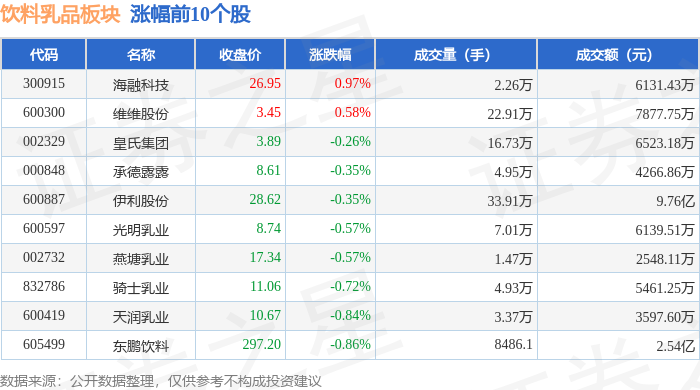
Market Overview - The beverage and dairy sector experienced a decline of 1.64% on September 12, with the leading decline from Pinwo Foods [1] - The Shanghai Composite Index closed at 3883.69, up 0.22%, while the Shenzhen Component Index closed at 12996.38, up 0.13% [1] Stock Performance - Key stocks in the beverage and dairy sector showed mixed performance, with Haierong Technology closing at 26.95, up 0.97%, while Yili Group and Bright Dairy both saw declines of 0.35% [1] - The trading volume and turnover for major stocks were significant, with Dongpeng Beverage achieving a turnover of 254 million yuan [1] Capital Flow - The beverage and dairy sector saw a net outflow of 627 million yuan from institutional investors, while retail investors contributed a net inflow of 444 million yuan [2] - Notable capital movements included Tianrun Dairy with a net inflow of approximately 8.95 million yuan from institutional investors, while Yiyuan Beverage experienced a net outflow of 359.77 million yuan from retail investors [2]

食品饮料行业双周报(2025、08、29-2025、09、11):白酒持续出清,大众品优选景气细分-20250912
Dongguan Securities· 2025-09-12 06:59
Investment Rating - The investment rating for the food and beverage industry is "Overweight" (maintained) [1] Core Viewpoints - The report highlights that the liquor sector continues to clear inventory, while consumer goods are favored in the thriving segments. The high-end liquor brand Kweichow Moutai shows resilient growth, while other brands like Shui Jing Fang and Yanghe have experienced declines due to ongoing pressure in consumption scenarios [8][51] - The report suggests focusing on high-certainty high-end liquor stocks such as Kweichow Moutai (600519) and other mid-range and regional liquor brands like Shanxi Fenjiu (600809), Jiu Gui Jiu (000799), and Gu Qing Gong Jiu (000596) [8][51] - In the consumer goods sector, performance varies across sub-segments, with some showing improvement in Q2. The report emphasizes the importance of monitoring demand and cost indicators in the beer sector, as well as consumption recovery and product structure optimization in the seasoning sector [8][51] Summary by Sections Market Review - From August 29 to September 11, 2025, the SW food and beverage industry index rose by 3.54%, outperforming the CSI 300 index by approximately 1.65 percentage points [15] - The liquor sector saw the highest increase at 4.52%, while other liquor categories experienced a decline of 0.89% [17] - Approximately 71% of stocks in the industry recorded positive returns during this period, with notable gainers including Huanle Jia (+23.38%) and Gai Shi Food (+14.13%) [19] Industry Important Data Tracking - The liquor sector's pricing trends show a decrease in the prices of Feitian and Pu Wu, while Guojiao 1573 remains stable. As of September 11, 2025, the price for Feitian is 1785 RMB/bottle, down 25 RMB from August 28 [26] - In the seasoning sector, the price of soybean and white sugar has decreased, while glass prices have increased. As of September 11, 2025, the price of white sugar is 5890 RMB/ton, down 20 RMB from August 28 [29] - The average wholesale price of pork is 19.93 RMB/kg, reflecting a slight increase from the previous month [41] Industry News - The report notes that from January to July 2025, the cumulative export value of liquor products reached 68.50 billion RMB, with traditional liquor accounting for a significant portion [45] - The China Liquor Market Prosperity Index for the first half of 2025 was reported at 47.14, indicating a weak economic environment [46] Company Announcements - Kweichow Moutai reported a stable performance in the first half of 2025, while other companies like Luzhou Laojiao and Gu Qing Gong Jiu showed varying results in their financial reports [49][50]
半年爆卖百亿,东鹏特饮杀疯了?
Hu Xiu· 2025-09-12 01:44
Core Insights - Dongpeng Beverage has achieved remarkable sales, generating revenue of 10.737 billion and a net profit of 2.375 billion in the first half of the year, indicating a strong market presence in the functional beverage sector [1] - The company has captured a significant market share, with one in every two energy drinks sold being Dongpeng's, showcasing its rapid growth and competitive edge over established brands like Red Bull [1] Company Performance - Revenue for the first half of the year reached 10.737 billion, reflecting a robust demand for its products [1] - The net profit of 2.375 billion demonstrates effective cost management and strong sales performance [1] Market Position - Dongpeng has positioned itself as a leader in the functional beverage market, effectively outpacing competitors, including Red Bull [1] - The company's growth trajectory suggests a strategic advantage in marketing and product development, contributing to its dominance in the sector [1]
中原证券晨会聚焦-20250912
Zhongyuan Securities· 2025-09-12 01:09
Core Insights - The report highlights a positive trend in the semiconductor industry, with significant growth in domestic AI computing chip manufacturers, indicating a robust market opportunity [14][16][18] - The media sector shows a notable recovery in profitability, with a significant increase in net profit compared to the previous year, suggesting a favorable investment environment [18][19] - The food and beverage sector has experienced a strong performance in August, with a notable increase in individual stock prices, indicating a potential investment opportunity [22][23][25] Domestic Market Performance - The Shanghai Composite Index closed at 3,875.31, with a daily increase of 1.65%, while the Shenzhen Component Index rose by 3.36% to 12,979.89 [3] - The average price-to-earnings ratio for the Shanghai Composite and ChiNext indices are 15.55 and 47.12, respectively, indicating a suitable environment for medium to long-term investments [9][10][12] Industry Analysis - The semiconductor industry saw a 23.84% increase in August, outperforming the Shanghai and Shenzhen indices, with integrated circuits rising by 31.47% [14] - The media sector's overall revenue reached 2,728.86 billion yuan in the first half of 2025, marking a 2.91% year-on-year increase, with net profit growth of 38.08% [18][19] - The food and beverage sector's stock performance improved significantly, with 83.59% of individual stocks rising in August, particularly in snacks and beverages [22][23] Investment Recommendations - The report suggests focusing on the semiconductor industry, particularly domestic AI computing chip manufacturers, as they are expected to gain market share [14][16] - In the media sector, the gaming sub-sector is highlighted for its strong fundamentals and growth potential, while the film and publishing sectors show mixed results [18][19] - The food and beverage sector is recommended for investment, particularly in white liquor, soft drinks, and snacks, due to their strong performance and recovery potential [22][25]
Monster:四面楚歌,昔日“怪兽”会变“病猫”吗?
3 6 Ke· 2025-09-12 00:00
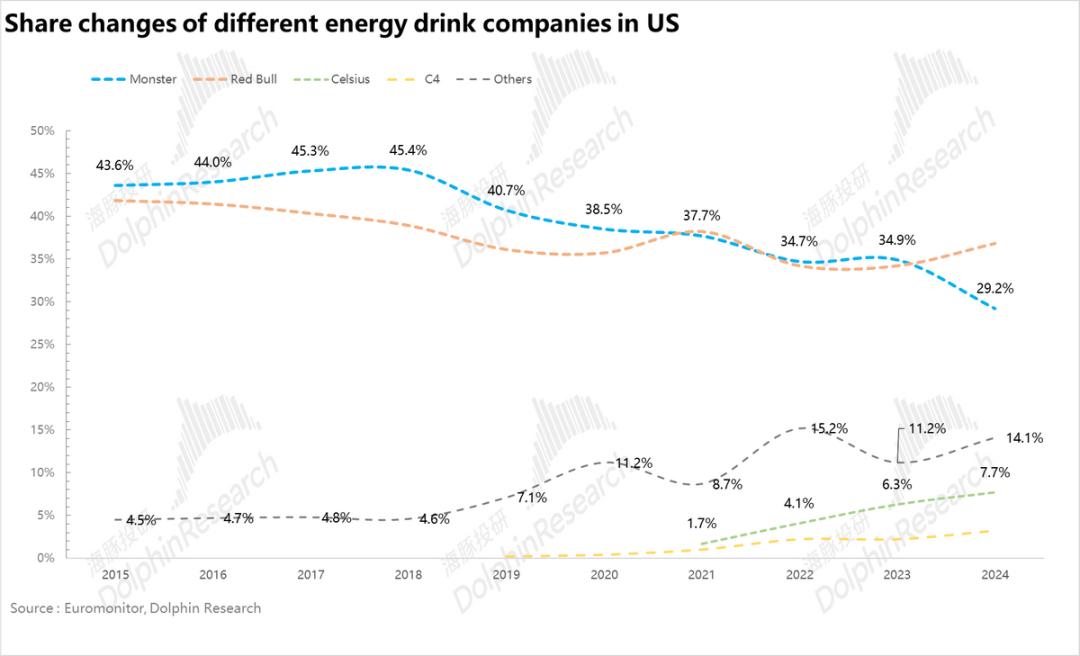
Core Viewpoint - The article analyzes the competitive landscape of the energy drink market in the U.S., focusing on Monster Beverage's declining market share and the rise of emerging brands like Celsius, Ghost, and Alani Nu, which are capitalizing on health trends and targeted marketing strategies [1][2][12]. Group 1: Market Dynamics - Since 2019, Monster's market share in the U.S. has decreased from 43.6% to 29.2% by the end of 2024, while its revenue growth for 2024 was only 4.9%, lagging behind the industry growth rate of 7% [2][12]. - The combined market share of Monster and Red Bull has dropped from 76% to 66%, indicating a significant decline in market concentration due to the emergence of smaller brands [2][12]. - Emerging brands have captured approximately 15% of the market share, up from less than 5% in 2015, highlighting a shift in consumer preferences towards healthier options [2][12]. Group 2: Competitive Analysis - New brands are leveraging health trends by offering zero-sugar and natural caffeine products, which resonate with the growing health consciousness among consumers [7][12]. - Monster's traditional high-sugar and high-caffeine products have not adapted quickly enough to these trends, leading to a loss of market share [8][12]. - The marketing strategies of emerging brands focus heavily on social media and KOL (Key Opinion Leader) engagement, with over 80% of their marketing budgets allocated to these channels, compared to less than 30% for Monster [10][12]. Group 3: Future Growth Potential - The North American energy drink market is expected to grow at a CAGR of 7%-8% from 2025 to 2029, but Monster's growth is projected to lag behind this rate due to its current market challenges [13][12]. - International markets present a significant growth opportunity for Monster, particularly in emerging markets where demand for energy drinks is more robust [16][12]. - Monster's international market share is expected to increase from 40% to 51% over the next five years, with a projected CAGR of 16% for international sales [17][12]. Group 4: Investment Considerations - Monster's current valuation appears high, with a historical average PE ratio of 38x, while its growth rate is slowing, suggesting potential overvaluation [25][12]. - The company's PEG ratio exceeds 2, indicating strong expectations for future growth, but the competitive landscape is becoming increasingly challenging [27][12]. - Despite the high valuation, Monster's position as a staple energy drink brand may provide some resilience against rapid valuation declines, especially compared to other brands facing similar market pressures [33][12].
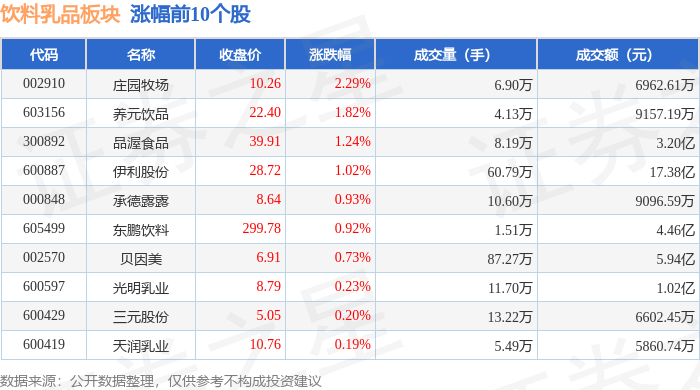
饮料乳品板块9月11日涨0.61%,庄园牧场领涨,主力资金净流出1.32亿元
Zheng Xing Xing Ye Ri Bao· 2025-09-11 08:43
Market Overview - The beverage and dairy sector increased by 0.61% on September 11, with Zhuangyuan Pastoral leading the gains [1] - The Shanghai Composite Index closed at 3875.31, up 1.65%, while the Shenzhen Component Index closed at 12979.89, up 3.36% [1] Stock Performance - Zhuangyuan Pastoral (002910) closed at 10.26, up 2.29% with a trading volume of 69,000 shares and a transaction value of 69.63 million yuan [1] - Yangyuan Beverage (603156) closed at 22.40, up 1.82% with a trading volume of 41,300 shares and a transaction value of 91.57 million yuan [1] - Yili Group (600887) closed at 28.72, up 1.02% with a trading volume of 607,900 shares and a transaction value of 1.738 billion yuan [1] - Other notable stocks include: - Pinhao Food (300892) at 39.91, up 1.24% [1] - Dongpeng Beverage (605499) at 299.78, up 0.92% [1] Capital Flow - The beverage and dairy sector experienced a net outflow of 132 million yuan from institutional investors, while retail investors saw a net inflow of 177 million yuan [2] - Notable capital flows include: - Yili Group saw a net inflow of 58.13 million yuan from retail investors but a net outflow of 5.81 million yuan from institutional investors [3] - Zhuangyuan Pastoral had a net inflow of 1.34 million yuan from retail investors [3]




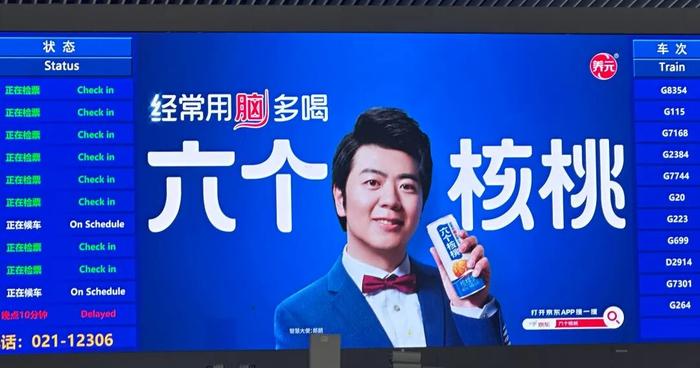
七大区域全线下滑,六个核桃卖不动了
Guo Ji Jin Rong Bao· 2025-09-10 12:24
Core Viewpoint - The company Yango Beverage, the parent company of "Six Walnuts," reported a significant decline in both revenue and net profit for the first half of 2025, attributing the downturn primarily to decreased sales of walnut milk products [1][3]. Financial Performance - Revenue for the first half of 2025 was 2.465 billion yuan, a year-on-year decrease of 16.19% - Net profit attributable to shareholders was 744 million yuan, down 27.76% year-on-year - This marks the first instance in three years where both revenue and net profit have declined simultaneously [1][3]. Sales and Market Dynamics - Sales revenue declined across all seven major regions, with the largest three regions experiencing double-digit declines [4]. - The walnut milk product, which constitutes approximately 90% of the company's total revenue, has seen a significant drop in sales, reflecting a lack of competitiveness in the product and brand [3][4]. Marketing and Advertising - The company increased its advertising and marketing expenses to 330 million yuan, a rise of 3.73% year-on-year, marking the first increase in three years - Despite the increased spending, the sales expense ratio rose from 10.81% to 13.37%, indicating ineffective marketing efforts [1][3]. Investment Strategy - Despite the declining sales of walnut milk, the company has not introduced new product plans or acquisitions to address growth challenges [6]. - Yango Beverage has engaged in significant cross-industry investments, totaling 1.1 billion yuan in 11 companies across sectors like renewable energy and media, which are unrelated to its core business [9][10]. - The company’s investment activities generated a net cash flow of approximately 980 million yuan in the first half of 2025, a year-on-year increase of 18.56% [11]. Research and Development - The company has spent relatively little on product research and development, with R&D expenses amounting to 18 million yuan, a decrease of 11.2% year-on-year [12].