巨子生物

Search documents
关注零售行业中期投资策略:深挖情绪消费景气赛道
KAIYUAN SECURITIES· 2025-05-11 14:41
Group 1: Core Insights - The retail industry is experiencing a slow recovery in social consumption, with overall business pressure on retail enterprises [27][28] - The report emphasizes the importance of emotional consumption, suggesting that companies should focus on enhancing consumer service experiences and emotional satisfaction to drive positive accumulation [28][32] - The investment strategy highlights four main themes: gold and jewelry, offline retail, cosmetics, and medical aesthetics, each with specific recommendations for companies to watch [4][7][49] Group 2: Industry Dynamics - Traditional retail is facing challenges as online traffic growth approaches its peak, and issues like e-commerce tax audits arise, making offline experiences more valuable [4][28] - The gold and jewelry sector is shifting from supply-driven to demand-driven, with emotional needs like self-appreciation and national pride becoming significant [4][36] - The cosmetics industry is witnessing a rise in domestic brands, with emotional consumption trends spreading to various segments, including functional skincare and home fragrances [41][49] Group 3: Company Recommendations - For gold and jewelry, companies like Lao Pu Gold, Chao Hong Ji, and Zhou Da Sheng are recommended for their differentiated product offerings and consumer insights [7][48] - In offline retail, companies such as Yonghui Supermarket and Ai Ying Shi are highlighted for their proactive transformation and exploration of new business models [7][48] - In the cosmetics sector, brands like Pechoin, Mao Ge Ping, and Juzi Biological are noted for their strong performance and ability to adapt to market trends [7][49] Group 4: Market Performance - The retail industry index rose by 0.88% in the week of May 6-9, 2025, but has decreased by 5.81% since the beginning of the year, underperforming the broader market [6][15] - The brand cosmetics sector showed the highest growth, with a weekly increase of 2.89% and a year-to-date increase of 15.91% [18][21] - Individual stocks such as Huazhi Wine and New Xunda saw significant weekly gains of 13.4% and 12.2%, respectively [24][25]




化妆品医美行业周报:聚美丽大会指引美业发展,国际集团在华触底反弹-20250511
Shenwan Hongyuan Securities· 2025-05-11 14:40
Investment Rating - The report maintains an "Overweight" rating for the cosmetics and medical beauty sector, with specific recommendations for various companies based on their market positions and growth potential [5][12][17]. Core Insights - The cosmetics and medical beauty sector has shown weaker performance compared to the market, with the Shenwan Beauty Care Index rising by 1.7% from April 30 to May 9, 2025, which is lower than the Shenwan A Index by 0.6 percentage points [5][6]. - The "Jumeili Conference" held in Shanghai highlighted the industry's development direction amidst a challenging environment, emphasizing the importance of technology-driven beauty, refined operations, and AI assistance [5][12]. - Domestic brands are gaining traction, while international brands are also experiencing growth, with Estee Lauder reporting a return to positive growth in key brands in China during Q1 2025 [5][12][28]. Summary by Sections Industry Performance - The cosmetics and medical beauty sector's performance has been below market expectations, with the Shenwan Cosmetics Index increasing by 2.8%, outperforming the Shenwan A Index by 0.5 percentage points [5][6]. - The report notes a competitive landscape where domestic brands are aggressively entering the market, prompting international brands to rebound [5][12]. Company Analysis - Shanghai Jahwa's Q1 2025 results showed a revenue of 1.704 billion yuan, down 10.59% year-on-year, with a net profit of 217 million yuan, down 15.25% [5][13]. - Estee Lauder's Q3 2025 results indicated a net sales figure of 3.55 billion USD (approximately 25.8 billion yuan), a 10% decline year-on-year, but with a notable increase in gross margin [5][28]. - The report highlights the employee stock ownership plan at Shanghai Jahwa, aimed at binding key personnel and setting profit recovery targets for 2025 [5][17]. Market Trends - The report indicates that the retail sales of cosmetics in Q1 2025 reached 114.9 billion yuan, with a year-on-year growth of 3.2% [22][26]. - The domestic skincare market is projected to continue growing, with local brands capturing a significant market share, reflecting a shift in consumer preferences towards domestic products [36][38]. E-commerce Insights - The report provides data on the performance of domestic brands on e-commerce platforms, with notable growth in GMV for brands like Proya and Marubi [20][19]. - The overall e-commerce landscape for cosmetics is evolving, with brands leveraging social media platforms to enhance visibility and sales [5][12].


上市国货美妆洗牌:上美、巨子生物增长最快,华熙生物倒数
Nan Fang Du Shi Bao· 2025-05-11 09:20
Core Insights - The domestic beauty industry in China is expected to undergo a significant restructuring by 2025, with companies showing rapid growth driven by strong single-brand performance and a shift in consumer focus towards verified efficacy rather than just ingredient composition [2][10] Revenue Performance - Proya has become the first domestic beauty company to surpass 10 billion yuan in revenue for 2024, achieving 10.779 billion yuan, maintaining its top position [4] - Shangmei Co. has shown the fastest revenue growth, with a 62.1% increase from 4.191 billion yuan in 2023 to 6.793 billion yuan in 2024, rising from sixth to second place among the sample companies [3][4] - Other notable companies include Betaini with 5.736 billion yuan, Shanghai Jahwa with 5.679 billion yuan, and Juzhibio with 5.54 billion yuan, all showing varying degrees of growth [4] Brand Performance - Shangmei's brand Han Shu generated nearly 5.6 billion yuan in 2024, accounting for 82.3% of the group's total revenue, with a growth rate of 73.7% [5] - Juzhibio's brand Kefu Mei achieved 4.54 billion yuan in revenue, representing 82% of its total revenue, with a growth rate of 62.9% [6] Market Trends - The popularity of hyaluronic acid is declining, while "recombinant collagen" is emerging as a lucrative ingredient, reflecting a shift in consumer preferences towards efficacy-driven skincare [7][9] - The market is witnessing a transition from ingredient-focused to efficacy-focused products, with companies like Proya leveraging this trend to capture market share [10][11] R&D and Investment - There is a growing disparity between revenue growth and R&D investment among companies, with Proya's R&D expenditure at only 1.95% of total revenue, the lowest among the sample companies [12] - In contrast, Juzhibio, despite its rapid revenue growth, has a low R&D investment ratio of 1.9%, indicating a potential risk in long-term sustainability [12] Industry Dynamics - The beauty industry is moving towards a phase where product efficacy and R&D capabilities are becoming critical competitive factors, as opposed to relying solely on marketing [13] - The gap in revenue between leading and mid-tier companies is widening, suggesting a trend towards market consolidation and structural transformation within the industry [13]


大学副校长成陕西首富!29岁学霸女儿,已任高管!
券商中国· 2025-05-09 13:20
Core Viewpoint - The article discusses the rise of Fan Daidi and her husband Yan Jianya as the new richest couple in Shaanxi, primarily due to their holdings in Juzi Biological and Triangle Defense, with a combined market value of nearly 900 billion yuan [2][9]. Group 1: Personal Background and Wealth - Fan Daidi holds a stock value of 443 billion yuan and has recently become the richest person in Shaanxi [2][5]. - The couple's daughter, Yan Yubo, has been rigorously trained and holds multiple financial certifications, currently serving as the secretary and executive director of Juzi Biological, with a salary increase from 140,000 yuan in 2023 to 360,000 yuan in 2024 [3][16]. Group 2: Company Overview - Juzi Biological - Juzi Biological, a leader in the field of recombinant collagen, has seen its revenue grow from 9 billion yuan in 2019 to 55 billion yuan in 2024, marking a fivefold increase over five years [18]. - The company has a projected revenue of 45.4 billion yuan in 2024, with a year-on-year growth of 62.9%, and a gross margin of 82% [17][21]. - Juzi Biological has raised a total of 45.6 billion yuan through various financing rounds since its IPO in 2022, while distributing 2.3 billion yuan in dividends to the Fan family [25] [24]. Group 3: Company Overview - Triangle Defense - Triangle Defense, which specializes in aerospace and military components, has a market value exceeding 100 billion yuan, with Yan Jianya controlling 16.09% of the shares [26][27]. - The company has experienced significant revenue growth from 4.7 billion yuan in 2018 to 24.9 billion yuan in 2023, but has faced a decline in 2024 due to reduced orders from major clients [28]. - Triangle Defense is currently under regulatory scrutiny for various management issues, which could impact its future performance [28].


谷雨冲刺“美白第一股”,国产美妆品牌加速IPO是“求生存”还是“谋增长”?
3 6 Ke· 2025-05-09 12:34
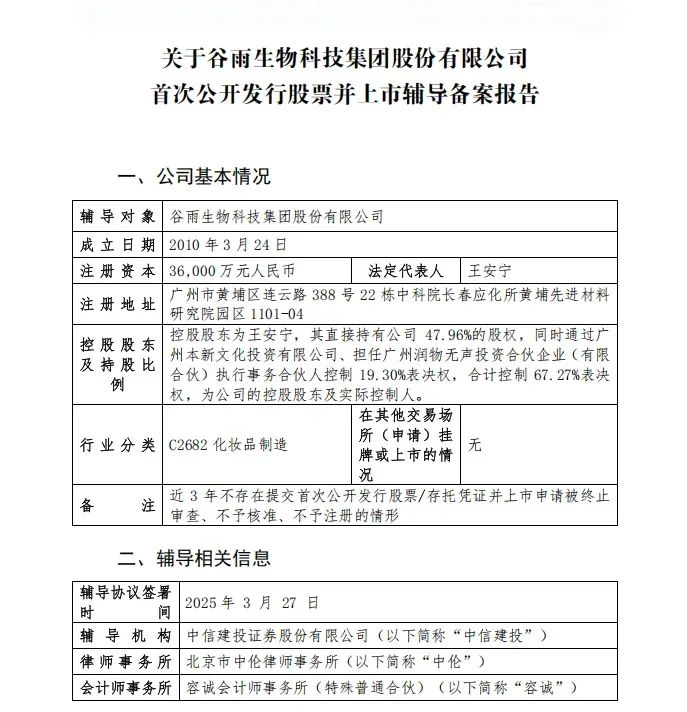
Core Viewpoint - The domestic skincare brand Gu Yu is set to launch its IPO process in A-shares, aiming to become the "first whitening stock" in the beauty market, despite facing challenges such as brand loyalty and high online sales ratio [1][3][25]. Company Overview - Gu Yu was established in March 2010 and has a registered capital of 36 million RMB. The company is headquartered in Guangzhou and is primarily engaged in cosmetics manufacturing [2]. - The company has shown rapid growth, with GMV reaching 10 billion RMB in 2010, and projected sales of 35 billion RMB in 2023 and over 50 billion RMB in 2024 [1][3]. Market Position - Gu Yu's sales growth positions it among leading domestic beauty brands, with competitors like Proya and Shiseido achieving significant revenue milestones [1][32]. - The brand's online sales ratio is projected to be 93% in 2024, indicating a heavy reliance on e-commerce channels [22]. Competitive Landscape - The domestic beauty market is experiencing intensified competition, with many brands accelerating their IPO processes as a survival strategy [25][26]. - Gu Yu has successfully leveraged various online platforms for marketing, including early adoption of live streaming on Taobao and collaborations with influencers on platforms like Xiaohongshu and Douyin [4][6]. Challenges and Risks - Despite its rapid growth, Gu Yu faces challenges such as insufficient brand loyalty, a lack of a diversified brand matrix, and the need to establish a stronger brand identity [3][14][20]. - The brand's reliance on a single product line and the potential for market saturation pose risks to its long-term sustainability [20][23]. Future Outlook - To succeed in the competitive landscape, Gu Yu must enhance its brand power and explore new product lines beyond its current offerings [20][30]. - The company aims to establish a more robust brand presence and diversify its product portfolio to mitigate risks associated with market fluctuations and consumer preferences [20][30].
2025 美妆行业拐点已至?高盛:这两大龙头最值得关注
Zhi Tong Cai Jing· 2025-05-09 07:36
中国化妆品行业2024/2025总结:需求与竞争态势趋稳,年初至今的估值重估已反映中期趋势;买入巨子 生物、上海家化(600315) 与高盛2025年的展望相符,中国美妆行业在2024年呈现出触底迹象,随后在2025年有所改善。需求从同 比负增长转为持平,竞争也变得更加理性,这在妇女节期间表现得尤为明显。 特别是2025年第一季度,中国内地市场销售额同比增长3.2%,高于高盛预期的全年内地市场需求增长 率1.2%。不过,这一增长被DFS渠道的滞后表现所抵消,韩国/海南地区的DFS渠道销售额同比分别下 降23%/11%,而高盛预期的全年美妆门店需求增长率为2.9%。 这就解释了为什么尽管美妆行业业绩表现并不突出(价格指数上涨31%,而MSCI中国指数仅上涨12%), 但年初至今该行业表现优异,这得益于50%的估值重估(12个月预期市盈率从下行周期的20倍升至30 倍),以及盈利基数滚动至2025年。同时,根据高盛共识数据,2025年预期盈利平均下调了11%。 高盛覆盖的中国化妆品公司2024/2025年业绩喜忧参半,除巨子生物外,其他公司销售额均未达预期, 但部分公司(如珀莱雅(603605)、上海家化)通过强 ...
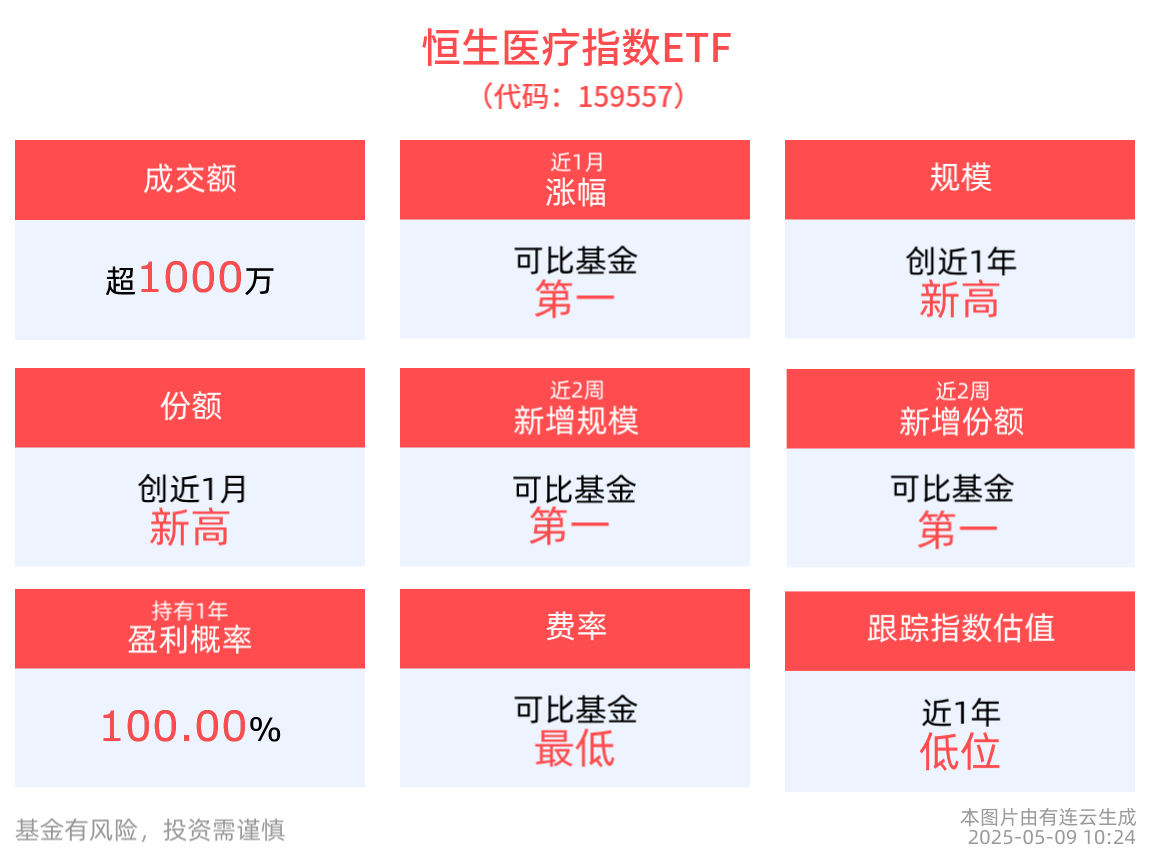
医药板块整体低估,恒生医疗指数ETF(159557)盘中涨近1%,最新规模创近1年新高!
Sou Hu Cai Jing· 2025-05-09 02:56
Core Viewpoint - The Hang Seng Healthcare Index has shown positive performance, with significant increases in constituent stocks, indicating a potential recovery in the healthcare sector [1][3]. Group 1: Index Performance - As of May 9, 2025, the Hang Seng Healthcare Index rose by 0.33%, with notable increases in stocks such as Zai Lab (+7.38%) and WuXi AppTec (+3.23%) [1]. - The Hang Seng Healthcare Index ETF (159557) has increased by 16.06% over the past month, ranking first among comparable funds [1]. Group 2: Liquidity and Scale - The Hang Seng Healthcare Index ETF recorded a turnover rate of 4.41% with a transaction volume of 11.35 million yuan [3]. - The ETF's latest scale reached 260 million yuan, marking a one-year high, with shares totaling 215 million, also a one-month high [3]. Group 3: Valuation Insights - The latest price-to-earnings ratio (PE-TTM) for the Hang Seng Healthcare Index ETF is 23.83, which is in the 4.36% percentile over the past year, indicating a valuation lower than 95.64% of the time in the last year [3]. Group 4: Market Outlook - China Galaxy Securities notes that the pharmaceutical sector has undergone a prolonged adjustment, resulting in low overall valuations and underweight public holdings. The policy support for commercial insurance development in 2025 is expected to improve payment conditions marginally, benefiting innovative drugs and medical devices [3]. - The company anticipates a sustained recovery in the pharmaceutical market, with structural opportunities remaining, particularly in the innovative drug supply chain [3].
从品类到品质,从品质到品牌
China Securities· 2025-05-09 01:20
Investment Rating - The report maintains a rating of "Outperform the Market" for the industry [3]. Core Insights - The industry fundamentals are expected to remain under pressure in 2024, with most sectors and companies still significantly affected by macroeconomic factors. However, a number of companies are emerging that are successfully navigating the challenges of consumer downgrade by upgrading from categories to quality and then to brand [1][2]. - The report highlights that companies with strong brand attributes are likely to continue outperforming as the market transitions from price-performance to quality-price comparisons [2]. Summary by Sections 1. Duty-Free Sector - The duty-free sales in Hainan are gradually stabilizing, with the implementation of the Hainan closure policy expected to benefit the duty-free sector. The market is seeing improvements in channel and supply chain capabilities, leading to a stable outlook for profitability [2][49]. - Key companies to watch include China Duty Free Group and Wangfujing [2]. 2. Tourism and Gaming - The tourism sector shows strong resilience in demand, becoming a crucial driver for domestic consumption. The recovery in inbound and outbound travel is significant, with a focus on new consumption scenarios and the silver-haired tourism market [2][3]. - Recommended companies include Jiuhua Tourism, Lingnan Holdings, and Sands China [2]. 3. Hotel Industry - The hotel sector is experiencing weak business travel demand, leading to pressure on RevPAR. However, leisure demand remains resilient, and leading companies are enhancing profitability through brand matrix validation and supply chain optimization [3][72]. - Companies to focus on include Huazhu Group, Atour, and Jinjiang Hotels [3]. 4. Restaurant Sector - Leading restaurant companies are demonstrating strong supply chain negotiation and profitability advantages. The overall supply in the restaurant industry is optimizing, with a competitive trend in price-performance [3][7]. - Notable companies include Mixue Ice City, KFC, and Haidilao [3][7]. 5. Cosmetics and Medical Aesthetics - The cosmetics sector is seeing a shift in focus towards profitability, with companies restructuring their product and channel strategies. High-growth companies are expected to achieve both revenue and profit increases [7][23]. - Key players include Juzhibio, Shumei, and Marubi [7][23]. 6. General Retail - The retail sector is undergoing digital upgrades and operational adjustments, with a focus on essential demand and cash flow stability. Companies like Yonghui Supermarket and Multi-Point Intelligence are recommended [8][30]. - The report also highlights the ongoing challenges in the jewelry sector due to rising gold prices [8][30]. 7. Overall Market Performance - The consumer services sector is expected to face challenges, with a projected performance of -8.70% in 2024. However, the beauty and personal care sector is anticipated to recover with a growth of +8.15% in 2025 [11][19].



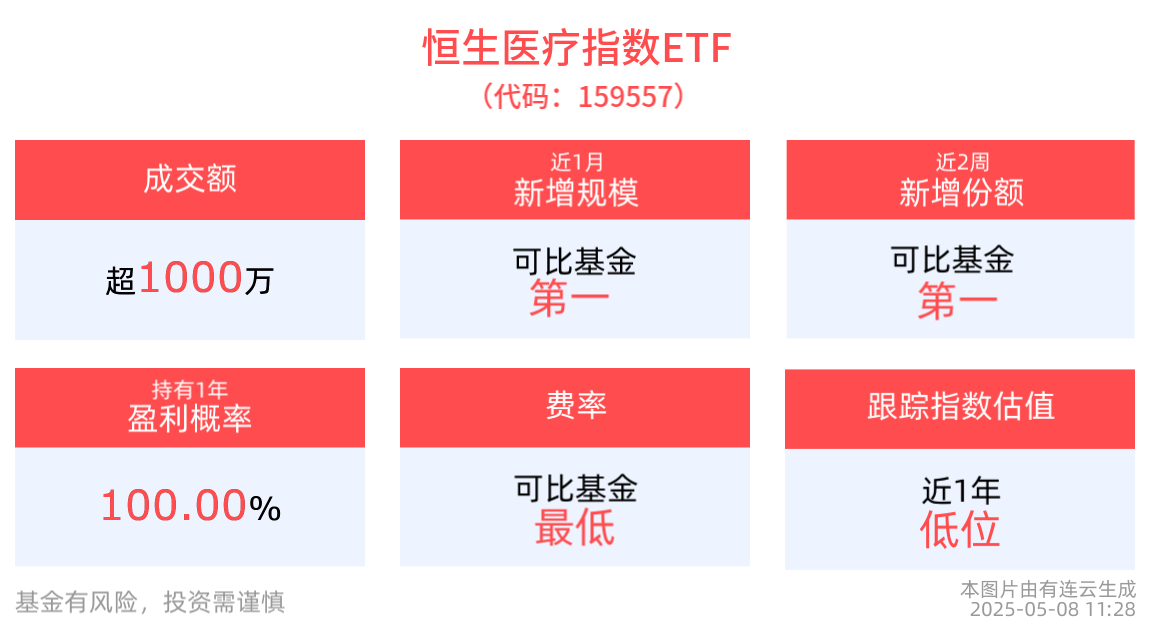
创新药市场有望迎来新的增长点,恒生医疗指数ETF(159557)近1月新增规模居可比基金首位
Sou Hu Cai Jing· 2025-05-08 03:55
Group 1 - The core viewpoint of the article highlights the significant growth and low valuation of the Hang Seng Medical Index ETF, indicating a potential investment opportunity in the healthcare sector [3] - The Hang Seng Medical Index ETF experienced a turnover of 5.22% during the trading session, with a transaction volume of 13.05 million yuan, and a scale increase of 38.30 million yuan over the past month [3] - The ETF's shares increased by 5 million over the past two weeks, reflecting strong demand [3] Group 2 - The current price-to-earnings ratio (PE-TTM) of the Hang Seng Medical Index is 24.24, which is in the 5.09% percentile over the past year, indicating that the valuation is lower than 94.91% of the time in the last year, suggesting a historical low [3] - As of May 7, 2025, the top ten weighted stocks in the Hang Seng Medical Index include WuXi AppTec, BeiGene, Innovent Biologics, and others, collectively accounting for 56.7% of the index [3] - According to Xinda Securities, the innovative drug sector is expected to show high investment value in the second quarter of 2025 due to positive industry dynamics and policy support, including expected outcomes from medical insurance negotiations and the recovery of the hospital market [3]
餐饮和化妆品怎么没跟上消费板块?
Sou Hu Cai Jing· 2025-05-08 02:38
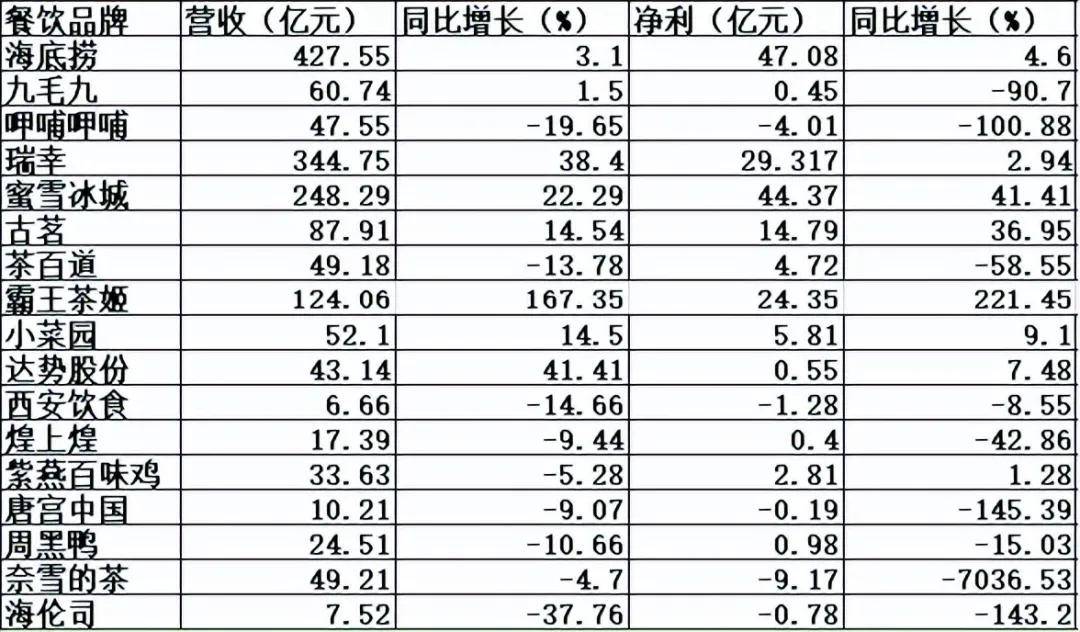
Core Viewpoint - The current hot sectors in the Chinese stock market are new consumption areas such as toys, tea drinks, and snacks, while traditional sectors like dining and cosmetics are lagging behind, with negative average growth rates in 2023 [1][14]. Dining Industry - The dining sector is experiencing a comprehensive downturn, with major players like Haidilao showing minimal growth, while tea drink companies are accelerating [1][7]. - The dining market is projected to grow at approximately 5.3% in 2024, contrasting with the 20% growth in the ready-to-drink tea segment, indicating a negative growth trend for dining [2][7]. - The dining industry faces challenges such as high competition, a saturated market with 9 million restaurants, and a business model that often prioritizes novelty over customer retention [7][9]. - Major dining companies are struggling with profitability, as evidenced by significant declines in net profits for brands like Jiumaojiu and Jiabujiahe [2][8]. - The dining sector's business model is unsustainable, with many restaurants failing to maintain long-term customer engagement, leading to a high turnover of brands [9][10]. Cosmetics Industry - The overall growth rate of the cosmetics industry is declining, with a notable 9% drop in imported cosmetics in 2024, indicating that domestic companies are not entirely to blame for the downturn [14][16]. - Consumer behavior is shifting towards reducing non-essential spending, impacting higher-priced cosmetics, which are often seen as replaceable [16][21]. - The performance of cosmetic companies is highly variable, with some achieving significant growth while others, like Aimeike and Huaxi Shengwu, face severe declines [18][21]. - The rise of new product trends, such as collagen-based skincare, is reshaping the competitive landscape, leading to the decline of established brands that fail to innovate [21][23]. - The cosmetics sector is characterized by intense competition and frequent brand turnover, making it difficult for companies to maintain long-term growth and stability [23][24]. Conclusion - Both the dining and cosmetics industries are facing significant challenges that hinder performance and valuation compared to more successful sectors like ready-to-drink tea and snacks [24].