宁德时代

Search documents
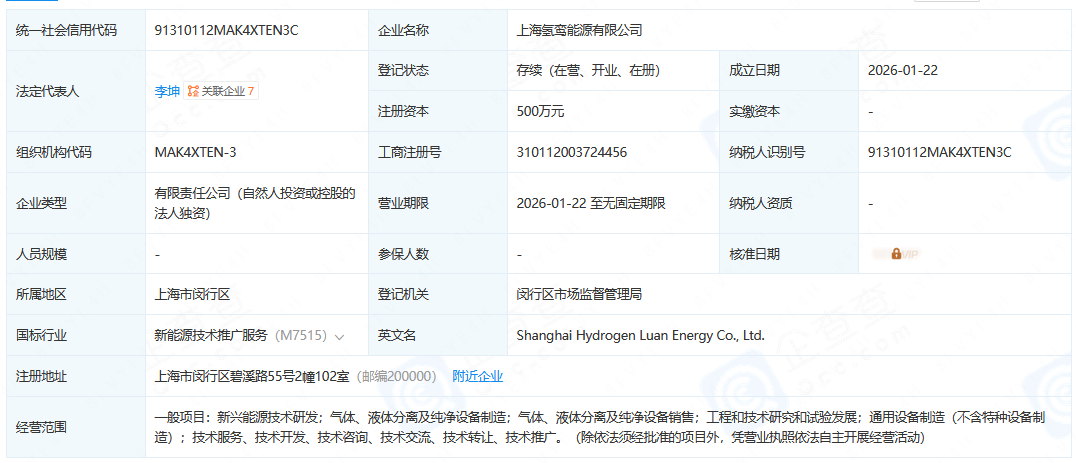
注资500万!上海氢鸾能源有限公司成立
Qi Cha Cha· 2026-02-10 01:54
Group 1 - Shanghai Qianluan Energy Co., Ltd. was established on January 22, 2026, with a registered capital of 5 million yuan, and is wholly owned by Shanghai Qianluan Technology Co., Ltd. [1] - The company's business scope includes emerging energy technology research and development, manufacturing and sales of gas and liquid separation and purification equipment, and various technical services [1] - The company is registered in Minhang District, Shanghai, and is currently in operation [1] Group 2 - Shanghai Qianluan Technology Co., Ltd. focuses on anion exchange membrane (AEM) water electrolysis hydrogen production technology and was founded in 2016 [2] - The core technical team of the company originates from Shanghai Jiao Tong University, Foshan Xianhu Laboratory, and the Dalian Institute of Chemical Physics, Chinese Academy of Sciences [2] - In November of the previous year, Ningde Times fully acquired a stake in Shanghai Qianluan Technology Co., Ltd., holding 11.1111% of the shares [2]

未知机构:GFDX宁德时代推荐员工持股计划调动积极性看好需求高增下业绩持续超预期2-20260210
未知机构· 2026-02-10 01:50
【GFDX】宁德时代推荐:员工持股计划调动积极性,看好需求高增下业绩持续超预期20260209 #事件。 今晚,宁德时代发布2026年A股员工持股计划(草案),拟参加持股计划员工总人数为4956人,受让价格(含预 留)为183.64元/股,规模不超过404.68万股,占公司总股本的0.09%。 参与对象为公司中层管理人员和核心骨干人员,主要是满足公司可持续发展需要以及吸引优秀人才。 解锁条件为个人绩效考核结果,持有人上一年度考核结果为A/B+/B/B-对应的解锁比例为100%,考核结果为C/D对 应的解锁比例为0%。 #锂电淡季即将结束、需求景气向上。 根据smm估计,3月电池环节排产环比+20%以上,反映需求向上。 我们认为,1)动力:1月以来,多个省市以旧换新细则落地,消费者观望情绪下降,车企订单有望逐步企稳。 2)储能:年后海外储能行业有望进入发货旺季,且在国内各省容量电价落地后,各省招标需求有望提升,储能有 望进入旺季。 展望26年,我们预计,动力增长15-20%+储能增长50-60%对应行业增长30%是大概率事件,看好需求增长带动锂 电周期反转。 【GFDX】宁德时代推荐:员工持股计划调动积极性,看 ...

传宁德时代收购华为数字能源最新进展!
鑫椤锂电· 2026-02-10 01:49
Core Viewpoint - The negotiation between CATL and Huawei Digital Energy regarding a potential acquisition has shifted from a full acquisition to a minority stake, ultimately stalling due to valuation discrepancies and strategic considerations [2][4][12]. Group 1: Market Overview - The global energy storage market is experiencing intense competition, with CATL's market share in energy storage cells declining from 37.9% to 26% in 2024, while Huawei Digital Energy ranks fifth in global energy storage system shipments [8][12]. - Huawei Digital Energy, established in June 2021, reported a sales revenue of 68.7 billion yuan in 2024, with a year-on-year growth of 24.4%, making it the third-largest business segment within Huawei [4][8]. Group 2: Strategic Implications - The initial plan for CATL was to fully acquire Huawei Digital Energy, but the valuation gap—Huawei's asking price of nearly 400 billion yuan versus CATL's expectation of 150-200 billion yuan—led to a shift towards a potential 20% stake acquisition [4][9]. - Huawei's strategy of focusing on core assets may conflict with the decision to sell Digital Energy, which plays a crucial role in its "energy digitalization" strategy [5][7]. Group 3: Competitive Landscape - If the acquisition had proceeded, it could have significantly altered the energy storage industry landscape, potentially increasing market concentration and intensifying competition with companies like Sungrow and BYD [11][12]. - The ongoing competition will continue as Huawei Digital Energy focuses on its inverter and energy storage systems, leveraging its technological advantages, while CATL aims to enhance its capabilities through self-research and strategic partnerships [12].
地平线(09660)与宁德时代子公司时代智能达成战略合作 共赴智能化新征程
智通财经网· 2026-02-10 01:45
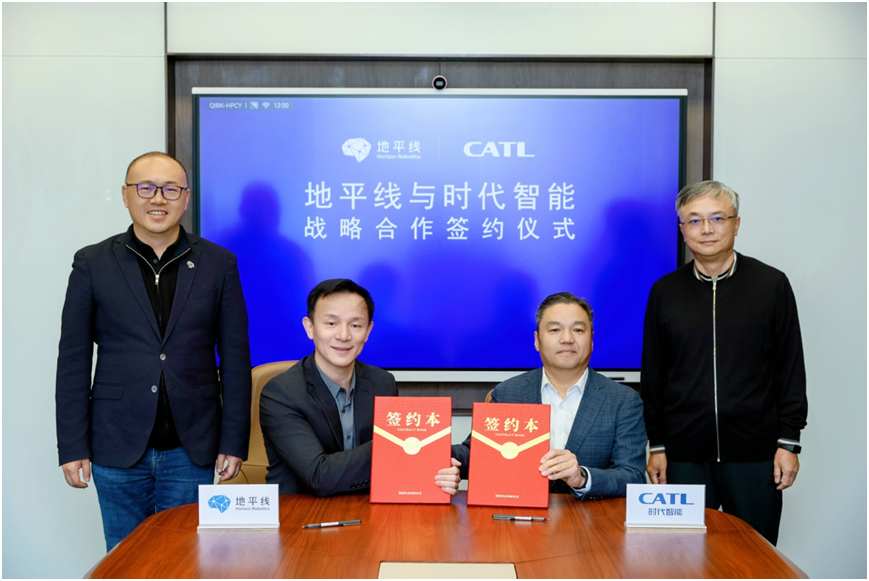
Core Insights - Horizon (09660) and CATL's subsidiary, CATL (Shanghai) Intelligent Technology Co., Ltd., signed a strategic cooperation agreement focusing on the intelligent upgrade needs of new energy vehicles, aiming to provide a high-intelligence and high-safety smart travel experience for global OEMs and end-users [1][3] Group 1: Strategic Cooperation - The agreement involves CATL providing its Rock Solid chassis series products and technologies, while Horizon contributes its full-scene assisted driving products and solutions, creating a comprehensive intelligent system from the underlying architecture to top-level applications [3][4] - This collaboration marks a transition from capital cooperation to technical research and product co-creation, indicating a new phase of value creation between the two companies [6] Group 2: Product and Technology Integration - Horizon specializes in passenger vehicle assisted driving solutions, integrating advanced algorithms, dedicated software, and processing hardware to enhance safety and user experience, having achieved over 10 million units shipped, making it the first domestic brand to reach this milestone [4][6] - The latest product, Horizon SuperDrive™ (HSD), is the industry's first mass-produced end-to-end full-scene assisted driving system, contributing to a new era of accessible intelligent driving [4] Group 3: Industry Ecosystem Development - Horizon has established partnerships with over 200 industry chain partners and strategic collaborations with top global Tier-1 suppliers like Bosch and Denso, aiming to build a mature, scalable production delivery system and a global industry ecosystem [6] - The partnership with CATL's Intelligent Technology is seen as a significant step in expanding technological boundaries and deepening commercial scenarios within the new energy smart vehicle ecosystem [6]
孚腾资本成立一支医疗健康基金
Sou Hu Cai Jing· 2026-02-10 01:38
Group 1 - The core viewpoint of the news is the establishment of the Shanghai Futeng Huming Private Equity Fund, which focuses on the healthcare sector, marking a significant step in Shanghai's investment in the biopharmaceutical industry and signaling the opening of a new value investment window in this field [1][2]. - The fund has a first-phase fundraising scale of 410 million yuan and has completed its first investment in Xihua Testing, a global integrated drug research and development outsourcing service company [1][2]. - The establishment of the fund is a result of deepening cooperation between Shanghai and Sanming, leveraging Sanming's innovative experience in medical reform and Shanghai's international resources [1][2]. Group 2 - Futeng Capital has already invested in several innovative companies in the healthcare sector, including leading firms in brain-computer interfaces and gene therapy, covering various fields such as innovative drugs and high-end medical devices [2]. - The fund will focus on growth and mature stage projects with clear clinical needs and commercial viability, employing strategies like "old shares + capital increase" and "mergers and acquisitions" to empower enterprises [2][3]. - The fund aims to leverage Shanghai Guotou's advantages in policy alignment and long-term capital to support portfolio companies in their international development paths and to attract more strategic partners for a sustainable healthcare investment ecosystem [3].
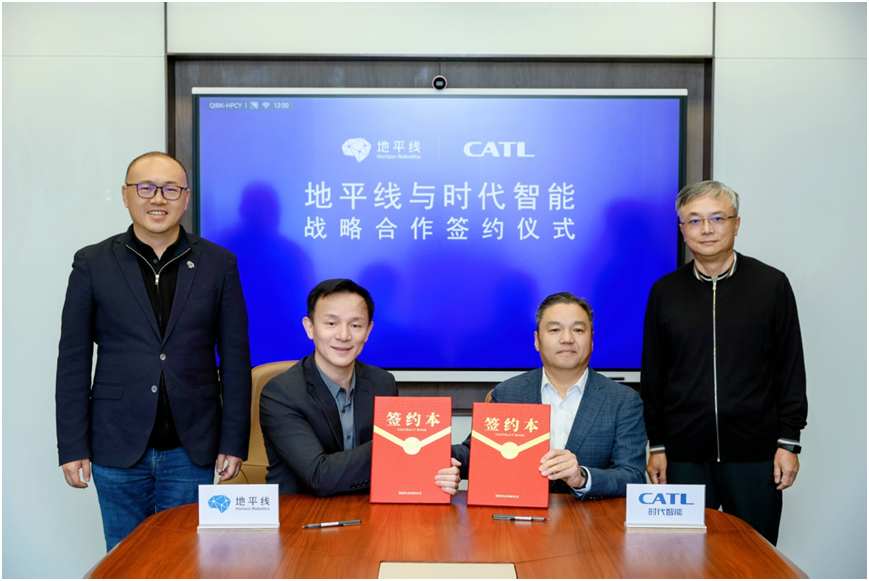
地平线与宁德时代子公司时代智能达成战略合作 共赴智能化新征程
Zhi Tong Cai Jing· 2026-02-10 01:32
2026年2月9日,地平线(09660)与宁德时代(300750)旗下子公司——宁德时代(上海)智能科技有限公司(简称"时代智能")签 署战略合作协议。双方将聚焦新能源汽车智能化升级需求,以"高智能、高安全的智能出行体验"为目标,为全球整车企业 与终端用户提供卓越的智能化出行体验。 随着市场对汽车智能化的需求日益强烈,时代智能与地平线此次合作,将成为汽车"智能载体"与"智能大脑"深度耦合的重要 探索。 从资本赋能到产品共创 共启新能源智能汽车新生态 地平线总裁朱威,时代智能董事总经理杨汉兵代表双方公司签约;宁德时代联合创始人、副董事长李平,地平线创始人兼 CEO余凯见证签约 软硬结合 探索"智能载体"与"智能大脑"结合新模式 根据协议,时代智能将提供其磐石底盘系列化产品与技术,地平线则将贡献其全场景辅助驾驶产品以及解决方案等汽车智 能化核心能力。双方通过软硬协同、跨域融合,共同探索从底层架构到顶层应用的完整智能化体系,为海内外OEM客户提 供更具竞争力与多样化的产品选择与服务支持。 时代智能是宁德时代旗下专注一体化智能底盘产品研发和技术服务子公司,核心产品为磐石底盘。磐石底盘作为独立的智 能移动载体,高度集成 ...
全国性储能容量电价机制出台,储能系统价格持续上涨
Zhong Guo Neng Yuan Wang· 2026-02-10 01:24
Core Viewpoint - The report highlights the growth in the solar and energy storage sectors, with significant export figures and production adjustments anticipated due to policy changes and market dynamics [1][4][5]. Production - Solar module production is expected to decrease by 13.58% month-on-month in December 2025, while there are plans for increased production due to export tax incentives, though actual implementation remains uncertain [2]. - Battery production for power, storage, and consumer applications is projected to be 188 GWh in February 2026, down 10.5% month-on-month, indicating a restructuring in supply with leading companies maintaining strong orders [2]. Pricing - As of February 4, 2026, the price of polysilicon remains stable at 54.00 CNY/kg, while the average price of 183N monocrystalline silicon wafers has decreased by approximately 7.41% to 1.25 CNY/piece [3]. - The average price of lithium battery storage systems in December 2025 is reported at 0.5882 CNY/Wh, reflecting a 2.82% increase month-on-month, with specific systems showing significant price variations [3]. Demand - In December 2025, solar module exports reached approximately $2.314 billion, marking an 18.22% year-on-year increase but a 4.05% month-on-month decline, while inverter exports totaled $839 million, up 26.12% year-on-year and 9.38% month-on-month [4]. - Domestic solar installations in November 2025 amounted to 22.02 GW, a 74.76% increase month-on-month, with cumulative installations for the year reaching 274.89 GW, a 33.25% year-on-year growth [4]. Investment Recommendations - The report suggests that the cancellation of VAT export rebates for certain products starting in April 2026 may boost domestic demand for solar products in the short term and lead to the elimination of outdated production capacity in the long term [5]. - Companies such as Sungrow Power Supply (300274), Chint Power (002150), and Nandu Power (300068) are recommended for investment, along with a focus on CATL (300750) and EVE Energy (300014) [5].




2026年中国换电站行业保有量、投资规模、企业排名速览:蔚来保有量占比超7成[图]
Chan Ye Xin Xi Wang· 2026-02-10 01:23
Core Insights - The article discusses the development and trends of battery swapping stations in China, highlighting their increasing importance in the electric vehicle (EV) ecosystem and the projected growth in the number of stations and investment scale by 2025. Group 1: Industry Overview - Battery swapping stations provide battery replacement services for electric vehicles, functioning as centralized charging facilities for battery storage, charging, and distribution [1] - By 2025, the number of battery swapping stations in China is expected to reach 5,155, representing a year-on-year growth of approximately 16% [7] - The investment scale for battery swapping stations in China is projected to be 3.418 billion yuan by 2025, showing a slight decrease compared to previous years [8] Group 2: Charging Methods - Current charging methods for new energy vehicles in China are divided into charging mode and battery swapping mode, with the latter being less mature but increasingly popular [2] - Battery swapping can be categorized into fixed swapping (swapping stations) and mobile swapping (swapping service vehicles), with fixed swapping being the primary method [2] Group 3: Pricing Structure - Revenue from battery swapping stations is mainly derived from package income and usage income, with C-end users paying around 1,000 yuan monthly for battery rental, while B-end users pay approximately 3,000 yuan for unlimited swaps [3] - Usage income is based on actual swapping volume, with two pricing options available for C-end users [3] Group 4: Policy Background - A comprehensive policy support system has been established for the battery swapping industry in China, including standards, subsidies, and operational guidelines [4][5] - Key policies include the release of design standards for battery swapping stations and initiatives to enhance charging infrastructure in county areas [4][5] Group 5: Industry Chain - The battery swapping industry chain consists of upstream battery suppliers, station component suppliers, and charging system suppliers, with midstream operators responsible for station construction and operation [6] Group 6: Current Market Status - The number of battery swapping stations in China is on a steady growth trajectory, driven by the rapid adoption of new energy vehicles and supportive policies [7] - By 2025, the market is expected to see a concentration of battery swapping stations in economically strong coastal provinces and major cities [9][10] Group 7: Competitive Landscape - The battery swapping market in China is characterized by a few dominant players, with NIO leading the market with a significant share of 71.6% of the total stations [11][12] - NIO's strategy includes building a self-operated battery swapping network, while other companies like Aodong focus on shared swapping services for high-frequency operational scenarios [11][12] Group 8: Future Trends - Battery swapping stations are evolving into integrated energy nodes that combine solar, storage, and V2G functionalities, enhancing operational efficiency and reducing costs [14] - The industry is shifting towards a more open and standardized model, allowing for compatibility across different vehicle brands and types, which is expected to increase station utilization and profitability [14]


2026格局与趋势 |(上):天黑请睁眼
3 6 Ke· 2026-02-10 01:20
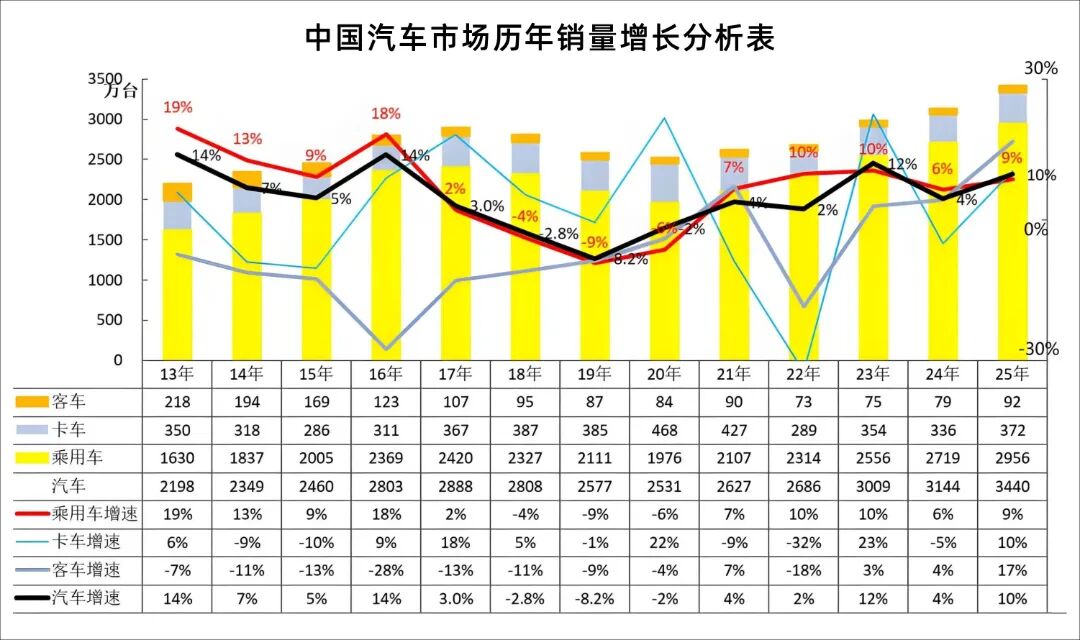
Core Viewpoint - The Chinese automotive market is facing significant challenges in 2026, with predictions of a decline in sales due to economic pressures and changing consumer behavior, despite some optimistic forecasts for growth in exports and specific segments like new energy vehicles [1][3][4]. Group 1: Market Trends and Predictions - In 2026, the overall automotive sales in China are expected to range between 34.5 million to 35 million units, with a potential decline in domestic retail sales by over 5% if no significant policy changes occur [3][7]. - January 2026 data shows a dramatic decline in retail sales, with a 28% year-on-year drop, indicating a challenging start to the year [6]. - Various institutions predict a range of outcomes for 2026, with the most pessimistic forecasts suggesting a 7% decline in sales, while the most optimistic predict only a 1% increase [4][7][8]. Group 2: Policy and Economic Influences - Key factors affecting the market include adjustments to subsidy policies for new energy vehicles, which have shifted from full exemptions to partial reductions, impacting consumer purchasing behavior [6][9]. - The decline in consumer confidence and shrinking middle-class income due to economic downturns are expected to further suppress automotive sales [6][9]. Group 3: Competitive Landscape - The automotive industry is experiencing intense competition, with a shift from price wars to a focus on technological advancements and value creation as companies seek to stabilize their market positions [12][16]. - Major players are adjusting their sales targets, with some aiming for significant growth while others adopt more conservative strategies in response to market conditions [18][19]. Group 4: Export Opportunities - Exports are projected to be a key growth area, with expectations of a 12-15% increase, potentially reaching 8 million units, which could help offset domestic market declines [22][26]. - The global supply chain dynamics are pushing Chinese automotive companies to enhance their international presence, with a focus on building global production and R&D capabilities [26][28]. Group 5: Segment-Specific Insights - The new energy vehicle segment is anticipated to grow, with retail sales expected to increase by 12-15%, driven by favorable policies for mid-range models [9][10]. - The large six-seat SUV market is projected to maintain strong growth, with expectations of a 30-50% increase in sales, despite overall market challenges [31][32].



锂电产业链历史不会重演,但会押韵
Zhong Guo Neng Yuan Wang· 2026-02-10 01:01
Core Viewpoint - The lithium battery supply chain has experienced significant price increases from 2020 to 2022, driven by strong demand and a smooth transmission of price hikes across the industry [2][3]. Group 1: Price Trends - Electrolyte prices started at 70,000 CNY/ton in September 2020, rising to 100,000 CNY/ton by the end of the year, and reaching a peak of 580,000 CNY/ton in February 2022, with long-term contract prices stabilizing between 200,000 to 300,000 CNY/ton [2][3]. - Iron lithium cathode prices, including phosphoric acid iron and processing fees, doubled in 2021, peaking at over 40,000 CNY/ton by the end of that year [2][3]. - Anode prices began to rise in Q3 2021 due to graphite production constraints, increasing from 12,000 CNY/ton to a high of 25,000 to 28,000 CNY/ton by Q2 2022 [2][3]. Group 2: Supply Chain Dynamics - Lithium carbonate prices rebounded from a low of 40,000 CNY/ton at the end of 2020 to 50,000 CNY/ton in early 2021, and surged to 300,000 CNY/ton by the end of 2021, eventually reaching 520,000 CNY/ton by February 2022 [2][3]. - The battery sector has effectively transmitted raw material price increases, with battery prices rising by 1 cent/wh in Q1 2021 and accelerating to 2-3 cents/wh in Q1 and Q2 of 2022, reaching over 1 CNY/wh [2][3]. Group 3: Future Outlook - Current market conditions resemble Q4 2020, with expectations for continued price increases due to strong demand and low profitability levels compared to previous years [3]. - The industry's expansion willingness is significantly lower than in 2021, with limited new supply expected by 2026, suggesting a more stable price environment [3]. - The anticipated price increases are not expected to be as dramatic as in 2021, with supply-demand tightness projected to be lower, particularly for hexafluorophosphate and lithium carbonate [3]. Group 4: Investment Recommendations - The current valuation of leading companies is considered reasonable, with expected industry growth of 20% in 2027, suggesting potential for investment in the battery sector, including companies like CATL, Yiwei Lithium Energy, and others [4]. - Material leaders such as Keda Lithium and others are also highlighted as strong investment opportunities, alongside companies in the lithium carbonate sector [4]. - The solid-state battery sector is recommended for investment, particularly with catalysts expected to materialize in Q4 2025 [4].