泸州老窖

Search documents
第四届中国酒业活态文化·国际化大会在太原举行
Zhong Guo Xin Wen Wang· 2025-11-13 06:25
会议同期启动"中国酒业口述史团体标准"起草工作,并成立"中国酒业口述史研究中心"。该中心作为活 态文化传承重要平台,将通过口述史方式系统记录酿酒业"心口相传"的技艺、记忆与经验,实现活态记 忆的规范化记录与传承,有效保存濒临失传的口头技艺和行业故事,为酒业活态文化发展提供有力支 撑。 中国酒业协会理事长宋书玉以《民族的就是世界的》为题发表主旨演讲,开篇即精准点明活态是中国酒 业新文化的本质特征。他指出,中国美酒的活态魅力,根植于千年传承却生生不息的酿造技艺,流淌于 社交场景的民俗礼仪,彰显于持续迭代的生活美学,承载着文化、文明、酿造、生活四重自信,推动国 际化已成为全行业的自觉行动。针对酒业出海的痛点难点,他明确五大"认知破壁"关键方向:打破"中 国白酒难出海"的思维定势、完成"中国美酒"到"世界名酒"的文化跨越、适配"中西合璧"的多元消费场 景、重塑"稀缺珍贵"的价值标签、升级"全球产业"的发展格局;同时给出四大实践路径:推动产业抱团 出海形成协同合力、实现从产品出口到产能输出的进阶升级、推进中国酒业"世界双遗"申报、聚焦香型 特色开展精准国际传播,为行业国际化发展指明方向。 帝亚吉欧大中华区公共事务与传播 ...

跌破1499,茅台来到了应有的位置上!
Sou Hu Cai Jing· 2025-11-13 06:17
Core Viewpoint - The price of Moutai has fallen below 1499 yuan, challenging the long-held belief in its price stability and raising concerns about the potential end of the "Moutai myth" [1][9]. Group 1: Factors Behind Price Decline - The decline in Moutai's price is attributed to multiple factors, including a stabilization in consumption and a decrease in demand due to the slow recovery of banquet and business consumption [7]. - The impact of e-commerce channels has disrupted the traditional pricing system, with platforms like Tmall and JD.com offering significant discounts, leading to transactions at the 1499 yuan price point [7]. - Increased supply from private stockpiles has emerged as individuals and scalpers begin to sell off their Moutai reserves, further pressuring prices [7][8]. Group 2: Implications for the Industry - The decline in Moutai's price has raised concerns about the broader implications for the high-end liquor market, as Moutai has historically served as a "value lighthouse" for other premium brands [13]. - As Moutai's price structure faces challenges, the premium pricing ability of other high-end brands is also under pressure, leading to a potential decline in their market performance [13]. - The industry may experience a structural rebalancing, with high-end liquor prices returning to rational levels and brand strength becoming a more critical competitive factor than price [14]. Group 3: Future Outlook - Moutai is expected to stabilize its market position through limited releases, optimized channel management, and the expansion of products targeting younger consumers [14]. - The brand's value may become more stable as it transitions from being viewed solely as an investment to being recognized as a consumable product that consumers are willing to buy and enjoy [14].


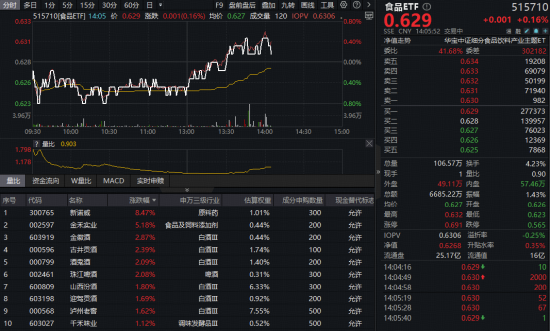
吃喝板块午后惊现逆转!白酒股集体躁动,食品ETF(515710)拉升翻红!估值洼地能否上车?
Xin Lang Ji Jin· 2025-11-13 06:13
Core Insights - The food and beverage sector experienced a reversal on November 13, with the Food ETF (515710) showing a slight increase of 0.16% after a period of low volatility [1][2] - Major liquor stocks, including Jinhuijiu, Gujinggongjiu, and Jiugui Jiu, saw significant gains, with increases exceeding 2% [1] - The China Alcohol Industry Association released a new cultural development outline for the industry, emphasizing the importance of cultural initiatives in addressing current challenges and enhancing international competitiveness [3] Industry Analysis - The newly released outline is seen as an upgrade from the previous five-year plan, targeting industry transformation by focusing on cultural aspects to resolve short-term sales issues and enhance long-term value recognition [3] - The food and beverage sector is currently at a historical low in terms of valuation, with the Food ETF's underlying index PE ratio at 21.24 times, indicating a favorable entry point for long-term investments [3] - The liquor sector has undergone five years of adjustment, with the average PE ratio of major liquor companies now below 20 times and an average dividend yield of approximately 3.5%, suggesting that the sector is entering a value zone [4] Investment Opportunities - The Food ETF (515710) is recommended for investors looking to gain exposure to core assets in the food and beverage sector, with a significant portion of its holdings in leading high-end liquor stocks [5] - The ETF tracks the China Securities Index's food and beverage theme index, with around 60% of its portfolio allocated to high-end liquor leaders and 40% to other segments like beverages and condiments [5]


泸州老窖(000568):泸州老窖2025年三季报点评:调整节奏,健康发展
Changjiang Securities· 2025-11-13 05:42
Investment Rating - The investment rating for the company is "Buy" and is maintained [6]. Core Views - The company reported a total revenue of 23.127 billion yuan for the first three quarters of 2025, a year-on-year decrease of 4.84% - The net profit attributable to the parent company was 10.762 billion yuan, down 7.17% year-on-year, while the net profit excluding non-recurring items was 10.742 billion yuan, also down 7.11% year-on-year - In Q3 2025, the total revenue was 6.674 billion yuan, a decline of 9.80% year-on-year, with a net profit of 3.099 billion yuan, down 13.07% year-on-year, and a net profit excluding non-recurring items of 3.092 billion yuan, down 13.41% year-on-year [2][4][6]. Financial Performance Summary - The company's gross profit margin for Q3 2025 was 87.17%, a decrease of 0.95 percentage points year-on-year - The net profit margin attributable to the parent company decreased by 1.75 percentage points to 46.44% - The operating expense ratio increased by 1.51 percentage points to 16.13%, with sales expense ratio increasing by 1.74 percentage points and management expense ratio increasing by 0.26 percentage points [6][9]. Future Outlook - The company is actively reducing inventory and is expected to operate with a lighter load in the future - The company is gradually assisting distributors in inventory clearance, and long-term, the national expansion of high-end products is progressing steadily, with increasing competitiveness of mid-tier products - The company is expected to achieve stable development, with projected EPS for 2025 and 2026 at 8.14 yuan and 8.43 yuan, respectively, corresponding to a PE ratio of 16 and 15 times [6][9].
食品饮料行业点评:内需政策提振及宏观数据持续修复下,食品饮料相关子行业有望回暖
Bank of China Securities· 2025-11-13 05:37
Investment Rating - The industry investment rating is "Outperform the Market" [1][19] Core Viewpoints - The food and beverage industry is expected to recover due to domestic demand policies and continuous macroeconomic data improvement. The focus on increasing residents' consumption power is a key goal in the "14th Five-Year Plan," making consumption enhancement a future policy priority. The recovery of the food and beverage sub-industries is anticipated under these conditions [2][4] - The report suggests prioritizing investments in sub-sectors benefiting from the recovery of dining consumption scenarios, such as frozen foods, condiments, and the broader dining supply chain. Key companies to watch include Anjijia Food, Yihai International, Baba Food, and Guoquan [2][4] Summary by Relevant Sections Macroeconomic Data - Since March, core CPI has been recovering, with September and October figures at 1.0% and 1.2%, respectively. The CPI turned positive in October at 0.2%, indicating a positive price trend. Retail sales of consumer goods from January to September increased by 4.5% year-on-year, with goods consumption outperforming dining consumption [4][2] Policy Environment - The report emphasizes that enhancing residents' consumption rates is a key goal in the "14th Five-Year Plan," with domestic demand playing a crucial role in economic growth. The contribution of final consumption expenditure to GDP growth has been higher than that of capital formation in recent years, indicating significant potential for consumption growth in China [4][2] Sub-Industry Performance - The liquor sector is showing signs of bottoming out, with revenue and net profit growth rates for the first three quarters of 2025 at -5.8% and -6.9%, respectively. The report notes that while the industry is currently at a low point, it is transitioning from "over-competition" to "orderly competition" [4][2] - The performance of leading companies in the consumer goods sector demonstrates resilience, particularly in frozen foods, beer, and dining chain formats. The report highlights that leading companies are adapting to market changes and improving their performance [4][2]
段永平:不买特斯拉,不喜欢马斯克品行|首席资讯日报
首席商业评论· 2025-11-13 04:36
1.段永平回应为何不买特斯拉,称不喜欢马斯克品行 11月11日,小霸王、步步高品牌创始人段永平在一档谈话节目中表示,不喜欢马斯克这个人。"马斯克这个 人是厉害,他有很多想法,也确实是很先进的,但是投资我觉得我比较难,我就说个人的角度来讲,我不 是很喜欢这个人的品行,就说你投资实际上你在跟着他做朋友,我不想跟他做朋友,哪怕给我钱我也不 干。 点评:日元贬值提振制造业,信心高涨迎复苏。 4.中期协:10月全国期货交易市场成交额为612,202.38亿元,同比增长4.54% 点评:企业家个人形象,对资本选择的影响力日益凸显。 2.谷歌将在德国投资55亿欧元,包括新建数据中心 11月11日,谷歌宣布将在德国投资55亿欧元(2026年至2029年),用于建设基础设施和办公场所,包括在迪 岑巴赫新建一座数据中心,继续投资现有的哈瑙数据中心园区,并扩建位于柏林、法兰克福和慕尼黑的办 公场所。 3.受日元贬值和稳健订单支撑,日本11月制造业信心创近四年新高 根据路短观调查,得益于日元贬值和稳健的订单,日本11月制造业信心升至近四年来的最高水平,电子和 汽车行业表现强劲。制造业信心指数从10月的8升至17,为2022年1月以来 ...

年轻人不买账,白酒这次真要凉?
3 6 Ke· 2025-11-13 03:02
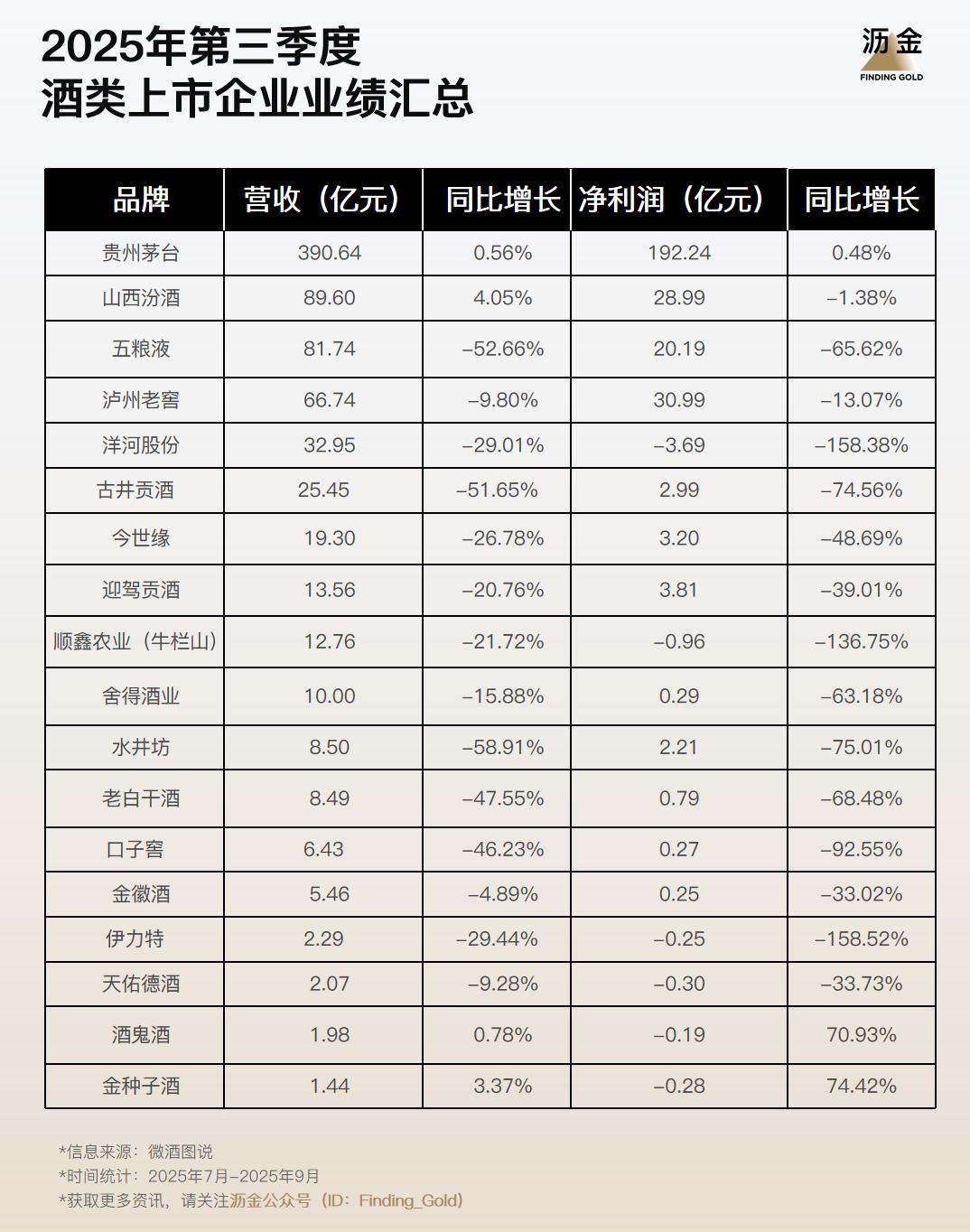
Core Viewpoint - The Chinese liquor industry, particularly the baijiu sector, is experiencing significant revenue and profit declines, with most companies facing challenges except for a few leading brands [1][4]. Financial Performance - Major brands like Kweichow Moutai reported a revenue of 39.064 billion yuan with a slight growth of 0.56%, while others like Wuliangye saw a drastic revenue drop of 52.66% to 8.174 billion yuan [2]. - The net profit for Kweichow Moutai was 19.224 billion yuan, reflecting a growth of 0.48%, whereas Wuliangye's net profit plummeted by 65.62% to 2.019 billion yuan [2]. - Other brands such as Yanghe and Gujing Gongjiu also reported significant declines in both revenue and net profit, indicating a broader industry downturn [2]. Market Sentiment and Public Perception - The introduction of the "ban on alcohol" in June is viewed as a catalyst for the current downturn, leading to reduced consumption in both public and business settings [1][4]. - Social media discussions have intensified around the notion that "baijiu is failing," with extreme expressions of pessimism emerging [3][4]. - The price of Kweichow Moutai's scattered bottles fell below 1,500 yuan, reflecting market panic and a loss of confidence [4]. Historical Context and Cycles - The baijiu industry has undergone four significant downturns since the establishment of New China, with each cycle characterized by structural adjustments and eventual recovery [6][11]. - The current downturn is seen as a continuation of a long-term structural adjustment rather than a sudden collapse, with historical patterns suggesting potential for recovery [8][11]. Cultural and Generational Shifts - The narrative surrounding baijiu has shifted, with younger generations perceiving it as a symbol of social pressure rather than a status symbol, leading to a disconnect in cultural significance [20][21]. - The traditional values associated with baijiu are being challenged by changing social dynamics, where younger consumers prioritize personal identity over societal expectations [22][23]. Future Outlook - The baijiu industry faces the challenge of redefining its narrative to resonate with contemporary consumers, particularly the younger demographic that shapes public discourse [25][27]. - Recovery will depend not only on price stabilization but also on rebuilding cultural relevance and consumer trust in the brand [28].


酒价内参11.13价格发布 飞天茅台终端价再小涨
Xin Lang Cai Jing· 2025-11-13 00:08
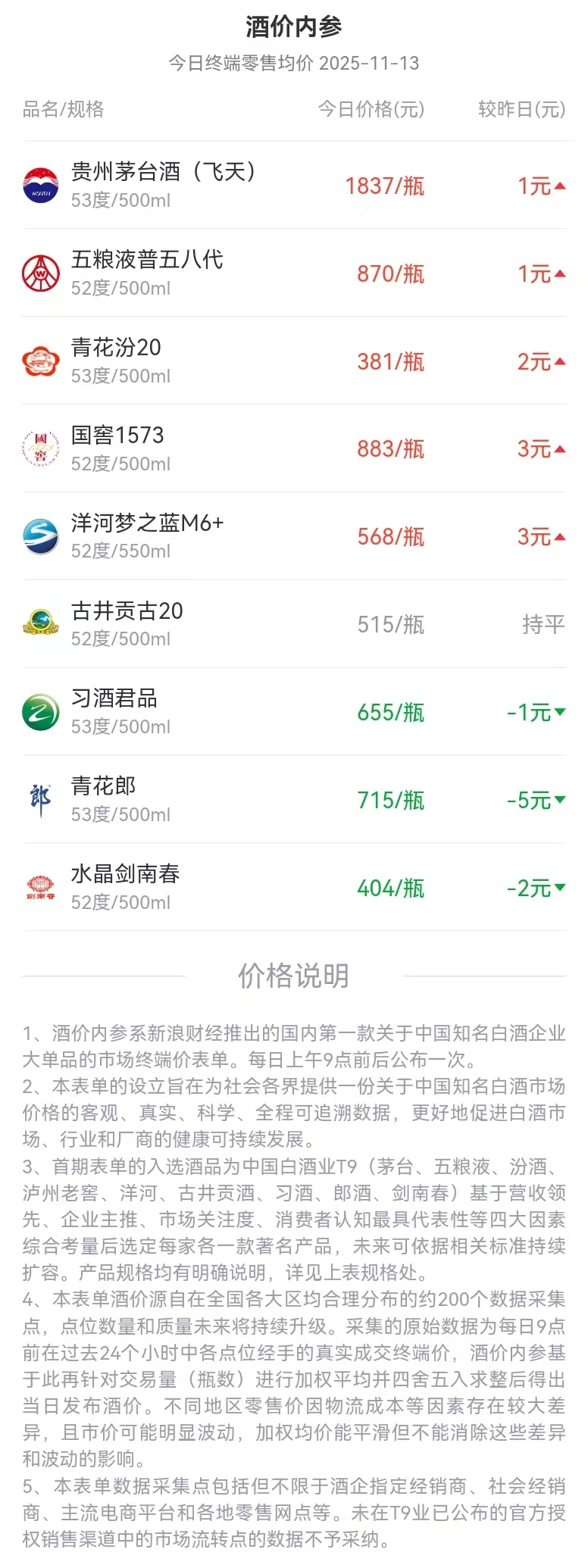
Core Insights - The average retail price of major Chinese liquor brands has shown a slight increase following the Double Eleven shopping festival, indicating a stable market trend for the industry [1] Price Trends - Moutai's Feitian liquor saw a price increase of 1 yuan per bottle, reaching 1837 yuan [3] - Other notable brands such as Guojiao 1573 and Yanghe Dream Blue M6+ both increased by 3 yuan per bottle, indicating a leading price rise among major products [1][3] - Wuliangye's Pu Wuhai edition increased by 1 yuan, showing signs of price stabilization [1] - Qinghua Fen 20 also experienced a price rise of 2 yuan, while Guqingong Gu 20 remained stable [1] - On the downside, Qinghua Lang saw a significant drop of 5 yuan per bottle, while Xijiu Junpin and Shuijing Jianan Chun decreased by 1-2 yuan, which is considered normal market fluctuation [1] Data Collection and Reporting - The price data is collected from approximately 200 points across major regions, including authorized distributors and retail outlets, ensuring a comprehensive representation of the market [6][7] - The data is published daily by Sina Finance, aiming to provide an objective and traceable overview of the Chinese liquor market [6]
A股鏖战4000点 多家券商看好明年慢牛行情
Zheng Quan Shi Bao· 2025-11-12 18:39
Core Viewpoint - The A-share market is experiencing significant rating adjustments by brokerages, with a total of 23 stocks upgraded and 40 downgraded since the end of October, indicating a mixed sentiment among investors and institutions [1][2]. Group 1: Rating Upgrades - A total of 23 A-share stocks have had their ratings upgraded, primarily in the electronics, pharmaceutical, food and beverage, power equipment, and automotive parts sectors [2]. - The electronics sector has the highest number of upgraded stocks, including companies like Guangli Micro (301095), Zhongwei Company, Yuanjie Technology, and Luguang Technology (301606), which are involved in high-tech fields such as semiconductors and consumer electronics [2][3]. - The upgrades are largely attributed to strong performance growth, high technical barriers, and improved industry conditions for the listed companies [2]. Group 2: Rating Downgrades - Approximately 40 A-share stocks have had their ratings or target prices downgraded, mainly in the pharmaceutical, food and beverage, electronics, power equipment, and beauty care sectors [4]. - The downgrades are primarily due to short-term performance challenges, declining gross margins, and reduced industry outlooks, leading to cautious sentiment from institutions regarding these companies' short-term profitability [4][5]. - The pharmaceutical sector has the highest proportion of downgraded stocks, including companies like Aibo Medical, Microelectrophysiology, and Mindray Medical (300760), with reasons including competitive pressures and performance pressures [4][5]. Group 3: Market Outlook - Major brokerages, including CITIC Securities and CICC, have released their 2026 annual investment strategies, generally optimistic about the A-share market's performance [7][8]. - CITIC Securities suggests that the A-share market is transitioning from a domestic focus to a global perspective, with expectations of a "slow bull" market characterized by low volatility during the "14th Five-Year Plan" period [7]. - CICC emphasizes the importance of global capital flows and domestic investment trends, suggesting a balanced market style in 2026, with a focus on growth sectors and external demand [8].
数字人民币试点覆盖民生多场景
Sou Hu Cai Jing· 2025-11-12 15:09
Core Insights - Digital RMB is becoming an integral part of daily life in China, enhancing various sectors from consumption to public services and cross-border payments [1][9] Group 1: Consumption Experience - Digital RMB is reshaping consumer experiences, particularly in daily transactions and services [3] - In Shenzhen, a collaboration between Agricultural Bank and the subway system has attracted 400,000 participants, enabling seamless payments even without internet or battery [2] - The introduction of "Digital RMB + Smart Contract" in housing services has streamlined the public fund withdrawal process, reducing it from three working days to real-time transactions [5] Group 2: Public Services - In healthcare, digital RMB is facilitating intelligent payment processes, with all public hospitals in Qingdao adopting online registration and payment systems [6] - The education sector is also benefiting, with digital RMB being used for tuition payments and research funding, ensuring transparency and security through its traceability and smart contract features [6] Group 3: Cross-Border Payments and Industrial Finance - Digital RMB is making strides in cross-border payments, exemplified by a recent transaction that reduced settlement time from 1-3 days to minutes for commodity imports [7] - In industrial finance, the "penetrating supervision" capability of digital RMB is aiding high-quality development in the real economy, as seen in a partnership between Zhejiang Wangshang Bank and Luzhou Laojiao [7] Group 4: Inclusive Finance - The ultimate goal of digital RMB is to create an inclusive financial ecosystem accessible to everyone, with initiatives like "one-click salary" for employees and a carbon credit platform in Qingdao [7] - Efforts are being made to extend digital RMB services from urban to rural areas, enhancing payment convenience for residents [8] Group 5: Future Outlook - The pilot practices of digital RMB signify a transformation in payment methods and an upgrade in financial services, evolving from a product to an industry [9] - Continuous innovations such as smart contracts and cross-border settlements are expected to further enhance the digital economy landscape [9]