格力电器

Search documents
格力拖了董明珠的后腿
Sou Hu Cai Jing· 2025-11-17 08:27
美的集团B+C模式驱动业务相对均衡,出海策略则多依托并购扩张,自主品牌建设度则相对不足。公司一号方洪波管理风格果断铁腕,为了变革敢于刀刃 向内,甚至趋于不近人情,由此也引发了不少争议。 海尔智家的家电门类较广,品牌扩散度较大,国内+海外双轮驱动营收,海外拓张有先发优势,是海尔集团营收基石,可难免稳定压倒一切。这些年低调 接棒的李华刚,遵从着张瑞敏时代的商业方针,这也让海尔智家表现得四平八稳,有些平平无奇。 不过,三家中引发最多争议与讨论的,或许归属格力空调和与之牢牢捆绑的董明珠。 缠斗多年的白电御三家,发展策略与掌舵者行事风格都有着鲜明特性。 "空调=格力=董明珠"的连带标签深入人心,与之相对的,是格力电器整体营收对空调为首的主营业务近8成的强依赖。急需二次成长格力电器需要更多时 间,更大空间。 只是摆在这家企业面前的,是一个ego越来越大的强势掌舵者。 一、长板与短板 企业战略选择本无对错。 类似"锥子效应"的企业战略是,在一定力量下,力量作用点越集中,聚焦效应越明显,企业往往可以集中资源办大事,在某一特定领域实现局部突破,刺 穿壁垒,从而对整体发展产生强大的带动作用。 这也是董明珠统领的格力电器坚守的战略 ...


价值投资的终极路线--理解社会大趋势
雪球· 2025-11-17 08:10
Core Viewpoint - The article discusses the investment philosophy of Warren Buffett, emphasizing that his investment in Google is not merely about supporting AI but rather about recognizing the potential for Google to remain resilient amidst rapid AI developments or potential market bubbles [4][11]. Group 1: Value Investment Understanding - Value investment is categorized into three levels: basic metrics like PB, PE, and PS; intermediate factors such as industry position, ROE, competitive advantages, growth potential, and free cash flow; and the ultimate understanding of future societal, economic, and industry changes [7][9][10]. - Many investors misunderstand value investment by equating it solely with purchasing leading companies in various sectors, such as consumer stocks or household appliances, without grasping the broader implications of Buffett's investment strategies [10][11]. Group 2: Misconceptions in Value Investment - Common misconceptions among value investors include linear thinking, excessive research, lack of understanding of major trends, and inefficiencies in research [12][13]. - Investors often mistakenly believe their understanding of industries and companies surpasses that of institutions and the market, leading to poor investment decisions [14][15]. Group 3: Investment Strategy Insights - The article highlights the importance of recognizing cyclical stocks versus growth stocks, stating that cycles are eternal while growth is temporary [14]. - It points out that many investors make errors by focusing too much on minute differences in valuation, especially when entering positions at high prices, which can lead to unfavorable odds [15][16].


可选消费W46周度趋势解析:A/H高股息和中高端消费回升带动子板块关注度提升-20251117
Haitong Securities International· 2025-11-17 07:49
Investment Rating - The report assigns an "Outperform" rating to multiple companies in the discretionary sector, including Nike, Midea Group, JD Group, Haier Smart Home, Gree Electric, Anta Sports, and others [1]. Core Insights - The report highlights a recovery in mid-to-high-end consumption and increased focus on high-dividend A/H stocks, which has driven attention to sub-sectors within discretionary consumption [1][4]. - Various sub-sectors have shown different performance trends, with overseas sportswear leading the gains, followed by luxury goods and domestic sportswear [4][12]. Performance Review by Sub-Sector - **Weekly Performance**: Overseas sportswear increased by 6.8%, luxury goods by 5.2%, and domestic sportswear by 3.8%. In contrast, the pet sector saw a decline of 5.8% [4][12]. - **Monthly Performance**: The gambling sector led with an 8.4% increase, while domestic cosmetics experienced a significant decline of 14.3% [12]. - **Year-to-Date Performance**: The gold and jewelry sector outperformed with a 137.2% increase, while overseas sportswear saw a decline of 21.5% [12]. Sub-Sector Analysis - **Overseas Sportswear**: Notable gains driven by strong Q3 FY25 earnings, particularly in EMEA and Asia-Pacific regions, alleviating market concerns [6][15]. - **Luxury Goods**: Companies like Samsonite and Burberry reported better-than-expected earnings, boosting market confidence [6][15]. - **Domestic Sportswear**: OEM companies confirmed growth expectations for 2026 orders, contributing to positive stock performance [6][15]. - **Gold and Jewelry**: The sector benefited from rising international gold prices and favorable tax regulations in Hong Kong and Macau [8][15]. - **Pet Sector**: Experienced a decline post Double Eleven sales, with increased competition among brands [15]. Valuation Analysis - The report indicates that most sub-sectors are trading below their historical five-year average P/E ratios, suggesting potential undervaluation [9][16]. - **Projected P/E Ratios for 2025**: - Overseas sportswear: 29.1x (55% of historical average) - Domestic sportswear: 14.8x (78% of historical average) - Gold and jewelry: 23.8x (45% of historical average) - Luxury goods: 27.0x (49% of historical average) [9][16].
“冷静王”三十而立 ——格力空调硬核质量的支流回眸
Zhong Guo Zhi Liang Xin Wen Wang· 2025-11-17 07:24
7月底的火焰山,空气都烫嘴。"您要做好心理准备,环境确实很恶劣。"格力电器市场总监朱磊飞赴吐鲁番之前接到了这样的现场汇报——搭建直播玻璃房 的工作人员,一个当地人工作半小时后晕倒,一个安装好空调后也晕倒了。 "真正缜密的,是'冷静王'本身的质量和技术。我们的底气,来自它的稳定与强悍。没有它,我们也不会有这个勇气跑到六七十(摄氏)度的火焰山去直 播。"朱磊在社交媒体上回忆。 老者道:"敝地唤做火焰山……却有八百里火焰,四周围寸草不生。若过得山,就是铜脑盖,铁身躯,也要化成汁哩。"三藏闻言,大惊失色。 《西游记》中唐僧师徒的第四十七难为"路阻火焰山,三借芭蕉扇",现实之中的"火焰山"映射在新疆吐鲁番市,这里被誉为中国的热极,夏季最高温度可达 47.8℃,地表温度更可高达82.3℃。 一个人在此地玻璃房中静待48小时并现场直播会发生什么?他能过关吗?媒体人任韧存疑,"陪伴他的,只有一台空调。他要把命吊在这台空调上。要么空 调送走高温,要么高温送走他"。 具体映射自然在产品本身。1998年,冷静王率先应用变频技术,成为品牌旗下首款变频空调。研发团队优化风道系统,采用大直径贯流风叶,创新将蒸发器 从单面升级为多折设计, ...

中国工业机器人上演“升职记”
Ren Min Ri Bao Hai Wai Ban· 2025-11-17 07:02
Core Insights - The evolution of industrial robots in China is transforming them from auxiliary tools to primary labor forces in manufacturing, significantly impacting global smart manufacturing dynamics [1][2][3] Group 1: Industrial Robot Development - China has become the world's largest industrial robot market, with an expected 2.027 million units by 2024, accounting for over 50% of global installations since the 14th Five-Year Plan [2][4] - In 2022, China installed nearly 300,000 new robots, surpassing the total installations in all other regions combined [3] - The density of industrial robots in China reached 470 units per 10,000 people, significantly exceeding the global average, indicating rapid advancements in smart manufacturing capabilities [3][4] Group 2: Application and Integration - Industrial robots are increasingly integrated into various sectors, with applications in 71 major industries and 241 sub-industries, enhancing productivity and efficiency [4][5] - The rise of "dark factories" in China, where automation is prevalent, is exemplified by companies like Midea, Xiaomi, and Gree adopting advanced robotic technologies in their manufacturing processes [4][5] - The integration of AI with robotics is enabling real-time monitoring and optimization of equipment performance, a practice that is not yet widespread in other regions [5][6] Group 3: Future Prospects and Innovations - The Chinese government is promoting the "Robot+" initiative to expand the depth and breadth of robot applications, focusing on areas like welding, assembly, and material handling [6][7] - Despite the early-stage application of humanoid robots in industrial settings, there is a growing ecosystem supported by government initiatives and a surge in startups focusing on specialized components [6][7] - The development of robots is seen as a solution to labor shortages and is expected to create new job opportunities in various sectors, including education, healthcare, and elder care [7]

国信证券:白电内销短期承压但韧性依旧 外销出海有望逐季复苏
智通财经网· 2025-11-17 03:50
2025年1-9月空调/冰箱/洗衣机内销量同比增长8%/2%/5%,其中9月开始出现下降,国补高基数压力初 显。后续看,国补高基数压力主要集中在2025Q4及2026Q2,后续增速有望逐步修复。中长期看,我国 空调需求仍具备增长潜力,尚有30%以上的家庭住房未安装空调;冰洗规模则相对稳定,行业需求韧性 充足。格局方面,空冰洗行业集中度均有所提升,1-9月空调行业CR3同比提升0.2pct,冰洗龙头海尔、 美的份额持续提升。 智通财经APP获悉,国信证券发布研报称,当前白电板块估值处于历史低位,内外销短期承压但中长期 韧性充足。内销在空调渗透率提升和龙头份额集中下仍有空间,外销随关税影响减弱、海外降息及产能 出海布局,有望逐季复苏。2026年基数压力缓解后有望回归稳健增长,龙头公司凭借份额提升与品牌出 海具备更强增长动能。 国信证券主要观点如下: 白电当前位置 通过复盘家电下乡期间家电的股价表现,该行发现,家电相对收益有望在销量同比增速最差的时间点触 底,并随着降幅的收窄而有所反弹。随着销量增速逐步回正并实现一定幅度的正增长,家电有望取得明 显正相对收益。在这期间,收入业绩增长稳健、市占率提升的家电龙头公司股价 ...
客厅里的智能战争
3 6 Ke· 2025-11-17 03:17
Core Insights - The home appliance industry in China is entering an era of full-home intelligence, with traditional appliance companies and tech firms like Huawei and Xiaomi intensifying competition through AI technology and smart ecosystems [1][2][7] Group 1: Market Dynamics - Traditional appliance companies such as Midea, Gree, Haier, and Hisense are seeking new growth points by developing AI technology, expanding product lines, and exploring international markets [1] - Tech companies like Huawei and Xiaomi leverage their established smart ecosystem advantages to enhance competition in the appliance market [1][2] - The trend towards smart appliances is evident, with many brands offering independent smart systems, often named with a prefix like "Xiao" [2] Group 2: Consumer Behavior - Consumers are increasingly drawn to smart appliances, with features like AI voice functionality appealing to families with children and elderly members [3] - A shift in consumer preferences is noted, with many opting for domestic brands over foreign ones, indicating a growing expectation for smart features in appliances [3][4] - The interest in full-home smart systems is rising, but many consumers face challenges due to incompatibility between different brands' systems [4] Group 3: Technological Advancements - Midea's full-home smart system integrates various home environments and appliances, evolving from passive responses to proactive services [5][6] - The interaction between vehicles and home systems is emerging, with Midea collaborating with companies like BYD and Tesla to enhance connectivity [5][6] - A report indicates that the smart home market in China is expected to grow at double-digit rates from 2023 to 2025, with smart security, lighting, and audio-visual products being the fastest-growing categories [6][7] Group 4: Competitive Landscape - Major players in the appliance sector include Gree, Midea, Haier, Hisense, and TCL, with the boundaries of the industry becoming increasingly blurred as companies embrace a broader home ecosystem [7][8] - The competition is intensifying, with a notable price war among domestic brands, as they strive to offer smart services that add higher value beyond traditional hardware manufacturing [8]


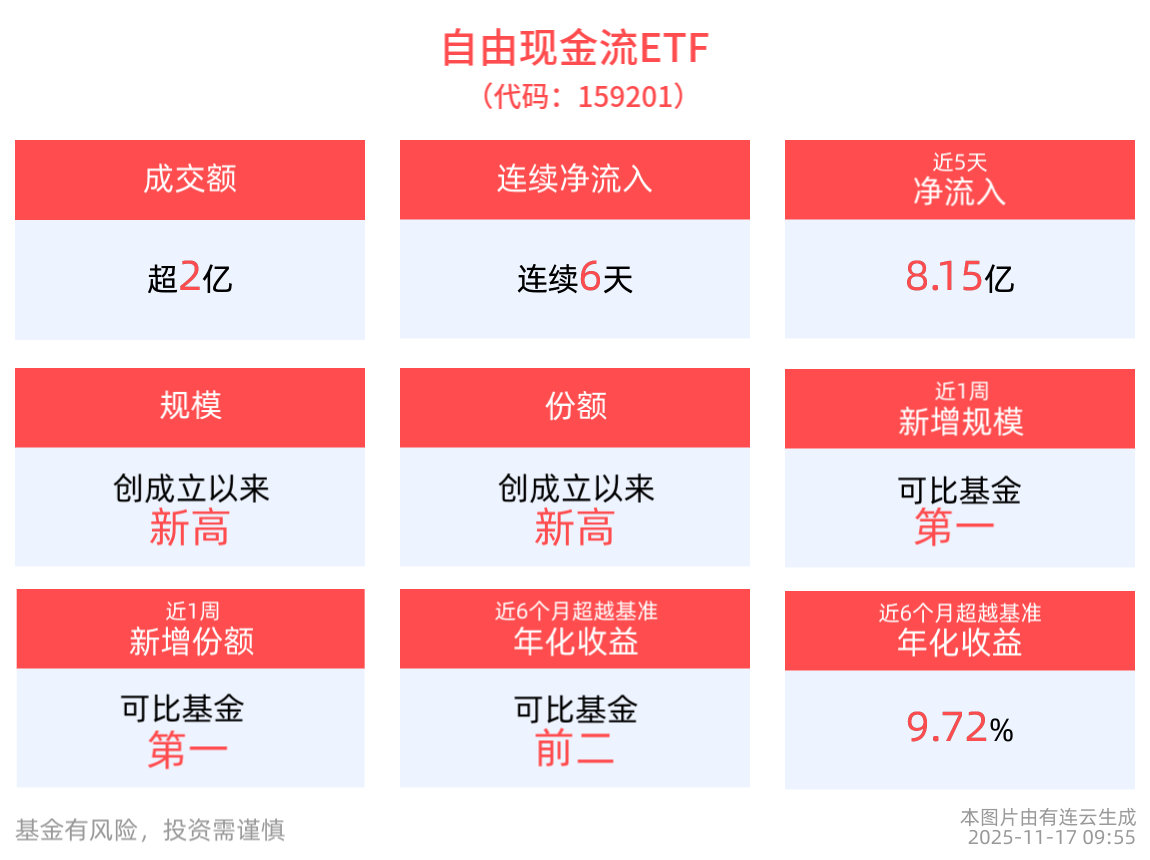
成交额超2亿元,自由现金流ETF(159201)连续6天净流入,合计“吸金”8.88亿元
Sou Hu Cai Jing· 2025-11-17 02:18
Core Insights - The Guozheng Free Cash Flow Index has decreased by 0.86% as of November 17, 2025, with mixed performance among constituent stocks [1] - The Free Cash Flow ETF (159201) has dropped by 1.07%, currently priced at 1.21 yuan, with a trading volume of 2.02 billion yuan [1] - Over the past six days, the Free Cash Flow ETF has seen continuous net inflows, totaling 8.88 billion yuan, with a daily average net inflow of 1.48 billion yuan [1][4] Performance Metrics - The Free Cash Flow ETF has achieved a net value increase of 22.85% over the past six months [4] - Historical performance shows a maximum monthly return of 7%, with the longest consecutive monthly gain of 6 months and a total gain of 22.69% [4] - The ETF has a monthly profit percentage of 87.5% and a historical 100% profit probability for holding over six months [4] Fund Details - The management fee for the Free Cash Flow ETF is 0.15%, and the custody fee is 0.05% [5] - As of October 31, 2025, the top ten weighted stocks in the Guozheng Free Cash Flow Index account for 54.79% of the index, including China National Offshore Oil Corporation and SAIC Motor [5] Stock Performance - The top ten stocks in the index have shown varied performance, with notable declines in stocks like Gree Electric Appliances (-1.08%) and China Aluminum (-2.57%) [7]






一个独具特色的城市发展样本
Ren Min Ri Bao Hai Wai Ban· 2025-11-17 02:07
Core Insights - The successful hosting of the first cross-border event in the history of the National Games, specifically the cycling race, highlights significant advancements in the integration of rules and mechanisms within the Greater Bay Area [1][3] Group 1: Innovation in Sports and Tourism - The cycling event featured a 231.8 km route across three regions, utilizing advanced technologies such as Beidou positioning and RFID for seamless border crossing [1] - The introduction of innovative tourism initiatives, including drone sightseeing and semi-submersible wave energy platforms, has enhanced the visitor experience in Zhuhai [2] - During the recent holiday period, Zhuhai welcomed over 3 million tourists, indicating a substantial increase in tourism revenue [2] Group 2: Economic and Infrastructure Development - Zhuhai has transformed from a traditional fishing city to a regional marine center, driven by innovation and significant investments in infrastructure [3] - The implementation of policies like "Hong Kong and Macau vehicles entering the mainland" has strengthened cooperation and connectivity between Zhuhai and its neighboring regions [3] - Major investments exceeding 100 billion yuan in "new marine infrastructure" projects are underway, alongside the development of drone logistics networks [3] Group 3: Cultural and Creative Initiatives - Historical buildings in Beishan Village have been revitalized under the concept of "art-led organic renewal," attracting young entrepreneurs from Macau [2] - The upcoming Asian General Aviation Exhibition will feature digital and interactive experiences, reinforcing Zhuhai's position in the international exhibition sector [4] - The ongoing development of innovative practices in Zhuhai contributes to its unique identity and confidence as it aims to become a world-class city cluster [4]

格力电器近10年分红1201亿 手握1162亿现金财务费持续为负
Chang Jiang Shang Bao· 2025-11-16 23:37
Core Viewpoint - Gree Electric Appliances continues its mid-term dividend plan, proposing a dividend of 5.585 billion yuan for the mid-2025 period, maintaining the same level as the previous year [2][3]. Dividend and Shareholder Returns - Since its listing in 1996, Gree has distributed a total of approximately 147.639 billion yuan in cash dividends, ranking 16th in the A-share market [4][5]. - Over the past decade, Gree has distributed around 120.1 billion yuan in cash dividends, placing it 14th in the A-share market [6]. - The company has conducted 32 cash dividend distributions since its IPO, with an average dividend payout ratio of 48.35% [4]. - Gree's dividend payout ratio for 2024 was 52.06%, with total cash dividends amounting to 16.755 billion yuan [3]. Share Buybacks - Since 2020, Gree has repurchased approximately 617 million shares, spending around 30 billion yuan, and has canceled about 415 million shares, which is 6.89% of the total shares before cancellation [10]. Financial Health - As of September 30, 2025, Gree's debt-to-asset ratio stood at 62.80%, with cash and cash equivalents totaling approximately 116.235 billion yuan [11]. - The company has a negative financial expense of -3.297 billion yuan for the first three quarters of 2025, indicating strong cash flow [13][14]. - Gree's cumulative profit since its listing is approximately 305.341 billion yuan, with a net profit of 32.185 billion yuan in 2024, marking a significant milestone [15]. Research and Development - Gree has invested approximately 33.3 billion yuan in R&D from 2020 to 2024, with R&D spending of 5.622 billion yuan in the first three quarters of 2025, reflecting a year-on-year increase [16].