
舜宇光学科技

Search documents
关税“黑天鹅”冲击全球市场,除了现金几乎没有资产是安全的
Sou Hu Cai Jing· 2025-04-07 04:57
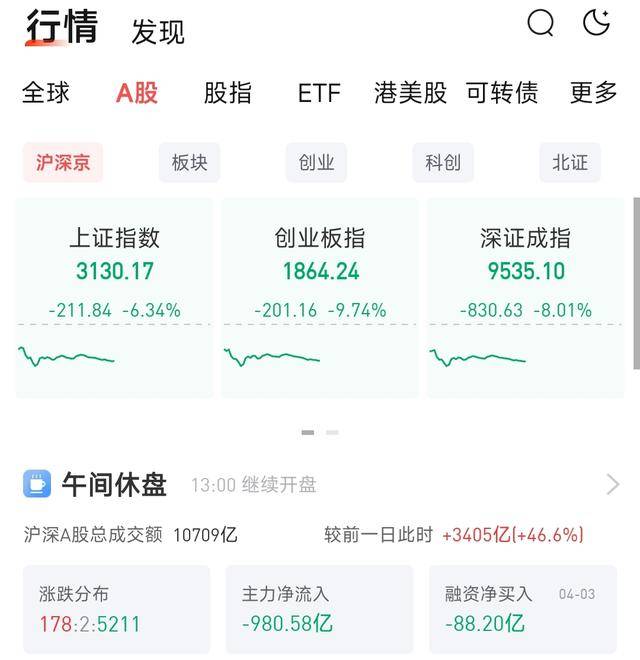
Market Overview - The A-share market experienced significant declines, with the Shanghai Composite Index dropping 6.34%, the Shenzhen Component down 8.01%, and the ChiNext Index falling 9.74%, resulting in over 5200 companies declining [2][4] - The Hong Kong market also faced severe losses, with the Hang Seng Index opening down 9.28% and the Hang Seng Tech Index falling 11.15%, as major stocks like WuXi AppTec and Lenovo Group dropped nearly 15% [5] Commodity Market Impact - The commodity market saw widespread declines, with WTI crude oil futures dropping below $60 per barrel, marking the lowest level since April 2021, and gold prices falling by 2.2% to below $3000 per ounce [8] - The Bloomberg Commodity Index experienced a significant drop of 5.8%, representing the worst weekly performance since 2022 [8] Tariff Policy Implications - The U.S. government's implementation of "reciprocal tariffs" has sparked global market turmoil, with the tariffs set at a minimum of 10% on trade partners, leading to widespread criticism and potential disruptions in global supply chains [9][10] - The Chinese government announced a 34% additional tariff on all imports from the U.S. starting April 10, 2025, in response to the U.S. tariffs, which are viewed as unilateral and damaging to international trade norms [10] A-share Market Outlook - Short-term market disturbances are anticipated due to the U.S. tariff increases, particularly affecting export-dependent industries, while long-term trends will depend on the recovery of domestic fundamentals [11] - Analysts suggest that the U.S. tariff policy may increase the risk of stagflation in the U.S. economy, potentially leading to earlier policy responses from China and creating opportunities for core asset allocations [11]

A股,冲上热搜!
证券时报· 2025-04-07 02:01
Market Performance - A-shares opened significantly lower, with the Shanghai Composite Index down 4.46%, Shenzhen Component Index down 5.96%, and ChiNext Index down 6.77% [5] - The North China Stock Index opened with a sharp decline of 7.04% [4] - The Hong Kong stock market also experienced a severe drop, with the Hang Seng Index down 9.28% and the Hang Seng Tech Index down 11.15% [11] Sector Performance - All major sectors in A-shares saw declines, with communication equipment, components, general machinery, and non-ferrous metals all dropping over 7% [7] - The agriculture, forestry, animal husbandry, and fishery sector showed relative resilience, with a decline of less than 1% [8] Impact of US Tariff Policy - The US tariff policy continues to impact global financial markets, leading to significant declines in A-shares and Hong Kong stocks [2][10] - The tariff policy is viewed as a tool for negotiation and coercion by the US, affecting various sectors in China, particularly electronics, light industry, and textiles [15][17] - The electronics sector, which accounts for 20% of China's exports to the US, is expected to face pressure due to the tariffs [17] Export Dependencies - The pharmaceutical and biotechnology sectors have a high dependency on exports to the US, with 25% of their total exports expected to be directed to the US in 2024 [18] - The automotive parts and home appliance sectors also have significant exposure to the US market and are likely to be heavily impacted by the tariffs [20]

中国滚针轴承行业发展状况及 投资前景调研2025~2031年
Sou Hu Cai Jing· 2025-04-06 04:43
Core Insights - The report provides a comprehensive analysis of the optical processing machinery industry, focusing on its development, market trends, and competitive landscape from 2021 to 2024, with forecasts extending to 2031 [2][3]. Industry Overview - The global optical processing machinery industry is expected to experience significant growth from 2021 to 2024, with key developments in major countries and regions [2]. - The Chinese optical processing machinery industry is also projected to grow, although it faces several challenges that need to be addressed [2]. Market Analysis - The market size and growth rate of the optical processing machinery industry from 2021 to 2024 are analyzed, indicating a robust expansion [3]. - The report discusses the market saturation levels and the impact of domestic and international economic conditions on market size [3]. Production Analysis - Production volume and growth rates for the optical processing machinery industry from 2021 to 2024 are detailed, along with capacity growth [3]. - The report predicts production trends for the industry from 2025 to 2031, highlighting the expected changes in supply and demand dynamics [3]. Competitive Analysis - The industry concentration and competitive landscape are examined, identifying key factors that influence competition, such as pricing, functionality, and product quality [3]. - The report categorizes competitors into different groups based on their market strategies and performance [3]. Downstream Industry Analysis - The growth and regional distribution of downstream industries utilizing optical processing machinery are analyzed, along with future development predictions [3]. - The impact of economic conditions on the downstream sectors is also discussed [3]. Profitability Analysis - The report includes an analysis of profitability metrics for the optical processing machinery industry, including gross profit margins and return on assets from 2019 to 2024 [4]. - Future profitability forecasts for the industry from 2025 to 2031 are provided [4]. Growth Potential Analysis - The growth potential of the optical processing machinery industry is assessed, with historical growth data and future projections [5]. - The report highlights key growth drivers and potential challenges that may affect the industry's trajectory [5]. Debt Servicing Capability Analysis - The report evaluates the debt servicing capabilities of companies within the optical processing machinery industry, analyzing key financial ratios [6]. - Predictions for the industry's debt servicing capacity from 2025 to 2031 are included [6]. Operational Efficiency Analysis - The operational efficiency of the optical processing machinery industry is analyzed, focusing on asset turnover ratios and operational metrics from 2019 to 2024 [7]. - Future operational efficiency forecasts for the industry are also discussed [7]. Key Company Analysis - The report provides detailed profiles of ten key companies in the optical processing machinery industry, including financial performance and competitive positioning [11][12]. - Each company's operational and financial metrics are compared to assess their market competitiveness [11][12].

舜宇光学科技(02382):手机产品结构优化显著,车载及新兴光学加速发展
Guoxin Securities· 2025-04-02 13:44
Investment Rating - The report maintains an "Outperform" rating for Sunny Optical Technology (02382.HK) [5] Core Views - The company is expected to achieve a revenue growth of over 20% year-on-year in 2024, with a significant increase in net profit by 145.5% [1][3] - The optimization of the mobile product structure is notable, with high-end products continuing to increase their market share [2] - The automotive optical sector is experiencing rapid development, with breakthroughs in various applications [2] - The emerging optical field, particularly in AI/AR glasses, is expanding significantly [3] Financial Performance Summary - In 2024, the company reported a revenue of 38.294 billion yuan (YoY 20.87%) and a net profit of 2.699 billion yuan (YoY 145.51%) [1] - Optical components revenue reached 11.708 billion yuan (YoY 22.53%), accounting for 30.6% of total revenue, while optoelectronic products generated 26.157 billion yuan (YoY 21.10%), making up 68.3% [1] - The overall gross margin improved by 3.8 percentage points to 18.3% in 2024, driven by product structure improvements [1] Product Segment Summary - Mobile-related revenue was 25.155 billion yuan (YoY 20.16%), representing 65.7% of total revenue, with the company maintaining the largest global market share in mobile camera lenses [2] - The automotive-related revenue reached 6.039 billion yuan (YoY 14.32%), accounting for 15.8% of total revenue, with the company also leading in the market share of automotive lenses [2] - AR/VR related revenue grew to 2.577 billion yuan (YoY 37.81%), making up 6.7% of total revenue, with the company holding the largest market share in XR visual modules [3] Earnings Forecast and Valuation - The forecast for net profit for 2025-2027 is adjusted to 3.462 billion yuan, 4.124 billion yuan, and 4.869 billion yuan respectively, with corresponding PE ratios of 21.4, 18.0, and 15.2 [3][4]

【招商电子】舜宇光学科技:24年业绩符合预期,关注智驾渗透、手机光学升规趋势带动
招商电子· 2025-04-02 11:08
Core Viewpoint - The company reported a strong performance for the year 2024, with revenue of 38.294 billion yuan, a year-on-year increase of 20.9%, and a net profit of 2.699 billion yuan, reflecting a significant year-on-year growth of 145.5% [2]. Group 1: Financial Performance - The company's revenue for 2024 reached 38.294 billion yuan, driven by the recovery in the smartphone market, increased sales of mobile camera lenses and modules, and growth in automotive intelligence and XR-related businesses [2]. - The gross margin for 2024 was 18.3%, an increase of 3.8 percentage points year-on-year, while net profit was 2.699 billion yuan, up 145.5% year-on-year, primarily due to improved product structure in mobile camera lenses and modules [2]. - In the second half of 2024, the company achieved a total revenue of 19.31 billion yuan, a year-on-year increase of 10.4%, with a net profit of 1.62 billion yuan, also reflecting a year-on-year growth of 145.5% [2]. Group 2: Mobile Business - The company expects an increase in both shipment volume and gross margin for mobile camera lenses and modules by 2025, with mobile product revenue for 2024 projected at 25.2 billion yuan, a year-on-year increase of 20% [3]. - In 2024, the shipment volume of mobile camera lenses reached 1.32 billion units, a year-on-year increase of 13.1%, maintaining the global leading position [3]. - The average selling price (ASP) of mobile camera modules significantly improved by 25%-27% in 2024, despite a 5.9% decline in shipment volume [3]. Group 3: Automotive Business - The automotive product revenue for 2024 was 6 billion yuan, a year-on-year increase of 14%, with camera lens shipments reaching 10.2 million units, marking a 12.7% year-on-year increase [4]. - The company aims for a 15%-20% year-on-year increase in automotive lens shipments by 2025, benefiting from the acceleration of automotive intelligence [4]. - The company has secured over 15 billion yuan in orders for automotive modules, with expected revenue growth of 40% in this segment by 2025 [4]. Group 4: XR Business - The company reported revenue of 2.6 billion yuan from AR/VR-related products in 2024, a year-on-year increase of 34%, with a focus on AI applications transforming XR hardware [5]. - Despite a potential decline in VR business, the growth in smart glasses is expected to keep overall revenue stable or slightly increase in 2025 [5]. - The company has expanded its customer base for AI glasses to 30 clients, indicating a strong market presence [5].

舜宇光学科技(02382):24年业绩符合预期,关注智驾渗透、手机光学升规趋势带动
CMS· 2025-04-02 08:48
Investment Rating - The investment rating for the company is maintained at "Buy" [6] Core Views - The company's 2024 annual revenue reached 38.294 billion yuan, a year-on-year increase of 20.9%, with net profit at 2.699 billion yuan, up 145.5% year-on-year. The growth is primarily driven by the recovery in the smartphone market and the rapid development of automotive intelligence [5][6] - The company is expected to benefit from domestic consumption subsidies and innovations in Android optical imaging, while the trend of intelligent driving is anticipated to drive growth in automotive lenses, camera modules, and related businesses [6] Summary by Sections Financial Performance - In 2024, the company's revenue was 38.294 billion yuan, with a gross margin of 18.3%, an increase of 3.8 percentage points year-on-year. The net profit was 2.699 billion yuan, reflecting a significant improvement in profitability [5][6] - The company aims for total revenue of 38.3 billion yuan in 2024, with projections of 43.072 billion yuan and 48.857 billion yuan for 2025 and 2026, respectively [6][7] Product Segments - **Mobile Segment**: Revenue from mobile products in 2024 was 25.2 billion yuan, with a year-on-year increase of 20%. The company maintained its position as the global leader in smartphone lens shipments, with a target to increase shipments by 5% in 2025 [5][6] - **Automotive Segment**: Revenue from automotive products reached 6 billion yuan in 2024, a year-on-year increase of 14%. The company aims for a 15%-20% increase in shipments in 2025 [5][6] - **XR Segment**: Revenue from AR/VR products was 2.6 billion yuan in 2024, a year-on-year increase of 34%. The company is focusing on AI applications to drive growth in this segment [5][6] Future Outlook - The company expects to see continued growth in its mobile and automotive segments, with significant improvements in product structure and profitability. The XR segment is anticipated to remain stable or see slight growth, driven by advancements in AI applications [6][7]
港股周报-2025-04-02
BOCOM International· 2025-04-02 06:52
Market Strategy - The report emphasizes a balanced allocation strategy, suggesting that investors should wait for opportunities for elastic rebounds after recent market pressures due to tariff policies and economic uncertainties [2][4]. - The report highlights that the market is currently lacking a clear narrative, leading to divergent capital flows and a technical adjustment in the Hang Seng Technology Index, which has fallen over 10% from its peak [4][5]. - The anticipated announcement of new tariffs by the U.S. is expected to include global tariffs as high as 20%, impacting all trade partners and increasing global risk aversion [4][5]. Sector Performance - The healthcare sector has shown resilience, with pharmaceutical companies experiencing upward momentum due to strong earnings, particularly in CDMO/CMO companies with significant overseas revenue [7][21]. - The materials sector has benefited from a rotation of funds into high-dividend stocks, with coal stocks seeing gains amid declining risk sentiment in technology and consumer sectors [7][21]. - The consumer sector is exhibiting structural trends, with companies like Pop Mart reporting strong earnings growth, while others like Miniso have seen stock price declines following underwhelming performance [7][21]. AI and Technology Developments - OpenAI and Alibaba have made significant updates to their AI models, enhancing multi-modal capabilities that integrate text, images, audio, and video, which are expected to drive commercial applications [10][16]. - The report notes that the AI infrastructure and cloud computing service providers are entering a valuation reconstruction phase, particularly in the context of domestic chip design companies benefiting from localization trends [7][10]. Consumer Sector Insights - The optional consumer sector has outperformed the necessary consumer sector in terms of profit growth, with a reported net profit increase of 39.4% compared to a decline of 2.76% for necessary consumer goods [21][32]. - Companies in the optional consumer sub-sector, such as Pop Mart, have reported significant revenue growth, with a 106.9% increase in annual revenue, driven by strong performance in overseas markets [35][36]. - The necessary consumer sector is under pressure, but there are expectations for marginal improvements as consumption stimulus policies are implemented in 2025 [32][35]. Market Overview - The Hong Kong stock market has experienced a continued pullback, particularly in the technology sector, with valuations nearing the highs of October 2024 [40][54]. - The report indicates that the risk premium for the Hang Seng Index has rebounded, reflecting a shift in market sentiment and a potential opportunity for investors [54][60]. - The report also highlights that the overall market momentum has weakened, with most sectors entering a lagging phase, except for optional consumer and healthcare sectors which are showing improvement [69][70].
3月科技、消费巨头获“爆买”,港股通科技ETF(513860)盘中涨超1%,零跑汽车涨超8%
2 1 Shi Ji Jing Ji Bao Dao· 2025-04-02 02:57
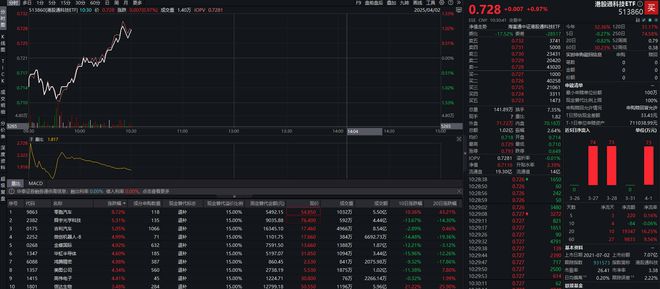
Group 1 - The Hong Kong stock market experienced a rapid rise on April 2, with the Hang Seng Index and Hang Seng Tech Index turning positive, the latter increasing by over 1% [1] - The Hong Kong Stock Connect Tech ETF (513860) saw a significant increase, rising over 1.1% at one point and closing with a gain of 0.97%, with a turnover rate exceeding 7% and a trading volume over 100 million [1] - Notable individual stocks included Li Auto, which rose over 8%, and Sunny Optical Technology and Geely Automobile, both increasing by over 5% [1] Group 2 - According to Wind Financial Terminal data, the Hong Kong Stock Connect Tech ETF (513860) had net inflows for 3 out of the last 5 days [3] - Southbound funds have aggressively purchased 160 billion HKD worth of stocks, particularly in the technology and consumer sectors, with a total net buy of 438.65 billion HKD year-to-date, surpassing half of last year's total net purchases [3] - In March, southbound funds recorded a net buy of 160.28 billion HKD, marking the third consecutive month with net purchases exceeding 100 billion HKD, the second-highest historical peak after January 2021 [3] Group 3 - West Securities reported that the breakthrough of DeepSeek technology diminishes the valuation monopoly of AI in the U.S., raising concerns about the U.S. economy due to tariffs imposed by Trump, leading to a shift in expected returns between China and the U.S. [4] - The Hang Seng Tech Index is currently trading at a lower price-to-earnings ratio compared to global tech stocks and is at a historical low for itself [4] - The emergence of DeepSeek positions Chinese technology firms as core competitors rather than mere followers, enhancing expectations for profitability [4]

2025年SEMICON大会总结及半导体行业观点更新
2025-03-31 05:54
Summary of the SEMICON Conference and Semiconductor Industry Insights Industry Overview - The SEMICON China conference held in Shanghai showcased over 1,400 exhibitors, marking a record high, with significant participation from the entire semiconductor supply chain including design, manufacturing, packaging, testing equipment, components, and materials [3][4] - Domestic semiconductor equipment and materials manufacturers are making notable progress, with new companies, technologies, and products emerging, injecting vitality into the industry [3] Key Trends and Insights - The number of exhibitors at the 2025 SEMICON is expected to grow by 30% compared to 2024, indicating an acceleration in domestic substitution and a trend towards industry consolidation [3] - SEMI forecasts a nearly 20% growth in the global semiconductor market in 2024, reaching approximately $620 billion, with over 10% growth expected in 2025 and a potential market size of $1 trillion by 2030, driven primarily by AI infrastructure development [3][5] - The investment sentiment in the electronics sector is currently weak, with a focus on low-position leaders like Luxshare Precision and a positive outlook on the IoT sector, particularly related to Xiaomi's upcoming products [6] Domestic Semiconductor Landscape - China's semiconductor upstream localization rate is currently below 30%, with even lower rates in advanced segments, facing challenges from tightening overseas restrictions. However, domestic manufacturers are expected to benefit from breakthroughs in advanced segments, potentially leading to growth rates surpassing the global average [10][9] - New product launches from companies like Jinkailai, including over 30 new devices in etching, thin film, diffusion furnace, and measurement equipment, are anticipated to accelerate the domestic semiconductor equipment localization process [11] - Major domestic players such as North Huachuang, Zhongyin Rongye, and Tuojing Technology are enhancing their technological capabilities, contributing to the completion of the domestic semiconductor supply chain [12] Government and Capital Support - The 2025 government work report emphasizes strengthening the semiconductor industry's foundational capabilities, with significant capital investments aimed at enhancing domestic supply chains [13] Future Industry Trends - The semiconductor industry is expected to undergo consolidation, with a trend towards platformization among domestic manufacturers. This will likely lead to a concentration of leading firms capable of industry integration [14][15] - The demand for wafer fabrication expansion in China is projected to rise rapidly in 2025, driven by increasing localization needs, benefiting companies with advanced process capabilities [16] Challenges and Opportunities - The U.S. export controls on AI chips are anticipated to further stimulate domestic chip demand in China, as the country seeks to adapt to increasing restrictions [17][18] - The recent updates to the U.S. entity list, which includes several Chinese AI-related companies, reflect ongoing demand for the Chinese supply chain, although the industry has developed strategies to mitigate potential impacts [19] Conclusion - The semiconductor industry is poised for significant growth, driven by domestic substitution, technological advancements, and supportive government policies, despite facing challenges from international trade dynamics and localization efforts.


舜宇光学科技:持续提升手机和车载光学技术能力,龙头地位稳固-20250330
Orient Securities· 2025-03-30 08:05
Investment Rating - The report maintains a "Buy" rating for the company with a target price of 114.55 HKD [5][10]. Core Insights - The company is expected to see significant growth in earnings per share (EPS), with projections of 2.47, 3.09, and 3.52 CNY for the years 2024 to 2026, respectively, reflecting an upward adjustment from previous estimates [2][10]. - The company is solidifying its leading position in mobile and automotive optical technology, with a focus on product development and market expansion [1]. Financial Performance Summary - Revenue is projected to grow from 31,832 million CNY in 2023 to 47,033 million CNY in 2026, with a compound annual growth rate (CAGR) of approximately 10% [4]. - Operating profit is expected to rebound significantly, from 750 million CNY in 2023 to 3,797 million CNY in 2026, indicating a strong recovery [4]. - Net profit attributable to the parent company is forecasted to increase from 1,099 million CNY in 2023 to 3,856 million CNY in 2026, with a notable growth rate of 146% in 2024 [4][9]. - The gross margin is anticipated to improve from 14.5% in 2023 to 19.0% in 2026, reflecting enhanced operational efficiency [4]. Business Segment Performance - The optical components business is expected to grow by approximately 23% in revenue, driven by a 13% increase in automotive lens shipments and the successful launch of new high-performance products [9]. - The mobile lens segment is projected to maintain its global market leadership, with a 13% increase in shipments, supported by advancements in product technology [9]. - The optoelectronic products segment is forecasted to grow by about 21%, with significant improvements in product structure and market share [9].