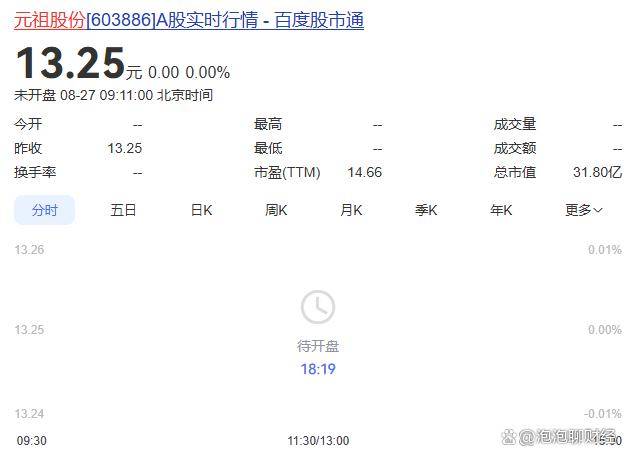
洋河股份

Search documents
寒武纪一度问鼎“股王”!这些公司股价也曾超越茅台
天天基金网· 2025-08-28 12:12
Core Viewpoint - The article discusses the recent surge in the stock price of AI chip giant Cambricon, which briefly surpassed Kweichow Moutai to become the new "king" of A-shares, and the implications of this event in relation to the so-called "Moutai curse" [5]. Group 1: Stock Performance - On August 27, Cambricon's stock price rose over 10%, reaching a peak of 1464.98 CNY per share, surpassing Kweichow Moutai [5]. - The "Moutai curse" refers to the phenomenon where companies that exceed Kweichow Moutai's stock price often experience a subsequent decline [5]. - Historical data shows that since Kweichow Moutai broke the 100 CNY mark in early 2007, over ten stocks have surpassed it, with varying durations of maintaining that position [5]. Group 2: Historical Context - The longest duration for a stock to remain above Kweichow Moutai was approximately one year for China Shipbuilding and Yanghe Brewery, while many stocks only briefly exceeded it, with some lasting less than a day [5]. - Notable examples of significant declines after surpassing Kweichow Moutai include the now-defunct company, Storm Technology, which saw a peak in stock price shortly after exceeding Moutai, followed by a cumulative drop of 70% within three months [5].




白酒:从周期角度看白酒的布局时点:充分考虑周期的学习效应,当下或是绝对收益起点
Hua Yuan Zheng Quan· 2025-08-28 06:26
Investment Rating - The report rates the white liquor industry as "Positive" (First Time) [1] Core Viewpoints - The current moment is seen as a potential starting point for absolute returns in the white liquor sector, considering the cyclical learning effects [4] - The white liquor industry has returned to cyclical characteristics, with fund holdings dropping to levels seen in 2017, and the food and beverage sector's overweight ratio has decreased significantly from a peak of 11% in 2019 to 3.2% [4][13] - The valuation of the white liquor sector has declined by 72% over the past four years, indicating a slow and steady adjustment process, unlike previous cycles [4][18] - Historical analysis suggests that the bottoming out of the white liquor index occurred after the 2014 Spring Festival, which is anticipated to happen again during the current cycle [5][22] Summary by Sections 1. Decline in White Liquor Holdings and Return to Cyclical Stock Characteristics - Fund holdings in the white liquor sector have decreased to 2017 levels, indicating a shift back to cyclical stock characteristics [10][13] - The overweight ratio of the food and beverage sector has significantly decreased, reflecting a gradual exit of funds focused on long-term value [4][13] 2. Review of Previous Cycle's Bottoming Characteristics - The previous cycle's bottoming process involved several stages, including a decline in dealer profitability, reduced receivables, and a subsequent recovery in real demand [4][18] - The current cycle is expected to show a similar pattern, with the learning effect potentially leading to an earlier inflection point for absolute returns [4][18] 3. Upcoming Investment Timing - The report suggests monitoring for signs of risk clearance in financial statements and early inventory reduction among dealers as indicators for potential investment opportunities [4][6] - Specific companies to watch include Luzhou Laojiao for its high dividend yield and Yingjia Gongjiu for its low valuation and inventory clearance [4][6]





【盘中播报】23只个股跨越牛熊分界线
Zheng Quan Shi Bao Wang· 2025-08-28 06:24
Market Overview - The Shanghai Composite Index is at 3812.43 points, above the annual line, with a change of 0.32% [1] - The total trading volume of A-shares is 1,230.98 billion yuan [1] Stocks Breaking Annual Line - 23 A-shares have broken above the annual line today, with notable stocks including Chuangyi Information, Zhongfu Information, and Qifeng New Materials, showing divergence rates of 11.29%, 5.02%, and 3.05% respectively [1] - Stocks with smaller divergence rates that have just crossed the annual line include Guizhou Tire, Andisoo, and Haier Smart Home [1] Top Stocks by Divergence Rate - Chuangyi Information (300366) has a daily increase of 13.27% and a divergence rate of 11.29% [1] - Zhongfu Information (300659) has a daily increase of 6.91% and a divergence rate of 5.02% [1] - Qifeng New Materials (002521) has a daily increase of 3.24% and a divergence rate of 3.05% [1] Additional Stocks with Minor Divergence - Anuoqi (300067) shows a daily increase of 2.60% with a divergence rate of 1.87% [1] - Henglin Shares (603661) has a daily increase of 2.56% and a divergence rate of 1.35% [1] - Other stocks with minor divergence rates include Rabbit Baby (002043), Landun Optoelectronics (300862), and Transsion Holdings (688036) [1]





7800%利润蒸发!21家消费龙头业绩集体崩塌,白酒零食全沦陷了
Sou Hu Cai Jing· 2025-08-28 05:44
Core Viewpoint - The consumer sector in China is facing a significant downturn, with major companies reporting substantial declines in performance, indicating a deep-rooted crisis within the industry [1][2][3][4][5][7]. Group 1: Alcohol Industry - The high-end liquor market, particularly represented by Moutai, has seen a drastic price drop from 3000 yuan to 1780 yuan, reflecting a significant decline in demand [2]. - Wuliangye's actual transaction price has fallen below 900 yuan, and the industry is experiencing widespread channel price inversion, causing distress among distributors [2]. - The net profit of Jiu Gui Jiu plummeted by 93%, with revenue shrinking by 44%, highlighting the severe impact of reduced demand for business banquets [2]. - Inventory issues are prevalent, with the liquor industry facing 150 billion yuan in stock and distributors experiencing an average turnover period of 900 days [2]. - Young consumers show a mere 19% preference for liquor, shifting towards beer and fruit wines, which casts a shadow over the future of the liquor industry [2]. Group 2: Snack Industry - The snack sector is also struggling, with companies like Liangpinpuzi reporting a loss of 100 million yuan and closing 223 direct stores and 366 franchise stores [3]. - The gross margin for Liangpinpuzi has decreased from 27.75% to 24.64% due to aggressive price cuts, leading to a vicious cycle of increasing losses [3]. - Laiyifen has closed 600 stores over the past three years, and its inventory issues have resulted in an 80 million yuan write-down [3]. - The sales expense ratio in the snack industry has surged to 30%, significantly squeezing channel profits and leading to the closure of traditional tobacco and alcohol shops [3]. - The online growth rate for Yuan Zuo is only 4.2%, indicating a lag in channel transformation compared to discount snack stores [3]. Group 3: Cost Pressures and Transformation Challenges - Companies are facing rising costs, with Ganyuan Foods experiencing a contraction in gross margin due to palm oil price increases [4]. - The cost of flour and oils for Taoli Bread has risen by 8%, but the company is unable to raise prices, resulting in profit declines [4]. - Companies like Qia Qia are struggling with chaotic transformation efforts, with e-commerce growth at only 8%, below the industry average [5]. Group 4: Signs of Hope - Some companies are managing to thrive amidst the downturn, with Qingdao Beer reporting a 7% increase in net profit to 3.9 billion yuan [5]. - Anji Foods has seen a 59% surge in net profit, while Yili plans to increase its raw milk self-sufficiency from 35% to 45% to control costs [5]. - Salted Fish has successfully increased its market share in lower-tier markets to 40% by partnering with snack wholesale stores [5]. Group 5: Market Transformation - The Chinese consumer market is undergoing profound changes, with consumers becoming more rational and altering their consumption habits [7]. - Companies need to reassess their strategies, embrace new channels, innovate products, and enhance brand value to remain competitive [7]. - The current market sentiment is fragile, exacerbated by shareholders cashing out, which complicates the recovery for consumer goods companies [7].
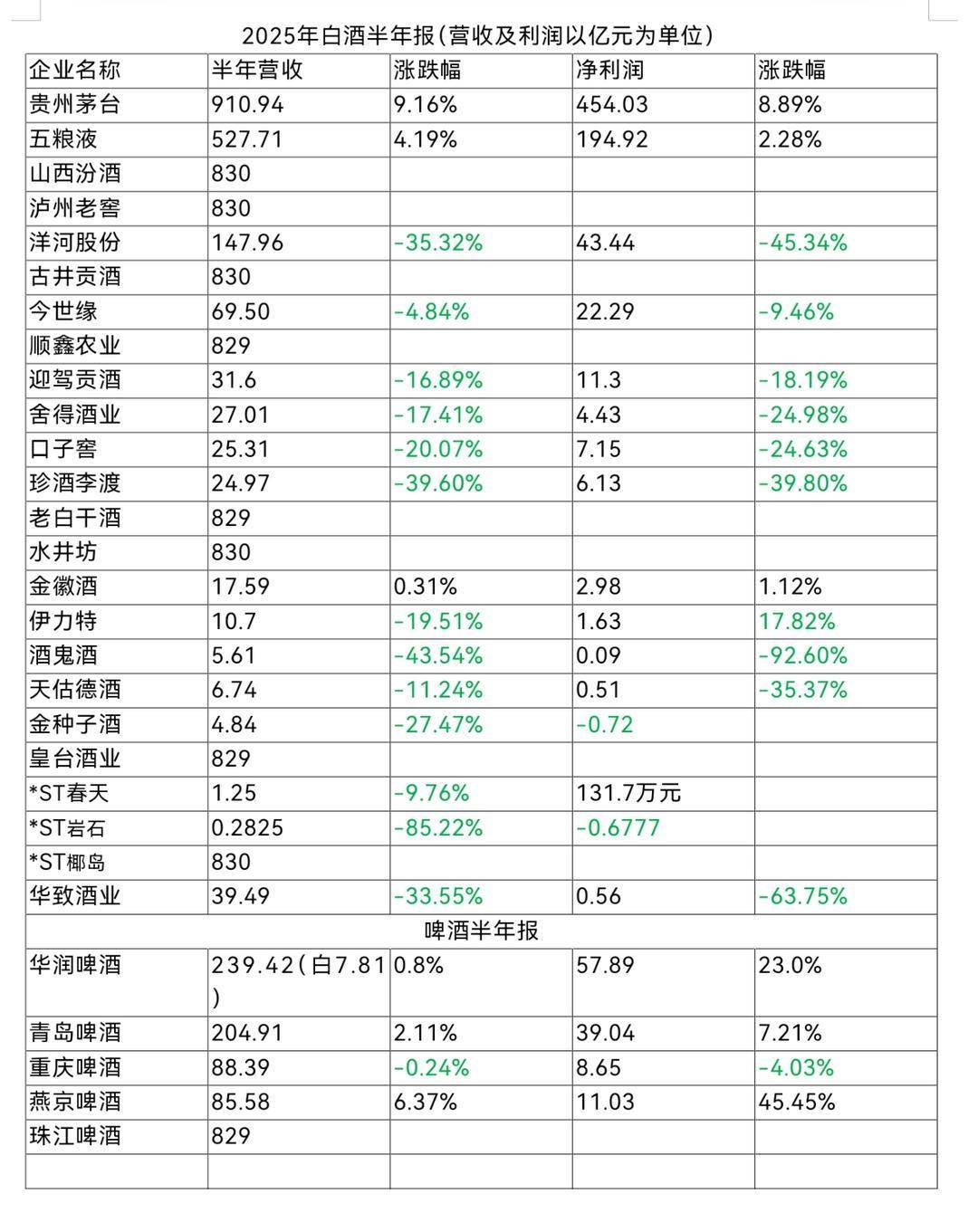
五粮液上半年营收利润微增,多数酒企营收利润双降 | 封面观酒
Sou Hu Cai Jing· 2025-08-28 05:26
Core Viewpoint - Wuliangye's revenue and net profit for the first half of 2025 reached historical highs, but growth rates have dropped to single digits, indicating a significant shift in the industry dynamics [1][4]. Company Performance - Wuliangye achieved a revenue of 52.771 billion yuan, a year-on-year increase of 4.19%, and a net profit of 19.492 billion yuan, up 2.28% [1][3]. - Other companies like Jinhui Wine reported revenue and profit growth of 0.31% and 1.12%, respectively [5]. - In contrast, most other liquor companies reported negative revenue growth, with many experiencing double-digit declines [5][6]. Industry Trends - A total of 15 liquor companies have released their semi-annual reports, with only three showing positive growth in both revenue and profit [3][5]. - The liquor industry is undergoing a significant adjustment, with over two-thirds of companies expected to report declines in both revenue and profit [7]. - The beer industry has shown better performance compared to the liquor sector in the first half of 2025 [7].
新贵“寒王”短暂登顶,茅台是“老虎屁股摸不得”?
Sou Hu Cai Jing· 2025-08-28 01:36
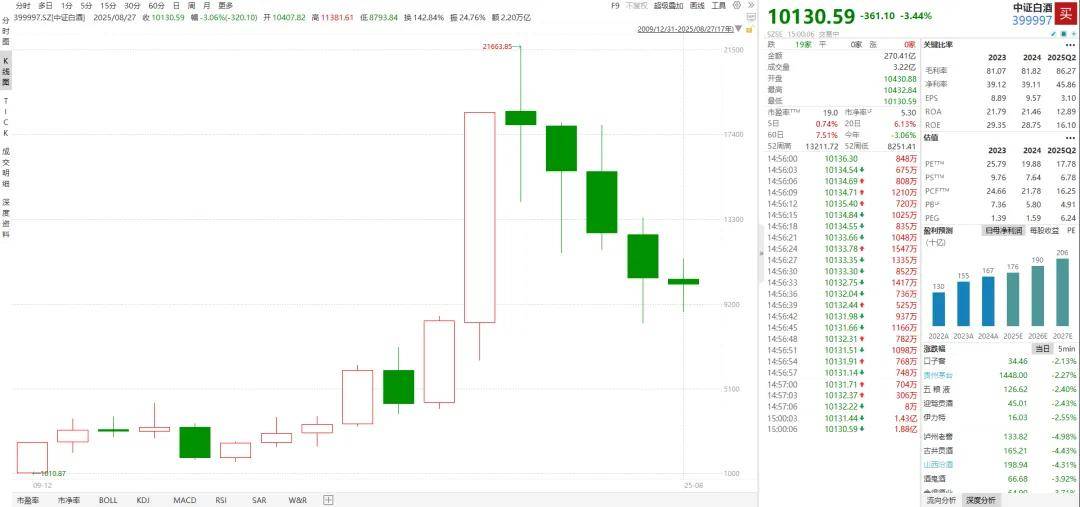
Core Viewpoint - The white liquor sector has been underperforming compared to the booming AI sector, with the China Liquor Index down 3.06% this year and experiencing five consecutive weeks of decline [2][11]. Industry Performance - The stock price of Kweichow Moutai (600519), traditionally the market leader, has recently been challenged by the new player, Cambrian (688256), which briefly surpassed Moutai's stock price, marking a significant event in the market [3]. - Historical instances of stocks surpassing Moutai, such as China Shipbuilding and Haipuri, have led to significant declines in their stock prices, with some experiencing drops of over 90% [4][5][6][7][8]. Market Dynamics - The white liquor industry is currently undergoing a deep adjustment cycle, with pressures from macroeconomic conditions and policy tightening affecting consumer demand [10][14]. - Despite the overall pressure, there are signs of a potential rebound in the white liquor sector, with some companies like Jiangjiu and Shendao showing varying degrees of recovery [13]. Recovery Signals - Analysts from CITIC Securities suggest that the white liquor industry is in the process of bottoming out, with expectations for a fundamental recovery by Q3 2025, contingent on various factors including inventory and pricing trends [14]. - Positive government policies aimed at boosting consumption are seen as a core driver for the industry's recovery, with multiple initiatives being rolled out to stimulate demand [15]. Valuation Insights - The white liquor sector is currently viewed as being at a valuation bottom, with low price-to-earnings ratios indicating potential for recovery as market sentiment stabilizes [17][20]. - Analysts from Dongxing Securities highlight that historical patterns suggest stock prices in the white liquor sector tend to recover before the fundamental performance improves, indicating a potential buying opportunity [18]. Future Outlook - The consensus among various securities firms, including Founder Securities and Guohai Securities, is optimistic regarding the white liquor sector's recovery, driven by policy support and improving fundamentals [21][22][23].
南财V快评:“茅台魔咒”再显灵?
2 1 Shi Ji Jing Ji Bao Dao· 2025-08-27 15:38
Group 1 - The stock price of AI chip company Cambrian Technology briefly surpassed that of Kweichow Moutai, sparking discussions about the "Moutai Curse" in the A-share market [1][2] - The "Moutai Curse" originated in 2007 when China Shipbuilding became the first high-priced stock in A-shares, but its price plummeted during the 2008 financial crisis [2] - Cambrian's rise is supported by strong performance, with a reported revenue of 2.881 billion yuan and a net profit of 1.038 billion yuan in the first half of 2025, marking a significant turnaround from previous losses [2][3] Group 2 - Cambrian's dynamic price-to-earnings ratio is currently at 343 times, shifting market focus from "can it profit" to "can it sustain profits" [3] - The rise of Cambrian represents a shift from traditional industries like liquor to emerging sectors like AI chips, reflecting a broader economic transformation [3] - The growth of Cambrian is driven by the explosion of global AI computing power and domestic substitution policies, with increased capital expenditure from cloud service providers [2]
白酒市场生变,酒企纷纷“降度”
Sou Hu Cai Jing· 2025-08-27 12:48
Group 1 - Major Chinese liquor companies, including Wuliangye and Shede, announced the launch of low-alcohol products, indicating a shift in the market towards lower alcohol content [1][4] - The trend of reducing alcohol content is a response to changing consumer preferences, particularly among younger demographics who favor taste and health [4][9] - The China Alcoholic Drinks Association's report highlights a mismatch between traditional liquor offerings and the demands of younger consumers born between 1985 and 1994 [4][5] Group 2 - Companies like Luzhou Laojiao and Yanghe are actively developing low-alcohol products, with Luzhou Laojiao planning to introduce a 28-degree version of its flagship product [5][4] - The introduction of low-alcohol products is seen as a proactive measure to adapt to a market undergoing significant adjustments, with many companies experiencing declining sales [4][9] - The market for low-alcohol beverages is expanding, with various companies launching products in the range of 15 to 28 degrees [4][5] Group 3 - In addition to lowering alcohol content, liquor companies are entering the craft beer market, with Wuliangye launching its first craft beer product [7] - Young consumers are driving the craft beer market, with over 75% prioritizing unique flavor experiences [7][9] - The strategy of combining liquor and beer aims to create a synergistic ecosystem, leveraging shared distribution channels and consumer engagement [7][9] Group 4 - Despite the opportunities presented by low-alcohol and craft beer strategies, companies face challenges such as technical difficulties in producing low-alcohol beverages and regional market differences [9] - The need for effective supply chain management is critical as beer has a shorter shelf life and higher consumption frequency compared to traditional liquor [9] - The dual strategy of lowering alcohol content and entering the beer market is essential for addressing the loss of younger consumers and the competitive landscape [9]

滞涨洼地!吃喝板块全线回调,食品ETF(515710)跌超2%!机构:建议关注估值修复机会
Xin Lang Ji Jin· 2025-08-27 11:53
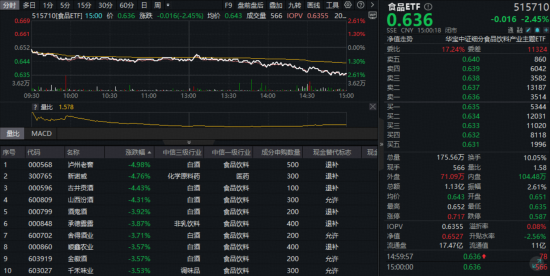
Group 1 - The food and beverage sector experienced a significant decline on August 27, with the Food ETF (515710) dropping by 2.45% to close at 0.636 [1][2] - Notable declines were observed in liquor stocks, with Luzhou Laojiao, Gujing Gongjiu, and Shanxi Fenjiu falling over 4%, while Kweichow Moutai and Wuliangye also saw declines exceeding 2% [1][2] - The overall market sentiment indicates that despite previous gains, the liquor sector remains at a low point, with institutions suggesting that the current market conditions may present attractive opportunities for high-quality liquor stocks [1][3] Group 2 - According to institutional analysis, the current environment, characterized by policy-driven demand and favorable supply-side conditions, is expected to gradually improve the supply-demand dynamics in the liquor sector [3] - The Food ETF's price-to-earnings ratio stands at 21.35, placing it in the 10.57 percentile over the past decade, indicating a favorable long-term investment opportunity [3] - Analysts from Ping An Securities believe that the liquor sector's fundamentals are stabilizing, with upcoming festive seasons likely to boost consumption [4] Group 3 - The liquor sector has faced pressure since the implementation of the alcohol ban, but recent policy changes are expected to alleviate some of this pressure, setting the stage for a potential recovery [4] - Investment strategies suggest focusing on high-end liquor, mid-range liquor with national expansion, and local market strongholds as key areas for potential growth [4] - The Food ETF (515710) is highlighted as a core asset for investors looking to gain exposure to the food and beverage sector, with a significant portion of its holdings in leading liquor stocks [5]

预调酒失速、烈酒待熟,百润股份上半年营利双降|看财报
Tai Mei Ti A P P· 2025-08-27 10:42
Core Viewpoint - Baijiu Co., Ltd. continues to experience a decline in performance, with a significant drop in revenue and net profit in the first half of 2025, indicating ongoing challenges in its core business and the failure of new product launches to reverse the trend [2][3]. Financial Performance - In the first half of 2025, Baijiu Co., Ltd. reported revenue of 1.489 billion yuan, a year-on-year decrease of 8.56% [2]. - The net profit attributable to shareholders was 389 million yuan, down 3.32% year-on-year, while the non-recurring net profit fell by 9% [2]. - The company's revenue in Q2 2025 was 752 million yuan, a decline of 9.0% year-on-year, with net profit dropping by 10.9% to 208 million yuan [3]. Product Performance - The RIO pre-mixed cocktail, once a leading product, has seen a significant decline in sales, with revenue from RIO dropping to 2.677 billion yuan in the previous year, a decrease of 7.17% [3]. - The introduction of new products, such as the RIO 12-degree flavored liquor, has not met market expectations, resulting in poor sales performance [4]. Market Competition - The low-alcohol beverage market is becoming increasingly competitive, with various brands, including traditional liquor companies, entering the pre-mixed cocktail segment [5]. - The presence of alternative products in the market has intensified competition for RIO, which is struggling to maintain its market share [5]. Strategic Initiatives - Baijiu Co., Ltd. has invested in the liquor segment, establishing a distillery in Sichuan to develop whiskey as a potential growth area [6]. - Despite the challenges, the company remains optimistic about its whiskey business, with significant increases in barrel storage capacity reported [7]. - The company has reduced its sales expenses by 24% in the first half of 2025, contributing to stable gross margins despite declining revenues [7].