小米

Search documents
17对17,小米要将苹果“斩于马下”?
3 6 Ke· 2025-10-02 04:09
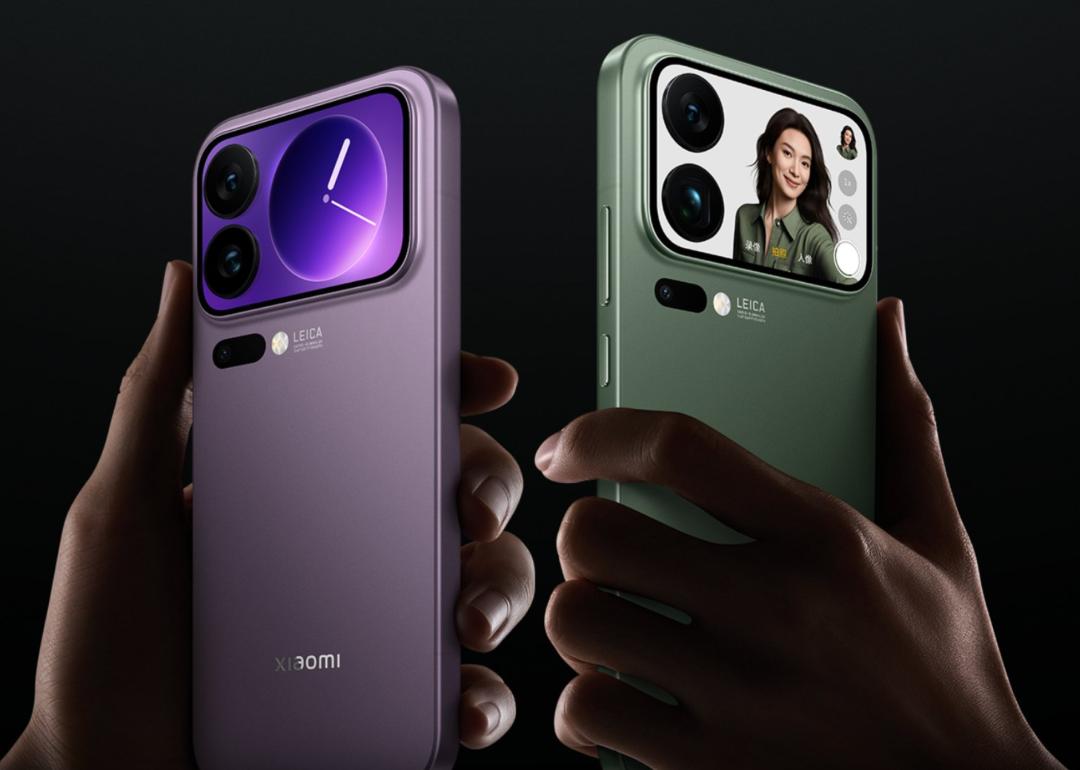
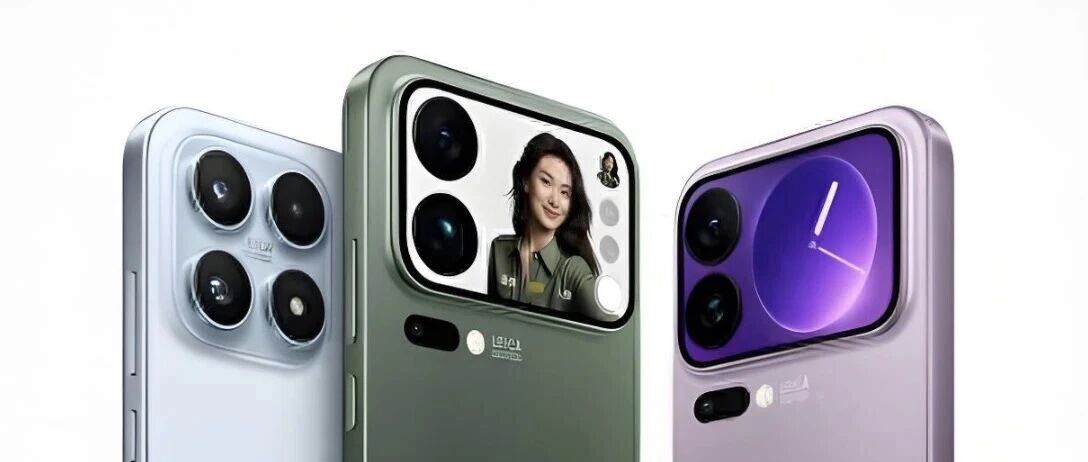
Core Insights - Xiaomi's new 17 series smartphones have set a record for first-day sales in the domestic market, indicating strong consumer interest and effective marketing strategies [7][11] - The pricing strategy for the Xiaomi 17 series has seen an increase, with the starting price set at 4,499 yuan, reflecting a shift towards a more premium positioning in the market [8][12] - Despite the initial sales success, market reactions have been mixed, with a notable drop in Xiaomi's stock price following the launch, attributed to concerns over lower-than-expected demand for the standard version of the 17 series [11][12] Product Features and Innovations - The Xiaomi 17 series introduces a unique "back screen" feature that supports various functionalities, including personalized wallpapers and important notifications, aiming to enhance user experience [3][5] - The series includes multiple versions (standard, Pro, and Pro Max), marking a first for Xiaomi's digital series to offer three models simultaneously, which may lead to consumer confusion [5][11] - Xiaomi's focus on high-end specifications and features is evident, as the company aims to compete directly with Apple's iPhone 17 series [5][19] Market Positioning and Strategy - Xiaomi's strategy appears to be a direct challenge to Apple, with the naming and marketing of the 17 series closely mirroring that of the iPhone 17, suggesting a deliberate positioning in the high-end market [5][21] - The company has been investing heavily in high-end product development, including chips and electric vehicles, to establish a stronger foothold in premium segments [16][18] - Analysts have noted that while Xiaomi's pricing strategy aims to attract consumers seeking high performance at lower prices, the overall market dynamics are shifting, with Apple also emphasizing value in its offerings [21][23] Sales Performance and Projections - Initial sales data indicates that the Xiaomi 17 series achieved record sales within the first five minutes of launch, surpassing previous records for domestic smartphone sales [7][11] - However, projections for total shipments of the 17 series have been revised down by approximately 20%, primarily due to lower-than-expected demand for the standard model [11][12] - Comparatively, Apple's iPhone 17 series has shown robust sales performance, with first-day sales significantly exceeding those of the previous generation, highlighting the competitive pressure Xiaomi faces [12][21] Consumer Perception and Market Challenges - Consumer feedback has been mixed regarding the practicality of the back screen feature, with some viewing it as unnecessary compared to existing alternatives like smartwatches [3][5] - The competitive landscape is intensifying, as both Xiaomi and Apple are vying for the same consumer base, particularly those who are price-sensitive yet performance-oriented [21][23] - Xiaomi's efforts to transition from a budget-friendly brand to a high-end competitor are ongoing, but the effectiveness of this strategy remains to be fully realized in the market [25]

17对17,小米要将苹果“斩于马下”?
首席商业评论· 2025-10-02 04:01
Core Viewpoint - The article discusses the competitive landscape between Xiaomi's new 17 series and Apple's iPhone 17, highlighting Xiaomi's strategies to redefine its products and target the high-end market while facing challenges in sales and market perception [2][3][10]. Group 1: Product Features and Innovations - Xiaomi's 17 series introduces a unique "back screen" feature that supports various functions, aiming to enhance user interaction and provide quick access to important notifications without flipping the phone [3][5]. - The naming strategy of the Xiaomi 17 series directly targets the iPhone 17, with Xiaomi's CEO emphasizing that the new series represents a significant upgrade over previous models [5][7]. - The 17 series achieved record sales within five minutes of launch, indicating strong initial consumer interest [9]. Group 2: Pricing and Market Positioning - Xiaomi has increased the starting price of its flagship models, maintaining a price range of 3999 to 4499 yuan, which reflects its strategy to move towards a higher-end market [11][19]. - The gross margin for Xiaomi's smartphone business has improved significantly, rising from around 2% to approximately 12% in recent years, indicating successful high-end positioning [11][19]. - Despite record sales, market reactions were lukewarm, with a notable drop in stock price following the launch, attributed to a downward revision of expected total shipments by about 20% [14][16]. Group 3: Competitive Analysis - The article notes that while Xiaomi aims to compete with Apple, the latter has also begun to emphasize value, with the iPhone 17 offering increased storage at the same price point as its predecessor, thus intensifying competition in the high-end market [25][27]. - Xiaomi's market share has fluctuated, benefiting from government subsidies but facing challenges as these effects wane, which could impact its competitive position against Apple and other brands [24][25]. - The article suggests that Xiaomi's strategy of directly comparing its products to Apple's may indicate a recognition of the gap in perceived quality and brand prestige [23][30].

卖爆了!小米17系列,销量超100万台!
中国基金报· 2025-10-02 03:21
Core Viewpoint - The Xiaomi 17 series has achieved sales exceeding 1 million units, demonstrating faster sales compared to previous models [1][4][7]. Sales Performance - Xiaomi 17 series sales surpassed 1 million units as of October 2, 2023, with production being ramped up to meet demand [4][10]. - The series set a record for first-day sales, with the Xiaomi 17 Pro Max model accounting for over 50% of total sales within the series [10][12]. - The launch on September 25, 2023, was marked by significant consumer interest, leading to a strong initial sales performance [10][12]. Market Position and Competition - Xiaomi aims to compete directly with Apple, particularly in the high-end market segment, with the Xiaomi 17 series priced starting at 4,499 RMB [10][12]. - Despite a reported 20% downward adjustment in total shipment targets for the Xiaomi 17 series, the company remains confident in surpassing the sales of the previous Xiaomi 15 series [12][14]. - The competitive landscape includes pressure from Apple and Huawei, with analysts noting that the demand for the standard version of the Xiaomi 17 is lower than expected [12][13]. Product Features and Innovations - The Xiaomi 17 series features innovative designs and technologies, including a new "super pixel" low-power display, which has attracted consumer attention [10][12]. - The introduction of a 1TB version of the standard model is expected to enhance the product mix and overall order volume compared to the previous generation [17]. Stock Market Reaction - Following the announcement of the sales figures, Xiaomi's stock price rose over 3%, reaching 55.65 HKD per share [19].
9月新势力销量:零跑6万,“鹏界米”4万
Xin Lang Cai Jing· 2025-10-02 02:21
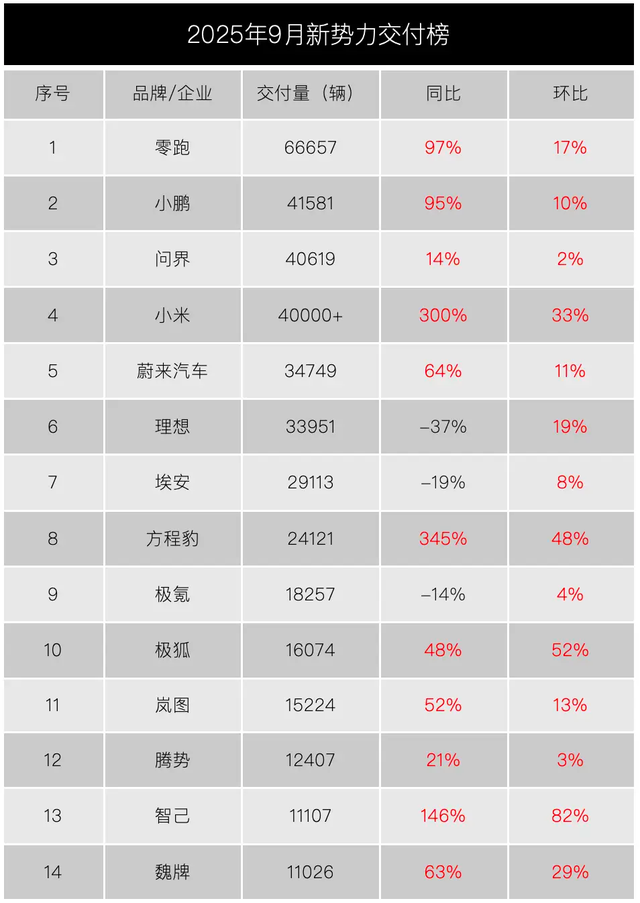
Core Viewpoint - The new energy vehicle market is experiencing significant changes, with new players like Leap Motor and Xiaomi making substantial gains in delivery volumes, while traditional brands face challenges in maintaining their positions [1][20]. Group 1: Delivery Rankings and Performance - Leap Motor leads the delivery rankings with 66,657 units, showing a 97% year-on-year increase and a 17% month-on-month increase [2][3]. - Xiaomi enters the top four for the first time with over 40,000 deliveries, marking a 300% year-on-year increase and a 33% month-on-month increase [2][4]. - NIO ranks fifth with 34,749 units delivered, reflecting a 64% year-on-year growth, indicating the effectiveness of its multi-brand strategy [5][14]. - Li Auto's performance is mixed, with 33,951 units delivered, a 19% month-on-month increase but a 37% year-on-year decline [6][18]. Group 2: Market Dynamics and Strategies - The market is seeing a shift where traditional automakers' new energy brands are growing but struggle to pose a significant threat to the top six new energy players [7]. - Leap Motor's strategy focuses on offering high-value features in mainstream models, appealing to cost-conscious consumers [8][9]. - Xiaomi's growth is attributed to improved production capacity, although it faces challenges with long wait times for customers [12][13]. Group 3: Competitive Landscape - The competitive landscape is evolving, with brands like Aion experiencing a nearly 20% year-on-year decline, while BYD's Equation Leopard sees a 345% increase [7][14]. - The delivery threshold for the top tier has risen to 40,000 units per month, creating a gap for brands unable to meet this benchmark [7][20]. - The introduction of new models, such as Li Auto's i6, is seen as a potential solution to declining sales, but internal competition may pose challenges [18][19]. Group 4: Future Trends - The market is expected to further differentiate, with technological advancements becoming crucial for maintaining competitiveness [21][22]. - Traditional luxury brands are beginning to take the electric vehicle market seriously, as seen with the local production of Mercedes-Benz's electric CLA [21]. - The overall conclusion points to a future where the winners will be those who can balance cost control through scale while offering differentiated experiences through technology and multi-brand strategies [23].


理想汽车失速,持续下滑
Shen Zhen Shang Bao· 2025-10-02 00:45
Core Insights - Li Auto reported a total delivery of 33,951 vehicles in September, with a year-on-year decline of 36.8% compared to 53,709 vehicles delivered in September 2024, marking a decrease of nearly 20,000 units [1] - The third quarter saw Li Auto deliver 93,211 vehicles, continuing a downward trend for the fourth consecutive month since June, although September's deliveries showed a 19% month-on-month increase from August's 28,529 vehicles due to the delivery of two new electric models, the i8 and i6 [1] - In contrast, Leap Motor led the market with a record delivery of 66,657 vehicles in September, achieving over 97% year-on-year growth, and a total of 395,516 vehicles delivered from January to September, reflecting a 128.8% increase [1] - Xpeng Motors delivered 41,581 vehicles in September, marking a year-on-year increase of approximately 95% and a month-on-month growth of 10%, with total deliveries reaching 313,196 vehicles for the year, up about 218% [1] - NIO reported 34,749 vehicle deliveries in September, a year-on-year increase of 64% and a month-on-month increase of 11%, setting a new historical high [1] - Xiaomi Auto also surpassed 40,000 vehicle deliveries in September, marking its first month of exceeding this threshold, following a previous milestone of over 30,000 deliveries in August [2] Company Performance - Li Auto's September deliveries: 33,951 vehicles, down 36.8% year-on-year [1] - Leap Motor's September deliveries: 66,657 vehicles, up over 97% year-on-year [1] - Xpeng Motors' September deliveries: 41,581 vehicles, up approximately 95% year-on-year [1] - NIO's September deliveries: 34,749 vehicles, up 64% year-on-year [1] - Xiaomi Auto's September deliveries: over 40,000 vehicles, first month exceeding this figure [2] Market Trends - Li Auto's deliveries show a recovery trend with a 19% month-on-month increase in September [1] - Leap Motor and Xpeng Motors demonstrate significant growth rates, indicating a competitive market landscape [1] - The overall performance of the electric vehicle sector remains strong, with multiple companies achieving record deliveries [1][2]
华尔街见闻早餐FM-Radio | 2025年10月2日
Hua Er Jie Jian Wen· 2025-10-01 23:16
Market Overview - US stock market showed resilience with the S&P 500 and Dow Jones reaching new highs despite the government shutdown, with Pfizer up nearly 7%, Eli Lilly over 8%, and Merck over 7% leading the Dow [2] - European stock indices recorded four consecutive gains, reaching historical highs for the first time in seven months [2] - Gold prices hit a record high for three consecutive days, while silver rebounded nearly 3%, reaching a fourteen-year high [2] Key News - The "Six Policies" housing policy in Shanghai has led to a 8% month-on-month increase and a 24% year-on-year increase in September transactions [4][11] - The US government officially shut down for the first time in seven years, causing uncertainty in the economy and financial markets [4][11] - The US ADP employment report showed a surprising decline of 32,000 jobs in September, raising expectations for two interest rate cuts by the end of the year [12] - The ISM manufacturing PMI for September contracted for the seventh consecutive month, indicating a decline in new orders and a three-month drop in the price index [12] Company Developments - OpenAI's CEO Altman visited Foxconn and TSMC to discuss collaboration on the "Star Gate" project and self-developed ASIC chips [5][13] - Microsoft announced the integration of AI services into Office, launching a new subscription tier [5][13] - Intel's stock surged over 7% amid reports of negotiations to bring AMD on as a new foundry client [5][13] Electric Vehicle Performance - In September, electric vehicle deliveries saw significant growth, with Li Auto and NIO achieving record highs, and Leap Motor surpassing 60,000 deliveries for the first time [6][15] Global Developments - The US government reached a "benchmark agreement" with Pfizer, leading to significant drug price reductions in exchange for tariff exemptions [16] - Concerns were raised about the soaring valuations in the AI sector, reminiscent of the internet bubble [16][17]


金十数据全球财经早餐 | 2025年10月2日
Jin Shi Shu Ju· 2025-10-01 23:03
男生普通话版 下载mp3 女声普通话版 下载mp3 粤语版 下载mp3 西南方言版 下载mp3 东北话版 下载mp3 上海话版 下载mp3 今日优选 市场盘点 周三,尽管"小非农"大幅不及预期,美元指数大体维持区间震荡,最终微跌0.09%,报97.73。基准的10年期美债收益率收报4.102%,对美联储政策利率敏感 的2年期美债收益率收报3.537%。 现货黄金于欧盘时段继续发力,再将历史新高刷新至3890美元上方,但随后回落至3860美元附近震荡整理,最终收涨0.19%,收报3865.43美元/盎司;纽约 期金盘中一度站上3900美元/盎司整数关口,再创历史新高;现货白银冲上47美元,盘中一度涨至47.82美元的日内高点,创14年新高,最终收涨1.44%,报 47.31美元/盎司。 原油连续第三日下跌。WTI原油日内再度跌超1%,盘中一度跌至61.21美元的日内低点,最终收跌1.03%,报61.58美元/桶;布伦特原油最终收跌1.04%,报 65.26美元/桶。 美国9月ADP就业人数大幅不及预期,创2023年3月来最大降幅 美国政府关门,参议院再度否决临时拨款法案,2日将暂停投票 美国最高法院拒绝允许特朗 ...

炸裂!小米、小鹏、蔚来……最新发布→
证券时报· 2025-10-01 14:08
Core Viewpoint - Multiple automotive companies reported record delivery data for September, indicating strong growth in the electric vehicle market [2]. Group 1: Company Deliveries - NIO delivered 34,749 vehicles in September, a year-on-year increase of 64%, marking a historical high [6]. - XPeng Motors delivered 41,581 vehicles in September, a year-on-year increase of 95% and a month-on-month increase of 10%, also achieving a historical high [6]. - Li Auto delivered 33,951 vehicles in September, with a total of 93,211 vehicles delivered in Q3 2025 [6]. - Xiaomi's vehicle deliveries exceeded 40,000 for the first time, following two consecutive months of over 30,000 [6]. - Leap Motor achieved a record delivery of 66,657 vehicles in September, a year-on-year increase of over 97% [6]. - Hongmeng Zhixing delivered 52,916 vehicles in September, with new orders exceeding 110,000 [6]. - Lantu delivered 15,224 vehicles in September, with a year-to-date growth of 85% [6]. - BYD sold 396,300 new energy vehicles in September, a slight decrease from 419,400 in the same month last year, but cumulative sales reached 3.26 million, up 18.64% year-on-year [6]. - Great Wall Motors sold 133,600 vehicles in September, a year-on-year increase of 23.29%, with new energy vehicle sales reaching 45,961, up 52.55% [6]. - BAIC Group achieved a total vehicle sales of 157,000 in September, a year-on-year increase of 1.3% [6]. - GAC Aion sold 29,113 vehicles in September [6]. - SAIC-GM sold 47,695 vehicles in September, with new energy vehicle sales increasing by 31% [6]. - SAIC-GM-Wuling sold 155,600 vehicles in September, with new energy sales surpassing 100,000 for the first time this year [6]. - FAW-Volkswagen sold 146,400 vehicles in September, with a year-on-year increase in fuel vehicle market share [6]. - FAW-Toyota sold 71,031 vehicles in September, with a cumulative year-to-date increase of 9.3% [6].


新势力七雄鏖战“金九”,多家车企冲刺百亿俱乐部
Di Yi Cai Jing· 2025-10-01 13:33
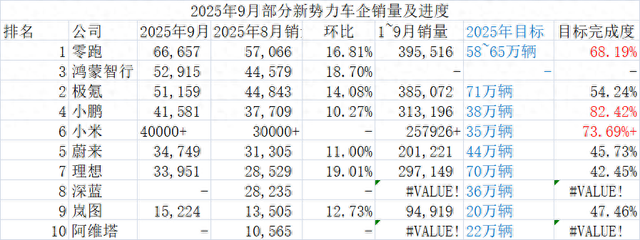
Core Insights - The new energy vehicle market is experiencing intense competition among seven key players, with each achieving sales of over 30,000 units in September [1] - The term "million club" is expected to be a significant focus in the latter half of the year, with several companies aiming to reach this milestone [1] - Leap Motor has become the second new energy vehicle company to reach the "million club" with its 1 millionth vehicle produced [1][4] Sales Performance - Leap Motor delivered 66,657 vehicles in September, maintaining its leading position among new energy vehicle companies for seven consecutive months [1][3] - NIO delivered 34,749 vehicles in September, with a year-to-date total of 872,800 vehicles, aiming for 150,000 deliveries in Q4 to reach the 1 million target [4] - Ideal Auto's September sales were 33,951 vehicles, showing a 19.01% month-over-month increase but a 36.8% year-over-year decline [5] Target Completion Rates - Leap Motor has achieved a cumulative delivery of 395,516 vehicles, with a completion rate of 68.19% against its adjusted target of 580,000 [2][3] - Xiaopeng Motors has delivered 313,196 vehicles year-to-date, achieving an 82.42% completion rate against its target of 380,000 [2][3] - Xiaomi's estimated deliveries are at least 257,926 vehicles, with a completion rate of 73.69% against its annual target of 350,000 [2][3] Competitive Landscape - Hongmeng Zhixing reported 52,916 vehicle deliveries in September, with total deliveries surpassing 950,000 [7] - Zeekr (part of Geely) sold 51,519 vehicles in September, with a year-to-date total of 385,072, achieving a completion rate of 54.24% against its target of 710,000 [7] - Other companies like Lantu and Avita have not disclosed their sales figures for September, while Deep Blue has lowered its annual target from 500,000 to 360,000 [7]
热度比肩刘德华,雷军的个人魅力,小米的枷锁?
Sou Hu Cai Jing· 2025-10-01 13:12
Core Insights - The recent competition for attention between Lei Jun's speech, Xiaomi's new product launch, and Andy Lau's concert highlights the challenges Xiaomi faces in brand positioning and market perception [2][3] - Xiaomi's strategy of leveraging high-profile events for product promotion is not new, indicating a consistent approach to enhance brand visibility [3][25] Group 1: Brand Positioning and Strategy - Xiaomi's recent product launch was strategically timed to coincide with Lei Jun's speech, aiming to generate buzz for the Xiaomi 17 series [3][25] - The concept of high-end branding can be divided into hard and soft strengths, where hard strength refers to product quality and features, while soft strength relates to brand story and emotional value [4][5][15] - The challenge for Xiaomi lies in overcoming its established image as a budget-friendly brand, which may hinder its efforts to penetrate the high-end market [16][19] Group 2: Market Dynamics and Consumer Perception - The high-end smartphone market is defined as products priced above $600, a segment where Xiaomi has struggled to establish a strong presence compared to competitors like Huawei and Apple [17][18] - Xiaomi's branding efforts are complicated by the strong association of its products with Lei Jun's personal charisma, which can overshadow the products themselves [20][21] - The immediate market reaction to Xiaomi's recent events was mixed, with a significant drop in stock price following the launch, indicating potential investor concerns [29] Group 3: Marketing and Communication Strategies - The effectiveness of Xiaomi's marketing strategy is questioned, as the approach of uniformly distributing content across platforms may not resonate with diverse audiences [31][39] - Differentiated marketing strategies, similar to those employed by Apple, could enhance Xiaomi's brand perception and consumer engagement [33][38] - The need for a compelling brand narrative is emphasized, as seen in the successful strategies of competitors like Huawei and Apple, which focus on storytelling to create emotional connections with consumers [14][15][43]