
光大证券

Search documents
证券ETF龙头(159993)政策信号释放叠加行业集中度提升,早盘涨0.46%
Xin Lang Cai Jing· 2025-09-22 03:02
Group 1 - Ant Group's chairman Han Xinyi clarified that the company will not issue virtual currency but emphasized that token economy needs to be rooted in the real economy [1] - As of September 22, 2023, the leading securities ETF (159993.SZ) rose by 0.46%, while its related index (399437.SZ) increased by 0.65% [1] - Among major constituent stocks, CITIC Securities rose by 1.52%, China Galaxy by 1.26%, East Money by 1.13%, and Huatai Securities by 0.82% [1] Group 2 - Galaxy Securities noted that industry profits are concentrating among leading brokerages, with the net profit CR5 reaching 45.88% in H1 2025, an increase of 6.81 percentage points year-on-year [1] - Leading brokerages are expanding competitive advantages through diversified operations and establishing barriers in derivatives and cross-border businesses [1] - According to招商证券, the self-operated income of the securities industry is expected to grow by 50% year-on-year in H1 2025, with self-operated yield increasing by 1.6 percentage points to 5.04% [1] - Leading firms like CITIC Securities and CICC are maintaining a competitive edge in international business, reflecting a trend of increasing industry concentration and improved profitability [1]
光大证券:维持华润万象生活(01209)“买入”评级 股息率具备吸引力
智通财经网· 2025-09-22 02:08
Group 1 - The core viewpoint of the report is that China Resources Mixc Life (01209) maintains a "buy" rating due to strong performance in shopping center operations and stable sales from related party China Resources Land, with a positive outlook for net profit forecasts for 2025 [1] - The company reported a significant increase in operating profit for the first half of 2025, reaching 2.63 billion yuan, a year-on-year growth of 20.2%, and declared a generous interim and special dividend totaling 0.881 yuan per share, representing 100% of the core net profit attributable to shareholders [1] - As of June 30, 2025, the company provided commercial operation services for 120 shopping centers and 27 office buildings, with four new shopping centers opened and six new high-quality commercial light asset projects signed in the first half of the year [1] Group 2 - The property segment's revenue fell short of expectations in the first half of the year, primarily due to a reduction in value-added services, with non-owner value-added income declining by 34.6% to 220 million yuan [2] - Owner value-added income also decreased by 32.7% to 490 million yuan, as the company divested from less profitable and high-inventory-cost businesses while focusing on transforming core operations towards a platform-based and light-asset model [2] - Despite the revenue decline in certain segments, the property management business saw an 8.8% year-on-year increase in revenue to 3.5 billion yuan, supported by an expansion in managed community area to 280 million square meters [2]

光大证券:维持华润万象生活“买入”评级 股息率具备吸引力
Zhi Tong Cai Jing· 2025-09-22 02:08
Group 1 - The core viewpoint of the report is that Everbright Securities maintains a "buy" rating for China Resources Vientiane Life (01209), highlighting strong performance in shopping center operations and stable sales from related party China Resources Land [1] - The company forecasts net profit attributable to shareholders for 2025 to be 39.9 billion, 44.6 billion, and 50.0 billion for the years 2025, 2026, and 2027 respectively [1] - For the first half of 2025, the company's operating profit (gross profit - selling and administrative expenses) reached 26.3 billion, representing a year-on-year growth of 20.2% [1] Group 2 - The report indicates that the company's property segment revenue fell short of expectations in the first half of the year, primarily due to a reduction in value-added services, with non-owner value-added income declining by 34.6% to 2.2 billion [2] - Owner value-added income also decreased by 32.7% to 4.9 billion, as the company divested from less profitable and high-inventory-cost businesses while focusing on transforming core operations towards a platform-based and light-asset model [2] - Despite the revenue decline in certain segments, property management business revenue grew by 8.8% to 35 billion, supported by an expansion in property management scale, with a total managed area of 280 million square meters and contracted area of 300 million square meters as of June 30 [2]
【有色】8月国内空调产量同比增长9%,好于此前预计的同比下跌2.8%——铜行业周报(250915-0919)(王招华/方驭涛)
光大证券研究· 2025-09-21 23:04
Core Viewpoint - The article maintains a positive outlook on copper prices, anticipating an upward trend due to various macroeconomic and supply-demand factors [4]. Macroeconomic Factors - Following a 25 basis point interest rate cut in the US in September, the dollar index experienced a short-term rebound, leading to a temporary decline in copper prices. However, the interest rate cut cycle is not over, suggesting a potential further weakening of the dollar index [4]. Supply and Demand - The inventory adjustments caused by US copper tariffs are nearing completion, with expectations that the accumulation of inventories on LME and COMEX will gradually end. The supply of copper from mines and scrap remains tight, with a slight decrease in electrolytic copper production in August. Demand for electricity and air conditioning is expected to rebound in Q4, supporting higher copper prices [4]. Inventory Levels - Domestic copper social inventory increased by 3.2%, while LME copper inventory decreased by 3.2%. As of September 19, 2025, domestic port copper concentrate inventory stood at 725,000 tons, up 4.6% from the previous week. Global electrolytic copper inventory totaled 557,000 tons, up 2.6% [5]. Raw Material Prices - The price difference between refined copper and scrap copper decreased by 193 yuan/ton compared to the previous week. In May 2025, China's refined copper production was 158,000 tons, up 22.7% month-on-month and 11.2% year-on-year [6]. Smelting and Processing - In August 2025, China's electrolytic copper production was 1.1715 million tons, down 0.2% month-on-month but up 15.6% year-on-year. The TC spot price as of September 19 was -40.64 USD/ton, reflecting a 0.8 USD/ton increase from the previous week, remaining at historically low levels [7]. Demand Trends - The cable industry's operating rate decreased by 1.8 percentage points week-on-week, while the production of household air conditioners in August exceeded expectations, showing a year-on-year increase of 9.4% [8][9].


A股行业轮动速度放缓,意味什么?机构:把握基本面 享受资金面
Feng Huang Wang· 2025-09-21 22:39
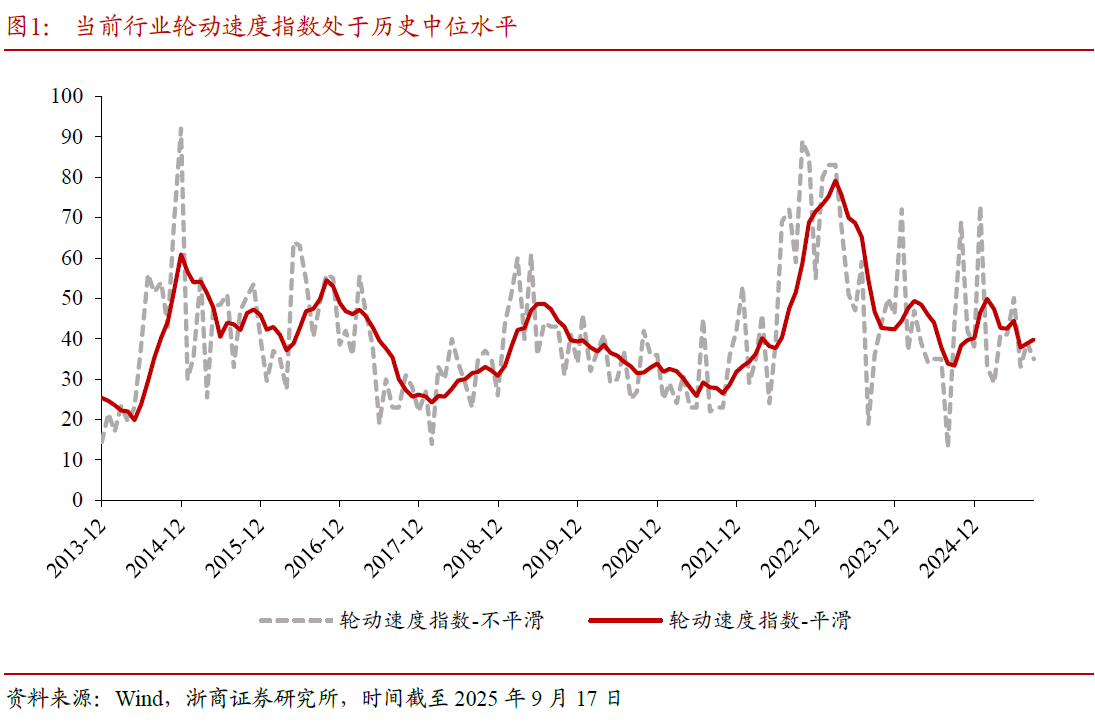
Core Viewpoint - The A-share market has entered a new phase of industry rotation, characterized by a slowdown in rotation speed but an increase in market differentiation [1][2][5] Group 1: Market Rotation Characteristics - The industry rotation speed has decreased since July, following a technology-led market rally, and is currently at the historical median over the past decade [2][5] - Despite the slowdown in rotation speed, the intensity of market differentiation has reached a new high for the year, indicating a significant structural divergence [5][6] Group 2: Driving Forces Behind Market Rotation - The core logic driving the current rotation is the interplay between liquidity and fundamentals, with liquidity being a major factor in the short term [6][7] - Different market phases are identified: liquidity-driven phases favor sectors like advanced manufacturing and TMT, while fundamental-driven phases benefit consumption, cyclical, and financial sectors [6][8] Group 3: Investment Strategies - Investment strategies should focus on balanced allocation to cope with moderate rotation speeds, while also identifying key opportunities in leading sectors [8][9] - Specific recommendations include focusing on the TMT sector due to strong catalysts and considering a shift to financial sectors as the market evolves [8][9] - The "dumbbell strategy" is suggested for long-term investors, emphasizing a tilt towards technology growth sectors while maintaining some exposure to dividend-paying stocks [9]
每周研选|十大券商策略展望:短期关注降息预期兑现后的市场波动 国庆长假后风险偏好或显著改善
Sou Hu Cai Jing· 2025-09-21 12:25
Group 1 - The A-share market is experiencing short-term fluctuations due to the recent Federal Reserve interest rate cut, which has led to a temporary decline in market sentiment [1][3][4] - Historically, the A-share market shows a calendar effect around the National Day holiday, with trading volume typically decreasing before the holiday and improving afterward, leading to a rebound in major indices [2][4] - The current market adjustment is viewed as a short-term phenomenon, with long-term upward momentum still expected for the indices [1][3][6] Group 2 - The probability of major indices such as the Shanghai Composite Index and CSI 300 rising after the National Day holiday exceeds 60%, indicating a strong likelihood of recovery [2] - A shift in market style is anticipated in the fourth quarter, with a potential rotation towards defensive sectors as investors take profits from previously outperforming sectors [8] - The long-term growth narrative for A-shares remains intact, driven by improvements in corporate profitability and supportive domestic policies [7][11] Group 3 - The current market environment is characterized by increased volatility, with a focus on sectors that align with policy expectations and emerging trends in technology and consumption [4][10][12] - The trend of Chinese manufacturing companies expanding their global presence is expected to enhance their market capitalization and profitability [9] - Investment opportunities are emerging in sectors such as AI, innovative pharmaceuticals, and new energy, as well as in cyclical industries benefiting from improved supply-demand dynamics [10][11]
揽客违规现形!券商合规红灯频亮
Shang Hai Zheng Quan Bao· 2025-09-21 02:16
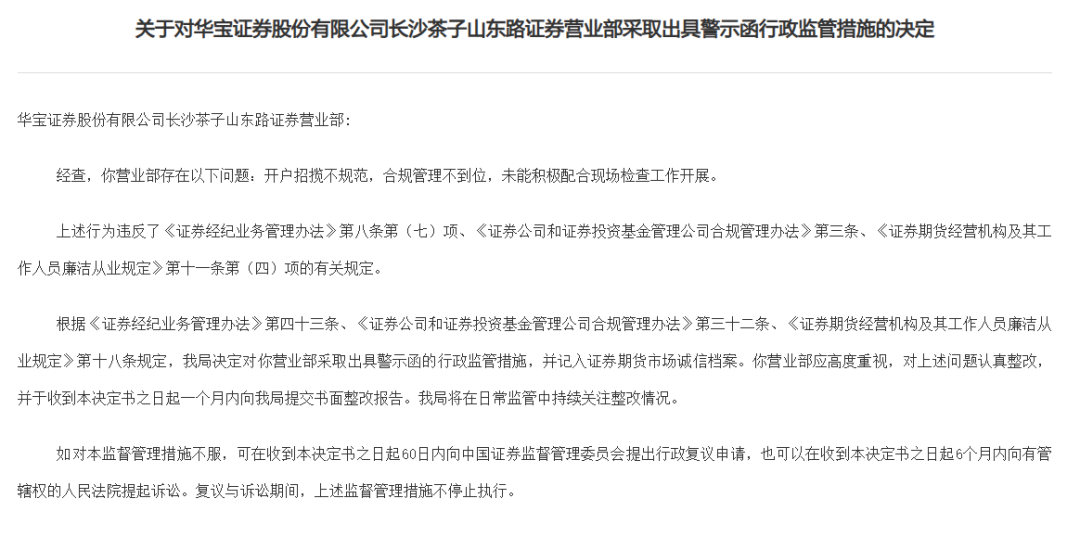
Core Viewpoint - The recent administrative regulatory measures disclosed by the Hunan Securities Regulatory Bureau highlight ongoing compliance issues within the brokerage industry, signaling a need for improved regulatory adherence and risk management practices [1][6]. Group 1: Regulatory Actions - Hunan Securities Regulatory Bureau issued three administrative measures involving two brokerages, emphasizing the importance of compliance in the brokerage sector [1]. - Huabao Securities' Changsha branch received a warning letter for irregularities in client account solicitation and failure to cooperate with inspections, leading to accountability for the responsible person [2]. - Dong Zhimei, an investment advisor at Northeast Securities' Hunan branch, was warned for investing in external companies and facilitating individual investors in off-market stock options trading [5]. Group 2: Prevalence of Violations - Numerous violations have been reported in the brokerage industry this year, covering various aspects such as account opening, product sales, margin financing, and off-market options [6]. - Specific cases include Shen Gang Securities' failure to diligently verify investor materials during new three-board account openings and Southwest Securities' improper client solicitation practices [6]. - Violations in product sales are also notable, with instances of misleading statements and promotion of fraudulent financial products leading to significant investor losses [6]. Group 3: Underlying Issues - The low entry barriers for the securities industry contribute to a lack of professional competence and compliance awareness among some practitioners, exacerbated by high performance pressures [7]. - The number of new accounts opened reached approximately 17.21 million in the first eight months of the year, a year-on-year increase of about 48%, indicating a surge in brokerage activities and highlighting gaps in investor suitability management [7]. Group 4: Need for Enhanced Suitability Management - The legal obligation of "suitability" requires brokerage firms to ensure that the risk levels of financial products match the risk tolerance of investors [8]. - Previous cases have shown failures in conducting adequate financial status reviews and verifying professional investor qualifications, leading to potential legal repercussions for brokerages [8]. - Strengthening compliance management through staff training and process control is essential for mitigating risks and protecting both investor rights and the brokerage's reputation [8][9].


人民币资产吸引力提升
2 1 Shi Ji Jing Ji Bao Dao· 2025-09-20 19:53
Core Viewpoint - The Federal Reserve has restarted interest rate cuts after nine months, lowering the federal funds rate target range by 25 basis points to 4.00%-4.25%, marking its first cut since December 2024 and following three previous cuts totaling 100 basis points in 2024 [2][4]. Economic Conditions - The current economic situation in the U.S. is described as "very special," with rising inflation and a weak labor market creating a "dual risk" scenario [4]. - Recent data shows a slowdown in the U.S. job market, with a downward revision of 911,000 in the annual non-farm payrolls, indicating an average monthly decrease of nearly 76,000 jobs [4]. - The unemployment rate rose from 4.2% in July to 4.3% in August 2025, highlighting labor market weaknesses [4]. Inflation Dynamics - Inflation risks remain, with the Personal Consumption Expenditures (PCE) price index rising 2.7% year-over-year as of August 2025, and core PCE increasing by 2.9%, both exceeding the Fed's 2% target [5]. - Powell indicated that current inflation pressures are primarily due to a temporary rebound in commodity prices, while service price inflation is slowing [5]. Policy Decision Influences - The decision to cut rates was influenced by external pressures, including ongoing calls from President Trump for rate cuts to stimulate economic growth [5]. - The Federal Open Market Committee (FOMC) voted 11-1 in favor of the rate cut, with one member advocating for a more aggressive 50 basis point cut [5][6]. Future Policy Outlook - Analysts suggest that if the labor market worsens, particularly with rising unemployment claims, the Fed may consider another 25 basis point cut in October 2025 or larger cuts in the following year [7]. - The Fed's recent rate cut is characterized as a "risk management" adjustment, indicating it does not signal the start of a sustained rate-cutting cycle [6]. Global Financial Market Reactions - The Fed's rate cut has triggered a chain reaction in global financial markets, affecting the U.S. dollar exchange rate and international capital flows [9]. - The dollar index has shown a downward trend, influenced by concerns over U.S. fiscal sustainability and the Fed's independence [9][11]. Currency and Capital Flows - The weakening dollar has led to a strengthening of the Chinese yuan, with a continuous surplus in bank foreign exchange settlements for four months [11][12]. - Foreign investment in emerging market stocks and bonds reached nearly $45 billion in August, with approximately $39 billion directed towards China, indicating increased capital inflows [12]. Monetary Policy Strategy - In response to the Fed's actions, China's monetary policy may focus more on fiscal measures and reforms rather than direct rate cuts, despite the narrowing interest rate differential with the U.S. [14]. - Experts caution that further rate cuts in China could increase pressure on bank margins and lead to greater volatility in financial markets [14]. Investment Strategies - The Fed's rate cut is expected to alter global asset pricing, prompting a need for diversified investment strategies across asset classes, sectors, and regions [15]. - Holding high-quality bonds is recommended as a strategy to prepare for the Fed's new rate-cutting cycle, optimizing potential returns while managing risks associated with economic slowdown [16].

人民币资产吸引力提升
21世纪经济报道· 2025-09-20 14:11
Core Viewpoint - The Federal Reserve has restarted interest rate cuts after nine months, lowering the federal funds rate target range by 25 basis points to 4.00%-4.25%, marking the first cut since December 2024 and following three previous cuts totaling 100 basis points in 2024 [1][2]. Economic Context - The current economic situation in the U.S. is described as "very special," with rising inflation and a weak labor market creating a "dual risk" scenario. The labor market has shown signs of slowing, with a downward revision of 911,000 in the annual non-farm payroll data, indicating an average monthly increase of nearly 76,000 fewer jobs [2][4]. - Inflation remains a concern, with the Personal Consumption Expenditures (PCE) price index rising 2.7% year-on-year as of August 2025, and core PCE rising 2.9%, both exceeding the Fed's 2% target [4]. Federal Reserve's Strategy - The Fed's decision to cut rates is influenced by the need to balance inflation control and employment stability, with a shift in focus towards job preservation as consumer spending, which accounts for 68% of GDP growth, relies on employment [4][5]. - The decision was also affected by external pressures, including ongoing calls from President Trump for rate cuts to stimulate economic growth, and internal dissent within the Federal Open Market Committee (FOMC), where one member voted against the cut, advocating for a more aggressive 50 basis point reduction [5][6]. Global Financial Market Reactions - The Fed's rate cut has triggered a chain reaction in global financial markets, impacting the U.S. dollar's exchange rate and international capital flows. The dollar index has shown signs of decline, influenced by concerns over U.S. fiscal sustainability and the Fed's independence [6][8]. - The weakening dollar has led to a strengthening of the Chinese yuan, with a continuous surplus in bank foreign exchange settlements for four months and a balanced cross-border capital flow [8][9]. Implications for China - In response to the Fed's actions, China's monetary policy may focus more on fiscal measures and reforms rather than direct rate cuts, despite the narrowing interest rate differential providing some room for easing [11]. - Analysts suggest that while further rate cuts in China could increase pressure on bank margins and lead to greater financial market volatility, the overall economic context may allow for more balanced capital flows and investment opportunities [9][11]. Investment Strategies - Investors are advised to adjust asset allocation strategies in light of the Fed's rate cuts, emphasizing diversification across asset classes, sectors, and regions. This includes considering lower correlation assets such as gold and infrastructure investments to enhance portfolio resilience [12]. - The anticipated decline in dollar cash rates and bond yields may increase the opportunity cost of holding dollar cash assets, prompting a shift towards high-quality bonds to optimize potential returns [12].

信用债周度观察(20250915-20250919):信用债发行量环比增长,各行业信用利差涨跌互现-20250920
EBSCN· 2025-09-20 12:22
Report Industry Investment Rating No relevant content provided. Core Viewpoints of the Report - From September 15th to September 19th, 2025, the issuance volume of credit bonds increased month - on - month, and the credit spreads of various industries showed mixed trends[1]. - The total trading volume of credit bonds increased, and the trading volumes of commercial bank bonds, corporate bonds, and medium - term notes ranked top three[4]. Summary by Directory 1. Primary Market 1.1 Issuance Statistics - During September 15 - 19, 2025, 455 credit bonds were issued, with a total issuance scale of 579.911 billion yuan, a month - on - month increase of 55.61%. Among them, 182 industrial bonds were issued, amounting to 202.499 billion yuan (up 63.71% month - on - month, accounting for 34.92% of the total); 217 urban investment bonds were issued, totaling 141.282 billion yuan (up 52.61% month - on - month, accounting for 24.36%); and 56 financial bonds were issued, reaching 236.13 billion yuan (up 50.98% month - on - month, accounting for 40.72%)[1][11]. - The average issuance term of credit bonds was 2.94 years. The average issuance terms of industrial bonds, urban investment bonds, and financial bonds were 2.42 years, 3.52 years, and 2.31 years respectively[1][13]. - The average issuance coupon rate of credit bonds was 2.28%. The average issuance coupon rates of industrial bonds, urban investment bonds, and financial bonds were 2.13%, 2.48%, and 1.97% respectively[2][18]. 1.2 Cancellation of Issuance Statistics - Four credit bonds were cancelled for issuance during the week, including "25 Xianggaosu CP003", "25 Datong D1", "25 Suzhou Energy MTN002", and "25 Tongzhouwan PPN003"[3][23]. 2. Secondary Market 2.1 Credit Spread Tracking - By industry, among Shenwan primary industries, for AAA - rated industries, the largest increase in credit spread was in the electronics industry (up 6.7BP), and the largest decrease was in the textile and apparel industry (down 6.8BP); for AA + - rated industries, the largest increase was in the electronics industry (up 1.2BP), and the largest decrease was in the mining industry (down 7BP); for AA - rated industries, the largest increase was in the real estate industry (up 14.3BP), and the largest decrease was in the agriculture, forestry, animal husbandry, and fishery industry (down 4.3BP)[3][25]. - By region for urban investment bonds, for AAA - rated bonds, the largest increase in credit spread was in Shanghai (up 3.3BP), and the largest decrease was in Shaanxi (down 10.2BP); for AA + - rated bonds, the largest increase was in Yunnan (up 4.7BP), and the largest decrease was in Hubei (down 5.9BP); for AA - rated bonds, the largest increase was in Fujian (up 6.5BP), and the largest decrease was in Jiangxi (down 5.8BP)[3][27]. - The credit spreads of coal and steel both showed mixed trends. The credit spreads of AAA and AA + - rated coal decreased by 1.2BP and 5.3BP respectively, and the credit spreads of AAA and AA + - rated steel decreased by 3.3BP and increased by 0.5BP respectively[25]. - The credit spreads of urban investment and non - urban investment bonds at all levels decreased. The credit spreads of three - level urban investment bonds decreased by 0.5BP, 3.1BP, and 1.8BP respectively, and the credit spreads of three - level non - urban investment bonds decreased by 1.5BP, 2.3BP, and 0.4BP respectively[25]. - The credit spreads of state - owned enterprises and private enterprises both showed mixed trends. The credit spreads of three - level central state - owned enterprises decreased by 1BP, 5.6BP, and increased by 0.2BP respectively; the credit spreads of three - level local state - owned enterprises decreased by 1.4BP, 1.8BP, and 2.1BP respectively; the credit spreads of three - level private enterprises decreased by 2BP, 2.3BP, and increased by 1BP respectively[26]. 2.2 Trading Volume Statistics - The total trading volume of credit bonds was 1.462306 trillion yuan, a month - on - month increase of 21.90%. The top three in terms of trading volume were commercial bank bonds, corporate bonds, and medium - term notes. The trading volume of commercial bank bonds was 479.739 billion yuan (up 26.26% month - on - month, accounting for 32.81% of the total trading volume); the trading volume of corporate bonds was 432.035 billion yuan (up 29.94% month - on - month, accounting for 29.54%); the trading volume of medium - term notes was 311.265 billion yuan (up 14.08% month - on - month, accounting for 21.29%)[4][28]. 2.3 Actively Traded Bonds This Week - According to DM client data, the top 20 urban investment bonds, industrial bonds, and financial bonds in terms of trading volume during the week are provided for investors' reference, including details such as bond codes, names, trading volumes, yields, and issuers[30][31][33].




