南京银行

Search documents
研报掘金丨国海证券:南京银行营收及业绩增速亮眼,维持“买入”评级
Ge Long Hui A P P· 2025-09-02 07:24
国海证券研报指出,南京银行2025H1营收同比+8.64%,归母净利润同比+8.84%,营收、归母净利润增 速双双提升,资产规模高速增长,对公贷款总额稳健增长,不良率改善。从收入结构来看,南京银行 2025H1利息净收入156.46亿元,同比上升22.13%。从贷款质量看,对公贷款不良率较2024年末下降1bp 至0.65%,信息传输、制造业等多个行业不良率得到改善。净息差、逾期贷款等主要指标保持稳健。 2025H1末,南京银行净息差为1.86%,较2024年末下降8bp;拨备覆盖率311.65%,环比2025Q1下降 12.04pct。净息差、逾期贷款等主要指标保持稳健,该行维持"买入"评级。 ...

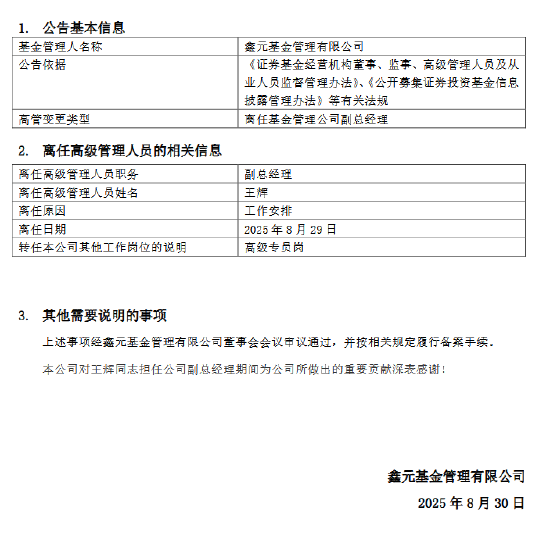
鑫元基金高管异动:副总经理王辉转任高级专员 股东南京银行完成“换血”布局?
Xin Lang Ji Jin· 2025-09-02 07:22
Group 1 - The recent personnel change at Xinyuan Fund, where Deputy General Manager Wang Hui was reassigned to Senior Specialist, indicates potential shifts in shareholder control, particularly by Nanjing Bank [1][7] - Wang Hui has been with Xinyuan Fund for over 12 years and served as Deputy General Manager for nearly 9 years, making this change noteworthy and not merely a promotion [1][5] - The announcement of Wang Hui's transition included unusual formatting in the acknowledgment section, raising speculation about the underlying reasons for the change [1] Group 2 - Xinyuan Fund has experienced systematic changes in its executive team, with Nanjing Bank increasing its control since 2022, including the appointment of new executives from its own ranks [7][8] - The fund's management structure has seen significant turnover, with 116 fund companies experiencing executive changes this year alone, involving over 260 personnel [14] - As of June 30, 2025, Xinyuan Fund's asset management scale reached 211.78 billion yuan, with a strong focus on fixed-income products, which accounted for 98% of its total fund size [11][13] Group 3 - The fund's recent financial performance shows a total revenue of 356 million yuan, reflecting a year-on-year growth of 17.49%, and a net profit of 107 million yuan, with an 18.99% increase [13] - The average tenure of current fund managers at Xinyuan Fund is only 3.70 years, which is below the industry average of 4.94 years, indicating a potential instability in the investment research team [14] - The future development of Xinyuan Fund will be closely monitored, particularly regarding its ability to enhance its equity product competitiveness while maintaining its fixed-income advantages [15]

业绩回升,夯实质效
HTSC· 2025-09-02 07:16
Investment Rating - The report maintains an "Overweight" rating for the banking sector [8]. Core Insights - The banking sector has shown a recovery in performance, with revenue and net profit growth of +1.0% and +0.8% year-on-year for H1 2025, respectively, indicating an improvement compared to Q1 2025 [14][29]. - Key focus areas include accelerated non-loan driven expansion, stable credit issuance, a recovery in deposits from a low base, narrowing interest margin declines leading to a recovery in net interest income, improved growth in non-interest income, and ongoing retail risk clearance [1][2][3]. Summary by Sections Market Overview - The banking sector has experienced a slight rebound with a +13.4% absolute return year-to-date as of August 29, 2025, although it slightly underperformed the broader market [13]. - The report anticipates a potential divergence in sector performance, favoring high-quality regional banks and high-dividend Hong Kong-listed banks for investment [13]. Profitability Breakdown - The net interest margin for listed banks was measured at 1.41% for H1 2025, showing a slight improvement from Q1 2025 [3][14]. - Non-interest income has seen a year-on-year increase of 10.7% in H1 2025, driven by a recovery in capital markets [3][15]. - The report highlights a need to monitor interest rate risks due to recent market volatility [3][15]. Asset and Liability Management - Total assets and liabilities for listed banks grew by +9.6% year-on-year as of H1 2025, with significant contributions from non-loan driven growth [2][16]. - The report notes a recovery in deposits, with a year-on-year increase of +8.3% in H1 2025, attributed to a low base effect from the previous year [2][17]. Risk Assessment - The non-performing loan (NPL) ratio remained stable at 1.23% as of H1 2025, with a provision coverage ratio of 238% [4][18]. - The report indicates a slight increase in retail loan NPLs, suggesting ongoing monitoring of retail credit risks [4][18]. Market Outlook - The report suggests that the narrowing of interest margin declines and reduced non-interest income volatility will support revenue and profit growth for banks in the near term [5][14]. - It emphasizes the importance of identifying quality stocks with structural opportunities in the banking sector, particularly those with strong performance and growth potential [5][14].




A股银行股逆势上涨,沪农商行、渝农商行涨超3%
Xin Lang Cai Jing· 2025-09-02 02:11
Group 1 - The main A-share indices experienced a general decline, while bank stocks showed an upward trend [1] - Notable gainers included Hu Nong Commercial Bank and Yu Nong Commercial Bank, both rising over 3% [1] - Other banks such as Qilu Bank, Ningbo Bank, Agricultural Bank of China, Nanjing Bank, Hangzhou Bank, China Merchants Bank, Chengdu Bank, Jiangyin Bank, and Changsha Bank all saw increases of over 1% [1]
上市银行重排座次:农业银行异军突起,江苏银行新晋城商行“一哥”
Xin Lang Cai Jing· 2025-09-01 13:12
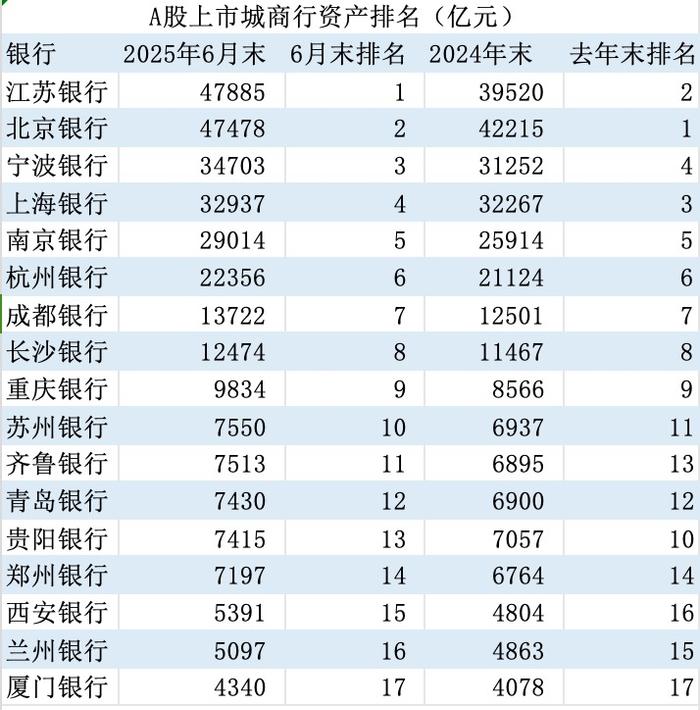
Core Insights - The report highlights the performance of 42 listed banks in A-shares as of September 1, with no significant changes in the rankings of state-owned and joint-stock banks in terms of total market value, asset scale, revenue, and net profit compared to the end of last year or the same period last year [1] - Jiangsu Bank has emerged as the leading city commercial bank in total assets, surpassing Beijing Bank, while Nanjing Bank has climbed to the third position among city commercial banks [6][7] Market Value and Revenue - The overall market value of listed banks has generally recovered, with the price-to-book ratio rising from 0.57 at the end of last year to 0.64 by the end of August [3] - Agricultural Bank of China has shown significant stock price growth, with its market value nearing that of Industrial and Commercial Bank of China, with a market value of 2.46 trillion yuan, only 715 billion yuan higher than Agricultural Bank [4] - Minsheng Bank's revenue increased by nearly 8% year-on-year, ranking first among state-owned and joint-stock banks, with a revenue of 724 billion yuan [10] Asset Scale - Agricultural Bank's total assets have grown rapidly, surpassing China Construction Bank, with a total asset scale of 52.3 trillion yuan as of June 30, accounting for approximately 11% of the total assets of China's banking industry [6][9] - Jiangsu Bank's total assets reached 4.8 trillion yuan, exceeding Beijing Bank by over 1 billion yuan, marking it as the top city commercial bank in terms of asset scale [7][8] Profitability - The net profit rankings for large banks, joint-stock banks, and rural commercial banks remained unchanged, while city commercial banks experienced significant shifts [11] - Guizhou Bank's revenue decreased by 12% year-on-year to 6.5 billion yuan, primarily due to a decline in net interest margin [10][11]



南京银行(601009):营收及业绩增速亮眼,资产总额稳健增长
Guohai Securities· 2025-09-01 13:03
Investment Rating - The investment rating for the company is "Buy" (maintained) [1] Core Views - The company has shown impressive revenue and profit growth, with total assets steadily increasing. The total revenue for H1 2025 reached 28.5 billion yuan, a year-on-year increase of 8.64%, while the net profit attributable to shareholders grew by 8.84% [5] - The asset scale is growing rapidly, with total assets reaching 2.90 trillion yuan, an increase of 11.96% compared to the end of 2024. Customer deposits totaled 1.65 trillion yuan, up 9.98% [5] - The company maintains a robust risk control system, with a non-performing loan ratio of 0.84%, which is stable compared to the previous year [5] Summary by Sections Revenue and Profit Growth - In H1 2025, the company achieved a revenue of 28.5 billion yuan, reflecting an increase of 8.64% year-on-year, with a net profit of 12.6 billion yuan, up 8.84% [5] - The revenue growth rate improved by 0.77 percentage points compared to the same period last year, while the net profit growth rate increased by 0.33 percentage points [5] Asset Growth - As of the end of H1 2025, total assets reached 2.90 trillion yuan, marking an 11.96% increase from the end of 2024 [5] - The total amount of loans and advances was 1.39 trillion yuan, up 10.41% from the end of 2024, with corporate loans specifically increasing by 12.71% to 1.06 trillion yuan [5] Key Financial Metrics - The net interest margin stood at 1.86%, a decrease of 8 basis points from the end of 2024, while the provision coverage ratio was 311.65%, down 12.04 percentage points from Q1 2025 [5] - The company’s non-performing loan ratio improved slightly, with a decrease of 1 basis point to 0.65% for corporate loans [5] Earnings Forecast - The company is projected to achieve revenues of 54.8 billion yuan, 59.9 billion yuan, and 65.6 billion yuan for 2025, 2026, and 2027 respectively, with year-on-year growth rates of 9.01%, 9.33%, and 9.51% [7] - The net profit attributable to shareholders is expected to be 21.2 billion yuan, 22.4 billion yuan, and 23.6 billion yuan for the same years, with growth rates of 5.30%, 5.25%, and 5.51% [7]
关注长端债券机会,注意把控节奏
Ning Zheng Qi Huo· 2025-09-01 10:11
关注长端债券机会,注意把控节奏 摘 要: 我国经济景气水平总体继续保持扩张,中国 8 月官方制造业 PMI、非制造业 PMI 和综合 PMI 分别为 49.4%、50.3%和 50.5%,环 比升 0.1、0.2 和 0.3 个百分点。九三阅兵在即,我国国际影响力 将进一步加强,离岸人民币汇率大幅升值,国内经济景气度的不断 上升,进一步提振风险偏好。下半年规模高达 5000 亿元的新型政 策性金融工具将出,重点投向新兴产业、基础设施等领域,国家开 发银行、中国农业发展银行、中国进出口银行等政策性银行参与其 中。如果下半年外围政策有任何变动,国内各种政策可以马上出台, 以保证经济复苏的趋势持续进行。 最近,多家中小银行宣布下调人民币存款利率,降幅达 10 到 20 个基点。近日,江苏银行、南京银行等多家银行宣布调整 3 年期 定期存款利率。央行新增支农支小再贷款额度 1000 亿元,引导和 鼓励金融机构加大对北京、河北、吉林、山东、甘肃等受灾地区的 经营主体特别是小微企业、个体工商户,以及农业、养殖企业和农 户的信贷支持力度。目前从流动性及货币政策方面,与央行发布第 二季度货币政策执行报告提出,下一阶段要落实落 ...
供需矛盾累积,盘面震荡偏弱
Ning Zheng Qi Huo· 2025-09-01 10:11
Group 1: Report Industry Investment Rating - Not provided Group 2: Core Viewpoints of the Report - The steel market is in a state of weak balance with supply and demand, and the cost still provides support. Next week, steel prices may adjust within a narrow range, and the pattern of repeated ups and downs will continue. The market should be treated as weakly volatile, and patiently wait for opportunities for a bottom - rebound [29]. Group 3: Summary by Relevant Catalogs 1. This Week's Market Review - Market sentiment was average, with the game between long - and short - term factors and fundamentals. This week, steel prices showed a volatile downward trend, and the price center of gravity shifted down compared with last week. The national average price of rebar decreased by 8 yuan/ton, and the average price of high - speed wire decreased by 9 yuan/ton. Except for a slight increase in the Northeast region, all other regions declined slightly, with a decline ranging from 10 - 30 yuan/ton [2][3] 2. Macro and Industrial News - The "Opinions of the Central Committee of the Communist Party of China and the State Council on Promoting High - Quality Urban Development" was released, supporting the construction of world - class city clusters in the Beijing - Tianjin - Hebei, Yangtze River Delta, and Guangdong - Hong Kong - Macao Greater Bay Area. The Ministry of Commerce will introduce policies to expand service consumption next month and has formulated policies to promote service exports. From January to July this year, the national issuance of new local government bonds was 331.59 billion yuan, and the total issuance of local government bonds was 670.36 billion yuan. From January to July, the total profit of the ferrous metal smelting and rolling processing industry was 64.36 billion yuan, a year - on - year increase of 5175.4%. In mid - August 2025, the daily output of key steel enterprises increased, and the estimated national daily output of steel also increased. As of the week of August 27, the capacity utilization rate of 523 coking coal mines decreased, and the inventory of raw coal and clean coal increased. Recently, many small and medium - sized banks announced a reduction in RMB deposit interest rates [5][6] 3. Fundamental Analysis - According to the survey of 237 mainstream traders by Mysteel, the average daily trading volume of building materials from Monday to Friday this week was 94,400 tons, lower than last week's 94,800 tons. The demand for steel in the off - season continued to be weak, downstream terminals purchased on demand, and merchants' willingness to replenish inventory was not strong. The short - term market was dominated by a wait - and - see attitude [9] 4. Market Outlook and Investment Strategies - The current steel demand is at the switching point between the off - season and peak season. Short - term demand is still weak, but there is an expectation of improvement in the medium - term. The increase in construction steel output is expected to slow down. The steel market is in a weak balance, and the cost still provides support. The steel price may adjust within a narrow range next week. From the perspective of the disk, most black commodities closed down, and the iron ore main contract rose slightly. The rebar main contract 2601 showed a downward trend, with the center of gravity shifting down. It should be treated as weakly volatile, waiting for a bottom - rebound opportunity. Investment strategies include mainly range - bound operations for single - side trading, waiting and seeing for inter - period arbitrage, volume - screw spread, and steel profit, and a wide - straddle consolidation for option strategies [29]
外资二季度持仓超千亿!185家公司被扎堆布局!“中东土豪”同时重仓这两家公司!
私募排排网· 2025-09-01 10:00
Core Viewpoint - The article discusses the increasing activity of foreign capital in the A-share market, particularly in the second quarter, highlighting the sectors and companies that have attracted significant foreign investment [2][5]. Group 1: Foreign Capital Activity - Since April 27, the A-share market has entered a slow bull market, with foreign capital becoming increasingly active, as evidenced by the disclosure of second-quarter holdings [2]. - In the second quarter, foreign capital entered 1,123 companies as major shareholders through QFII, with a total holding value of 139.29 billion yuan, an increase of over 40 billion yuan compared to the first quarter [2][3]. - The electronic sector was the most favored by foreign investors, with a total holding value of 17.57 billion yuan, reflecting a significant increase of 5.55 billion yuan [3][4]. Group 2: Sector Performance - Excluding five banks with significant foreign ownership, the electronic sector saw a 25.65% average increase in stock prices since the end of the second quarter [3]. - Other sectors that attracted foreign investment include machinery equipment, non-ferrous metals, and automobiles, with respective holding values of 6.29 billion yuan, 5.44 billion yuan, and 5.08 billion yuan [3][4]. - The average increase in stock prices for the 126 companies with over 100 million yuan in foreign holdings reached 19.05%, with 15 companies experiencing gains of over 50% [5][11]. Group 3: Notable Companies - The top foreign-held stocks include Ningbo Bank and Nanjing Bank, with significant holdings by foreign institutions [5]. - A notable company in the electronic sector reported a total revenue of 12.68 billion yuan in the first half of the year, a year-on-year increase of 31.68%, and a net profit of 1.43 billion yuan, up 52.98% [5][6]. - Companies like Huafang Co. and Anji Food have been heavily targeted by multiple foreign investors, with significant stock price movements observed [11][12]. Group 4: Sovereign Wealth Funds - Sovereign wealth funds from the Middle East, such as the Abu Dhabi Investment Authority, have made substantial investments in A-shares, with a focus on long-term value [17][20]. - The Abu Dhabi Investment Authority's largest holding is Zijin Mining, with a market value of 3.38 billion yuan, reflecting a strategic investment approach [17][18]. - The Kuwait Investment Authority has also been active, holding significant stakes in 16 A-share companies, with a total market value of approximately 3.73 billion yuan [20][21].

东方证券:25H1银行业绩全面回暖 非信贷资产驱动扩表提速
智通财经网· 2025-09-01 07:30
Core Viewpoint - The performance of A-share listed banks has shown a comprehensive recovery, with state-owned banks demonstrating the most significant improvement in performance as of H1 2025 [1][2]. Financial Performance - As of H1 2025, the cumulative year-on-year growth rates for A-share listed banks are 1.0% in revenue, 1.1% in PPOP, and 0.8% in net profit attributable to shareholders, with quarter-on-quarter increases of +2.8 percentage points, +3.3 percentage points, and +2.0 percentage points respectively [1]. - The growth in net interest income increased by 0.4 percentage points quarter-on-quarter, while net fee income and other non-interest income grew by 3.8 percentage points and 13.9 percentage points respectively [1]. Asset and Loan Growth - Total assets, interest-earning assets, and total loans of listed banks saw year-on-year growth rates of +2.1 percentage points, with loan growth being marginally positive at +0.04 percentage points [2]. - The contribution of corporate and retail loans is approximately 9:1, indicating that state-owned and city commercial banks have stronger marginal loan growth compared to joint-stock and rural commercial banks [2]. Interest Margin and Cost - The net interest margin for listed banks in H1 2025 is estimated at 1.33%, narrowing by 11 basis points compared to 2024, primarily due to improved funding costs [3]. - The cost of interest-bearing liabilities improved by 30 basis points in H1 2025 compared to the same period last year, with high-interest time deposits entering a concentrated repricing cycle [3]. Asset Quality - As of H1 2025, the non-performing loan (NPL) ratio decreased by 0.4 basis points quarter-on-quarter, while the overdue rate increased by 3 basis points [4]. - The pressure on asset quality remains concentrated in personal loans, with mortgage loans, consumer loans, business loans, and credit cards showing increases in NPL generation rates [4]. Capital Adequacy - Capital adequacy ratios have significantly improved, with 17 banks planning to implement mid-term dividends in H1 2025, particularly among state-owned banks [5]. Investment Recommendations - With the improvement in bank performance in H1 2025, the adjustment space for bank stocks is expected to be limited, focusing on high-dividend stocks and fundamentally sound mid-sized banks [7].