
奔驰

Search documents
财新周刊-第16期2025
2025-05-07 01:52
财新观察|有序推进服务业开放 来源于 《财新周刊》 2025年04月28日第16期 服务业持续开放是经济转型必经之路,也是提升消费水平和生活质量的题中之义 中国服务业规模在三大产业中稳居第一,增加值占GDP的比重不断攀升。图:视觉中国 服务业开放正在提速加力。近日,国务院批复《加快推进服务业扩大开放综合试点工作方 案》(下称《工作方案》),要求赋予新一轮服务业扩大开放综合试点新内容新任务,主动对 接国际高标准经贸规则,大胆试、大胆闯。《工作方案》从重点服务领域开放、产业创新发展 等多个维度,提出155项具体试点任务,其中多数来自经营主体的日常经营、跨境投资等活动 的实际需要。另外,在既有试点省市基础上,将大连、宁波、厦门、青岛、深圳、合肥、福州、 西安、苏州等9个城市纳入试点范围。 在应对内外部经济挑战,尤其是特朗普发动的关税战的背景下,服务业扩大开放综合试点 彰显了中国扩大高水平对外开放的决心和诚意,是以实际行动维护多边贸易体制。这并非应急 之策,而是一个有序推进的进程所取得的新进展。实际上,自2015年以来,国务院分三批先后 批准了北京等11个省市开展试点。服务业的持续开放符合中国经济发展方向,是经济转型 ...
Rivian 宣布在美投资 1.2 亿美元加强供应链建设,以应对关税压力
Sou Hu Cai Jing· 2025-05-07 00:37
Core Insights - Rivian announced a $120 million investment to build a supplier park near its factory in Normal, Illinois, aimed at reducing logistics costs and accelerating production of the 2026 Rivian R2 SUV [1][3] - The supplier park will cover 1.2 million square feet and is expected to create hundreds of jobs, directly generating nearly 100 positions [1] - This initiative is part of Rivian's strategy to address U.S. import tariffs and reduce reliance on imported parts, aligning with similar moves by other automakers [3] Investment and Expansion - Rivian previously announced a $1.5 billion plan to expand its factory in Illinois [1] - The Illinois government will provide $16 million in incentives, including over $5 million in tax breaks and capital grants, in exchange for Rivian's commitment to invest at least $119.6 million and create 93 jobs [3] - The current annual production capacity of the Normal factory is 215,000 vehicles, producing R1T pickups, R1S SUVs, and commercial electric vans [3] Future Production Plans - Rivian has paused construction of a new factory in Georgia to conserve cash and has shifted R2 production to the Normal facility, with mass production expected in the first half of 2026 [3] - The company secured a $6.6 billion loan from the U.S. Department of Energy, planning to resume construction in Georgia in 2026 and start producing R2 and subsequent R3 crossover models in 2028 [3]



关键技术加速升级 合资合作持续深化 人工智能深度赋能 从上海车展看汽车业转型“中国速度”(产经观察)
Ren Min Ri Bao· 2025-05-06 21:37
Core Insights - The 21st Shanghai International Automobile Industry Exhibition showcased nearly 1,000 domestic and foreign enterprises, highlighting bold explorations by Chinese new energy vehicle companies in product definition, pricing, and business models, as well as a high acceptance of digital and intelligent experiences among young consumers [1] Electric and Intelligent Technology Upgrades - Chinese smart electric vehicle companies and supply chain enterprises unveiled impressive new technologies, indicating that China's electrification and intelligentization are leading the global automotive industry's transformation [2] - CATL, a global leader in power battery shipments, introduced its sodium-ion battery, which reduces reliance on lithium resources and achieves an energy density of 175 Wh/kg, supporting a range of 500 kilometers [2] - The new dual-core battery architecture from CATL enhances energy density by 60% and weight energy density by 50%, significantly improving range [3] Advanced Driver Assistance Technologies - Major automakers presented advanced driver assistance technologies, including GAC Aion and Didi's L4 autonomous driving Robotaxi, set for delivery by the end of the year [4] - Huawei's ADS 4 system improves efficiency and reduces latency, with a flagship version designed for high-speed L3 applications [4] - Horizon Robotics showcased its high-performance chip with a processing power of 560 TOPS, marking a significant advancement in domestic L2 urban driving assistance systems [4] Global Collaboration and Innovation - Multinational companies are transitioning from "Made in China" to "Developed in China for the World," with significant R&D efforts localized in China [5][6] - Mercedes-Benz's new electric long-wheelbase CLA was developed entirely by a local team in just 18 months, reflecting the rapid innovation pace in the Chinese market [6] - GM's Buick brand introduced a new high-end electric sub-brand and plans to launch six new models based on a versatile architecture within the next 12 months [6] AI Integration in Automotive Development - AI technologies are increasingly integrated into vehicle development, with companies like Zhiji and Xpeng introducing AI-driven chassis systems that enhance safety and adaptability [8][9] - Geely has applied AI across various domains, including architecture, power, chassis, and driving assistance, achieving significant reductions in development cycles and costs [9] - The automotive industry is urged to adopt AI strategies to foster innovative organizational structures and accelerate transformation [10]
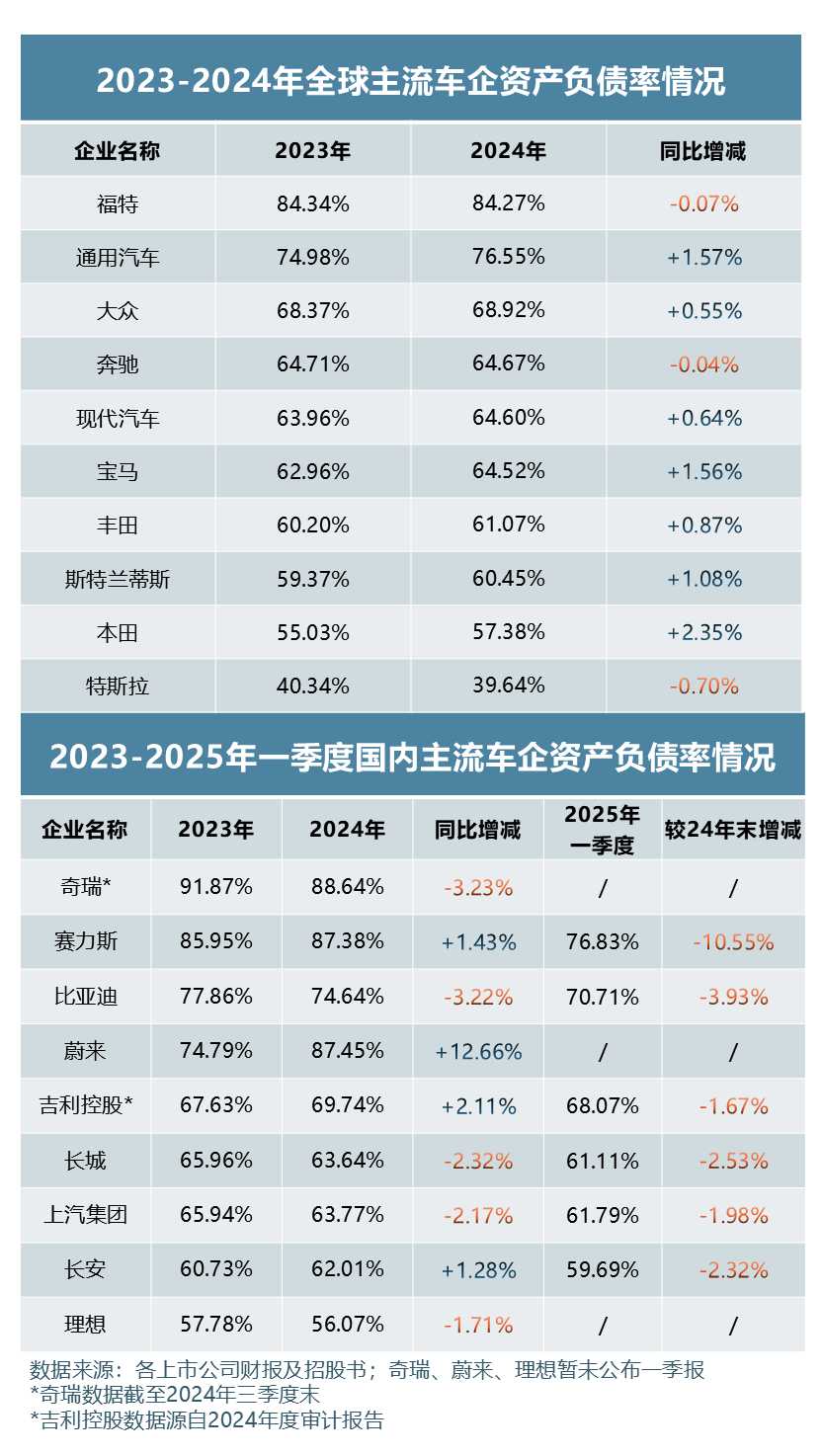
全球车企“负债密码”:谁在负重前行,谁在轻装领跑?
经济观察报· 2025-05-06 12:53
Core Viewpoint - The financial status, particularly the debt ratio, is a critical factor determining the fate of automotive companies amid the global shift towards electrification and intelligence in the automotive industry [2][5]. Debt Situation of Global Automotive Companies - In 2024, the debt ratios of major global automotive companies generally exceed 60%, with some surpassing 80%. Ford leads with a debt ratio of 84.27%, followed by General Motors at 76.55% and Volkswagen at 68.92% [2][3]. - Among domestic companies, Chery has the highest debt ratio at 88.64%, followed by NIO at 87.45% and BYD at 74.64% [2][4]. Financial Metrics of Major Companies - The financial metrics for selected global automotive companies in 2024 include: - Toyota: Debt ratio 61.07%, total debt 273.09 billion, interest-bearing debt 186.95 billion [3]. - Ford: Debt ratio 84.27%, total debt 171.16 billion, interest-bearing debt 112.89 billion [4]. - BYD: Debt ratio 74.64%, total debt 58.47 billion, interest-bearing debt 0.286 billion [4]. High Debt Ratios and Industry Dynamics - The high debt ratios in the automotive industry are attributed to the capital-intensive nature of manufacturing, requiring significant investments in factories, equipment, and new technologies, especially during the transition to electrification and intelligence [5][6]. - Major international companies like Volkswagen and Ford are investing heavily in transformation, with Volkswagen planning to invest 170 billion euros from 2025 to 2029 for new product development and battery business [5][6]. Comparison of Debt Structures - The proportion of interest-bearing debt to total debt is a crucial indicator of financial health. Generally, a reasonable ratio is around 30%. However, many international companies exceed this, with Toyota at 68% and Ford at 66% [6][7]. - In contrast, domestic companies maintain lower interest-bearing debt ratios, with BYD at only 5%, indicating less repayment pressure compared to international peers [6][7]. Operational Health Indicators - BYD's operational health is reflected in its low accounts payable ratio, which stands at 31% of revenue, the lowest among domestic companies, indicating a strong position in supply chain management [9]. - The average payment cycle for BYD is 127 days, also among the shortest in the industry, suggesting efficient cash flow management [9]. Trends and Future Outlook - The overall debt ratio in the automotive industry is high compared to other manufacturing sectors, but recent reports indicate a downward trend in debt ratios among domestic companies, particularly BYD, which has seen a decrease of nearly seven percentage points in the last six months [9][10]. - The automotive industry is expected to undergo a new round of restructuring in asset and debt situations, with companies needing to balance scale expansion and financial health to thrive in a competitive environment [10].

拆解全球车企财报:高负债背后的真相与启示
2 1 Shi Ji Jing Ji Bao Dao· 2025-05-06 12:48
Core Viewpoint - The financial health of automotive companies is under scrutiny due to rising debt levels amid global economic pressures, with a focus on the debt-to-equity ratio as a key indicator of financial stability [1] Group 1: Debt Ratio Trends - The debt ratio is high among major automotive companies globally, with most falling between 60% and 80%, including General Motors, Volkswagen, Mercedes-Benz, and Toyota, as well as leading domestic firms like BYD and Geely [1] - Notably, while overseas companies are experiencing rising debt ratios, domestic companies are seeing a decline, with BYD's debt ratio dropping nearly seven percentage points to 70.7% [4][5] Group 2: Interest-Bearing Debt - The automotive industry typically sees larger companies carrying higher debt levels; for instance, Volkswagen has total liabilities of 3.4 trillion yuan and Toyota 2.7 trillion yuan, totaling over 6 trillion yuan [6] - Interest-bearing debt is a critical concern, as it poses liquidity risks; for example, General Motors faced bankruptcy in 2009 due to an inability to manage its debt [10] - Domestic companies maintain lower interest-bearing debt levels, with BYD at just 286 billion yuan, representing only 5% of its total liabilities, indicating a more cautious financial approach [10] Group 3: Supplier Relationships - Lower interest-bearing debt allows Chinese automotive companies to operate effectively through non-interest-bearing liabilities, with accounts payable being a significant component [11] - The accounts payable to revenue ratio for major domestic companies like BYD is 31%, while others like Great Wall and Changan are at 39% and 49%, respectively, indicating a healthy balance [12][14] - Efficient payment cycles enhance supplier relationships, with BYD averaging 127 days to settle accounts, which is favorable compared to other companies [14][15] Group 4: Industry Outlook - The automotive industry, traditionally reliant on substantial debt, is witnessing a shift as Chinese companies demonstrate robust financial performance while expanding rapidly, particularly in the electric vehicle sector [15]


计算机周观点第3期:各大厂发力AI Agent,AI商业化元年加速到来-20250506
Haitong Securities International· 2025-05-06 12:16
Investment Rating - The report rates the industry as "Outperform" [1] Core Viewpoints - The development of AI Agents by major companies indicates that AI Agents are a key theme for this year, with expectations for accelerated commercialization of AI applications [2][3] - Current AI technology is sufficient to support the deployment of excellent segment-specific agents, marking the beginning of a large-scale commercialization era for the AI industry [2][3] - Baidu's recent product releases demonstrate steady progress in foundational AI technology, continuously raising the industry's potential ceiling [2][3] Summary by Relevant Sections - **Recent Developments**: ByteDance has released several intelligent tools, while Alibaba's Fliggy launched a travel AI named "Ask Me," which provides customized services. The Doubao foundation model is widely used across various industries, covering 400 million devices and 80% of major automobile companies [8][9] - **Product Performance**: Baidu's Wenxin 4.5 Turbo and X1 Turbo models show improved performance at reduced prices, with significant enhancements in multimodal capabilities and a price reduction of 80% for Wenxin 4.5 Turbo [9] - **Government Initiatives**: The National Development and Reform Commission is promoting low-altitude economic development, indicating a strategic push for this emerging industry, which is expected to become more standardized and rapidly deployed nationwide [10]


加速成熟的中国汽车市场:新能源、技术路线与全球化
Sou Hu Cai Jing· 2025-05-06 08:28
Core Insights - Global sales of new energy vehicles (NEVs) reached 7.279 million units in the first half of 2024, marking a 21.3% year-on-year increase, with a market penetration rate exceeding 17% [2] - China leads the global NEV market with 4.944 million units sold, accounting for 68% of the global market, and a year-on-year growth rate of 32%, surpassing the global average by nearly 11 percentage points [2] - The rapid development of China's NEV industry not only meets global consumer demand but also supports the electric transformation of automotive industries worldwide [2] Market Dynamics - The competition in the automotive market is intensifying, leading to price wars as companies strive to maintain market share amid technological and market cycles [3] - Chinese automotive companies are working to reshape the market pricing structure, leveraging cost advantages and scale [3] Challenges in Development - The rapid growth of the NEV sector presents challenges, including the need for improved product performance in low-temperature conditions and quality safety [4] - Issues such as underdeveloped charging infrastructure and protectionist trade policies in various countries pose significant barriers to the widespread adoption of NEVs [4] Sales Growth and Market Maturity - From January to August 2023, China's NEV sales reached 7.037 million units, a 30.9% increase, with new energy passenger vehicles achieving over 50% retail market share for three consecutive months [5] - The global NEV market is transitioning to a mature phase, with 2023 global sales nearing 14 million units, representing 18% of total automotive sales [5] Technological Innovations - Solid-state batteries are a key focus for NEV manufacturers, although they face challenges related to material costs and vehicle integration [6] - The cost of liquid batteries has decreased to 0.1 yuan/wh, while solid-state battery costs are projected to reach 1 yuan/wh by 2030 [6] Diverse Technological Approaches - The rise of plug-in hybrid electric vehicles (PHEVs) has contributed significantly to NEV penetration, with PHEV sales growing by 75.6% year-on-year [6] - The development of multiple technological routes, including hydrogen fuel cells, is essential for achieving zero-carbon emissions [8] Global Expansion and Trade Barriers - Chinese automotive companies are increasingly pursuing global markets, but face trade barriers such as increased tariffs and restrictive standards in various regions [9] - The EU's temporary tariffs on Chinese electric vehicles could reach up to 47.6%, significantly impacting the competitiveness of Chinese NEVs in Europe [10] Internal Challenges for Overseas Expansion - Many Chinese brands primarily focus on trade exports and lack localized operations in overseas markets [11] - The domestic price wars highlight the need for differentiation in value propositions to succeed internationally [11]
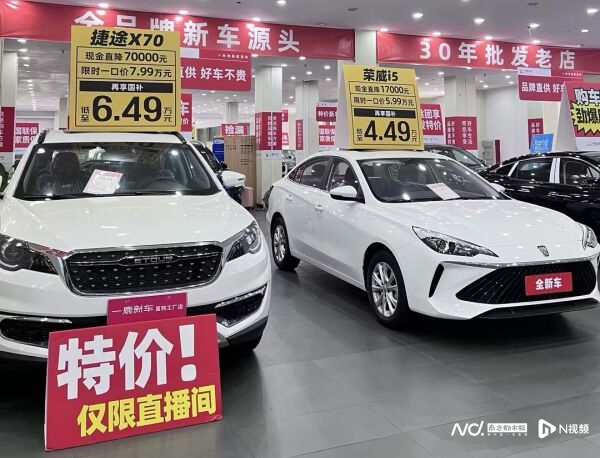
五一华南新车“放价”,送补贴送保险还0息!有车降7.5万
Nan Fang Du Shi Bao· 2025-05-06 08:26
Group 1: Core Insights - The five-day holiday has led to a surge in car purchases, with local auto shows crowded and various automakers increasing discounts to capture orders [1][2] - GAC Group's brands are heavily promoting during the holiday, offering extensive benefits such as lifetime free charging and maintenance, as well as attractive financing options [2][3] - The second-hand car market is facing increased pressure, prompting more second-hand car dealers to explore new car sales as a potential revenue stream [5][6] Group 2: Promotions and Discounts - GAC Aion is offering significant incentives, including up to 45,000 yuan in trade-in subsidies for certain models, and zero down payment options [3][4] - GAC Honda and GAC Toyota are also providing substantial discounts, with some models offering up to 67,000 yuan in comprehensive benefits during the holiday [3][4] - Chery Automobile is promoting attractive trade-in prices, allowing customers to save up to 40,000 yuan on new purchases [4] Group 3: Second-Hand Car Market Trends - The second-hand car market has seen a notable increase in transaction volume during the holiday, with a 23.6% year-on-year growth in vehicle sales [9] - The transaction value reached approximately 83 million yuan, marking a 28.7% increase compared to the previous year [9] - The market is expected to evolve with trends such as policy-driven growth, technological innovation, and consumer segmentation, particularly in the second-hand electric vehicle segment [10]

富泰和北交所IPO:站在资本市场的聚光灯下
Jing Ji Guan Cha Bao· 2025-05-06 07:13
Core Viewpoint - Shenzhen Fuhai Precision Manufacturing Co., Ltd. (Fuhai) is at a critical juncture as it seeks to transform from a traditional fuel vehicle supplier to a player in the new energy sector, with its IPO application accepted by the Beijing Stock Exchange [1][2] Group 1: Company Overview - Fuhai, established for 20 years, plans to allocate 81.5% of its IPO proceeds (approximately 269 million yuan) to smart production lines targeting the demand for new energy components from leading automakers like Tesla and BYD [1] - Currently, revenue from the new energy business accounts for less than 3% of total revenue, while the chassis component segment has shown resilience, increasing its revenue share from 39% in 2021 to 50% in 2024, with a stable gross margin of 24.65% [1] Group 2: Financial Challenges - The company faces significant financial strain, with cash reserves of only 88.91 million yuan and short-term loans amounting to 244 million yuan, compounded by a buyback agreement with investors if the company does not go public by the end of 2025 [2] - Concerns about governance arise from a history of concealing equity holding relationships and frequent changes in financial leadership, raising doubts about the company's internal control systems [2] Group 3: Market Position and Risks - Fuhai's R&D investment is only 3.51% of revenue, below the industry average of 5.2%, and the IPO fundraising plan excludes upgrading the R&D center, indicating weak technical reserves [2] - The company has produced 12% more new energy electric drive components than it has sold, raising questions about its ability to absorb new capacity in a market dominated by giants like Bosch and CATL [2] - The challenges faced by Fuhai reflect a broader paradox for traditional automotive supply chain companies, which must navigate the decline of the fuel vehicle market while facing barriers in technology iteration, customer certification, and capital investment in the new energy sector [2]
在上海车展找到汽车新消费的密钥
Zhong Guo Qi Che Bao Wang· 2025-05-06 02:26
Group 1 - The 2025 Shanghai International Automobile Exhibition reflects the hot automotive consumption in China, showcasing new technologies and products while highlighting new consumer characteristics such as a shift from "price wars" to "technology wars" [2] - McKinsey's report indicates that consumers are increasingly favoring hybrid and range-extended vehicles due to their convenience and ability to alleviate range anxiety, marking a significant trend in automotive consumption [7][9] - The exhibition emphasizes the importance of "scene-based" applications in creating differentiated products, driven by the rising wave of "technology equality" among consumers [5][11] Group 2 - The theme of the exhibition is centered around intelligent driving, with numerous brands showcasing advanced autonomous driving systems, including BYD's "Heavenly Eye" and NIO's third-generation NAD system [3][4] - Major automotive brands like Volkswagen and Mercedes-Benz presented their latest intelligent connected vehicles, with Volkswagen showcasing over 50 models, including 7 global debuts [3] - The collaboration between Huawei and automakers, such as the launch of the "SAIC尚界" brand, highlights the integration of technology and automotive sectors, aiming for significant market impact [18] Group 3 - The exhibition features a variety of new energy vehicles, with companies like Buick and Chery presenting plug-in hybrid models that combine electric and fuel efficiency [7][12] - Innovations in charging technology were prominent, with BYD's "Megawatt Flash Charge" and Huawei's 1.5MW solution demonstrating significant advancements in charging speed and efficiency [14][15] - The introduction of hydrogen fuel cell vehicles by various manufacturers indicates a growing interest in alternative energy solutions for long-distance travel [15] Group 4 - The event showcased a diverse range of products catering to various consumer needs, from family-oriented vehicles to high-performance luxury cars, reflecting the industry's response to evolving consumer preferences [11][12] - The presence of numerous technology companies at the exhibition underscores the critical role of tech in the automotive ecosystem, with firms like Bosch and Intel highlighting their contributions to automotive intelligence [17][19] - The collaboration between automotive manufacturers and tech companies is seen as a key strategy to meet rapidly changing consumer demands and to lead the automotive market [19]


