
北方稀土

Search documents
金价冲击4400美元,为啥华尔街说黄金还能再涨?白银有色逆市涨停,有色龙头ETF(159876)一度涨超2%
Xin Lang Ji Jin· 2025-10-17 11:53
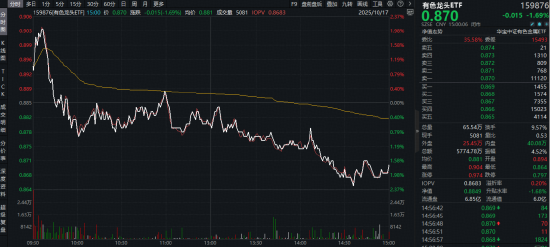
Core Viewpoint - The market is experiencing consolidation, with the Nonferrous Metal Leader ETF (159876) showing volatility, initially rising over 2% before closing down 1.69% on October 17, 2023, with a total trading volume of 57.74 million yuan [1]. Group 1: ETF Performance - As of October 16, 2023, the Nonferrous Metal Leader ETF (159876) has a latest scale of 606 million yuan, with an average daily trading volume of 122 million yuan in October [1]. - Among three ETFs tracking the same index in the market, this ETF ranks first in terms of scale and liquidity [1]. Group 2: Component Stocks - Notable performers include the copper leader Yinxing Nonferrous Metals hitting the daily limit, lithium leader Shengxin Lithium Energy rising over 2%, and other lithium stocks like Zhongfu Industrial also increasing by over 2% [3]. - The top ten gainers include five gold leaders, with Western Gold rising over 3% and Zhongjin Gold increasing over 2% [3]. - On the downside, companies like Bowei Alloy and Chuangjiang New Materials saw declines exceeding 6%, negatively impacting the index [3]. Group 3: Gold Price Drivers - International gold prices are approaching 4,400 USD/ounce, driven by three main factors: the Federal Reserve's interest rate cuts, increased risk aversion due to the U.S. government shutdown, and ongoing de-dollarization trends [5]. - Historical data shows that gold prices typically rise during Fed rate cut cycles, with an average increase of 6% within 60 days of such announcements [4]. - The global official gold reserves reached a record high of 36,274 tons by June 2023, with China increasing its gold reserves for 11 consecutive months, totaling 7.406 million ounces by the end of September [5]. Group 4: Future Outlook for Nonferrous Metals - Analysts suggest that nonferrous metals are entering a long-term upward price cycle due to capital expenditure trends and increasing demand for strategic metal resources amid globalization challenges [7]. - Specific sectors like rare earths, lithium, and copper are expected to benefit from favorable catalysts, with rare earth companies projecting significant profit increases in their upcoming quarterly reports [6][7]. - The copper market is facing supply disruptions, particularly from the Grasberg mine in Indonesia, which may tighten global copper supply and drive prices higher [7]. Group 5: Investment Strategy - The Nonferrous Metal Leader ETF (159876) and its associated funds provide a diversified investment approach across various nonferrous metals, reducing risk compared to investing in single metal sectors [10]. - The ETF tracks the CSI Nonferrous Metals Index, with weightings of 27.6% for copper, 14.5% for gold, 13.1% for aluminum, 10.4% for rare earths, and 8.4% for lithium, making it suitable for portfolio diversification [10].


又一稀土龙头业绩预喜:出口管制升级、龙头提价,多家公司业绩将翻倍
Di Yi Cai Jing· 2025-10-17 10:36
Group 1: Core Industry Insights - The security of rare earth resources has become a core dimension of national security, leading to a potential high-quality development era for the rare earth industry chain [1] - Major companies in the rare earth sector, such as Northern Rare Earth (600111.SH), Shenghe Resources (600392.SH), and Jieneng Permanent Magnet (300748.SZ), have reported significant profit increases, with Northern Rare Earth expecting a net profit of 1.51 to 1.57 billion yuan, a year-on-year growth of 272.54% to 287.34% [7] - The overall market demand for rare earth products is improving, and prices are continuously rising, indicating a favorable market environment for the industry [1][7] Group 2: Export Control Measures - On October 9, China's Ministry of Commerce announced an upgrade in export controls for rare earth products, including five additional medium and heavy rare earth elements, affecting key materials used in military and semiconductor sectors [2] - The new regulations expand the scope of controls from domestic to international, covering the entire rare earth industry chain from mining to recycling [2][4] - Analysts believe that these measures will enhance China's pricing power over medium and heavy rare earth strategic resources [4] Group 3: Market Dynamics and Price Trends - The price of rare earth minerals is expected to rise, with Baotou Steel and Northern Rare Earth adjusting their associated prices for rare earth concentrates to 26,205 yuan per ton, a 37% increase from the previous quarter [6] - The rare earth price index has shown a steady upward trend, with a reported increase of nearly 24% from the end of 2024 [6][7] - The overall market for rare earths is experiencing a recovery, driven by both supply-side management and increasing global demand for green transition technologies [7]




资金流向周报:沪指本周跌1.47%,3017.49亿资金净流出
Zheng Quan Shi Bao Wang· 2025-10-17 10:09
Market Overview - The Shanghai Composite Index fell by 1.47% this week, while the Shenzhen Component Index dropped by 4.99%, and the ChiNext Index decreased by 5.71%. The CSI 300 Index declined by 2.22% [1] - Among the tradable A-shares, 1,104 stocks rose, accounting for 20.33%, while 4,285 stocks fell [1] Capital Flow - This week, the total net outflow of main funds was 301.749 billion yuan, with net outflows recorded on each trading day. The ChiNext saw a net outflow of 80.378 billion yuan, while the STAR Market had a net outflow of 33.297 billion yuan, and the CSI 300 components experienced a net outflow of 88.522 billion yuan [1][2] Industry Performance - Only four industries saw gains this week, with the banking and coal industries leading with increases of 4.89% and 4.17%, respectively. Conversely, the electronics and media sectors faced significant declines of 7.14% and 6.27% [2][3] - In terms of capital flow, the banking sector had a net inflow of 2.419 billion yuan, while the coal sector saw a net inflow of 0.267 billion yuan. In contrast, 29 industries experienced net outflows, with the electronics sector leading the outflow at 70.079 billion yuan [3][4] Individual Stock Performance - A total of 1,257 stocks experienced net inflows this week, with 147 stocks seeing inflows exceeding 100 million yuan. Agricultural Bank of China had the highest net inflow of 2.472 billion yuan, followed by Industrial and Commercial Bank of China and Changan Automobile [4] - On the other hand, 735 stocks had net outflows exceeding 100 million yuan, with CATL, SMIC, and Northern Rare Earth leading the outflows at 4.045 billion yuan, 3.950 billion yuan, and 3.756 billion yuan, respectively [4]





由创新高个股看市场投资热点
量化藏经阁· 2025-10-17 09:41
Group 1: Market Trends and Highs - The report tracks stocks, industries, and sectors reaching new highs, serving as market indicators and highlighting the effectiveness of momentum and trend-following strategies [1][4] - As of October 17, 2025, the distance to the 250-day new highs for major indices are: Shanghai Composite Index at 2.39%, Shenzhen Component Index at 7.55%, CSI 300 at 4.15%, CSI 500 at 7.06%, CSI 1000 at 6.05%, CSI 2000 at 6.64%, ChiNext Index at 10.01%, and STAR Market 50 Index at 11.43% [5][26] - Among the CITIC primary industry indices, sectors such as Power and Utilities, Nonferrous Metals, Steel, Coal, and Electric Equipment & New Energy are closest to their 250-day new highs, while Food & Beverage, Consumer Services, Comprehensive Finance, Banking, and Oil & Petrochemicals are further away [9][26] Group 2: High-Performing Stocks - A total of 1,233 stocks reached 250-day new highs in the past 20 trading days, with the highest numbers in the Electronics, Machinery, and Basic Chemicals sectors [2][14] - The highest proportion of new high stocks is found in Nonferrous Metals, Electronics, and Steel industries, with respective proportions of 59.68%, 41.20%, and 39.62% [14][26] - The Technology and Manufacturing sectors had the most stocks reaching new highs this week, with respective counts of 406 and 364 [16][26] Group 3: Stable High-Performing Stocks - The report identifies 27 stable high-performing stocks, including companies like Shannon Chip Creation, Oriental Tower, and Nuway Shares, based on analyst attention, relative strength, price path stability, and continuity of new highs [3][21] - The highest number of stable high stocks comes from the Cyclical and Manufacturing sectors, with 14 and 8 stocks respectively, particularly in Nonferrous Metals and Machinery [21][26]




稀土精矿价格实现“五连涨” 涨幅达37.13%
Zhi Tong Cai Jing· 2025-10-17 09:29
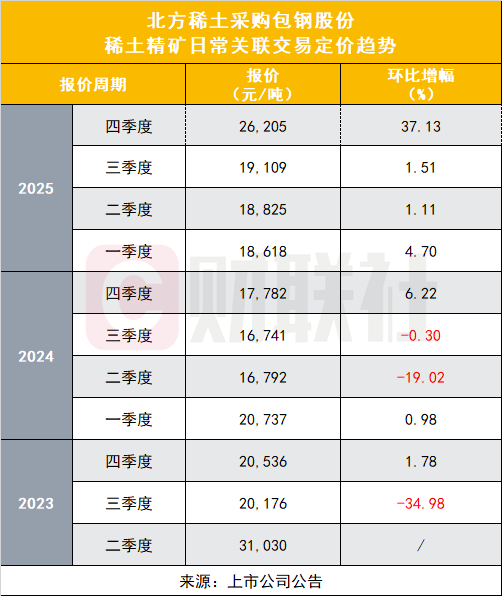
Core Viewpoint - The price of rare earth concentrate has increased for five consecutive quarters, with a rise of 37.13% for the fourth quarter of 2025, as announced by Baogang Co. and Northern Rare Earth [1][4]. Price Adjustment Summary - Baogang Co. has adjusted the rare earth concentrate transaction price for the fourth quarter of 2025 to 26,205 yuan/ton (excluding tax, REO=50%), with a price change of 524.10 yuan/ton for every 1% change in REO [1][2]. - The price for the third quarter of 2023 was set at 19,109 yuan/ton, indicating a quarter-on-quarter increase of 37.13% for the fourth quarter [2][4]. - The price adjustment mechanism between Northern Rare Earth and Baogang Co. has been in place since April 1, 2023, allowing for quarterly price calculations based on a fixed pricing formula [2][4]. Historical Price Trends - The price of rare earth concentrate has seen significant fluctuations, with a high of 31,030 yuan/ton in the second quarter of 2023, dropping to 16,741 yuan/ton by the third quarter of 2024, representing a decline of 46.05% [5]. - The current price adjustment marks the largest increase since the second quarter of 2023, following a period of price stabilization starting from the fourth quarter of 2024 [4][5]. Company Performance - Northern Rare Earth has projected a net profit of 1.51 billion to 1.57 billion yuan for the first three quarters, reflecting a year-on-year increase of 272.54% to 287.34% [5]. - The company has focused on market changes, budget management, cost reduction, and production organization, leading to significant growth in product sales and overall performance [5]. - Since the third quarter of this year, Northern Rare Earth's stock price has surged by 110.8%, closing at 52.48 yuan per share, with a total market capitalization of 189.7 billion yuan [5].
小金属板块10月17日跌2%,东方锆业领跌,主力资金净流出21.86亿元
Zheng Xing Xing Ye Ri Bao· 2025-10-17 08:28
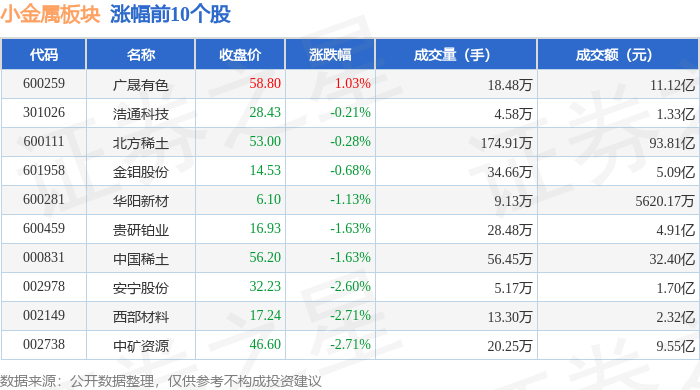
Market Overview - The small metals sector experienced a decline of 2.0% on October 17, with Dongfang Zirconium leading the drop [1] - The Shanghai Composite Index closed at 3839.76, down 1.95%, while the Shenzhen Component Index closed at 12688.94, down 3.04% [1] Individual Stock Performance - Guangsheng Nonferrous (600259) closed at 58.80, up 1.03% with a trading volume of 184,800 shares and a transaction value of 1.11 billion [1] - Dongfang Zirconium (002167) closed at 12.96, down 5.68% with a trading volume of 392,100 shares and a transaction value of 524 million [2] - The highest decline was seen in Dongfang Zirconium, which fell by 5.68% [2] Capital Flow Analysis - The small metals sector saw a net outflow of 2.186 billion from main funds, while retail investors contributed a net inflow of 1.784 billion [2][3] - The main funds showed a negative net flow in several stocks, including Guangsheng Nonferrous and Huayang New Materials [3] Trading Volume and Transaction Value - The trading volume for Guangsheng Nonferrous was 184,800 shares, while Dongfang Zirconium had a trading volume of 392,100 shares [1][2] - The transaction value for Guangsheng Nonferrous was 1.11 billion, and for Dongfang Zirconium, it was 524 million [1][2]


有色金属行业双周报(2025、10、03-2025、10、16):白银价格续创新高,国际金价突破4300美元-20251017
Dongguan Securities· 2025-10-17 07:54
Investment Rating - The report maintains a "Market Weight" rating for the non-ferrous metals industry, indicating that the industry is expected to perform within ±10% of the market index over the next six months [67]. Core Insights - Silver prices continue to reach new highs, with international gold prices surpassing $4,300 [2]. - As of October 16, 2025, the non-ferrous metals industry has seen a 3.35% increase over the past two weeks, outperforming the CSI 300 index by 3.83 percentage points, ranking 4th among 31 industries [3][13]. - The precious metals sector has risen by 6.04%, while the industrial metals sector has increased by 3.58% during the same period [18]. Market Review - As of October 16, 2025, the COMEX gold price closed at $4,344.30 per ounce, up $828.2 since early September, while the COMEX silver price reached $53.43 per ounce, an increase of $12.68 [6][35]. - The LME copper price stood at $10,620 per ton, with other industrial metals like aluminum at $2,796 per ton and nickel at $15,230 per ton [25][60]. - The rare earth price index was recorded at 204.65, down 22.28 from early September, indicating a need for caution regarding external risk sentiment [42][61]. Industry News - The Ministry of Commerce announced export controls on rare earth-related technologies to safeguard the global supply chain and address illegal acquisition issues [50]. - The World Gold Council noted that overall gold holdings remain low, suggesting potential for future price increases despite current market concerns [50]. Company Announcements - Shenghe Resources expects a net profit increase of 697% to 783% year-on-year for the first three quarters of 2025, driven by favorable market conditions for rare earth products [51][52]. - Northern Rare Earth anticipates a net profit increase of 273% to 287% for the same period, reflecting strong market demand and effective management strategies [53][54]. - Shandong Gold forecasts a net profit increase of 84% to 99% for the first three quarters of 2025, attributed to rising gold prices [57][58]. Investment Recommendations - The report suggests focusing on companies such as Zijin Mining (601899), Xinyi Silver (000426), and Chifeng Jilong Gold (600988) in the precious metals sector [60][63]. - For industrial metals, companies like Western Mining (601168) and Luoyang Molybdenum (603993) are recommended [60][63]. - In the rare earth sector, attention is drawn to Xiamen Tungsten (600549) and Northern Rare Earth (600111) [62][63].




A股午评:创业板指跌2.37%,农业银行创历史新高
2 1 Shi Ji Jing Ji Bao Dao· 2025-10-17 04:17
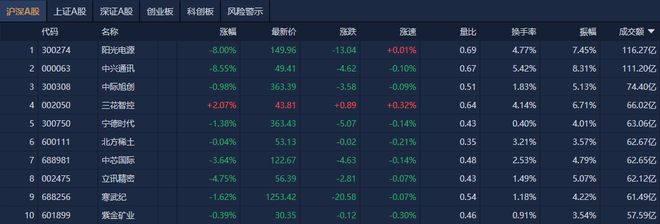
Market Overview - The market experienced a downward trend in early trading, with the Shenzhen Composite Index and ChiNext Index dropping over 2% at one point. By the end of the morning session, the Shanghai Composite Index fell by 1%, the Shenzhen Composite Index by 1.99%, and the ChiNext Index by 2.37% [1] Sector Performance - The port and shipping sector continued to show strength, with Haitong Development achieving a second consecutive trading limit increase. Defensive sectors, including coal and gas stocks, performed well, with Dayou Energy hitting five trading limits in six days and Guo New Energy achieving three trading limits in four days [1] - The banking sector saw fluctuations, with Agricultural Bank of China rising over 2% to reach a historical high [1] Declining Stocks - The data center power supply concept faced significant declines, with stocks like Igor and Zhongheng Electric hitting the trading limit down. Additionally, several heavyweight stocks, including Sungrow Power and ZTE, experienced substantial drops [2] Trading Volume - The total trading volume for the Shanghai and Shenzhen markets reached 1.18 trillion yuan, a decrease of 32.6 billion yuan compared to the previous trading day [3] Individual Stock Highlights - Sungrow Power led in trading volume with over 11.6 billion yuan, followed by ZTE, Zhongji Xuchuang, and Sanhua Intelligent Control, which also had high trading volumes [4]


离披露完毕只剩10个交易日!掘金三季报窗口期,需要注意什么?
Mei Ri Jing Ji Xin Wen· 2025-10-17 03:56
Core Insights - The A-share market has shown an upward trend since October, with the Shanghai Composite Index recovering above 3900 points, coinciding with the third-quarter earnings report disclosure period [1] - As of October 15, 126 companies have released earnings forecasts, with 105 of them expecting year-on-year profit growth, indicating a strong market focus on financial data [1] Group 1: Earnings Forecasts - Two main reasons for companies' positive earnings forecasts are price increases and the ramp-up of product production [2] - Companies like Xianda Co., ShuoBeide, and Chujian New Materials are leading the earnings growth forecast, with increases exceeding 2000% [2] - Resource cycle companies have benefited from significant price increases, while certain tech companies are entering a phase of mass production, driving their earnings growth [2][4] Group 2: Notable Companies - Xianda Co. expects a net profit increase of 2807% to 3211% for the first three quarters, driven by rising market prices for its main product, and operational reforms [2] - Shenghe Resources anticipates a net profit of approximately 740 million to 820 million yuan, reflecting a year-on-year increase of 696.82% to 782.96%, due to favorable market conditions and price increases [3] - ShuoBeide's net profit is projected to increase by 2836.86% to 3203.96%, attributed to enhanced production capacity and successful collaborations with major clients [4] Group 3: Market Trends and Reporting Schedule - The third-quarter earnings report window is short, with only ten trading days left until the reports are due by October 31 [6] - A total of 2352 companies are expected to disclose their earnings in the final week of October, marking a peak in reporting activity [6][11] - Key companies such as NIO, China Telecom, and major banks are scheduled to release their earnings reports between October 21 and October 31 [7][8]




2025年4月中国稀土进出口数量分别为1.26万吨和0.48万吨
Chan Ye Xin Xi Wang· 2025-10-17 03:33
Group 1 - The core viewpoint of the articles highlights the trends in China's rare earth imports and exports, indicating a decrease in import volume but an increase in import value, while exports show mixed results with a decline in value despite an increase in volume [1][2]. Group 2 - In April 2025, China's rare earth imports amounted to 12,600 tons, representing a year-on-year decrease of 4%, while the import value reached $19 million, reflecting a year-on-year increase of 4.2% [1]. - In the same month, China's rare earth exports totaled 4,800 tons, showing a year-on-year increase of 4.8%, but the export value was $2.2 million, which is a significant year-on-year decline of 34.4% [1].

