
易方达基金

Search documents
见好就收?年末基金“攻守战”,基金经理操作不一
券商中国· 2025-12-01 23:31
Core Viewpoint - The article discusses the shift in investment strategies among mutual funds as they approach the end of 2025, with many funds adopting a defensive stance to lock in profits and mitigate risks associated with market fluctuations [1][2][3]. Group 1: Fund Performance and Strategy - As the market enters the fourth quarter, many previously high-performing sectors are experiencing volatility, prompting some actively managed equity funds to take profits and reduce positions to preserve gains [3]. - For instance, the Yimin Service Leading Fund, which had significant holdings in companies like BOE Technology Group and Ping An Insurance, managed to limit its decline to only 0.72% during a market downturn, suggesting a possible reduction in its position [3]. - Historical data indicates that the Yimin Service Leading Fund has successfully navigated market downturns by adjusting its positions, achieving over 30% returns this year with a maximum drawdown of approximately 6% [3]. Group 2: Fund Size and Flexibility - The flexibility in adjusting positions is largely attributed to the relatively small size of the funds, such as the Yimin Service Leading Fund with a size of only 44 million yuan, allowing for quicker tactical changes [4]. - Smaller fund sizes enable managers to execute defensive and offensive strategies more effectively, providing an advantage in rapidly changing market conditions [4]. Group 3: Market Sentiment and Future Outlook - Despite the general belief in long-term investment, fund managers are increasingly focusing on tactical adjustments to enhance investor experience amid market volatility [5]. - Some newly established funds are actively entering the market, with 41 new active equity funds launched in November alone, indicating a belief in future market opportunities despite recent fluctuations [6]. - Research from Dongwu Securities highlights that the fourth quarter is crucial for performance, with institutions shifting focus from seeking excess returns to securing existing profits and avoiding ranking volatility [7]. Group 4: Investment Themes and Expectations - The article notes a divergence in views among institutions regarding future market trends, with some expecting sustained benefits from themes like self-sufficiency in industrial chains amid a resilient domestic capital environment [7]. - The expectation of potential policy stimulus in December may lead to stronger domestic market performance compared to overseas markets [7].


【ETF观察】12月1日行业主题ETF净流出22.17亿元
Sou Hu Cai Jing· 2025-12-01 22:30
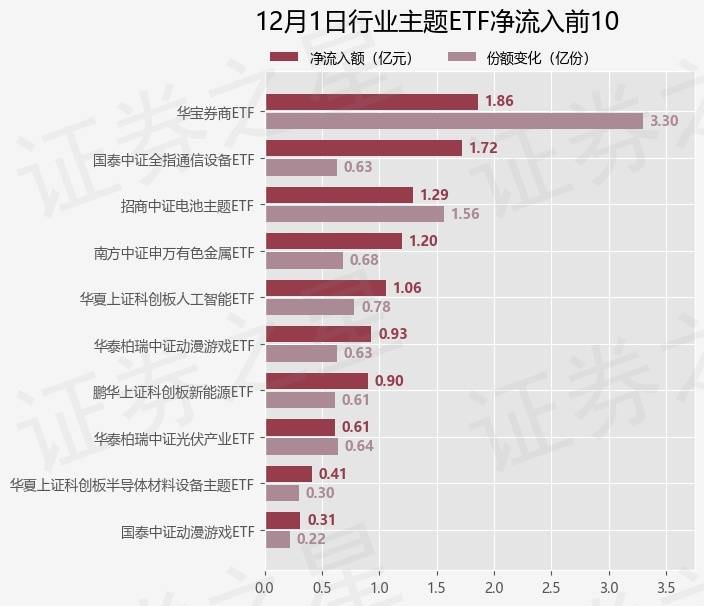
Summary of Key Points Core Viewpoint - On December 1, the industry-themed ETF funds experienced a net outflow of 2.217 billion yuan, with a cumulative net outflow of 21.43 billion yuan over the past five trading days, indicating a trend of capital withdrawal from these funds [1]. Fund Performance - A total of 66 industry-themed ETFs saw net inflows on December 1, with the Huabao Securities ETF (512000) leading the inflow, increasing by 330 million shares and a net inflow of 186 million yuan [1][3]. - Conversely, 141 industry-themed ETFs experienced net outflows, with the Guotai Zhongzheng All-Index Securities Company ETF (512880) having the largest outflow, decreasing by 501 million shares and a net outflow of 592 million yuan [1][4]. Top ETFs by Net Inflow - The top ETFs by net inflow on December 1 included: - Huabao Securities ETF (512000): 1.86 billion yuan net inflow, 701.77 million shares [3]. - Guotai Zhongzheng All-Index Communication Equipment ETF (515880): 1.72 billion yuan net inflow, 42.93 million shares [3]. - Other notable inflows included the China Merchants Zhongzheng Battery Theme ETF (561910) and the Southern Zhongzheng Shenwan Nonferrous Metals ETF (512400) [3]. Top ETFs by Net Outflow - The top ETFs by net outflow on December 1 included: - Guotai Zhongzheng All-Index Securities Company ETF (512880): 5.92 billion yuan net outflow, 499.03 million shares [4][5]. - Huabao Zhongzheng Bank ETF (512800): 4.35 billion yuan net outflow, 213.76 million shares [5]. - Other significant outflows were seen in the Guolian An Zhongzheng Semiconductor ETF (512480) and the Yongying Zhongzheng Hong Kong Gold Industry ETF (517520) [5].
【ETF观察】12月1日宽基指数ETF净流出48.21亿元
Sou Hu Cai Jing· 2025-12-01 22:30
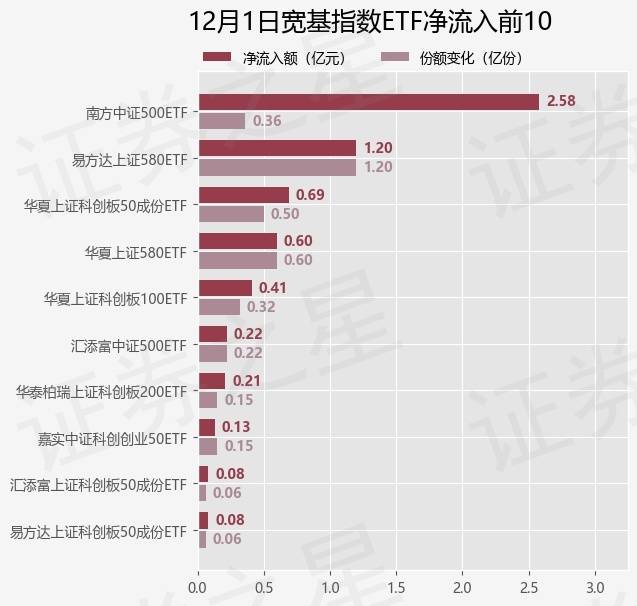
Core Insights - The total net outflow of broad-based index ETFs reached 4.821 billion yuan on December 1, with a cumulative net outflow of 37.065 billion yuan over the past five trading days [1] - During the same period, 20 broad-based index ETFs experienced net inflows, with the Southern CSI 500 ETF (510500) leading with an increase of 36 million shares and a net inflow of 258 million yuan [1][3] Summary by Category Net Inflows and Outflows - On December 1, 74 broad-based index ETFs saw net outflows, with the largest outflow from the Huaxia SSE 50 ETF (510050), which had a reduction of 492 million shares and a net outflow of 1.539 billion yuan [3] - The Southern CSI 500 ETF (510500) had a net inflow of 258 million yuan, with a share increase of 36 million [1][3] Performance Metrics - The Southern CSI 500 ETF (510500) recorded a price increase of 0.94% [3] - Other ETFs with notable performance include: - E Fund SSE 580 ETF (530100) with a 0.70% increase and a net inflow of 120 million yuan [3] - Huaxia SSE Sci-Tech Innovation Board 50 ETF (588000) with a 0.79% increase and a net inflow of 69 million yuan [3]
长不大的“五毛基”
Shang Hai Zheng Quan Bao· 2025-12-01 19:23
Core Insights - The article discusses the performance of public funds in a structurally rising market, highlighting the contrast between successful funds and those struggling, referred to as "five-dime funds" [1] - It emphasizes the importance of fundamental analysis, diversification, and effective risk management for fund managers to navigate market cycles successfully [1] Fund Performance Overview - Active equity funds have shown strong performance this year, with the mixed equity fund index rising over 28%. However, many funds have missed opportunities, with 84 active equity funds having a net value below 0.6 yuan as of November 28, and 20 of those below 0.5 yuan [2] - A specific example is the Dongfang Alpha Zhaoyang Mixed Fund, which has a net value of 0.4193 yuan and has lost over 17% this year, primarily due to a concentrated bet on the military industry sector [2] Notable Fund Management Issues - The Huiquan Zhenxin Zhiyuan Mixed Fund, managed by well-known investor Liang Yongqiang, has only returned 5.75% this year and has lost over 50% since inception. The fund has seen multiple changes in management, with significant losses during these transitions [3] Successful Turnarounds - Some previously underperforming funds have successfully recovered, such as Hengyue Advantage Selected Mixed Fund and Huatai Bairui Quality Selected Mixed Fund, which have seen their net values rise above 1 yuan as of November 28 [4] - The Hui Tianfu Hong Kong Advantage Selected Mixed Fund, which switched its holdings to the innovative drug sector, has seen a recovery with over 140% returns this year, reaching a net value of 1.6454 yuan [5] Strategic Adjustments - The Hengyue Advantage Selected Mixed Fund has achieved over 136% returns this year, primarily due to a strategic shift towards storage concept stocks and AI-related investments [6][7] - Fund managers are increasingly focusing on risk management and portfolio diversification to avoid heavy losses during market fluctuations [8] Investor Behavior and Market Dynamics - Despite some funds recovering, many investors have chosen to redeem their shares after net value increases, indicating a lack of confidence in long-term holding [8] - High volatility in fund net values can lead to frequent trading by investors, which diminishes overall returns and creates a cycle of higher risk with lower rewards [9]
最高52%!养老基金今年真的很赚钱
Sou Hu Cai Jing· 2025-12-01 18:49
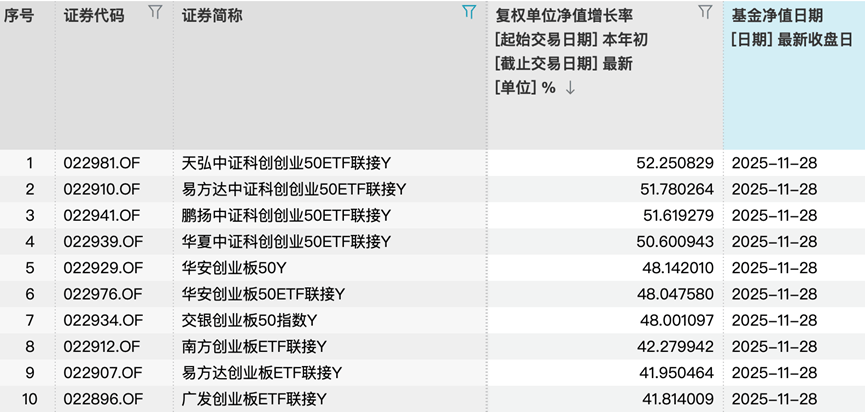
Core Insights - The article discusses the performance of various pension funds (Y shares) as the deadline for personal pension tax incentives approaches in 2025, highlighting the significance of evaluating their returns [1][2][3] - It emphasizes the opportunity for investors to reassess their pension investments amidst a medium-term bull market that began in the fourth quarter of the previous year [1][2] Group 1: Fund Performance - Index funds have led the performance among pension funds, with significant gains observed in specific index funds such as the CSI Technology Innovation 50 and the ChiNext 50, with some funds exceeding a 50% increase year-to-date [6][5] - As of November 28, 2025, notable funds include Tianhong CSI Technology Innovation 50 ETF Link Y, which has a year-to-date growth rate of 52.25%, and others in the range of 40% to 49% [6][7] Group 2: Active Fund of Funds (FOF) - Active FOFs have also shown impressive performance, with funds like Guotai Min'an Pension 2040 Three-Year Y and ICBC Pension 2050 Five-Year Holding Y achieving over 30% growth [10][11] - The article highlights that these FOFs have managed to maintain competitive returns compared to some index funds, with growth rates ranging from 23.6% to 28.2% for several funds [10][11] Group 3: Investment Strategies - The Guotai Min'an Pension 2040 Three-Year Y fund has a strategic asset allocation focusing on equity, with a significant portion invested in gold and non-ferrous metals, contributing to its strong performance [16][18] - The ICBC Pension 2050 Five-Year Holding Y fund has adopted a technology-focused investment strategy, adjusting its holdings to include sectors like gaming and cloud computing, which aligns with market trends [20][24] Group 4: Overall Market Trends - The article concludes that the performance of pension funds in 2025 is commendable, with strategies ranging from technology-focused investments to stable dividend routes, indicating a diverse approach to pension fund management [26][29]
基础设施REITs五年探索 为商业不动产REITs提供有益借鉴
Zheng Quan Shi Bao· 2025-12-01 18:14
Core Viewpoint - The announcement by the China Securities Regulatory Commission regarding the pilot launch of commercial real estate investment trusts (REITs) marks a significant step in capital market development, aiming to revitalize a large stock of commercial real estate assets and enhance the multi-tiered capital market financing system [1][4]. Summary by Sections Development of Infrastructure REITs - The pilot for infrastructure REITs has been ongoing for nearly five years, resulting in over 70 listed products with a total scale exceeding 200 billion yuan [1]. - As of December 1, there are 77 listed infrastructure REITs, with a total market value close to 220 billion yuan, and the average yield of these products is 26.14% [2]. Market Performance and Trends - In 2023, the market for infrastructure REITs has shown a divergence, with assets that have higher dividend certainty being favored, leading to significant price increases [3]. - The CSI REITs total return index has achieved over 20% growth in 2024, with some products like the Huaxia Dayue City Commercial REIT seeing cumulative gains exceeding 30% this year [3]. Future Outlook - The market is expected to see further expansion of infrastructure REITs into more sectors, including urban renewal facilities, hotels, and commercial office spaces, with an emphasis on optimizing the application process for new projects [4]. - The pilot for commercial real estate REITs is anticipated to provide valuable insights from the infrastructure REITs experience, contributing to the development of a new model for real estate growth [4].
11月份公募基金发行延续回暖趋势
Zheng Quan Ri Bao· 2025-12-01 16:45
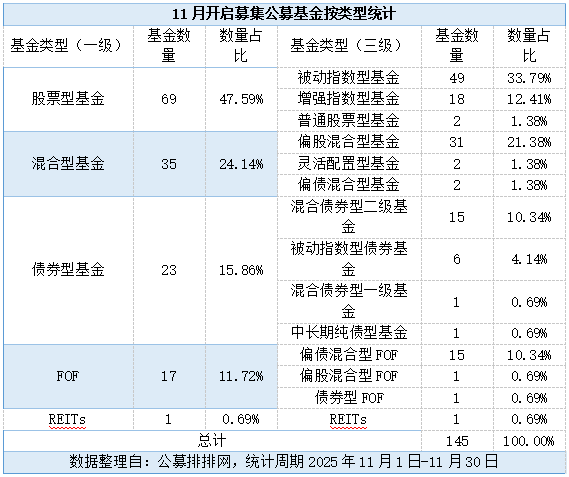
Group 1 - The public fund issuance market continued its recovery trend in November, with 145 public funds launched, a 6.62% increase from October's 136 funds, indicating a steady rise in market issuance pace [1] - Equity funds dominated the issuance market in November, with 104 equity funds launched, accounting for over 70% of the total new funds issued that month. This includes 69 stock funds and 35 mixed funds, reflecting high confidence in equity assets among fund managers and investors [1] - Among stock funds, passive index products performed notably well, with 49 passive index funds launched, representing 33.79% of the total new funds issued in November [1] Group 2 - Bond fund issuance saw significant growth in November, with 23 funds launched, a 64.29% increase from 14 in October. Mixed bond funds accounted for 65.22% of bond fund issuance [2] - FOF (Fund of Funds) products also showed remarkable performance, with 17 funds launched in November, marking a new monthly high for the year. By the end of November, 76 new FOF products had been established in 2023, more than double last year's total [2] - The overall recovery in the public fund issuance market in November was primarily driven by the significant growth of bond funds and FOF products, while equity funds maintained stable issuance momentum [3] Group 3 - In November, one public REITs product was launched, contributing to the overall market activity [3] - A total of 71 public fund institutions issued new products in November, with 38 institutions launching one product each and 33 institutions issuing two or more products. E Fund and GF Fund led with nine products each, primarily in stock ETFs [3] - The market's interest in bond funds is expected to continue, with predictions of a potential increase in non-bank funds' allocation to bond assets due to market conditions [3]
11月公募基金发行环比增6.62%,权益基金占比近七成
Sou Hu Cai Jing· 2025-12-01 13:49
Core Viewpoint - The public fund issuance continues to show a warming trend, with a total of 145 public funds launched in November 2025, representing a 6.62% month-on-month increase from October's 136 funds [1]. Fund Issuance by Type - Equity funds dominate the issuance market in November, with 69 stock funds launched, accounting for 47.59% of the total. Among mixed funds, 31 equity-mixed funds were issued, making up 21.38%. Together, these two categories represent 68.97% of the total issuance for the month, indicating strong confidence in the equity market from both fund companies and investors [2][3]. - Passive index funds lead the stock fund category, with 49 issued in November, comprising 33.79% of the total fund issuance. Enhanced index funds accounted for 12.41% with 18 funds, while ordinary stock funds only had 2 issued, representing 1.38%. This structure suggests a preference for low-cost, high-transparency passive index products in the current market environment [3]. - Bond fund issuance saw a significant month-on-month increase, with 23 bond funds launched in November, up 64.29% from 14 in October. Mixed bond funds accounted for 65.22% of bond fund issuance, reflecting a continued focus on "fixed income plus" strategies to seek moderate equity-enhanced returns [3]. - FOF (Fund of Funds) products performed exceptionally well, with 17 launched in November, marking a new monthly high for 2025 and the highest in nearly 31 months. The FOF market has shown continuous expansion, with 76 new FOFs established in 2025, more than double last year's total, and issuance volume reaching 71.353 billion units, a four-year high [3]. Market Dynamics - The increase in bond fund issuance is driven by expectations of declining market interest rates and volatility in the equity market, which has created a demand for risk-averse investments. Regulatory guidance encouraging long-term capital to enter the market has also contributed to the rise in FOF fund issuance, which aligns with institutional needs for asset allocation and risk diversification [4]. - Despite fluctuations in the A-share market, there remains confidence in future market performance, supporting stable issuance of equity funds [5]. Issuance by Fund Companies - In November, 71 public fund institutions participated in the issuance, with 38 institutions each launching one product, while 33 institutions issued two or more products. Notably, GF Fund and E Fund each launched 9 public funds, primarily focusing on stock ETFs. Penghua Fund and China Europe Fund followed closely with 6 funds each, with the latter exclusively issuing mixed funds. Other notable issuers included Fortune Fund, Ping An Fund, and Tianhong Fund, each launching 5 funds [5].
股票股指期权:隐波持续回落,可考虑备兑策略
Guo Tai Jun An Qi Huo· 2025-12-01 13:32
Report Industry Investment Rating - Not provided in the content Core Viewpoint - With the continuous decline of implied volatility in stock index options, investors can consider the covered call strategy [1] Summary by Related Catalogs Market Data Statistics - **Underlying Market**: The closing prices of the Shanghai Stock Exchange 50 Index, CSI 300 Index, and CSI 1000 Index were 2993.68, 4576.49, and 7386.68 respectively, with increases of 24.06, 49.82, and 52.47. The trading volumes were 46.52 billion, 200.38 billion, and 234.41 billion shares respectively, with changes of 9.25 billion, 57.48 billion, and 33.73 billion shares. The synthetic futures prices and basis for the current and next months are also provided [1] - **Option Market**: The trading volumes of Shanghai Stock Exchange 50 Index Options, CSI 300 Index Options, and CSI 1000 Index Options were 28345, 86757, and 169033 respectively, with changes of 9677, 12980, and -4500. The open interests were 65173, 172339, and 301690 respectively, with changes of 2743, 723, and 4331. The VL - PCR and OI - PCR values are also presented [1] Volatility Statistics - **Near - Month**: The ATM - IV of Shanghai Stock Exchange 50 Index Options was 10.97%, with a change of - 1.04%. The same - term HV was 12.03%, with a change of 0.54%. Similar data for other options are also provided [4] - **Next - Month**: The ATM - IV of Shanghai Stock Exchange 50 Index Options was 12.58%, with a change of - 0.66%. The same - term HV was 11.82%, with a change of 0.10%. Similar data for other options are also given [4] Option Types - **Shanghai Stock Exchange 50 Index Options**: Figures for full - contract PCR, main - contract skewness, volatility cone, and volatility term structure are presented [7][8] - **CSI 300 Index Options**: Similar figures for full - contract PCR, main - contract skewness, volatility cone, and volatility term structure are provided [11][12] - **CSI 1000 Index Options**: Figures for relevant indicators are also shown [15][16] - **Shanghai Stock Exchange 50ETF Options**: Figures for full - contract PCR, main - contract skewness, volatility cone, and volatility term structure are included [24][25] - **Huatai Berui 300ETF Options**: Similar figures for relevant indicators are presented [28][29] - **Southern China Securities 500ETF Options**: Figures for relevant indicators are provided [35][36] - **Huaxia Science and Technology Innovation 50ETF Options**: Figures for relevant indicators are shown [43][44] - **E Fund Science and Technology Innovation 50ETF Options**: Figures for relevant indicators are presented [51][52] - **Harvest 300ETF Options**: Figures for relevant indicators are provided [62][63] - **Harvest China Securities 500ETF Options**: Figures for relevant indicators are shown [68][69] - **Growth Enterprise Market ETF Options**: Figures for relevant indicators are presented [72][73] - **Shenzhen Stock Exchange 100ETF Options**: Figures for relevant indicators are provided [76][77]
基金产品审批或启动逆周期调节!主动控制规模 不追求爆款
Zhong Guo Ji Jin Bao· 2025-12-01 13:24
Core Viewpoint - The regulatory body is implementing a counter-cyclical adjustment mechanism for fund product approvals to better protect investor interests, emphasizing a cautious approach towards new equity fund approvals amid high valuation benchmarks [1][2][6]. Group 1: Regulatory Actions - The approval process for new equity funds has become more stringent, with requirements for performance benchmarks to be below the 90th percentile for the last five years and the 80th percentile for the last three months [2][3]. - The regulatory framework encourages fund companies to focus on quality over size, promoting a rational and restrained approach during market highs and increasing counter-cyclical investments during market lows [2][6]. Group 2: Market Trends - Despite a bullish A-share market, fund companies are limiting the scale of new equity fund launches, with many setting initial fundraising caps at 2 billion to 3 billion yuan [1][4]. - A significant portion of newly established equity funds this year has set fundraising limits, with 57% of these caps below 3 billion yuan [5]. Group 3: Fund Management Practices - Fund companies are actively controlling the scale of new products and limiting large subscriptions for existing high-performing funds to protect investor interests and maintain stable fund operations [5][6]. - The focus is on aligning fund size with strategy capacity to avoid increased transaction costs and ensure a fair investment experience for all investors [5]. Group 4: Long-term Investment Ecosystem - The deepening implementation of the counter-cyclical adjustment mechanism is shifting the public fund industry from a focus on scale to one on quality, which is expected to attract more long-term capital and enhance investor satisfaction [7]. - Regulatory measures are designed to create a balanced approval rhythm that avoids excessive capital inflow into popular sectors while supporting key areas like hard technology during market corrections [7].