
赛力斯

Search documents
豪美新材定增加码轻量化 机构看好低空、液冷等领域应用空间
Zheng Quan Shi Bao Wang· 2025-11-19 10:41
Core Viewpoint - Haomei New Materials (002988) plans to raise up to 1.897 billion yuan through a private placement of A-shares to support its expansion in automotive lightweight aluminum materials and components, as well as to enhance its R&D capabilities and production facilities [1][2] Group 1: Fundraising and Investment Plans - The company intends to issue no more than 74.9255 million shares, accounting for up to 30% of its total share capital, to raise funds primarily for capacity expansion in East and South China [1] - A total of 232 million yuan will be allocated to the construction of an R&D innovation center focusing on high-performance lightweight automotive components, low-altitude aircraft structures, robotic joints, and new liquid cooling products [1][3] - The company plans to invest 479 million yuan in expanding production capacity for high-performance aluminum materials in East China and 554 million yuan in South China to meet growing customer demand [2] Group 2: Business Growth and Market Opportunities - Haomei New Materials is a leading domestic player in automotive lightweight aluminum materials, with a comprehensive industry chain from casting to deep processing [2] - The company's revenue from automotive lightweight business has grown from 168 million yuan in 2020 to 1.775 billion yuan in 2024, with a compound annual growth rate of 80.29% [2] - The company has secured over 400 automotive lightweight project designations by the end of 2024, with an additional 70 expected in the first half of 2025 [2] Group 3: Emerging Markets and Applications - The company is expanding into new applications such as low-altitude aircraft, humanoid robots, and liquid cooling systems, leveraging the advantages of aluminum and magnesium alloys [3][4] - The low-altitude economy is projected to consume 870,000 tons of aluminum by 2024, with a market size of 23.5 billion yuan, expected to grow to 32 billion yuan by 2025 [3] - The liquid cooling server market in China is anticipated to reach 2.37 billion USD in 2024, with a growth rate of 67% compared to 2023, and a projected CAGR of 46.8% from 2024 to 2029 [3] - The humanoid robot market is expected to exceed 2.05 million units sold by 2030, with a market size of 287.03 billion yuan, potentially driving demand for aluminum and magnesium alloys [3]
直辖市重大调整!一个史无前例的新“省会”,诞生了
商业洞察· 2025-11-19 09:55
Core Viewpoint - The article discusses the significant administrative restructuring in Chongqing, where the two existing districts, Jiangbei and Yubei, have been merged into the newly established Liangjiang New Area, marking a transition from an economic function zone to an official administrative district [5][6][9]. Group 1: Administrative Restructuring - On November 6, Chongqing announced a major administrative restructuring approved by the State Council, merging Jiangbei and Yubei districts into Liangjiang New Area, reducing the total number of districts from 38 to 37 [6]. - Liangjiang New Area, previously an economic function zone, now serves as a formal administrative district, addressing issues of management overlap and fragmentation that hinder regional development [9][10]. - The new Liangjiang New Area covers approximately 1,360 square kilometers and has a population of about 3.52 million, with a projected GDP exceeding 600 billion yuan, positioning it as the largest economic and population center in the central and western regions of China [10]. Group 2: Economic Significance - The restructuring is seen as a strategic move to enhance Chongqing's role as a "strong provincial capital," similar to Chengdu, which has seen significant economic growth and population influx due to its provincial capital status [12][13]. - Liangjiang New Area contributes around 20% of Chongqing's GDP while occupying less than 2% of the city's area, highlighting its importance as the economic heart of the city [14][15]. - The area is home to key infrastructure such as Jiangbei International Airport and Guoyuan Port, making it a central hub for Chongqing's development as an inland open gateway [15]. Group 3: Industrial Development - Chongqing's manufacturing sector is robust, producing nearly 50% of the world's laptops and ranking second in automotive production in China, with significant contributions from companies like Changan and Seres [16][17]. - The city is implementing a "33618" modern manufacturing cluster system, focusing on three trillion-level leading industries, three five-hundred billion-level supporting industries, six thousand billion-level characteristic industries, and eighteen emerging industries [18]. - Liangjiang New Area is pivotal in this strategy, housing two of the three leading trillion-level industries: intelligent connected new energy vehicles and next-generation electronic information manufacturing [20]. Group 4: Automotive and Electronics Industry - As the heart of Chongqing's automotive industry, Liangjiang New Area is expected to produce 1.25 million vehicles in 2024, with nearly 580,000 of those being new energy vehicles, accounting for about 58% of the city's total output [21][22]. - The area is also a hub for the new generation of electronic information manufacturing, with a complete industrial chain from display panels to smart terminals, driven by companies like BOE and Unisoc [26][28]. - The integration of the automotive and electronics sectors is anticipated to create a synergistic effect, particularly in the development of intelligent connected vehicles, which is projected to become a trillion-yuan market by 2025 [29][30].





黄金突破4000美元!新能源化为泡沫?消费习惯迎来大洗牌
Sou Hu Cai Jing· 2025-11-19 09:16
Market Overview - The A-share market is stagnant around 4000 points, with individual stocks experiencing significant declines, leading to a net value drop of 20% for many investors [4][5] - The ETF market has expanded dramatically, with total shares reaching 3.16 trillion, a 19% increase from the previous year, and total scale hitting 5.74 trillion, up 2 trillion in just over six months [4] Economic Indicators - In October, household loans decreased by 360.4 billion, marking a 520.4 billion drop compared to the same period last year, indicating reduced consumer borrowing and spending [5] - Retail sales growth was only 2.9%, the lowest this year, while residential sales saw declines of 7% and 9.4% in sales volume and value, respectively [5] Investment Trends - Major funds are exiting the market, with a pension fund planning to reduce its growth stock holdings significantly and 115 companies announcing share reduction plans [6] - Share buybacks are accelerating, with proposed buybacks exceeding 330 billion, and banks have already released over 120 billion for this purpose [8] Industry Specifics - The new energy vehicle (NEV) sector is facing challenges, with a 0.8% year-on-year decline in retail sales in October, marking the first month-on-month drop since August 2024 [10] - The market for NEVs is becoming increasingly competitive, with domestic brands holding a 72.5% market share and penetration rates reaching 55.3% [10] IPO Market - The Hong Kong IPO market is thriving, with total IPO scale reaching 216.47 billion HKD, surpassing 200 billion for the first time in four years, and is expected to approach 300 billion by year-end [8] Luxury Goods Market - The luxury goods market is recovering, with LVMH planning to open multiple flagship stores in China, indicating confidence in high-end consumer spending [18] Policy Developments - The recent "13 Measures for Private Investment" policy allows private capital to hold over 10% in previously state-dominated sectors like railways and energy, presenting new investment opportunities [20] - The policy also encourages private participation in low-altitude economy and commercial aerospace, aiming to enhance competition in these emerging sectors [20]

恒勃股份(301225) - 2025年11月18日投资者关系活动记录表
2025-11-19 09:00
Group 1: Company Overview - The company, established in 1995, has developed production bases in Zhejiang Taizhou, Guangdong Jiangmen, Chongqing Tongliang, and Jiangsu Changzhou, and successfully went public in 2023 [2] - Main products include automotive and motorcycle intake systems, carbon canisters, smart instruments, water side flow plates, and pipelines, widely used in fuel vehicles, hybrid, and new energy vehicles [2] - Key clients include major automotive manufacturers such as GAC, Chery, Geely, BYD, and Seres [2] Group 2: Technological Advancements - The company has achieved core process autonomy through independent research and development and is actively investing in the PEEK high-performance materials industry [2] - A joint venture with Discover Material Inc. focuses on the domestic application of advanced materials, particularly in robotics, aerospace, and medical devices [2][3] - PEEK materials are characterized by high strength, wear resistance, self-lubrication, high-temperature resistance, and good insulation, suitable for extreme environments [3] Group 3: Market Strategies - The company anticipates price reductions from major manufacturers and is preparing by simplifying designs, optimizing production processes, and enhancing bargaining power [3] - Adjustments in payment terms by automotive manufacturers to 60 days are expected to improve cash flow and reduce bad debt risks for the company [3] Group 4: Stock Performance and Shareholder Actions - The company emphasizes market value management and aims to align intrinsic and market value, with stock price fluctuations influenced by various external factors [4] - Recent share reductions were primarily due to employee stock platforms and early external investors, with the scale being relatively small [5]
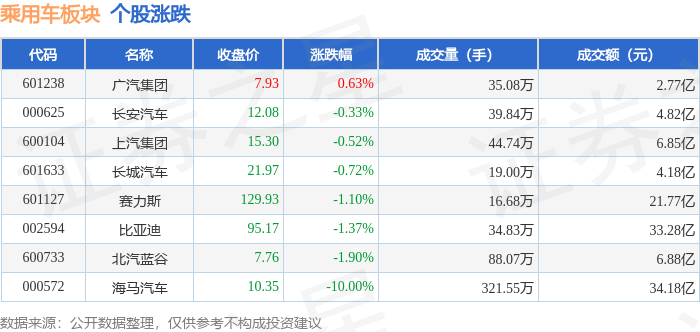
乘用车板块11月19日跌1.06%,海马汽车领跌,主力资金净流出13.93亿元
Zheng Xing Xing Ye Ri Bao· 2025-11-19 08:51
Core Viewpoint - The passenger car sector experienced a decline of 1.06% on November 19, with Haima Automobile leading the drop, while the Shanghai Composite Index rose by 0.18% [1] Group 1: Market Performance - The Shanghai Composite Index closed at 3946.74, while the Shenzhen Component Index closed at 13080.09, showing a slight decrease of 0.0% [1] - The passenger car sector saw a net outflow of 1.393 billion yuan from main funds, while retail investors contributed a net inflow of 1.235 billion yuan [1] Group 2: Individual Stock Performance - GAC Group closed at 7.93, with a slight increase of 0.63% and a trading volume of 350,800 shares, amounting to 277 million yuan [1] - BYD's stock closed at 95.17, down by 1.37%, with a trading volume of 348,300 shares and a total transaction value of 3.328 billion yuan [1] - Haima Automobile saw the largest decline of 10.00%, closing at 10.35, with a trading volume of 3,215,500 shares and a transaction value of 3.418 billion yuan [1] Group 3: Fund Flow Analysis - GAC Group had a main fund net inflow of 38.48 million yuan, while retail investors had a net outflow of 24.90 million yuan [2] - Great Wall Motors experienced a main fund net inflow of 19.33 million yuan, with retail investors showing a net outflow of 24.83 million yuan [2] - BYD faced a significant main fund net outflow of 623 million yuan, while retail investors contributed a net inflow of 576.1 million yuan [2]

全球性能最强!北京人形具身智能破局,机器人ETF(159770)半日净申购超2500万份,连续24日“吸金”17.60亿元
Xin Lang Cai Jing· 2025-11-19 05:18
Core Insights - The Robot ETF (159770) has seen significant capital inflow, with a net subscription of 25.5 million shares in just half a day, despite the underlying index (CSI Robot Index H30590) declining by 1.41% [1] - The Robot ETF's total shares reached a record high of 9.823 billion, with a weekly growth of 20.41 million [2] - The Computer ETF (159998) also experienced growth, with a weekly increase of 45.26 million and a total of 8.4 million shares [3] Fund Performance - The Robot ETF (159770) recorded a trading volume of 172 million yuan, with notable individual stock performances including Weichuang Electric (688698) up by 1.24% and Zhongdali De (002896) up by 0.56% [1] - The Computer ETF (159998) had a trading volume of 29.45 million yuan, with leading stocks like Shiji Information (002153) rising by 4.71% [2][3] - Both ETFs have shown consistent net inflows, with the Robot ETF accumulating a total of 1.76 billion yuan over the past 24 days [2] Industry Developments - The Beijing Humanoid Robot Innovation Center has open-sourced the Pelican-VL1.0 model, which is the largest open-source embodied intelligent VLM model to date, enhancing the capabilities of robots in various sectors [5] - Alibaba International Station has launched AI Mode to automate cross-border e-commerce procurement processes, indicating a significant shift in the B2B e-commerce landscape [6] Institutional Insights - Recent reports suggest that Tesla is preparing for large-scale manufacturing of its Gen3 robot model, with expected shipments of 30,000 to 50,000 units, and plans for a Gen4 model [7] - The domestic robot sector is anticipated to see a tenfold increase in shipment volume by 2026, driven by favorable industry policies and capital investments [7]


2025年1-9月中国汽车产量为2404.8万辆 累计增长10.9%
Chan Ye Xin Xi Wang· 2025-11-19 03:56
上市企业:比亚迪(002594),长城汽车(601633),上汽集团(600104),广汽集团(601238),一汽解放 (000800),东风汽车(600006),赛力斯(601127) 相关报告:智研咨询发布的《2026-2032年中国汽车制造业市场全景调查及投资前景分析报》 根据国家统计局数据显示:2025年9月中国汽车产量为323万辆,同比增长13.7%;2025年1-9月中国汽车 累计产量为2404.8万辆,累计增长10.9%。 2020-2025年1-9月中国汽车产量统计图 数据来源:国家统计局,智研咨询整理 知前沿,问智研。智研咨询是中国一流产业咨询机构,十数年持续深耕产业研究领域,提供深度产业研 究报告、商业计划书、可行性研究报告及定制服务等一站式产业咨询服务。专业的角度、品质化的服 务、敏锐的市场洞察力,专注于提供完善的产业解决方案,为您的投资决策赋能。 ...

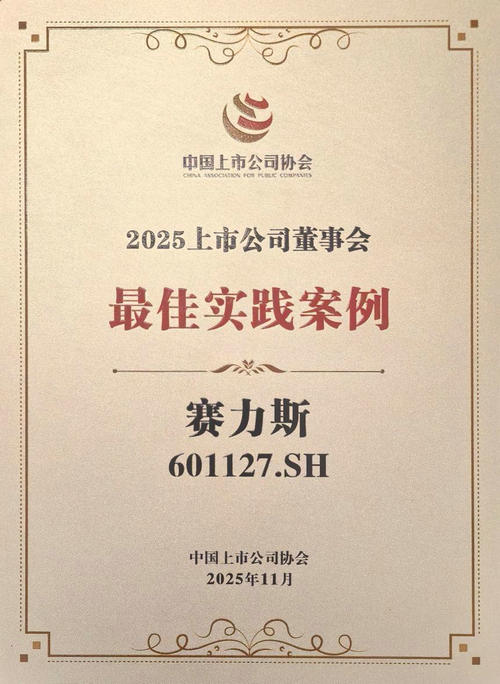
赛力斯获评2025年上市公司董事会最佳实践案例
Zheng Quan Shi Bao Wang· 2025-11-19 03:08
Core Viewpoint - The recognition of Seres as a "Best Practice Case" for corporate governance by the China Listed Companies Association highlights the company's effective governance mechanisms and operational efficiency, reinforcing its commitment to high-quality development and value sharing with stakeholders [1][3]. Group 1: Corporate Governance - The "Best Practice Case" award aims to promote compliance and effective operation of listed company boards, enhancing governance efficiency and demonstrating exemplary practices [3]. - Seres' selection for this award reflects high recognition from regulatory bodies and the capital market regarding its governance standards [3]. Group 2: Financial Performance - In the first three quarters of 2025, Seres achieved a revenue of 110.534 billion yuan and a net profit attributable to shareholders of 5.312 billion yuan, marking a year-on-year growth of 31.56% [3]. - As of October 2025, Seres has sold a total of 356,085 electric vehicles [3]. Group 3: Market Position and Expansion - On November 5, Seres successfully listed on the Hong Kong Stock Exchange, becoming the first luxury electric vehicle company to be dual-listed in both A-share and H-share markets [3]. - This dual listing is expected to inject strong international capital into the company, aiding in technological innovation and global expansion, thereby enhancing its global competitiveness and brand influence [3].
公司互动丨这些公司披露在汽车、电池等方面最新情况
Di Yi Cai Jing· 2025-11-18 14:29
Key Insights - Multiple listed companies disclosed their latest developments in the automotive and battery sectors through various channels on November 18 [1] Automotive - Deep Blue Automotive emphasized that safety is more important than speed for young consumers [1] - Seres is actively expanding into overseas markets and is committed to advancing its high-end smart electric vehicle export strategy [1] Battery - Zhongwei Co. has secured orders for sodium batteries at a thousand-ton level and has achieved rapid mass production of 3/4 generation phosphate materials [1] - Anfu Technology reported a robust order backlog in its battery main business and plans to add 500 million units of production capacity [1] Chips - Xiechuang Data stated that its storage business covers the entire industry chain from storage chip packaging to storage module assembly [1] - Zhaosheng Microelectronics expects that as the utilization rate of its chip production capacity increases, the negative impact of self-produced wafer costs on overall gross margin will gradually diminish [1] - Yintang Zhikong reported a significant year-on-year increase in its storage chip business due to industry demand [1] Other - Sanmu Group clarified that it has not undertaken any projects or investments in Pingtan County [1] - JieJie Microelectronics mentioned that its current relationship with Huawei is indirect cooperation [1] - Liren Lizhuang noted that its prepared dish product line contributes a very low proportion to the overall revenue [1] - Dashengda holds a 5.625% stake in Zhejiang Qusu Technology [1] - Huate Gas has generated sales orders for new products including ethyl silane, hydrogen bromide, and boron trichloride, achieving results in product transformation [1] - Dongrui Co. anticipates supplying approximately 260,000 live pigs to Hong Kong and Macau in 2025 [1] - Qixiang Tengda expects a quarter-on-quarter improvement in the profitability of its main products in the fourth quarter [1]
原赛力斯一中层干部陈家才将任广汽集团副总 犹如一步登天
Xin Lang Cai Jing· 2025-11-18 14:23
Core Viewpoint - Chen Jiacai is set to become the Vice General Manager of GAC Group, focusing on the company's overseas automotive business, which has garnered significant attention [1]. Group 1: Background of Chen Jiacai - Chen Jiacai, born in 1982, is relatively young for a management position in the domestic automotive industry but has extensive experience [3]. - His career began at Foton Motor, and he joined Chery Automobile in 2006, where he spent most of his career [3]. - Chen gained visibility in 2017 as the Director of Human Resources and Administration at Chery Commercial Vehicle Company, later becoming General Manager of Ruitesi Electric Vehicles and then General Manager of Jietu International Marketing [5]. Group 2: Achievements and Contributions - Under Chen's leadership, Jietu Automobile achieved overseas sales of 100,000 units within three years, indicating his strong capabilities and familiarity with international markets [5]. - He has held various significant positions, including General Manager of Chery Commercial Vehicle International Company and Assistant General Manager at Jietu Automobile [5]. - Recently, he was responsible for advancing the global strategy at Seres, where he served as the rotating president of the overseas business unit [5]. Group 3: GAC Group's Performance - GAC Group sold 170,700 vehicles in October 2025, with 15,400 units exported, marking a year-on-year increase of 69.2% in exports [5]. - The export volume of self-owned brands increased by 36% in the first ten months of the year [5].

