蔚来

Search documents
风停帆转:车市告别“顺风时代”,打响技术与出海“体系战”
2 1 Shi Ji Jing Ji Bao Dao· 2025-12-25 08:24
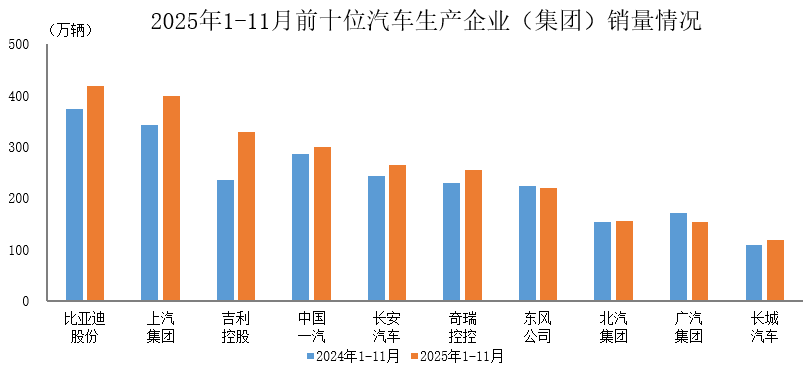
Core Insights - The Chinese automotive market is at a historic crossroads, transitioning from a growth phase to a competitive landscape characterized by technology, ecology, and globalization [1] - The penetration rate of new energy vehicles (NEVs) has reached 62.3%, marking a significant shift in market dominance [3] - The competition has intensified, moving from volume-driven growth to a focus on technology iteration, ecological construction, and organizational efficiency [5] Market Performance - In November 2025, retail sales of passenger vehicles in China were 2.225 million units, a year-on-year decline of 8.1% and a month-on-month decline of 1.1% [2] - Retail sales of fuel vehicles fell by 22% year-on-year, while pure electric models grew by 9.2%, pushing the NEV retail penetration rate to 59.3% [3] Competitive Landscape - BYD's domestic sales in November 2025 were 348,300 units, down 26.81% year-on-year, indicating increased competitive pressure [5] - Geely's NEV sales exceeded 1.5 million units in the first 11 months of 2025, achieving a penetration rate of 60.5% [6] - Chery's NEV sales reached 116,800 units in November, a year-on-year increase of 50.1%, marking a historical high [6] Export Dynamics - China's automotive exports surpassed 700,000 units in November 2025, with NEV exports doubling year-on-year [9] - BYD's overseas sales in November were 132,000 units, a 297% increase, with a target of over 1.6 million overseas sales in 2026 [10] - Chery's exports in November were 136,700 units, a year-on-year increase of 30.3%, indicating strong international demand [11] Strategic Shifts - The automotive industry is transitioning from a trade-oriented export model to a more integrated approach involving localized production and ecosystem collaboration [9] - Companies like NIO and Leap Motor are adopting unique strategies for international expansion, focusing on user-centric models and cost control [12][9] Policy Implications - The adjustment of the new energy vehicle purchase tax in 2026 will require companies to enhance cost control and supply chain optimization [14] - The new regulatory guidelines aim to address excessive competition and promote a shift towards high-quality development in the industry [14] Future Outlook - The market is expected to see a modest growth of around 3% in 2026, with NEV penetration continuing to rise but at a slower pace [15] - Companies are focusing on product iteration, technological implementation, and cost optimization to prepare for intensified competition [16][17]


汽车出海的决胜关键是什么?
3 6 Ke· 2025-12-25 07:10
Core Viewpoint - The Chinese automotive industry is at a critical juncture in its globalization efforts, with a strong market presence but facing potential short-term growth slowdowns due to various constraints. The focus on deep localization and industry chain collaboration is essential for maintaining competitive advantages in international markets. Group 1: Globalization and Market Strategy - The Chinese automotive industry has successfully entered the global mainstream, achieving market share comparable to American and Korean manufacturers, with a promising outlook for future growth [1] - By 2030, it is projected that China's overseas sales share could reach 15% to 20%, although growth may slow in the next two years due to factors like overseas inventory and localization challenges [1] - Key criteria for selecting target markets include large market size and a relatively mature industry chain, or a faster transition towards electrification [5][10] Group 2: Localization and Industry Collaboration - "Industry chain collaboration" and "deep localization" are identified as critical factors for Chinese automotive companies to maintain their leading position in the global market [2] - Deep localization is emphasized as a key focus for the next phase of automotive globalization, requiring companies to adapt their products and strategies to local market needs [2][17] - Companies must integrate their core value propositions with local insights to transition from a purely global layout to a symbiotic local presence [17] Group 3: ESG and Core Competitiveness - ESG (Environmental, Social, and Governance) factors are not only entry barriers for international markets but also represent core competitive advantages for companies [6][13] - Quality and trust are highlighted as essential components of ESG, which are crucial for Chinese automotive companies to succeed globally [13][16] - The traditional supply chain structures are inadequate for meeting the demands of smart electric vehicles, presenting an opportunity for restructuring the supply chain [7][13] Group 4: Market Entry and Development Strategies - Companies are encouraged to develop differentiated market expansion strategies tailored to various regions, leveraging their technological and cost advantages from the domestic market [17] - Successful global companies must ensure their values are recognized globally, and their innovative technologies and products meet local demands [17][20] - Establishing distribution and service channels is critical for overseas development, and finding local partners can facilitate market entry [23]

中国市场 L3 自动驾驶车型量产准入许可:象征性举措还是重大产业机遇?
Counterpoint Research· 2025-12-25 06:14
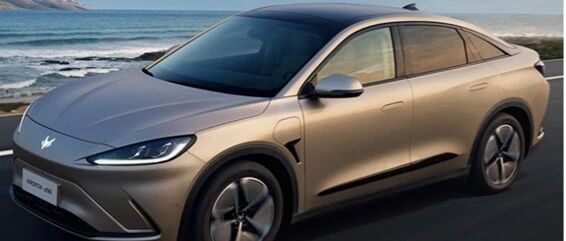
Core Insights - The article discusses the approval of L3-level conditional autonomous driving vehicles in China, specifically the Changan Deep Blue SL03 and BAIC Arcfox αS6, highlighting their operational limitations and the significance of this regulatory milestone [4][6]. Group 1: Regulatory Approval and Market Impact - On December 15, 2025, the Ministry of Industry and Information Technology of China approved Changan and BAIC's applications for L3-level autonomous vehicles, allowing them to operate under specific conditions [4][6]. - The approval is seen as a symbolic milestone that exceeds the immediate production value, with the first half of 2026 expected to be a critical window for mass production of L3-level autonomous vehicles in China [6][7]. Group 2: Competitive Landscape - Tesla's Full Self-Driving (FSD) 14.2 system is anticipated to enter mass production in China between Q2 and Q3 of 2026, increasing competitive pressure on local automakers [6]. - Joint ventures represented by companies like BMW, GM, and Mercedes are likely to miss the approval window for L3-level autonomous production in 2026 due to internal communication and localization compliance challenges [6]. Group 3: Technical Analysis of Approved Models - Both approved models, Changan Deep Blue SL03 and BAIC Arcfox αS6, are based on L2-level hardware but have been adapted for specific L3 operational design domains (ODD) [7]. - Changan's solution relies on pure visual perception and a rule-based planning and control system, reflecting the company's ongoing advancements since 2020 [10]. - BAIC's approach utilizes multi-sensor fusion and an end-to-end software architecture, optimized for L3 highway scenarios based on Huawei's commercial autonomous driving system [10]. Group 4: Future Projections - Additional models from companies such as BYD, FAW, GAC, NIO, and SAIC are expected to receive L3-level approval, with models from XPeng, Tesla, and those equipped with Huawei ADS 4.0 anticipated to launch in the latter half of 2026 [7].


亏超20亿,“玩具大王”跨界豪赌
首席商业评论· 2025-12-25 04:18
Core Viewpoint - Aodong New Energy, a leading company in battery swapping solutions, has submitted its IPO application to the Hong Kong Stock Exchange, aiming to establish a comprehensive product and service ecosystem for battery swapping despite facing significant losses and intense competition in the industry [4][10]. Financial Performance - Aodong New Energy has incurred cumulative losses exceeding 2 billion RMB over three and a half years, with net losses reported as 785 million RMB in 2022, 655 million RMB in 2023, 419 million RMB in 2024, and 157 million RMB in the first half of 2025 [10][12]. - The company's revenue for the first half of 2025 was 324 million RMB, a 31.7% decline compared to 474 million RMB in the same period of 2024, exacerbating external skepticism regarding its financial stability [10][12]. Technology and Innovation - Aodong's technological advantage lies in its innovative snap-on battery swapping technology, which significantly enhances swapping speed and extends the lifespan of battery modules while ensuring safety [7]. - The company operates 267 self-owned stations and provides services to 62 third-party stations, indicating a growing operational scale [9]. Market Dynamics - The battery swapping market is relatively new and rapidly evolving, with no guarantee of sustained growth, and Aodong may lack sufficient experience to navigate the challenges in this fast-developing sector [12]. - The competition in the battery swapping industry is intensifying, with major players like CATL and NIO entering the market, which could pose significant challenges for Aodong [14][16]. Strategic Direction - Aodong plans to use the funds raised from its IPO to accelerate the expansion of its battery swapping network, enhance core technology research and development, and optimize its financial structure to support heavy asset investments [18][19]. - The company aims to broaden its battery swapping solutions to include more electric vehicle markets, such as ride-hailing and commercial vehicles, while establishing partnerships with vehicle manufacturers [16].

国资入主联创电子,未来三年联创战略转型新蓝图
Jing Ji Guan Cha Wang· 2025-12-25 03:39
Core Viewpoint - The company, Lianchuang Electronics, is shifting its strategic focus from being a "comprehensive electronic manufacturing enterprise" to concentrating entirely on the optical industry, aiming to become a "giant in optical technology" within the next three years [1] Group 1: Strategic Direction - Lianchuang Electronics will channel its resources into the optical industry, which is seen as having a competitive advantage [1] - The company has outlined three clear execution paths for its new development plan [1] Group 2: Execution Paths - The first path focuses on automotive optics, leveraging its glass-plastic hybrid lens technology to target key Tier 1 platforms such as NIO, Huawei, and Horizon, aiming to make this the primary source of profit while also entering the medical endoscope market to cultivate a second growth curve [1] - The second path involves a defensive strategy for the touch display business, shifting from scale expansion to enhancing equipment utilization and reducing amortization, with a focus on profitability [1] - The third path emphasizes strict control over capital expenditures, moving away from the high-intensity R&D and fixed asset investment model of the past five years, and instead prioritizing internal management and cost reduction over large-scale new investments [1] Group 3: Strategic Logic - The core logic behind this strategic transformation is to leverage the resources and financial advantages provided by state-owned capital to convert Lianchuang Electronics' technological barriers into market orders and profits, achieving a transition from "diversified layout" to "specialized and innovative" [1]

首批汽车智能底盘实测研究报告发布,仰望U7、蔚来ES8、智界R7成标杆车型
Feng Huang Wang· 2025-12-25 01:45
Core Viewpoint - The China Automotive Engineering Research Institute (CAERI) successfully held the "2025 Intelligent Chassis Pioneer Plan" testing research results release conference, showcasing benchmark models that excelled in various critical tests [1] Group 1: Testing and Evaluation - The selected benchmark models include the Yangwang U7, NIO ES8, and Zhijie R7, which demonstrated strong technical integration and adaptability in key tests such as slippery handling, emergency stability, and complex road conditions [1] - CAERI conducted real vehicle tests based on eight group standards for intelligent chassis testing, establishing a multi-scenario and multi-dimensional testing system [1] Group 2: Focus on Real-World Application - The testing focused on real-world consumer pain points, including slippery moose tests, simulated tire blowouts, slopes, and continuous curves, assessing the chassis performance in emergency avoidance, response, and overall coordination [1] - The emphasis of the tests was not on extreme data accumulation but on whether the intelligent chassis system can genuinely enhance safety, smoothness, and driver confidence in real scenarios, providing consumers with a reference based on scenario verification [1]

港股市场2025年终盘点:IPO规模冠全球,多项指标创纪录
Sou Hu Cai Jing· 2025-12-25 01:44
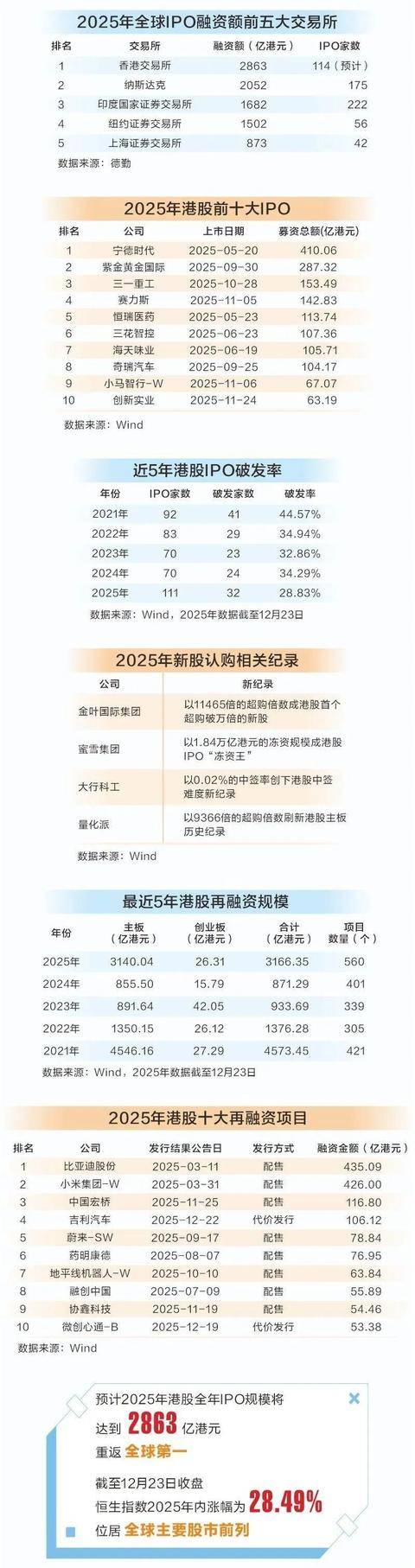
Core Viewpoint - The Hong Kong stock market is expected to fully recover in 2025 after experiencing a significant downturn from 2021 to 2024, with the Hang Seng Index dropping over 50% during that period. The market revival is driven by technological breakthroughs and a surge in IPO activities, establishing a solid foundation for a comprehensive rebound [1]. IPO Market Performance - In 2025, the Hong Kong Stock Exchange is projected to lead the global IPO market with a total financing amount of 286.3 billion HKD from approximately 114 IPOs [2]. - The top five exchanges for global IPO financing in 2025 are: Hong Kong Stock Exchange (286.3 billion HKD, 114 IPOs), Nasdaq (205.2 billion HKD, 175 IPOs), National Stock Exchange of India (168.2 billion HKD, 222 IPOs), New York Stock Exchange (150.2 billion HKD, 56 IPOs), and Shanghai Stock Exchange (87.3 billion HKD, 42 IPOs) [2]. - Eight companies in the top ten IPOs of 2025 raised over 10 billion HKD each, with notable contributions from companies like CATL and Zijin Mining [11]. IPO Quality and Market Sentiment - The IPO breakage rate in 2025 is reported at 28.83%, the lowest in five years, indicating a positive market sentiment and improved quality of IPOs [12]. - The new pricing mechanism implemented by the Hong Kong Stock Exchange has strengthened institutional investors' pricing power, contributing to the lower breakage rate [12]. Record-Breaking Subscription Metrics - The IPO market in Hong Kong has seen record-breaking subscription metrics, with companies like Jinye International Group achieving a subscription multiple of 11,465 times, setting a historical record [13]. - The "frozen capital" for the IPO of Mixue Group reached 1.84 trillion HKD, marking it as the "frozen capital king" in Hong Kong IPO history [13]. Secondary Financing Market - The total refinancing amount in Hong Kong for 2025 exceeded 316.6 billion HKD, surpassing the IPO scale and reaching a new high in project numbers with 560 projects [14]. - Major companies like BYD and Xiaomi led the top refinancing projects, raising significant amounts for business expansion and development [15]. Stock Market Performance - The Hang Seng Index recorded a year-to-date increase of 28.49%, ranking among the top global indices [16]. - Sectors such as innovative pharmaceuticals, non-ferrous metals, and semiconductors have shown significant growth, with stocks like Aijie Ankang experiencing a staggering increase of 950.95% [17]. Capital Inflows and Market Dynamics - Southbound capital inflows into the Hong Kong stock market reached a record high of approximately 1.41 trillion HKD in 2025, significantly enhancing market liquidity [18][19]. - The total buyback amount by listed companies in Hong Kong exceeded 175.9 billion HKD, indicating strong buyback enthusiasm amid market recovery [20][21]. Dividend Distribution - The total dividend distribution in the Hong Kong market for 2025 reached nearly 1.46 trillion HKD, surpassing the total for 2024 and reflecting a robust dividend environment [22]. Delisting Trends - The delisting process in Hong Kong accelerated in 2025, with 61 companies exiting the market, primarily due to privatization and forced delisting [23].
我们什么时候能有自己的“BBA”?
Zhong Guo Jing Ji Wang· 2025-12-25 01:33
(责任编辑:郭跃) 我们什么时候能有自己的"BBA"?#国产品牌冲高#豪华品牌#2025星途品牌之夜#蔚来#小鹏#理想# 极氪#阿维塔#岚图#腾势#奔驰#宝马#奥迪#BBA ...
至信股份发布招股意向书 拟募资超13亿元聚焦智能制造
Zheng Quan Shi Bao Wang· 2025-12-25 01:15
Core Viewpoint - Chongqing Zhixin Industrial Co., Ltd. (referred to as "Zhixin Co."), plans to raise 1.329 billion yuan through an IPO on the Shanghai Stock Exchange, aiming to expand production capacity and enhance technology for its welding production lines, as well as to supplement working capital [1] Group 1: Company Overview - Zhixin Co. has been focused on the research, production, and sales of automotive welding parts and related molds since its establishment in 1995, creating an integrated service system of "components + molds + intelligent manufacturing" [2] - The company has become a first-tier supplier for numerous well-known automotive manufacturers, including Changan Automobile, Geely, and BYD, and has established a diverse customer ecosystem covering both traditional fuel vehicles and new energy vehicles [2] - As of June 30, 2025, Zhixin Co. holds 371 patents, including 58 invention patents, and has received multiple awards, highlighting its strong technological capabilities and industry position [2] Group 2: Financial Performance - From 2022 to 2024, Zhixin Co. achieved operating revenues of 2.091 billion yuan, 2.564 billion yuan, and 3.088 billion yuan, with net profits attributable to the parent company (after deducting non-recurring gains and losses) of 52.25 million yuan, 120 million yuan, and 185 million yuan, reflecting a compound annual growth rate of 88.02% [3] - In the first half of 2025, the company continued its robust growth, generating revenue of 1.604 billion yuan and a net profit of 87.18 million yuan [3] - The revenue from welding components used in new energy vehicles increased significantly from 25.27% in 2022 to 71.42% in the first half of 2025, becoming a key driver of the company's sustained growth [3] Group 3: IPO and Future Projects - The funds raised from the IPO will be primarily allocated to projects including the "Zhixin Industrial Production Line Renovation Project," "Ningbo Zhixin Automotive Parts Production Line Intelligent Upgrade Project," and "New Energy Vehicle Parts Welding Production Line Expansion and Technology Renovation Project," located in Chongqing, Ningbo, and Anhui [3] - These projects are expected to add an annual production capacity of 2.3999 million sets of welding parts, significantly enhancing the company's intelligent manufacturing capabilities and consolidating its market competitiveness [3]
中国汽车智能化步入全新攻坚期
Zhong Guo Qing Nian Bao· 2025-12-24 22:15
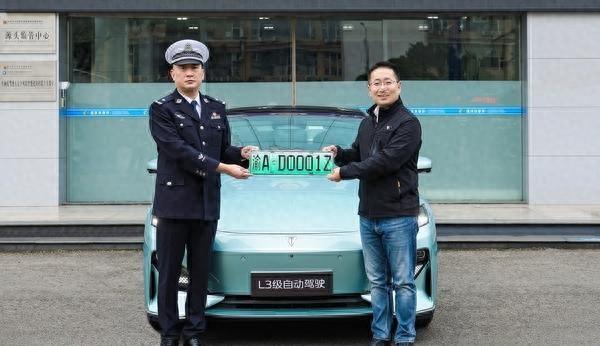
Core Insights - The issuance of the first L3-level autonomous driving license plate "渝AD0001Z" to Changan Automobile marks a significant milestone in China's progress in the autonomous driving sector, reflecting the company's commitment to safety and innovation [2][3] - The approval of L3-level conditional autonomous driving products by the Ministry of Industry and Information Technology indicates a critical advancement in the management practices of strategic technologies in China, serving as a catalyst for the industry's intelligent transformation [2][3] Industry Developments - Changan Automobile has undergone seven iterations of technology since establishing its intelligent research and development team in 2009, showcasing its deep-rooted automotive manufacturing experience and successful transition to smart technology [3] - The penetration rate of L2-level advanced driver assistance systems (ADAS) in new passenger cars in China exceeded 60% in the first three quarters of this year, with expectations to rise to 90% by 2030, indicating a shift from technology validation to large-scale commercial application [3] Collaborative Innovation - The achievement of L3-level autonomous driving is attributed to collaborative innovation across the industry chain, with leading domestic brands and new car manufacturers investing heavily in intelligent driving as a core strategy [4] - Domestic chip companies have made significant breakthroughs in high-performance AI computing chips, reducing reliance on foreign suppliers and providing a "digital foundation" for China's smart vehicles [4] Data Advantage - The rapid proliferation of L2-level assistance driving has established a strong foundation for the advancement of higher-level intelligent driving, creating a unique data advantage through millions of smart connected vehicles operating in complex road environments [5] - This data-driven approach enhances the iterative capabilities of autonomous driving algorithms, making it difficult for other countries to replicate [5] Regulatory Framework - The approval of L3-level products does not equate to mass production, as it serves as a "permit" for specific models to conduct road tests under strict conditions, emphasizing safety and regulatory compliance [6][10] - The initial speed limit of 50 km/h for L3-level autonomous driving reflects a cautious approach to ensure safety during testing in complex urban traffic environments [7] Future Outlook - Achieving safe and rapid deployment of L3-level autonomous driving requires a collaborative effort from government, enterprises, research institutions, and society [9] - A clear and stable regulatory framework is essential to define the legal identity of L3 vehicles and clarify responsibilities in the event of accidents [10] - Continuous investment in technology and infrastructure, along with public trust and understanding of autonomous driving, will be crucial for the industry's long-term success [11]