
华为

Search documents
持续服务创新!华为视频服务启动试点 可视化沟通打破空间壁垒
Cai Jing Wang· 2026-01-23 05:08
在数字化服务普及的当下,用户对服务体验的期待也在持续升级。针对设备复杂场景故障、操作指引等 问题,传统服务形式难以高效为用户排忧解难。坚持以消费者为中心,华为服务持续创新,于2026年1 月正式启动试点"华为视频服务"。此次试点将通过线上实时可视化沟通模式,突破空间壁垒,高效解决 用户问题,为消费者带来全新的服务体验。 此外,针对鸿蒙新机用户,凡购买鸿蒙电脑并生成电子保修卡后的90天内,均可通过华为视频服务获得 实时、直观的产品功能讲解与使用技巧指导,快速熟悉鸿蒙系统,充分享受科技带来的便捷体验。长辈 关怀视频服务,采用一对一视频交流模式,以极具亲和力与耐心的服务态度,为长辈提供一站式服务; 无论是手机、平板、电脑等产品的使用问题,还是各类产品使用技巧的咨询,长辈都能通过该服务获得 细致解答。 洞察用户需求,华为视频服务应运而生 随着智能设备融入生活的方方面面,用户对服务的需求早已超越"能解决问题",转向"高效、便捷、直 观"的更高要求。尤其在面对路由器组网、网络调试等涉及多设备、多环节的复杂场景时,传统远程协 助方式往往难以快速定位问题,导致沟通成本增加,而服务效率也不容乐观;再如新用户面对鸿蒙电脑 时,缺 ...
华为破了vivo的金身
3 6 Ke· 2026-01-23 03:52
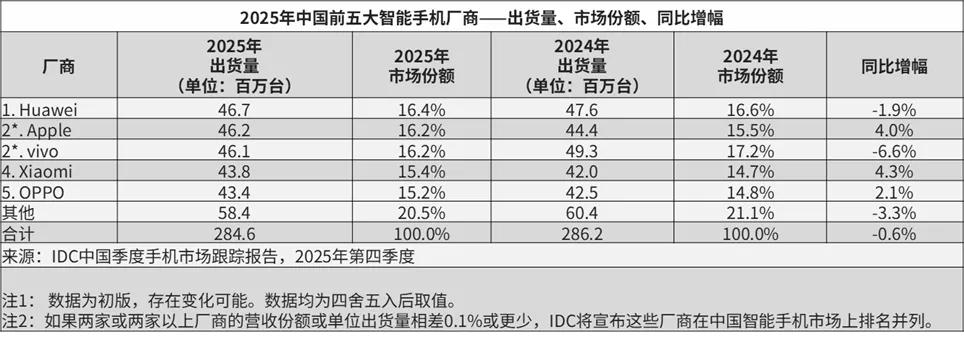
Core Viewpoint - The Chinese smartphone market has experienced significant changes in rankings, with Huawei regaining the top position in market share after several years, despite a slight decline in overall shipment volume [1][4]. Market Overview - In 2025, the total shipment volume of smartphones in China is projected to be 285 million units, reflecting a year-on-year decrease of 0.6% [1][4]. - The competitive landscape is intensifying, with major brands closely contending for market share [3][4]. Key Players and Market Share - The top five smartphone manufacturers in China for 2025 are: 1. Huawei: 46.7 million units, 16.4% market share, down 1.9% from 2024 2. Apple: 46.2 million units, 16.2% market share, up 4.0% from 2024 3. Vivo: 46.1 million units, 16.2% market share, down 6.6% from 2024 4. Xiaomi: 43.8 million units, 15.4% market share, up 4.3% from 2024 5. OPPO: 43.4 million units, 15.2% market share, up 2.1% from 2024 [2]. Vivo's Market Position - Vivo has dropped from first to third place in market share, with a significant year-on-year decline in shipment volume [2][11]. - The brand's strategy of releasing a high number of models (81 in 2025) is under scrutiny as the market shifts towards high-end devices [11][12]. Industry Trends - The smartphone market is transitioning from an incremental growth phase to a saturated market, with a notable increase in the share of high-end devices priced above 4,000 RMB [12][13]. - The competition is expected to intensify in 2026, particularly due to rising costs in components like memory [5][23]. User Experience and Brand Loyalty - Vivo's user retention rate is lower than competitors like Huawei and Apple, indicating potential issues with customer satisfaction [22]. - The brand has faced criticism regarding user experience, particularly in areas such as camera performance and software functionality [16][21]. Future Outlook - Vivo needs to enhance its focus on high-end market segments to remain competitive, especially as the overall market is expected to decline further in 2026 [14][23].

广货行天下 全球开“利是”
2 1 Shi Ji Jing Ji Bao Dao· 2026-01-23 03:31
Core Insights - The article emphasizes the integration of cultural elements into the global marketing strategy of Guangdong products, using the concept of "Li Si" as a cultural symbol to enhance emotional connections with consumers worldwide [1][2][11] - It highlights the transition from a focus on manufacturing scale and efficiency to a narrative that includes emotional and cultural dimensions, positioning Guangdong products as not just goods but as carriers of cultural significance [5][8][11] Group 1: Hard Currency of Guangdong Products - Guangdong products represent a significant portion of China's global manufacturing, with the Greater Bay Area's smart home appliance industry accounting for nearly 30% of the global market [3] - The region's products, such as electronics and traditional foods, are characterized by stringent quality standards, which serve as a passport to international markets [3][4] - Guangdong's manufacturing prowess is evident in various sectors, including consumer electronics and textiles, with a notable share of national exports [3][4] Group 2: Emotional Branding and Cultural Significance - The concept of "Nian Huo" (New Year goods) is evolving into a cultural and emotional branding tool, with Guangdong's agricultural exports leading the nation in value [5][6] - The emotional aspect of these products is crucial, as they are seen as symbols of cultural connection and tradition, enhancing their appeal in international markets [6][8] - Innovative marketing strategies, such as storytelling and cultural narratives, are being employed to resonate with global consumers, transforming products into meaningful gifts [9][10] Group 3: Media+ Ecosystem for Global Reach - The "Media+" initiative is being developed to create a comprehensive ecosystem that connects Guangdong products with global consumers, enhancing the efficiency of supply and demand [9][10] - This platform aims to facilitate storytelling and cultural exchange, making Guangdong products more relatable and desirable in international markets [9][10] - The initiative also addresses practical challenges faced by small and medium enterprises in exporting, providing them with tools and networks to navigate global markets [10][11]
具身智能“拐点期” 北上深珠比拼城市创新生态
2 1 Shi Ji Jing Ji Bao Dao· 2026-01-23 03:24
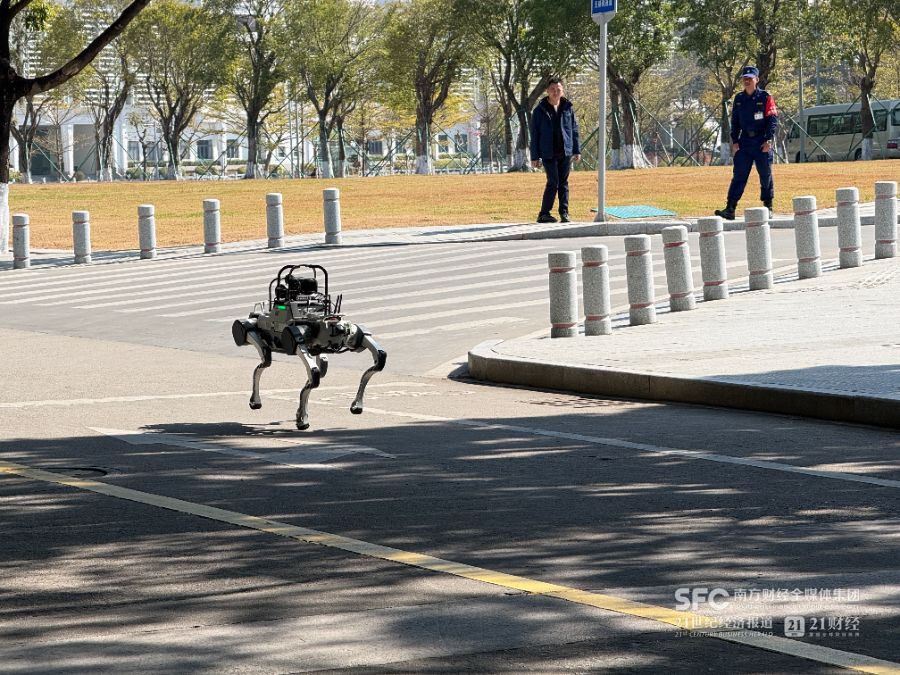
Core Insights - The year 2025 is referred to as the "Year of Embodied Intelligence," with significant government focus and investment in this technology, as highlighted in various city policies and the "14th Five-Year Plan" [1][9] - The Chinese market for robotics and embodied intelligence is at a critical turning point, with the emphasis on integrating perception, decision-making, control, system integration, and scene understanding into scalable solutions [1][5] City Competitiveness - Beijing is focusing on becoming a global hub for AI innovation, aiming to enhance its foundational theories and core technologies within two years, producing more original achievements in embodied intelligence [2] - Shanghai is leveraging standardization to advance in the field, having established the first national-level standardization pilot for embodied intelligence, which has led to multiple pioneering projects [2] - Shenzhen benefits from a robust ecosystem of tech giants and component manufacturers, facilitating efficient collaboration across the robotics industry, with a complete supply chain supporting rapid production [3][4] - Zhuhai is adopting a "scene-driven" approach to carve out its niche in the embodied intelligence race, focusing on innovative application scenarios to accelerate the adoption of new technologies [4][8] Industry Development - The embodied intelligence industry encompasses a wide range of components, including sensors, chips, algorithms, and diverse applications, with new leading companies filling critical gaps in the market [7] - Zhuhai is implementing a closed-loop model of "policy + scene + orders" to build a comprehensive industrial ecosystem, aiming to transform technology into market-ready solutions [7][9] - The city has launched 22 application scenarios in areas such as inspection, security, and smart services, fostering partnerships with various industry leaders to enhance its innovation ecosystem [8] Future Outlook - Zhuhai is positioning itself to cultivate a high-tech, high-growth, and large-scale industrial cluster in "AI + Robotics," supported by multiple innovation platforms [9] - The city aims to strengthen collaboration across the industry chain and leverage existing talent policies to facilitate the establishment of a cooperative development framework [9]
广货行天下 全球开“利是”
21世纪经济报道· 2026-01-23 03:20
Core Viewpoint - The article emphasizes the integration of cultural elements into the global marketing strategy of Guangdong products, using the concept of "利是" (red envelopes) as a symbol of warmth and emotional connection in international trade [1][2]. Group 1: Hard Power of Guangdong Products - Guangdong products have established themselves as a core representative of Chinese manufacturing in global competition, with the Guangdong-Hong Kong-Macao Greater Bay Area's smart home appliance industry accounting for nearly 30% of the global market [3]. - The region produces a significant portion of China's consumer electronics, with brands like Huawei, OPPO, and vivo leading innovation, and Guangdong's exports in textiles and toys making up nearly 20% of the national total [3][4]. - The true "hard currency" attribute of Guangdong products lies in their stringent quality control and standards, which serve as a passport to international markets [3][4]. Group 2: Soft Power and Emotional Connection - The concept of "年货" (New Year goods) is evolving from mere products to carriers of culture, emotion, and blessings, with Guangdong's agricultural products leading in export value during the 14th Five-Year Plan period [6]. - The emotional aspect of "年货" is highlighted as a key factor in consumer purchasing decisions, with products like Guangdong lychees and traditional dishes becoming symbols of cultural connection for overseas Chinese [6][7]. - Digital technology is reshaping the export of "年货," allowing for precise market targeting and enhancing consumer engagement through storytelling and cultural narratives [7][8]. Group 3: Media+ Ecosystem for Global Reach - The "Media+" ecosystem is being developed in Guangdong to enhance the connection between products and global consumers, focusing on storytelling and cultural representation [10][11]. - This platform aims to improve supply-demand connectivity and address challenges faced by small and medium enterprises in international markets, facilitating easier access to global procurement networks [11][12]. - The initiative is expected to create a continuous narrative around Guangdong products, aligning with seasonal themes to maintain engagement and cultural relevance throughout the year [12].

中国如何面对美国突然的放松对华出口管控?
日经中文网· 2026-01-23 03:08
Core Viewpoint - The U.S. Department of Commerce has relaxed its export policy for NVIDIA's AI semiconductor "H200" to China, shifting from a ban to a licensing system, raising questions about China's previous "self-reliance" strategy under restrictions [2][4]. Group 1: U.S. Policy Changes - The U.S. has allowed the export of the H200 semiconductor, which has led to a rise in Chinese tech stocks, indicating market optimism about these companies accelerating their AI development [5]. - NVIDIA's CEO Jensen Huang noted strong demand from Chinese customers for the H200, highlighting the importance of this product for AI model training [4]. Group 2: China's Response and Strategy - China has not officially responded to the U.S. policy change but is reportedly developing import acceptance rules, including total procurement amounts [4]. - Experts suggest that China may be reluctant to approve imports of U.S. products, as the government aims to promote "self-reliance" in high-tech sectors and reduce dependency on American supply chains [6]. Group 3: Domestic Developments in China - China is making strides in achieving self-reliance in the AI supply chain, particularly in semiconductor technology, with ongoing efforts to develop domestic EUV lithography equipment [7]. - The stock market has reacted positively to the prospects of semiconductor self-sufficiency, with companies like SMIC and Hua Hong Semiconductor seeing significant stock price increases [7].


国新证券每日晨报-20260123
Guoxin Securities Co., Ltd· 2026-01-23 02:20
Domestic Market Overview - The domestic market experienced narrow fluctuations with a slight increase, with the Shanghai Composite Index closing at 4122.58 points, up 0.14%, and the Shenzhen Component Index closing at 14327.05 points, up 0.5% [1][10] - Among the 30 sectors, 21 sectors saw an increase, with oil and petrochemicals, building materials, and telecommunications leading the gains, while automotive, pharmaceuticals, and banking sectors experienced significant declines [1][10] - The total trading volume of the A-share market reached 27,164 billion, showing a slight increase compared to the previous day [1][10] Overseas Market Overview - All three major U.S. stock indices closed higher, with the Dow Jones up 0.63%, the S&P 500 up 0.55%, and the Nasdaq up 0.91% [2][10] - The U.S. technology index rose by 1.47%, with Facebook increasing by over 5% and Tesla rising by more than 4% [2][10] - Most Chinese concept stocks also saw gains, with Xiaoma Zhixing up nearly 6% and Canadian Solar up over 5% [2][10] Key News Highlights - The People's Bank of China will continue to implement a moderately loose monetary policy in 2026, focusing on stabilizing economic growth and ensuring a reasonable recovery in prices [3][12] - Six major banks collectively announced the implementation of the latest fiscal interest subsidy policy for personal consumption loans [3][14] - The market regulatory authority issued a warning regarding mergers and acquisitions in the public utility sector, marking a significant regulatory action [3][18] - The public fund's fourth-quarter report for 2025 has been disclosed, with a focus on electronic and power equipment sectors [3][20] - Important global economic data has been released, indicating various trends in different markets [3][21]
自动驾驶行业遭遇剧烈洗牌,车路云一体化面临“四道坎”
Xin Hua Cai Jing· 2026-01-23 01:36
Core Insights - The autonomous driving industry is undergoing significant upheaval, highlighted by the suspension of operations at the unicorn company Haomo Technology, which had previously achieved a valuation exceeding $1 billion [1] - Safety concerns are intensifying public distrust in autonomous driving, with notable incidents such as a fatal accident involving Tesla's Autopilot and a pedestrian collision involving a Robotaxi in China [1] - The current landscape features nearly 500 domestic autonomous driving companies, indicating a seemingly thriving sector, yet underlying challenges such as capital withdrawal, technological bottlenecks, and safety anxieties persist [1] Group 1: Technology and Safety - The debate over the technical route of intelligent driving centers on how to safely advance towards full autonomy, with Tesla's pure vision approach contrasting with the multi-sensor fusion strategies of companies like Huawei and Momenta [1][2] - Tesla's data collection capabilities from mass-produced vehicles support algorithm iteration, but its reliance on cameras presents limitations in recognizing static objects and performing in low-visibility conditions [2] - Multi-sensor fusion solutions, while addressing some of Tesla's shortcomings, face challenges such as complex data calibration between different devices [2] Group 2: Levels of Automation - The "Automated Driving Classification" standard categorizes driving automation from L0 to L5, with L3 being a critical threshold for human intervention and system dominance [3] - Companies are cautious in their claims about automation levels, with Huawei referring to its system as "L2.9999," while some Robotaxis boldly claim L4 capabilities despite ongoing safety concerns [3] - The rapid expansion of low-speed autonomous vehicles in urban areas raises significant safety issues, as these vehicles often violate traffic regulations and create hazards [3] Group 3: Vehicle-Road-Cloud Integration - The industry is recognizing the need for vehicle-road-cloud integration to address coordination gaps that lead to safety issues, such as blind spots and outdated traffic signals [5] - This integration aims to enhance the capabilities of autonomous systems by providing superior perception and decision-making through real-time data sharing [5] - Successful implementation of this integration has been demonstrated in Wuxi, where a vehicle-road-cloud system has improved traffic efficiency by approximately 15%-20% [6][7] Group 4: Challenges Ahead - Despite the promise of vehicle-road-cloud integration, challenges remain, including the need for standardized data governance and the alignment of investment returns with operational costs [8] - The collaboration among various stakeholders, including government, automotive companies, and tech firms, is essential to avoid fragmented efforts in the development of intelligent transportation systems [8] - The diverse conditions across Chinese cities complicate the scalability of successful models, necessitating tailored approaches for different urban environments [9]


上海 向上 人无我有 保持追求卓越闯劲 顶峰相见 天才极客逐梦圆梦
Jie Fang Ri Bao· 2026-01-23 01:34
Economic Performance - Shanghai's GDP surpassed 5.6 trillion yuan in 2025, growing by 5.4% year-on-year, which is higher than the national average [1] - From 2023 to 2025, Shanghai's GDP growth rate improved significantly, moving from below the national average to exceeding it by 0.4 percentage points [1] Innovation and Development - Shanghai is home to innovative projects like the "Louis" concept landmark and the "Magic City" cruise ship, showcasing its ability to attract global attention and enhance commercial activity [2][3] - The city has established a robust ecosystem for technology and innovation, with significant advancements in AI, robotics, and biomedicine, leading to a rapid growth in its three leading industries, which reached 1.8 trillion yuan in 2024 [7] Infrastructure and Connectivity - The construction of the new "Oriental Hub" in Pudong aims to facilitate international business cooperation and enhance cross-border movement of goods and people, positioning Shanghai as a key global connector [9] - Shanghai's port has achieved a record container throughput of over 50 million standard containers in 2024, maintaining its status as the world's busiest port for 16 consecutive years [2] Future Outlook - Shanghai's continuous pursuit of innovation and its strategic alignment with national development goals suggest a strong potential for sustained economic growth in the coming years [12][13] - The city's ability to adapt and explore new opportunities outside traditional centers indicates a promising trajectory for future investments and developments [10][11]
【新华财经调查】自动驾驶行业遭遇剧烈洗牌 车路云一体化面临“四道坎”
Xin Hua Cai Jing· 2026-01-23 01:20
Core Insights - The automatic driving industry is facing a significant reshuffle, highlighted by the suspension of operations at the unicorn company Haomo Zhixing, which was once valued over $1 billion and seen as a leader in high-level autonomous driving in China [1] - Safety concerns are intensifying public trust issues in autonomous driving, with recent accidents involving autonomous vehicles in both China and the U.S. [1] - The current landscape shows nearly 500 domestic companies in the autonomous driving sector, indicating a seemingly prosperous market but underlying challenges due to capital withdrawal, technological bottlenecks, and safety anxieties [1] Technology Pathways - The debate over the technical routes for intelligent driving centers on how to safely advance towards full autonomy, with Tesla's pure vision approach contrasting with the multi-sensor fusion strategies of companies like Huawei and Momenta [2][3] - Tesla's advantage lies in its vast data collection from mass-produced vehicles, but it faces limitations in recognizing static objects and performing in low-visibility conditions [2] - Multi-sensor fusion solutions, while addressing some of Tesla's shortcomings, also present challenges such as complex data calibration between different devices [2] Levels of Automation - The "Automated Driving Classification" standard categorizes driving automation from L0 to L5, with L3 being a critical threshold for human intervention and system dominance [3] - Companies are cautious in their claims about automation levels, with some, like Huawei, using terms like "L2.9999" to describe their systems, while others boldly label their autonomous taxis as "L4" [3] Industry Challenges - The rapid expansion of low-speed autonomous vehicles in urban areas raises safety concerns, as these vehicles often violate traffic rules and create hazards [3] - The reliability of autonomous taxis is still dependent on multiple backup strategies and remote control, indicating that full operational capability is not yet achieved [3] Integration of Vehicle, Road, and Cloud - The industry is recognizing the need for a "vehicle-road-cloud" integration to address coordination gaps that lead to operational failures [5] - This integration aims to enhance safety and efficiency by providing advanced perception and decision-making capabilities beyond what individual vehicles can achieve [5][6] Pilot Projects and Efficiency Gains - Wuxi has emerged as a pilot city for vehicle-road-cloud integration, demonstrating significant improvements in traffic efficiency, with average traffic flow increasing by 15%-20% [6][7] - The cost-effectiveness of digital infrastructure is highlighted, as it requires only 1% of the investment compared to new road construction while achieving substantial efficiency gains [7] Future Challenges - Despite the potential of vehicle-road-cloud integration, challenges remain in data quality, investment returns, multi-party collaboration, and scalability across diverse urban environments [8][9] - The lack of unified data standards and governance can hinder the effective use of collected information, while the need for clear operational mechanisms and quantifiable benefits is critical for long-term success [8][9]