
泸州老窖

Search documents
白酒业新观察:“马太效应”愈发显著
Shang Hai Zheng Quan Bao· 2025-11-01 12:57
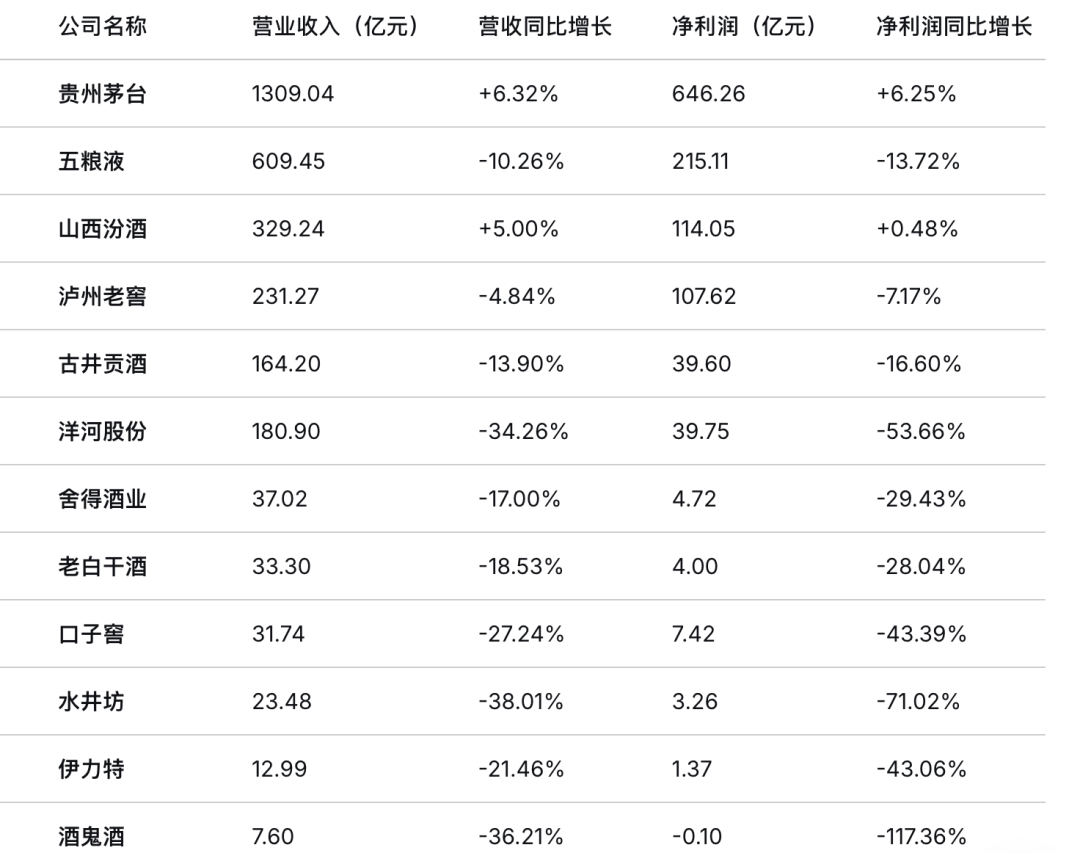
Core Viewpoint - The high-end liquor industry is struggling with growth, while mid-range and regional liquor companies are experiencing significant declines in performance, as evidenced by the third-quarter reports of 20 A-share liquor companies, highlighting challenges such as weak consumption, high channel inventory, and falling prices [1][8]. Company Performance Summary - Guizhou Moutai reported revenue of 130.9 billion yuan, a year-on-year increase of 6.32%, and a net profit of 64.6 billion yuan, up 6.25% [2][9]. - Wuliangye's revenue was 60.9 billion yuan, down 10.26%, with a net profit of 21.5 billion yuan, a decline of 13.72% [2][11]. - Shanxi Fenjiu achieved revenue of 32.9 billion yuan, a 5.00% increase, but its net profit fell by 1.4% to 39.7 billion yuan [2][10]. - Luzhou Laojiao's revenue decreased by 4.84% to 23.1 billion yuan, with a net profit of 10.8 billion yuan, down 7.17% [2][12]. - The performance of regional liquor companies like Kuaijie and Yingjia Gongjiu showed significant declines, with Kuaijie reporting a 46.23% drop in revenue and a 92.6% decrease in net profit [4][6]. Industry Trends - The third quarter showed a clear downward trend, with many regional liquor companies experiencing accelerated declines, and some even reporting losses [3][8]. - The "Matthew Effect" is becoming more pronounced, with only Guizhou Moutai and Shanxi Fenjiu achieving positive growth in both revenue and net profit among the 20 companies [8][13]. - The overall industry is undergoing a profound supply-side adjustment, with strong brand power and national distribution allowing leading companies to withstand cyclical fluctuations, while smaller companies face greater challenges [13]. Market Outlook - Expectations for the upcoming Mid-Autumn Festival and National Day indicate a potential 20%-30% decline in overall liquor demand, with inventory expected to increase by 10%-20% [13]. - The current high channel inventory and weak consumption scenarios suggest that the liquor industry will continue to face significant pressure into the 2026 Spring Festival [13].






十月最后一天
Ge Long Hui· 2025-11-01 12:06
Market Overview - Despite a significant drop in indices, the median market performance showed an increase of approximately 0.8%, indicating that most small and mid-cap stocks rose, while declines were primarily seen in previously high-performing sectors such as AI, materials, and technology [1] - The market behavior is attributed to profit-taking at the end of the month, with expectations for a style shift in the upcoming month [1] Company Earnings Reports - **Wuliangye**: Reported a net profit of 2.02 billion, down 66% year-on-year; **Luzhou Laojiao** reported a net profit of 3.1 billion, down 13% year-on-year; **Fenjiu** maintained a stable net profit of 2.9 billion; **Yanghe** incurred a loss of over 300 million, indicating a potential financial cleanup rather than actual losses [1] - **Agricultural Bank of China**: Q3 revenue reached 180.9 billion, up 4.3% year-on-year, with a net profit of 81.35 billion, up 3.66% year-on-year; the bank's price-to-earnings ratio stands at 10 [2] - **Industrial and Commercial Bank of China**: Q3 revenue was 212.9 billion, up 3.4% year-on-year, with a net profit of 101.8 billion, up 3.3% year-on-year; its price-to-earnings ratio is 7.6 [2] - **CNOOC**: Reported a Q3 net profit of 32.4 billion, down 12% year-on-year; oil and gas production increased by 7%, while capital expenditure decreased by 10% [2] - **Gree Electric Appliances**: Q3 revenue was 39.855 billion, down 15.09% year-on-year, with a net profit of 7.049 billion, down 9.92% year-on-year [2] - **SF Express**: Q3 revenue reached 78.4 billion, up 8.2% year-on-year, with a net profit of 2.57 billion, down 8.5% year-on-year; the decline in profit is attributed to international expansion costs [2] - **Huatong**: Q3 net profit was 1.7 billion, slightly below expectations; the company increased R&D expenses by 250 million, indicating a potential for future growth [3] - **BYD**: Reported a Q3 net profit of 7.2 billion, down 33% year-on-year, reflecting intense competition in the electric vehicle sector [4] - **Amazon**: AWS achieved its fastest growth in three years, resulting in a post-market increase of 14% [4] - **Meta (Facebook)**: Experienced an 11% drop due to higher-than-expected AI expenditures and declining competitiveness compared to Google [4] - **Luxshare Precision**: Q3 revenue was 96.4 billion, up 31% year-on-year, with a net profit of 4.874 billion, up 32.5% year-on-year, driven by AI and automotive sectors [4]
白酒业“最差季报”,是至暗时刻也是价值投资的光明前奏
Mei Ri Jing Ji Xin Wen· 2025-11-01 11:01
Core Viewpoint - The Chinese liquor industry is currently experiencing its "darkest moment," with significant declines in performance across many companies, highlighting a growing industry divide [2][3]. Industry Performance - Most liquor companies reported accelerated declines in their Q3 2025 performance, with some regional firms experiencing nearly triple-digit declines in net profit, such as Kuaizi Liquor, which saw a 92.6% drop in net profit [2]. - Even industry leader Kweichow Moutai managed to achieve 130 billion yuan in revenue with a 6.32% year-on-year growth, but this growth rate is the lowest in nearly a decade [2]. Market Sentiment - The market reaction to the poor performance has been mixed, with various stakeholders expressing skepticism, indifference, pessimism, and optimism about the industry's future [3]. - The current situation is viewed as an opportunity for investors to reassess the investment logic in the liquor industry, focusing on the transparency and courage shown by companies in reporting their true performance [3]. Industry Cycle - The liquor industry is transitioning from a phase of rapid growth to a period of stable, high-quality development, indicating that the era of high-speed growth is over [4]. - Historical context shows that the industry has faced similar challenges in the past, suggesting that the current downturn may lead to a stronger, more resilient market in the long run [4]. Competitive Landscape - The differentiation within the liquor industry is intensifying, with leading companies leveraging strong brand power and channel control to capture market share from smaller firms, resulting in increased industry concentration [5]. - The core value of the liquor industry is shifting from explosive growth to resilience and stable returns, prompting investors to recalibrate their investment strategies [5]. Consumer Trends - Despite a slowdown in overall demand growth, high-end liquor and collectible aged liquor maintain solid demand, with business consumption gradually recovering, providing a stable foundation for the industry [5]. Business Model Strengths - Leading liquor companies possess strong competitive advantages, including addictive consumption patterns, scarcity, and cultural premiums, which contribute to high profit margins, such as Moutai's 91.29% and Luzhou Laojiao's 87.11% [6]. - The industry's cash flow remains relatively stable during the downturn due to a "pay first, deliver later" model and the appreciation of aged liquor, ensuring long-term value is not diminished by short-term adjustments [6]. Market Reaction - The market's initial shock to the poor performance reports has shifted towards a more rational assessment, with some stocks, like Gujing Gongjiu, rising nearly 7% following the announcements, indicating a potential recovery and value reallocation in the industry [6].
白酒行业下滑真相:不是年轻人不喝,是这盘棋下错了
Sou Hu Cai Jing· 2025-11-01 04:23
Core Viewpoint - The frequent leadership changes at Moutai reflect deeper issues within the Chinese liquor industry, which is facing significant challenges including declining market demand and changing consumer preferences [1][3][4] Group 1: Leadership Changes - Moutai has experienced four leadership changes in five years, with the latest being Chen Hua, who lacks experience in the liquor industry [1][3] - Each leader implemented various strategies, but short tenures hindered the continuity of these strategies, leading to confusion among distributors and consumers [3][4] Group 2: Industry Challenges - The liquor industry is suffering from a significant decline in demand due to economic downturns, which has reduced business-related drinking occasions and gift-giving [4][6] - Moutai's revenue growth of 9% in the first half of the year was misleading, as it was achieved through inventory control rather than genuine market demand [6][9] - Young consumers are not abandoning liquor; rather, the industry has failed to attract them due to a lack of appealing products and marketing strategies [6][7] Group 3: Market Dynamics - The industry is facing overcapacity and inflated prices, resulting from a decade of aggressive expansion that has led to a surplus of unsold inventory [7][9] - The price system has become unstable, with significant fluctuations causing uncertainty for both consumers and distributors [9][10] Group 4: Future Outlook - Despite current challenges, the liquor industry is expected to recover, with historical resilience during past economic downturns [9][10] - For recovery, Moutai and other industry leaders need to stabilize their strategies, engage younger consumers with relevant products, and align pricing with market conditions [10][12]

高端稳盘与创新突围:探寻泸州老窖财报背后的新增长图谱
Guo Ji Jin Rong Bao· 2025-11-01 02:17
Core Viewpoint - Luzhou Laojiao demonstrates strong resilience and growth potential during the "volume reduction and quality improvement" phase of the liquor industry, supported by a clear strategic focus and innovative approaches in low-alcohol, youth-oriented, and scenario-based developments [1][2]. Group 1: Financial Performance - In the first three quarters of 2025, Luzhou Laojiao achieved revenue of 23.127 billion yuan and a net profit attributable to shareholders of 10.762 billion yuan, maintaining a net profit margin exceeding 46% [2][4]. - The company's high profitability is attributed to the continuous optimization of its product structure towards high-value categories, reflecting the successful implementation of its "dual brand, three product lines, and major single product" strategy [2][5]. Group 2: High-End Strategy - Luzhou Laojiao's high-end strategy has proven to be a core support for stabilizing its operational fundamentals, with its flagship brand, Guojiao 1573, maintaining a strong competitive position in the high-end market [2][3]. - The brand's value has been enhanced through cultural and sports IP initiatives, including the International Poetry and Wine Culture Conference and sponsorship of major sports events, which have helped to elevate its global brand image [3][4]. Group 3: Low-Alcohol Innovation - The company has recognized the trend towards low-alcohol consumption, launching the 38% vol Guojiao 1573 in 2001, which has now become the first low-alcohol product in the industry to exceed 10 billion yuan in sales [4][5]. - Luzhou Laojiao's long-term investment in low-alcohol brewing technology has created a competitive edge, allowing it to integrate traditional brewing techniques with modern technology [5][6]. Group 4: Youth Engagement and Scenario Innovation - The rise of younger consumers is reshaping the market, prompting Luzhou Laojiao to focus on product renewal and scenario reconstruction to connect with this demographic [6][7]. - The launch of the 2025 version of Luzhou Laojiao Erqu, positioned as a value-returning light bottle wine, aims to enhance quality recognition and consumer loyalty among younger audiences [6][7]. - Luzhou Laojiao has implemented immersive experiences and cultural events, such as the "Jiao Master Festival," to deepen consumer engagement and resonate with younger lifestyles [7].
泸州老窖三季报:稳健经营筑牢基本盘,数智创新激活新动能
Zhong Guo Zheng Quan Bao· 2025-11-01 00:31
Core Viewpoint - Luzhou Laojiao demonstrates resilience and strategic determination in navigating the challenges of the liquor industry adjustment period, focusing on consumer-centric innovation and maintaining a stable yet progressive approach [1][2]. Financial Performance - In the first three quarters of 2025, Luzhou Laojiao achieved revenue of 23.127 billion yuan and a net profit attributable to shareholders of 10.762 billion yuan [1]. - The net cash flow from operating activities reached 9.823 billion yuan, indicating a robust financial foundation [2]. Market Position and Strategy - Luzhou Laojiao, as a leading enterprise in the liquor industry, showcases strong brand heritage, a clear product matrix, and deep digital transformation, enhancing its anti-cyclical capabilities [2]. - The company has announced a high dividend policy, with cash dividend ratios set to increase annually to no less than 65%, 70%, and 75% over the next three years, with absolute amounts not less than 8.5 billion yuan [2]. Brand and Product Development - The company adopts a "high-end preservation and innovative attack" strategy, with its flagship brand, Guojiao 1573, solidifying its position in the high-end liquor market, achieving a scale of over 20 billion yuan [3]. - Luzhou Laojiao emphasizes cultural heritage as a core value, leveraging its unique cultural assets to strengthen brand competitiveness [3]. Innovation and Consumer Engagement - The company targets the low-alcohol and younger consumer segments, with its 38-degree Guojiao 1573 becoming the largest single product in the low-alcohol market, reaching a scale of over 10 billion yuan [4]. - Innovative marketing strategies, including collaborations with music and sports events, have successfully engaged younger consumers [4]. Digital Transformation - Luzhou Laojiao has implemented a digital twin system across its production and supply chain, improving equipment utilization by 45%, emergency response efficiency by 40%, and reducing operational costs by 25% [6][7]. - The integration of AI technology into production processes has enabled the company to predict and guide production, transforming traditional craftsmanship into a data-driven model [6][7]. Future Outlook - The company plans to deepen its market penetration, particularly in lower-tier markets, and shift its focus from quantity expansion to quality and efficiency improvement [8]. - Luzhou Laojiao is well-positioned to achieve high-quality development in the new industry cycle, supported by its strategic layout and brand advantages [8].
市场高切低,白酒利空出尽可以布局了!
Sou Hu Cai Jing· 2025-10-31 16:39
Core Viewpoint - The article discusses the uncertainty arising from the recent US-China talks, particularly concerning the technology sector and the potential impact on companies like NVIDIA, while highlighting the resilience of certain domestic sectors such as liquor and renewable energy amidst these geopolitical tensions [1]. Group 1: Market Reactions - Despite a 2.51% drop in the Sci-Tech Innovation Board, liquor stocks experienced a collective rise, with notable increases such as Gujing Gongjiu up nearly 6% and other major brands like Moutai and Shanxi Fenjiu also seeing gains [1]. - The liquor sector index rose by 2.02%, indicating strong investor interest in this segment despite broader market concerns [2]. Group 2: Investment Sentiment - Investors are shifting focus towards "old economy stocks" like liquor, which are perceived as lower risk in the current market environment characterized by high valuations in other sectors [3]. - The government’s emphasis on boosting domestic demand in its 2025 work report is expected to create new momentum in the consumption sector, benefiting industries like liquor [3]. Group 3: Industry Outlook - The liquor industry has likely reached its lowest point in terms of market sentiment, with pessimistic expectations already priced in, suggesting potential for recovery and valuation improvement [3]. - The long-term demand for liquor remains strong due to its social and cultural significance, supported by established brands with deep competitive advantages [3]. Group 4: Investment Opportunities - Investors interested in the liquor sector can consider index funds like the China Securities Liquor Index Fund to mitigate individual stock risks, with a suggested investment of 1000 yuan [4].

五粮液第三季度净利大降超65%,有机构提出左侧布局
2 1 Shi Ji Jing Ji Bao Dao· 2025-10-31 13:01
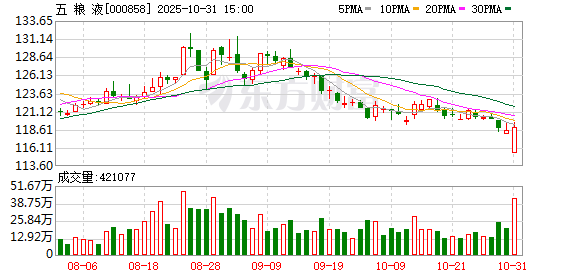
Core Viewpoint - Wuliangye's Q3 2025 financial results showed significant declines in both revenue and net profit, reflecting broader challenges in the Chinese liquor industry, while leading brand Kweichow Moutai maintained positive growth [2][3][4]. Financial Performance - Wuliangye reported a revenue of 60.945 billion yuan for the first three quarters of 2025, a year-on-year decrease of 10.26%, and a net profit of 21.511 billion yuan, down 13.72% [2]. - In Q3 alone, Wuliangye's revenue was 8.174 billion yuan, a decline of 52.66%, with net profit falling 65.62% to 2.019 billion yuan [2]. - Other liquor companies like Yanghe and Gujing Gongjiu also reported significant declines in revenue and net profit, with Yanghe's revenue down 34.26% and net profit down 53.66% [2][4]. Industry Comparison - Kweichow Moutai, as a leading brand, reported positive growth with revenue of 128.454 billion yuan and net profit of 64.627 billion yuan for the first three quarters of 2025, reflecting a growth of 6.36% and 6.25% respectively [4]. - The overall performance of the liquor sector has been poor, with the liquor index down 10.23% this year, indicating a significant decline from previous high levels of industry prosperity [4]. Market Outlook - Despite the current downturn, institutions remain optimistic about the future of the liquor industry, citing potential recovery driven by domestic demand policies and the strategic adjustments of leading companies [5]. - Analysts suggest that companies like Kweichow Moutai and Wuliangye, positioned at the bottom of the industry cycle, may benefit from a recovery in the market [5].
食品饮料行业2026年度投资策略:底部修复,柳暗花明
KAIYUAN SECURITIES· 2025-10-31 12:42
Core Insights - The food and beverage sector has underperformed the market, with a decline of 1.6% from January to October 2025, lagging behind the CSI 300 by approximately 37.2 percentage points, ranking last among primary sub-industries [4][11][25] - The snack segment has shown better performance with a growth of 32.5%, while beer, seasoning, and liquor have experienced declines of 9.7%, 6.5%, and 4.8% respectively [4][11][25] - The sector's price-to-earnings (PE) ratio has decreased by 10.4% compared to the end of 2024, with an expected net profit growth of 5.4% for 2025, leading to a 5.6% decline in market capitalization [4][17][20] Market Performance - The food and beverage sector has underperformed the market, with a decline of 1.6% from January to October 2025, ranking last among primary sub-industries [4][11] - The snack segment has shown better performance with a growth of 32.5%, while beer, seasoning, and liquor have experienced declines of 9.7%, 6.5%, and 4.8% respectively [4][11] - The sector's PE ratio has decreased by 10.4% compared to the end of 2024, with an expected net profit growth of 5.4% for 2025, leading to a 5.6% decline in market capitalization [4][17] Fund Holdings - In Q3 2025, the allocation of food and beverage in the overall market funds dropped to a new low of 6.4%, down from 8.0% in Q2 2025, marking the lowest level since 2020 [5][37] - The allocation in active equity funds also decreased from 5.6% in Q2 2025 to 4.1% in Q3 2025, indicating a significant reduction in food and beverage exposure [5][37] - The white liquor segment has seen a reduction in fund allocation, with companies like Luzhou Laojiao and Shede Liquor gaining more market favor due to their performance [5][42] Industry Judgment - The macroeconomic environment shows a weak recovery, with China's GDP growth at 4.8% in Q3 2025, slightly down from Q2 2025 [6][46] - Retail sales of consumer goods grew by 3.5% year-on-year in Q3 2025, reflecting a slower recovery pace, primarily due to the impact of the alcohol ban on dining consumption [6][46] - The food manufacturing sector has faced pressure, with revenue growth of only 1.5% and profit growth of 2.1% from January to September 2025, indicating a downward trend [6][52] Investment Opportunities - The food and beverage industry is expected to see a recovery from its bottom, with a focus on resilient consumer spending and improved economic activity [7][65] - The white liquor sector is nearing a left-side layout zone, suggesting gradual investment opportunities in companies like Kweichow Moutai and Luzhou Laojiao [7][68] - The snack segment is recommended for investment due to its growth potential, with companies like Wei Long and Ximai Foods highlighted for their market opportunities [7][69][62]

白酒业“最差季报”背后:坦诚与理性的投资回归
Mei Ri Jing Ji Xin Wen· 2025-10-31 11:45
Core Insights - The white liquor industry has reported its worst quarterly performance in nearly a decade for Q3 2025, leading to a mixed market reaction, with some stocks rising despite the poor results [1][2] - The decline in performance is attributed to a weak macroeconomic environment, reduced business dining, high inventory turnover days of up to 900, and widespread price inversions [1][2] - The transparency shown by companies in disclosing their true performance figures is seen as a courageous step, indicating a willingness to accept the industry's adjustment cycle [2][3] Industry Performance - Many liquor companies experienced accelerated declines in performance, with some regional firms reporting net profit drops nearing 100%, exemplified by Kuaizhou's 92.6% drop in net profit [1][2] - The industry is transitioning from a phase of rapid growth to a more stable and mature high-quality development cycle, with increasing concentration as leading firms capture more market share [2][3] Investment Perspective - The core value of the white liquor industry is shifting from explosive growth to resilience and stable dividend attributes, prompting investors to reassess the investment value of the sector [3] - Despite a slowdown in overall demand growth, high-end liquor and collectible old liquor maintain solid demand, providing a stable foundation for the industry [3] - Leading companies continue to benefit from strong brand power, addictive consumption patterns, and cultural premiums, with high gross margins (e.g., Kweichow Moutai at 91.29% and Luzhou Laojiao at 87.11%) supporting their cash flow stability [3]

