
博通

Search documents
2025 AI芯片激战:巨头竞逐,重划产业版图
Sou Hu Cai Jing· 2026-01-03 12:13
Core Insights - The AI chip industry is undergoing a significant transformation, with a shift from Nvidia's dominance to a more competitive landscape involving multiple players such as AMD, Google, Amazon, and others [5][6][42] - The emergence of domestic Chinese AI chip manufacturers is accelerating, driven by geopolitical factors and increasing local market penetration [8][43][58] - The competition is evolving from a focus on hardware performance to system-level efficiency and ecosystem integration, indicating a shift in industry dynamics [11][47][80] Group 1: Industry Trends - The global AI chip shipment is expected to exceed 10 million units by 2025, with Nvidia currently holding over 90% market share in the GPU segment, but the competitive landscape is changing [7][42] - China's AI chip market is projected to grow at a compound annual growth rate of 53.7% from 2025 to 2029, with the market size expected to increase from 142.54 billion yuan in 2024 to 1.34 trillion yuan by 2029 [8][43] - The competition is intensifying, with Google and Amazon's ASIC chip shipments expected to reach 40% to 60% of Nvidia's GPU shipments by 2025 [9][43] Group 2: Competitive Dynamics - The technological competition has shifted from architecture battles to system-level efficiency, with Nvidia maintaining its lead through a comprehensive solution while Google’s TPU represents a rising ASIC alternative [11][45] - The industry is moving towards ecosystem bundling, with Nvidia still leading but other manufacturers like AMD and Broadcom forming partnerships with major clients like OpenAI [13][80] - Geopolitical factors are increasingly influencing the AI chip landscape, with U.S. policies affecting the presence of American companies in China and boosting local manufacturers [14][81] Group 3: Company Strategies - Nvidia is facing intensified competition, with significant milestones achieved in 2025, including becoming the first company to surpass a $4 trillion market cap and launching new products like the Blackwell chip [17][84] - AMD is aggressively pursuing market share in the GPU space, launching new AI chips and forming a strategic partnership with OpenAI for substantial hardware procurement [20][54] - Broadcom is experiencing rapid growth in the custom AI chip market, with its stock price rising significantly and expected to benefit from the increasing demand for custom solutions [21][55] Group 4: Future Outlook - The AI chip market is anticipated to continue its rapid growth, with predictions of a 300% increase in global AI model training volume by 2026, leading to a 45% growth in the AI chip market, surpassing $80 billion [29][63] - The focus of AI models is shifting from training to application inference, with cost efficiency becoming a critical factor, potentially leading to a surge in demand for low-cost ASIC chips [31][64] - The competition between GPU and ASIC is likely to escalate into an "ecosystem war," with companies like Google and Amazon pushing their self-developed chips into commercial markets [33][65]


“沸腾了”!中国资产,大爆发!
Zhong Guo Ji Jin Bao· 2026-01-03 00:20
Market Performance - On January 2, 2026, U.S. stock markets showed mixed results with the Dow Jones Industrial Average rising by 0.66% to 48,382.39 points, and the S&P 500 increasing by 0.19% to 6,858.47 points, while the Nasdaq Composite fell by 0.03% to 23,235.63 points [1] - The Nasdaq Composite index was affected by declines in several major tech stocks, including Tesla down 2.59%, Microsoft down 2.21%, Amazon down 1.88%, Meta down 1.41%, and Netflix down 2.97% [2] Semiconductor Sector - The semiconductor sector experienced a significant rally, with the Philadelphia Semiconductor Index rising by 4%, driven by strong performances from AI chip stocks [5] - Notable individual stock performances included Micron Technology up over 10%, TSMC up 5.19%, Intel up 6.72%, and AMD up 4.35% [5][6] - TSMC received a U.S. government annual license to export chip manufacturing equipment to its Nanjing plant, which has garnered market attention [7] Chinese Stocks - Chinese stocks saw a strong performance on the first trading day of 2026, with the Nasdaq Golden Dragon China Index rising by 4.38% [8] - Key individual stock movements included Alibaba up 6.24%, NetEase up 7.22%, Baidu up 14.97%, and JD.com up 2.89% [10][11] Electric Vehicle Market - BYD topped the global electric vehicle sales chart, with approximately 2.26 million pure electric vehicles sold in 2025, marking a nearly 28% increase from 2024 [11] - Tesla's total vehicle deliveries for 2025 were approximately 1.64 million, slightly above market expectations of 1.6 million [12] Economic Indicators - The final value of the U.S. Manufacturing PMI for December 2025 was reported at 51.8, unchanged from expectations and the previous value, but down from 52.2 in November [13] - Despite manufacturers increasing production in December, the economic outlook for early 2026 appears less optimistic, with rising costs for U.S. businesses continuing to outpace those of competitors in other major economies [13]



美股AI芯片股走高,英特尔(INTC.O)涨超5%,AMD(AMD.O)涨4.4%,台积电(TSM.N)涨3.8%,博通(AVGO.O)、英伟达(NVD...
Jin Rong Jie· 2026-01-02 14:53
Core Viewpoint - The U.S. stock market saw a rise in AI chip stocks, with notable increases in share prices for major companies in the sector [1] Group 1: Company Performance - Intel (INTC.O) experienced a share price increase of over 5% [1] - AMD (AMD.O) saw a rise of 4.4% in its stock price [1] - TSMC (TSM.N) reported a stock price increase of 3.8% [1] - Broadcom (AVGO.O) and NVIDIA (NVDA.O) both had stock price increases of nearly 3% [1]
美股三大期指集体走强 科技、贵金属板块开局强劲
Xin Lang Cai Jing· 2026-01-02 14:20
Market Overview - On January 2, 2026, U.S. stock futures showed a general increase, with S&P 500 futures up by 0.51%, Nasdaq 100 futures up by 0.93%, and Dow Jones futures up by 0.28% [2] - Asian markets experienced a positive start, suggesting a similar trend for U.S. markets, potentially reversing the previous three years of declines on the first trading day of the year [3] Key Stocks and Sectors - Major tech stocks saw significant pre-market gains, with ASML rising nearly 6%, Micron Technology up over 3%, and TSMC, Tesla, and Palantir each up over 2% [2] - Chinese concept stocks also performed well, with Baidu up over 10% and Bilibili up over 4% [2] - In the precious metals sector, silver returned to $74 and gold surpassed $4,370, with mining stocks also showing strong pre-market performance [3] Economic Indicators and Federal Reserve Outlook - Investors are closely monitoring the Federal Reserve's policy direction, with a 14.9% probability of a 25 basis point rate cut in January and an 85.1% chance of maintaining current rates [3] - Barclays maintains its forecast for two rate cuts in 2026, each by 25 basis points, expected in March and June [4] International Market Performance - European indices showed broad increases, with Germany's DAX up by 0.38%, the UK's FTSE 100 up by 0.48%, and France's CAC 40 up by 0.57% [4] Company News - Samsung Electronics and SK Hynix both reached record highs, with Samsung up 7.17% and SK Hynix up 3.99% [6] - Samsung SDS announced a significant investment of 427.3 billion KRW to build a new AI data center [6] - Stellantis plans to resume production of the V8-powered Ram TRX pickup due to relaxed U.S. federal emissions regulations [6] - OpenAI is enhancing its audio AI model in preparation for the launch of its first AI-driven personal hardware device [7]

2025年表现最佳美股科技股
Xin Lang Cai Jing· 2026-01-02 12:01
Group 1 - SanDisk has become the standout tech stock of 2025, with its stock price soaring 559% since its spin-off from Western Digital in February [2][8] - The surge in SanDisk's stock is primarily driven by its NAND flash memory business, which is now a critical need for data center operators, fueled by the demand from artificial intelligence workloads [2][8] - Analysts predict that SanDisk's revenue will increase by 43% by June 2026, compared to a mere 10% growth in the previous fiscal year [2][8] Group 2 - Micron, similar to SanDisk, has benefited from the explosion in AI-related demand, with its stock price rising 240% in 2025 [3][9] - General Electric Vernova, a major player in power generation equipment, has also seen its stock price soar by 99% in 2025, with analysts forecasting a doubling of its revenue growth to 12.4% in 2026 [3][9] - Rolls-Royce, which produces various power generation equipment including those for data centers, has also experienced a doubling of its stock price in 2025 [3][9] Group 3 - Palantir has emerged as a focal point in the software sector, with its stock price increasing by 135% in 2025 and a revenue growth of 50% in the first nine months of the year [4][10] - The company's success is attributed to its strong government business and the growth in its enterprise segment, partly due to the implementation of AI technologies [4][10] - In contrast, established software giants like Salesforce and ServiceNow have seen their stock prices decline by 20% to 30% due to concerns over emerging AI services impacting their core businesses [4][10] Group 4 - The performance of major tech stocks in 2025 varied significantly, with Nvidia up 39%, Apple up 8.6%, and Microsoft up 14.8% [5][11] - Other notable performances include Shopify up 51.4%, and Robinhood Securities soaring by 203.4% [6][12] - Conversely, companies like Strategy saw a decline of 47.5%, while ServiceNow and Salesforce faced declines of 27.8% and 20.7% respectively [6][12]

AI芯片2025:巨头血拼,权力鼎革
Tai Mei Ti A P P· 2025-12-31 11:13
Core Viewpoint - The AI chip industry is undergoing significant changes, with increasing competition and the emergence of new players, leading to a potential shift in market dominance from established leaders like NVIDIA to other companies such as AMD, Google, and domestic Chinese firms [4][5][6]. Group 1: Industry Dynamics - The AI chip market is expected to see over 10 million units shipped globally by 2025, with NVIDIA currently holding over 90% market share in the GPU sector, but the competitive landscape is changing [5][6]. - The Chinese AI chip market is projected to grow at a compound annual growth rate of 53.7% from 2025 to 2029, with market size expected to increase from 142.54 billion yuan in 2024 to 1.34 trillion yuan by 2029 [6][20]. - Geopolitical factors are influencing the AI chip landscape, with U.S. export restrictions impacting NVIDIA and AMD's presence in China, leading to a rise in domestic chip production [19][20]. Group 2: Competitive Strategies - The competition is shifting from a focus on product supply to ecosystem integration, with companies like NVIDIA expanding their CUDA ecosystem while others like AMD and Google are forming partnerships to enhance their market positions [8][10]. - NVIDIA's investments in various AI companies, including OpenAI and Anthropic, indicate a strategy to maintain its competitive edge through ecosystem expansion [14][15]. - AMD is aggressively pursuing market share in the GPU sector, with new AI chips that claim to outperform NVIDIA's flagship products and a strategic partnership with OpenAI for significant hardware procurement [15][16]. Group 3: Technological Trends - The competition between GPU and ASIC technologies is intensifying, with a potential shift towards ASIC chips as the market's focus moves from training to application inference, emphasizing cost efficiency [26][27]. - Google is advancing its self-developed ASIC chips (TPU) and aims to create a competitive ecosystem against NVIDIA, with significant cost advantages reported [18][27]. - Domestic Chinese companies like Huawei and Cambrian are rapidly advancing in AI chip technology, with Huawei's roadmap for its Ascend AI chips and Cambrian's significant revenue growth indicating a strong competitive presence [21][23]. Group 4: Future Outlook - The AI chip market is expected to continue its rapid growth, with predictions of a 45% increase in market size by 2026, driven by the demand for high-efficiency ASIC chips [24][26]. - The year 2026 is anticipated to be pivotal for the AI chip ecosystem, with a focus on building robust domestic capabilities in China and enhancing the usability of local chips [29].

国盛证券:高速率光芯片前景广阔 看好光芯片景气周期
Zhi Tong Cai Jing· 2025-12-29 06:53
Core Insights - The global Ethernet optical module market is expected to grow rapidly, with a projected increase of 35% to reach $18.9 billion by 2026, driven by strong demand for AI infrastructure and the application of optical interconnect technology in AI scale-up networks [3][1] - The demand for optical chips, which are essential components of optical modules, is expected to remain tight due to increasing requirements for high-speed optical communication [4][3] Group 1: Optical Chip Market Dynamics - Optical chips, consisting of laser and detector chips, are critical for optical modules, primarily used for optical signal conversion and processing [1] - The EML laser chip market is projected to reach $3.71 billion by 2024 and grow to $7.41 billion by 2030, with a compound annual growth rate (CAGR) of 12.23%, dominated by a few international giants [2][1] - Silicon photonic modules are driving demand for continuous wave (CW) lasers due to their high integration, low power consumption, and suitability for high-speed short-distance transmission [2][1] Group 2: Demand Drivers and Supply Constraints - The demand for optical modules is expected to continue rising, with the global Ethernet optical module market projected to exceed $35 billion by 2030, supported by AI infrastructure and cloud service providers increasing GPU purchases [3][1] - Major companies like Coherent and Lumentum are expanding their production capacities to meet the growing demand for high-speed optical components, with Coherent's production capacity expected to double within a year [4][5] - Tower's silicon photonic business is anticipated to exceed $220 million in revenue by 2025, driven by strong demand for 1.6T products and significant investments in capacity expansion [6][5] Group 3: Company-Specific Developments - Coherent is experiencing strong growth in orders for 800G and 1.6T transceivers, with plans to expand production capabilities in multiple locations [4][1] - Lumentum has set a record for EML laser shipments driven by demand for 100Gbps products and is beginning to deliver CW lasers to 800G optical module manufacturers [5][1] - Broadcom's AI network demand has led to a significant increase in orders for optical components, with a backlog of approximately $73 billion, including $20 billion from network and optical interconnect products [7][1]


国产超节点概念发酵,科创100ETF基金(588220)涨1%,上周合计净流入超13.7亿元
Xin Lang Cai Jing· 2025-12-29 03:43
Group 1 - ByteDance plans to invest 160 billion yuan in the AI sector by 2026, with 85 billion yuan allocated for AI chips, indicating a significant commitment to AI development [1] - The market anticipates that 2026 will be a pivotal year for domestic supernodes, driven by the need for improved capital efficiency and performance in AI computing [1] - Concerns about the H200's impact on domestic computing capabilities are noted, but it is emphasized that domestic inference can still rely on supernodes for efficiency improvements [1] Group 2 - The copper connection segment is highlighted, with Huafeng Technology as a leading player, benefiting from increased interconnect speeds and connector channel counts, potentially doubling the value of high-speed modules [2] - Domestic switch manufacturers are expected to see revenue growth due to AI infrastructure investments, particularly in the Scale out segment, while new opportunities arise from the introduction of Switch trays in supernodes [2] - Major chip manufacturers like Broadcom and ZTE are positioned to benefit from the demand for Scale-up switching chips, with Broadcom already offering advanced chip options for CSP manufacturers [2] Group 3 - The STAR Market 100 Index has shown a strong performance, with significant gains in constituent stocks such as Yuanjie Technology and Huafeng Technology, reflecting positive market sentiment [3] - The STAR Market 100 Index includes a diverse range of sectors, with electronics, biomedicine, and power equipment being the top three industries, indicating a broad investment landscape [4] - The STAR Market 100 Index's top ten weighted stocks account for 26.72% of the index, showcasing the concentration of investment in key players within the market [4]
“银色狂想曲”进入高波动章节? 白银火速跳水 创84美元历史最高位后急跌超3%
Zhi Tong Cai Jing· 2025-12-29 01:13
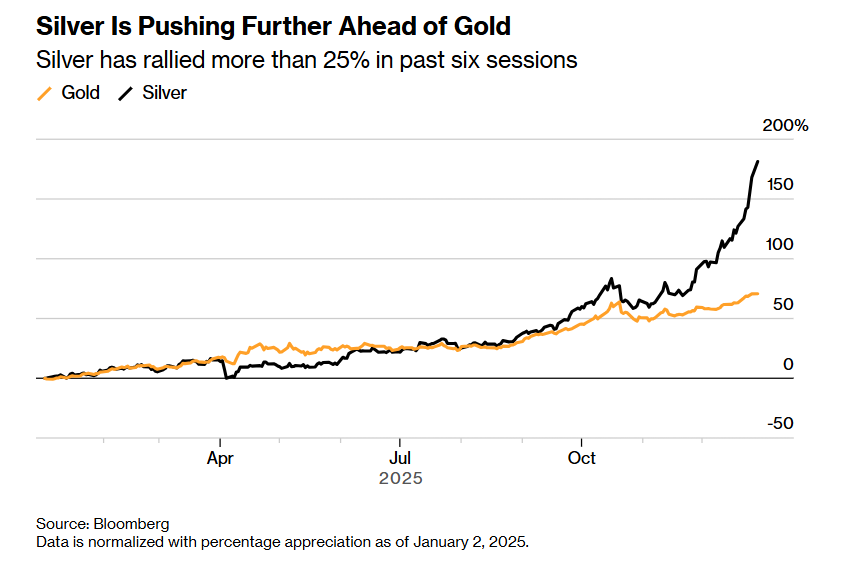
Core Viewpoint - Silver prices have surged to record highs, surpassing $80 per ounce for the first time, driven by speculative trading and supply shortages, with a notable increase of 165% year-to-date [1][4]. Group 1: Price Movements and Market Dynamics - Silver reached an all-time high of $84 per ounce before experiencing a sharp decline, highlighting the volatility driven by profit-taking among speculative investors [1]. - The recent six-day rally in silver prices has resulted in a cumulative increase of approximately 25%, marking the largest six-day gain since 1950 [1]. - The price of silver has been influenced by significant inflows of speculative funds and a supply mismatch in global commodity markets [1]. Group 2: Supply and Demand Factors - The silver market has been in a structural deficit for five consecutive years, with physical inventories rapidly depleting, leading to a supply squeeze [7]. - In 2025, global silver demand is projected to reach 1.24 billion ounces, while supply is expected to be only 1.01 billion ounces, resulting in a supply gap of 100 to 250 million ounces [7]. - The primary reason for the supply constraints is the rigid nature of global mining supply, as silver is often a byproduct of copper and zinc mining, and new mines take over a decade to develop [7]. Group 3: Investment Sentiment and Future Projections - Analysts suggest that the current surge in silver prices is driven by macroeconomic factors, including expectations of further interest rate cuts by the Federal Reserve, tight supply conditions, and strong industrial demand narratives [8]. - The World Silver Association highlights that the growth in demand for silver is supported by trends in AI data centers, electrification, and the transition to electric vehicles, with significant growth rates projected for these sectors [8][9]. - Some analysts predict that silver could reach $100 per ounce, driven by ongoing industrial demand and investment flows, with expectations of continued price increases until at least 2026 [10].
高速率光芯片前景广阔,看好光芯片景气周期
GOLDEN SUN SECURITIES· 2025-12-28 11:18
Investment Rating - The report maintains a "Buy" rating for the industry, specifically highlighting the potential of high-speed optical chips and the favorable market conditions for optical modules [5]. Core Insights - The optical chip market is expected to experience significant growth driven by AI demand, with the global EML laser chip market projected to reach 3.71 billion yuan in 2024 and grow to 7.412 billion yuan by 2030, reflecting a compound annual growth rate (CAGR) of 12.23% [1][27]. - The demand for optical modules is on the rise, with the global Ethernet optical module market expected to grow by 35% to 18.9 billion USD in 2026, and further double-digit growth anticipated from 2027 to 2030, potentially exceeding 35 billion USD by 2030 [3]. - The report emphasizes the critical role of optical chips in optical modules, which are essential for high-speed data transmission in various applications, including data centers and telecommunications [12][13]. Summary by Sections Section 1: Optical Chips - Optical chips are the core components of optical modules, essential for converting optical signals and determining transmission efficiency in communication systems [12]. - The EML laser chip, a high-end product, is in high demand due to its capabilities in long-distance and high-speed data transmission, particularly in AI applications [24][26]. - The market for EML chips is currently dominated by a few international giants, including Lumentum and Coherent, with domestic manufacturers striving to increase their market share through technological advancements [27][38]. Section 2: Silicon Photonic Modules - Silicon photonic modules are characterized by high integration, low power consumption, and cost-effectiveness, which are driving the demand for continuous wave (CW) lasers [2]. - The transition to higher data rates (800G/400G) necessitates the use of advanced laser chips, further boosting the demand for CW lasers [2]. Section 3: Market Dynamics - The report indicates a tight supply-demand situation for optical chips, driven by the increasing demand for optical modules in AI infrastructure and cloud computing [3]. - Major companies like Coherent and Lumentum are expanding their production capacities to meet the growing demand for high-speed optical components [6][7]. - The report highlights the expected growth in the optical module market, with significant contributions from AI-driven applications and the expansion of data center networks [3][28]. Section 4: Key Companies - Coherent is experiencing strong growth in demand for its 800G and 1.6T transceiver orders, with plans to double its production capacity in the coming year [5][6]. - Lumentum has reported record shipments of EML lasers, driven by demand for 100Gbps and 200Gbps products, and is expanding its production capacity to meet future needs [6][7]. - Tower Semiconductor is also seeing significant revenue growth from silicon photonic products, with plans for substantial capacity expansion [8].