江苏银行

Search documents
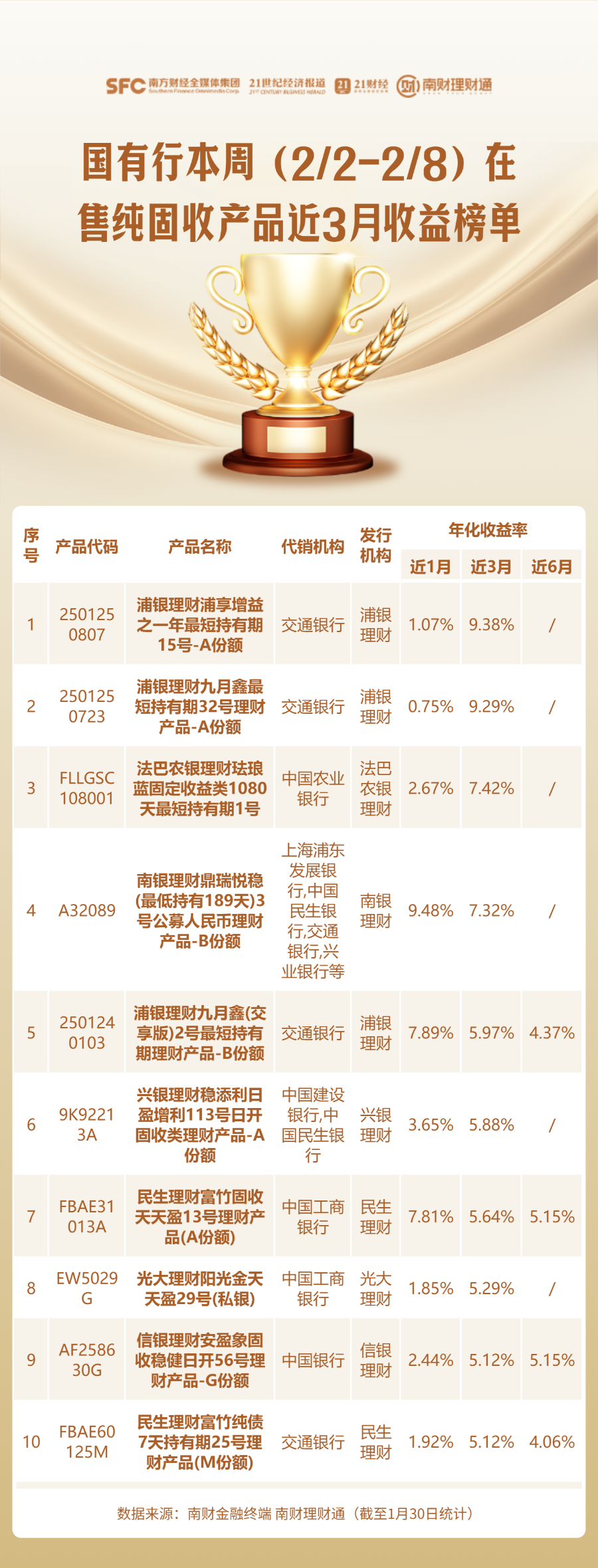
各银行在售高收益纯固收产品一览!合资理财子产品首次上榜
2 1 Shi Ji Jing Ji Bao Dao· 2026-02-02 09:13
Core Insights - The report focuses on the performance of pure fixed-income products issued by wealth management companies, highlighting the best-performing products available for sale through various distribution channels [1][4] Group 1: Product Performance - The ranking of products is based on their annualized returns over the past month, three months, and six months, with a particular emphasis on the three-month annualized yield to reflect their performance amid recent market fluctuations [1] - A total of 28 distribution institutions are involved, including major banks such as Industrial and Commercial Bank of China, Bank of China, Agricultural Bank of China, and others [1] Group 2: Product Availability - The list of products is categorized as "available for sale," but actual availability may vary due to factors such as sold-out quotas or differences in product listings shown to different customers by banks [1] - Investors are advised to refer to the actual displays on the distribution bank's app for the most accurate information regarding product availability [1] Group 3: Data Source - The data presented in the report is sourced from the Nanfang Financial Terminal and Nanfang Wealth Management, with statistics as of January 30 [3][5]







上证指数收跌2.48%,险守4000点,银行ETF逆势收红
Ge Long Hui A P P· 2026-02-02 08:10
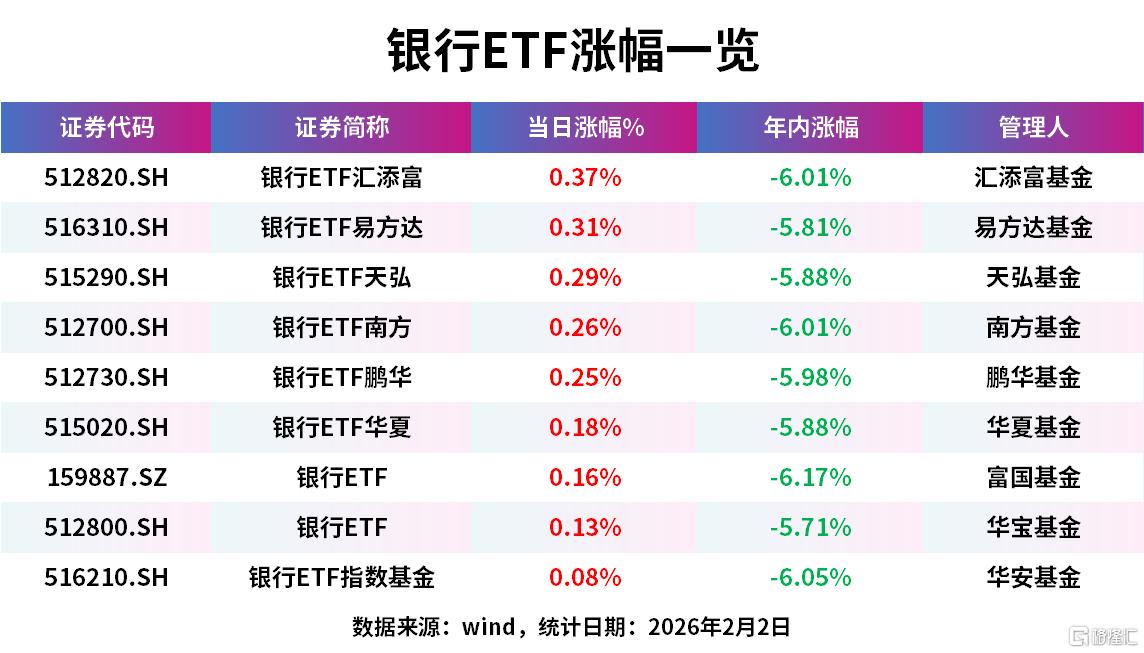
Market Overview - The Shanghai Composite Index fell by 2.48%, narrowly holding above the 4000-point mark, while the ChiNext Index dropped by 2.46%. A significant decline was observed in sectors such as gold and non-ferrous metals, with resource stocks including oil, coal, steel, and chemicals experiencing widespread losses. Conversely, high-voltage concept stocks, liquor stocks, and bank stocks showed resilience, with over 4600 stocks declining overall [1]. ETF Performance - Several bank ETFs, including those managed by Huatai-PB, E Fund, Tianhong, Southern, Penghua, and Huaxia, saw gains despite the overall market downturn. The performance of these ETFs ranged from a 0.08% to 0.37% increase, although their year-to-date performance remains negative, with declines between 5.71% and 6.17% [3]. Fund Holdings Analysis - By the end of 2025, actively managed equity funds held a total market value of 1.61 trillion yuan in A-shares, with 30.367 billion yuan allocated to the banking sector, representing 1.89% of the total. This allocation is below the historical averages of 3.02% and 3.89% over the past 5 and 10 years, respectively. The proportion of active funds in the banking sector remained stable at 1% [5]. Individual Bank Holdings - The concentration of holdings among individual banks has decreased, with the top five banks—China Merchants Bank, Ningbo Bank, Chongqing Rural Commercial Bank, Jiangsu Bank, and Industrial and Commercial Bank of China—accounting for 57.6% of the total holdings. There were 23 banks with increased holdings and 15 banks with decreased holdings in the fourth quarter [5]. Investment Outlook - According to Xinyi Securities, the banking sector may face selling pressure due to net outflows from broad-based ETFs. However, the impact is expected to ease as the banking index has returned to its low point from the third quarter of 2025. Many quality stocks are now considered to have high cost-performance ratios, with projected dividend yields for major state-owned banks in 2026 expected to rise to between 4.4% and 5%, and some quality regional banks exceeding 6% [6]. Long-term Investment Strategy - Huachuang Securities emphasizes the importance of long-term capital inflows and public fund reforms, suggesting that the banking sector remains under-allocated. The expectation for 2026 is a systematic recovery in bank valuations, transitioning from defensive to a balanced approach. The investment logic for bank stocks is anticipated to shift from purely dividend defense to a dual focus on dividends and growth [7]. Key investment themes include state-owned banks and quality regional banks benefiting from regional policies and improved performance [7].
兴业银行25年中期分红派发在即,银行ETF天弘(515290)标的指数盘中涨超1%,近10日净流入1.45亿元
Sou Hu Cai Jing· 2026-02-02 06:32
Core Viewpoint - The banking ETF Tianhong (515290) has shown significant growth in both scale and net inflow, indicating strong investor interest in the banking sector, particularly in light of the upcoming operational strategies for 2026 and the performance of constituent banks [2][3][9]. Group 1: ETF Performance - As of February 2, 2026, the banking ETF Tianhong (515290) recorded a transaction volume of 46.018 million yuan, with the tracked CSI Bank Index (399986) rising over 1% [1]. - In the week leading up to January 30, 2026, the banking ETF Tianhong (515290) saw a scale increase of 70.4748 million yuan and a share increase of 36.3 million shares [2]. - Over the past 10 days, the banking ETF Tianhong (515290) has accumulated a net inflow of 145 million yuan [3]. Group 2: Product Highlights - The banking ETF Tianhong (515290) tracks the CSI Bank Index and includes 42 listed banks in A-shares, with nearly 30% of its holdings in major state-owned banks like ICBC, ABC, and CCB, focusing on high dividend opportunities [4]. - Approximately 70% of the ETF's holdings are in high-growth joint-stock banks, city commercial banks, and rural commercial banks, making it an efficient investment tool for tracking the overall banking sector [4]. Group 3: Key Events - On February 2, 2026, Industrial Bank announced a cash dividend of 5.65 yuan per 10 shares, totaling approximately 11.957 billion yuan, as part of its 2025 interim profit distribution plan [6]. - The bank's 2025 annual performance report indicated a dual increase in revenue and net profit, with total assets surpassing 11 trillion yuan [7]. Group 4: Industry Outlook - The 2026 banking industry management meetings emphasized serving the real economy, optimizing business structures, enhancing risk control, and advancing digital transformation, with a focus on "seeking progress while maintaining stability" [8]. - Huachuang Securities highlighted that the banking sector remains under-allocated, predicting a systemic recovery in valuations for 2026, transitioning from a defensive to a dual-driven growth model [9].
信用债市场周观察:关注CRMW一级发行定价机会
Orient Securities· 2026-02-02 03:43
Report Industry Investment Rating - Not mentioned in the provided content Core Viewpoints of the Report - In the second half of 2025, CRMW products were issued intensively in conjunction with private enterprise science and technology innovation bonds, with obvious cost - reduction and credit - enhancement effects. Currently, there is little room for participation in the secondary market. It is recommended to focus on the pricing opportunities during the primary issuance of new products. The "underlying bond + CRMW" combination under the strong guarantee of large - scale national and joint - stock banks has valuation advantages, and institutions with stable liability ends such as proprietary trading can hold them until maturity [5]. - When classified by creation entities, special attention should be paid to CRMW created by joint - stock banks [5]. Summary According to Relevant Catalogs 1. Credit Bond Weekly Viewpoint: Focus on the Pricing Opportunities of CRMW Primary Issuance - CRMW is an important credit - enhancement product. In 2025, over a hundred CRMW were created by various institutions, a slight reduction from 2024. Nearly 40% of the protected underlying bonds were science and technology innovation bonds, and the protected issuers were mostly technology - based private enterprises. Commercial banks are the mainstream creation institutions, while securities companies have rarely participated since 2024, and guarantee companies such as Zhongyu Guarantee and Zhongzhai Zengxin have been active [9]. - It is difficult to participate in the secondary market of CRMW. The focus should be on the primary issuance, especially the CRMW created by joint - stock banks. The average maturity of recently issued underlying bonds is about 2 years, and the maturity considering the exercise right is generally no more than 3 years, which meets the preferences of mainstream institutions [15]. - By creation entity types: - State - owned banks: Since 2024, the frequency of state - owned banks creating CRMW has declined. The credit spread of the "CRMW + underlying bond" investment portfolio created by state - owned banks is generally low, with most spreads around 40bp since Q4 2025, and there is no excess return compared to mainstream urban investment/industrial bonds [15][17]. - Joint - stock banks: Banks such as China Zheshang Bank have created a relatively large number of CRMW. The credit spread of the "CRMW + underlying bond" investment portfolio is around 70bp, and the absolute return can exceed 2.4%, which is very attractive in a low - return environment. The higher return mainly comes from the higher coupon rate of the protected underlying bonds, and there is sufficient safety margin under the strong guarantee of CRMW [25]. - City commercial banks: Banks such as Dongguan Bank and Qingdao Bank are the main creation institutions. The returns of their "CRMW + underlying bond" portfolios are more differentiated, and the recent returns are mainly in the range of 2.1% - 2.2%, with limited attractiveness [25]. - Rural commercial banks: Only Shanghai Rural Commercial Bank participates, and the overall return of the portfolio is not high due to the strong credit quality of the credit - enhancement subject [25]. - Guarantee companies: Zhongyu Guarantee and Zhongzhai Zengxin have created a small number of CRMW in the past two years. The returns are scattered, and the "underlying bond + CRMW" portfolio has a slightly higher return due to weak liquidity, which is suitable for institutions with stable liability ends and high - risk preferences to hold until maturity [23][26]. - Secondary market opportunities are mainly concentrated in the "underlying bond + CRMW" portfolio with a maturity of less than 1 year. The primary market is the main way to participate, while the secondary market has weak liquidity. The short - term portfolio with a maturity of less than 1 year and a return of over 2.1% created by state - owned banks and strong joint - stock banks has cost - effectiveness [28]. 2. Credit Bond Weekly Review: The Enthusiasm for Medium - Term Bond Mining Continues 2.1 Negative Information Monitoring - There were no bond defaults, overdue payments, downgrades of issuer or bond ratings, or overseas rating downgrades during the week from January 26 to February 1, 2026. However, there were significant negative events for companies such as Sunshine City Group, Country Garden Real Estate Group, and Rongqiao Group [31][33]. 2.2 Primary Issuance: Net Financing Remains High, and Financing Costs Fluctuate Narrowly - The new issuance scale of credit bonds remained high, the maturity volume decreased, and the net financing remained high. From January 26 to February 1, 2026, the primary issuance of credit bonds was 307.4 billion yuan, a slight decrease from the previous period. The total repayment was 151.7 billion yuan, a 19% decrease from the previous period, and the net financing was 155.7 billion yuan [34]. - The number and scale of cancelled or postponed bond issuances remained at a low level. The financing costs of medium - and high - grade bonds fluctuated slightly. The average coupon rates of AAA and AA+ grades were 2.12% and 2.24% respectively, with a month - on - month increase of 9bp and a decrease of 7bp [35]. 2.3 Secondary Trading: Valuations Fluctuated Slightly, and 3 - year Bonds Outperformed Relatively - The valuations of credit bonds of various grades and maturities were mostly flat compared to the previous period, except for a 3bp decline in the 3 - year medium - and low - grade bonds. The risk - free interest rate fluctuated slightly, and the credit spreads were mostly flat. The term spreads of 3Y - 1Y and 5Y - 1Y of various grades almost all narrowed, with an average of about 2bp, and the AA - grade 3Y - 1Y narrowed by up to 4bp. The AA - AAA grade spread of the 3 - year bond narrowed by 4bp [37][40]. - The credit spreads of urban investment bonds in various provinces narrowed slightly, with an average narrowing of about 2bp, and the spreads in Heilongjiang and Yunnan narrowed the most. The credit spreads of industrial bonds fluctuated within ±1bp, significantly underperforming urban investment bonds, and the real estate sector widened by 3bp [42][43]. - The weekly turnover rate decreased by 0.18 percentage points to 1.85%. The issuers of the top - ten turnover bonds were mostly central and state - owned enterprises. The issuers of credit bonds with a discount of more than 10% in trading were mainly related to Country Garden, Vanke, and AVIC Industry Finance [45]. - The distribution of urban investment bonds with the largest narrowing or widening of spreads was scattered. Among industrial bonds, the top five issuers with widening spreads were mostly real - estate companies, including Times Holdings, Rongqiao, Yuzhou Hongtu, and Greenland [47][48].
以“四季市集+全域联动”构建文旅消费升级新范式 “镇有好市”,这里邀您过大年
Zhen Jiang Ri Bao· 2026-02-01 23:49
"镇有好市"以谐音双关,寓意"镇有好事""镇游好市",将城市情感价值与市集这一具体业态紧密结 合,以口语化表达强化城市记忆点,迅速建立起"镇江=活力市集"的公众认知,使市集成为一张鲜活、 亲切、可持续发展的文旅新名片。活动以"4+11+N"作为年度运营架构,4场四季主题链接四季促消费重 点活动;11场赛会配套市集,在场馆周边、观演动线布置轻量化、主题化的市集,引入面超、非遗、咖 啡、农创产品等主题;力争全年超100场主题市集深入街区、商圈、乡村,真正让"镇有好市"扎根市民 身边、融入游客动线、服务产业所需。 多元互动:从"赶集购物"到"文旅体验" "为了给这次市集活动做好充分准备,我们前天就到了镇江,这次带来1300斤橙子做品牌宣传推 广,有脐橙、红心橙、沃柑、黄心柑这些品种,你可以尝尝!"活动主会场显眼位置即是永州道县的农 产品展示摊位,道县祥霖铺镇的种植户黄敬热情地向记者介绍。 市集闹古渡,年味满西津。2月1日,由市文广旅局、市商务局、市农业农村局、润州区政府主办, 润州区文体旅局、润州区商务局、西津渡公司承办,市总工会、江苏银行镇江分行、江苏恒顺集团、市 邮政管理局支持的2026"镇有好市·邀您过大年" ...
【金工】市场交易情绪回落——金融工程市场跟踪周报20260131(祁嫣然/张威)
光大证券研究· 2026-02-01 23:03
点击注册小程序 查看完整报告 特别申明: 截至2026年1月30日,宽基指数来看,中证500、中证1000、创业板指处于估值分位数"适中"等级,上证指 数、上证50、沪深300处于估值分位数"危险"等级。 中信一级行业分类来看,食品饮料、非银行金融处于估值分位数"安全"等级。 截面波动率来看,沪深300、中证500、中证1000指数成分股横截面波动率环比前一周上升,短期Alpha环 境好转。 时间序列上来看,最近一周沪深300指数成分股时间序列波动率环比前一周上升,Alpha环境好转;中证 500中证指数成分股时间序列波动率环比前一周无变化,Alpha环境保持不变;1000指数成分股时间序列波 动率环比前一周下降,Alpha环境恶化。 资金面跟踪: 本订阅号中所涉及的证券研究信息由光大证券研究所编写,仅面向光大证券专业投资者客户,用作新媒体形势下研究 信息和研究观点的沟通交流。非光大证券专业投资者客户,请勿订阅、接收或使用本订阅号中的任何信息。本订阅号 难以设置访问权限,若给您造成不便,敬请谅解。光大证券研究所不会因关注、收到或阅读本订阅号推送内容而视相 关人员为光大证券的客户。 报告摘要 本周市场核心观点: ...

破体育赞助壁垒,筑融通共赢生态
Xin Lang Cai Jing· 2026-02-01 20:19
转自:中华工商时报 2026年江苏省城市足球联赛(简称"苏超")商务方案日前发布,在敲定24家官方合作伙伴的同时,推出 小微企业专项遴选计划,为各地通过特色产业资源优化民营经济发展环境、激发经营主体活力提供了极 具价值的江苏探索。 长期以来,小微经营主体普遍面临营销预算有限、高端传播渠道匮乏、品牌曝光机会稀缺的发展痛点, 即便有品牌升级的需求,也难以切入体育赛事这类高价值传播场景。本届苏超打破体育赛事赞助领域 的"规模壁垒",设置5万元的省级赞助门槛、各设区市不高于5万元的赛区赞助门槛,同时划定省级32 家、各赛区2家的遴选规模,让街头小店、本土小微商户能以"小投入"登上省级体育IP的舞台。公证摇 号的方式更保障了各类经营主体平等参与,让体育产业红利真正下沉至民营经济最基层。 (来源:中华工商时报) 苏超赛事推动形成了大中小微企业融通发展的良好生态。今年苏超构建起"大企业引领、骨干企业支 撑、小微经营主体参与"的赞助体系,江苏银行、苏豪控股等本土大企业提供核心支撑,海澜之家等骨 干企业提升赛事影响力,小微经营主体则注入了本土烟火气。大企业品牌优势与小微经营主体本土优势 互补,既助力小微经营主体触达本地消费群体 ...
“南京味道”惊艳“我是厨神”
Xin Lang Cai Jing· 2026-02-01 17:15
(来源:南京晨报) 转自:南京晨报 "厨神·新春团圆宴"。 南京市商务局供图 作为本次活动的核心消费体验区,市集以"回家路"为动线设计,集结超200家商户,展销全省各地及来 自湖南永州市的特色年味美食、优质年货及绿色农产品,营造浓厚的"来宁赶集""热闹过年"氛围。活动 首天,场馆人流量超1.5万人次,预计首日销售额破60万元。 通讯员 宁商轩 南京晨报/爱南京记者 黄益 金磊 记者从南京市商务局获悉,南京厨神战队由金陵饭店夏万峰、古南都饭店刘家祥、小厨娘集团刘峰、寻 魏·金陵十二菜魏学林、大惠企业许宁5位名厨组成,分别带来南京盐水鸭、素什锦、炖生敲、蟹粉虾仁 年年高以及秦淮八绝等参赛菜品。大赛比拼现场,精菜馆主厨许宁端上他的作品"琥珀酥骨龙池鲫鱼 冻",一眼惊艳。鱼肉被封在琥珀般的皮冻里,宛如还在水里游,许师傅讲解说,用鱼冻来包裹鱼肉, 就像是包裹住了时光和新鲜,好吃好看。 "我是厨神·新春团圆宴"发布仪式回顾了"我是厨神"系列赛事活动,发布了"十大美食街区""百道菜""厨 神·新春团圆宴"等成果,邀请"苏超"球员和南京都市圈为江苏美食打Call,开展了"团圆宴"大礼包及 2026年"苏超"观赛资格抽奖发布等 ...
多行业联合红利资产1月报:红利内部轮动模型:迈向周期与制造-20260201
Huachuang Securities· 2026-02-01 12:42
证 券 研 究 报 告 【策略月报】 红利内部轮动模型:迈向周期与制造 ——多行业联合红利资产 1 月报 策略研究 策略月报 2026 年 02 月 01 日 华创证券研究所 证券分析师:姚佩 邮箱:yaopei@hcyjs.com 执业编号:S0360522120004 证券分析师:吴一凡 邮箱:wuyifan@hcyjs.com 执业编号:S0360516090002 证券分析师:徐康 电话:021-20572556 邮箱:xukang@hcyjs.com 执业编号:S0360518060005 证券分析师:马野 邮箱:maye@hcyjs.com 执业编号:S0360523040003 相关研究报告 《【华创策略】杠杆&ETF 资金分化趋势逆转—— 流动性&交易拥挤度&投资者温度计周报》 2025-12-01 《【华创策略】自媒体 A 股搜索热度重回高位— —流动性&交易拥挤度&投资者温度计周报》 2025-11-25 《【华创策略】60 日均线的机遇挑战——策略周 聚焦》 2025-11-23 《【华创策略】股票型 ETF 为当前流入主力—— 流动性&交易拥挤度&投资者温度计周报》 2025-11-1 ...
金融风向标2026-W04:不一样的“开门红”
CMS· 2026-02-01 12:31
Investment Rating - The report maintains a positive outlook on the banking sector, indicating a potential for stabilization and improvement in operational pressures for banks in 2026 [2][5]. Core Insights - The banking sector has shown a "double opening red" phenomenon in both deposits and loans, with a structural difference in credit allocation. The signs of "deposit migration" are not significant, suggesting a stable deposit base [2][5]. - The total assets of the banking industry reached 471 trillion yuan by the end of 2025, reflecting an 8.0% year-on-year growth. Major banks, joint-stock banks, city commercial banks, and rural commercial banks reported asset growth rates of 11.0%, 4.7%, 9.7%, and 5.2%, respectively [3][14]. - The overall net interest margin is expected to decline further, but at a slower pace, indicating some relief in operational pressures. The banks have passed the phase of accelerated risk exposure and are nearing a "stock digestion period" [5][6]. Summary by Sections Regulatory Dynamics - The Financial Regulatory Bureau released data on the total assets and liabilities of the banking sector for 2025, showing a total asset growth of 8.0% year-on-year [3][14]. Industry Dynamics - Qingdao Bank and Xiamen Bank reported their 2025 performance, with Qingdao Bank achieving a net profit growth of 21.66% and an asset quality improvement, while Xiamen Bank also reported significant growth in total assets and loans [15][16]. Market Dynamics - The overall A-share market saw a decline of 1.59%, while the banking sector increased by 0.86%, indicating a defensive characteristic of the banking stocks [2][18]. Data Overview - The report highlights the central bank's net injection of 0.4 trillion yuan and the mixed movement of interest rates across different maturities, with short-term rates showing slight declines and long-term rates experiencing mixed trends [4][21][23].