吉利汽车

Search documents
2025年车市收官:当中国豪华品牌站上50万元赛道,极氪做对了什么?
Ge Long Hui· 2026-01-05 09:32
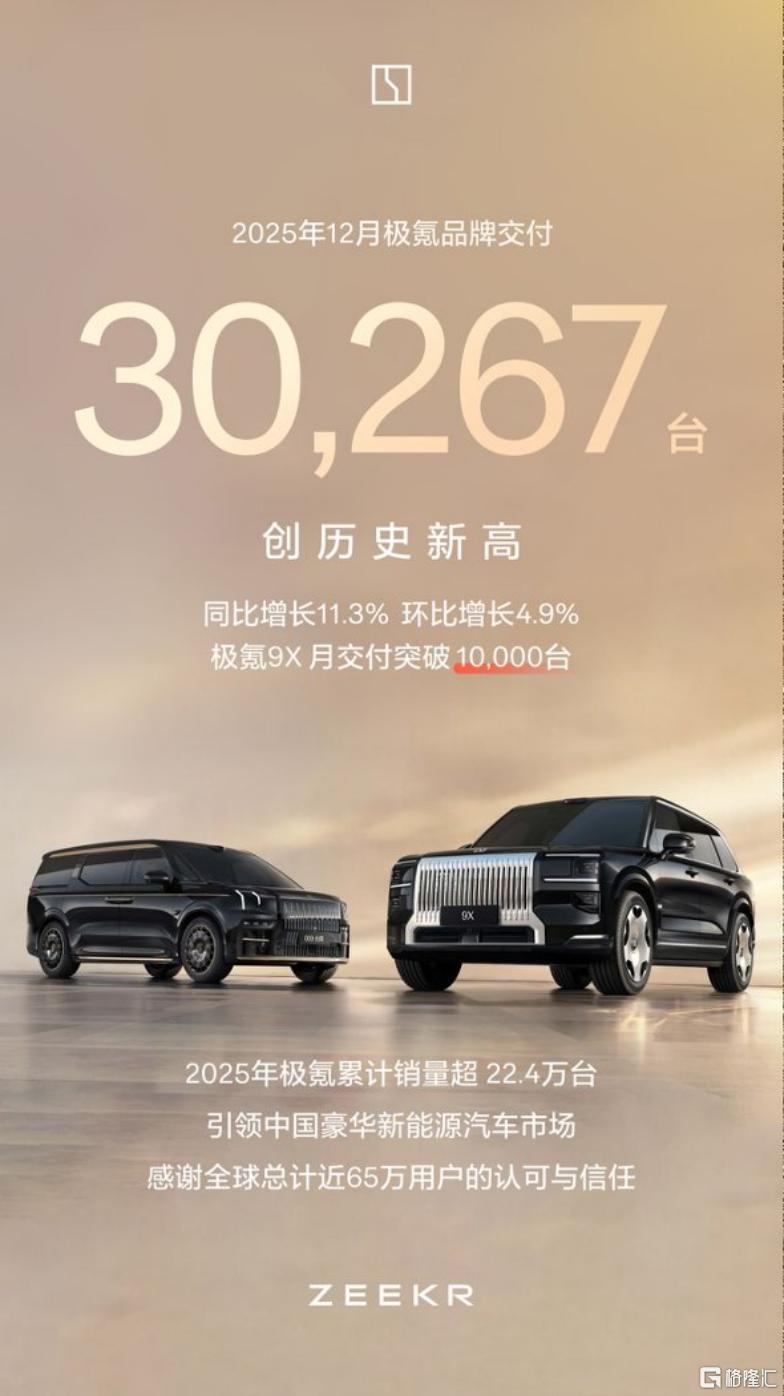
Core Insights - The Chinese automotive industry has shown strong performance in 2025, with Geely and BYD leading the growth in the electric vehicle market, while high-end breakthroughs are essential for the industry's transition from large to strong [1] - Zeekr's impressive performance, with total deliveries of 224,133 units in 2025 and a record monthly sales of over 30,000 units in December, highlights the brand's successful penetration into the high-end market [1][6] Group 1: Market Performance - Zeekr 9X has become a phenomenon in the market, achieving over 10,000 units sold in December and a significant average selling price of 538,000 yuan, marking it as the first Chinese brand to reach this milestone in its price segment [6] - 80% of Zeekr 9X users are from traditional luxury brands, indicating its strong penetration into the high-end fuel vehicle market [6] Group 2: Brand Strategy - Zeekr's growth is attributed to its focus on high-value models, avoiding the short-sighted strategy of competing solely on price, and enhancing its product structure to increase the proportion of high-value models [7] - The brand has established a strong luxury image, becoming the official vehicle for major events and attracting high-profile owners, which reinforces its position in the high-end market [7] Group 3: Technological and Structural Advantages - Zeekr's success is supported by its long-term focus on the luxury segment and the backing of Geely's global R&D capabilities, which help overcome technical and cost challenges [9] - The brand's independent operation post-privatization allows for agile responses to market changes, while its user-centric approach enhances customer trust and loyalty [11] Group 4: Future Outlook - With the expected tax reductions in 2026, market competition is anticipated to intensify, focusing on product quality, technology, and brand value, where Zeekr's technological reserves and brand image position it favorably [12] - Zeekr aims to launch more high-end products in 2026, further solidifying its market presence and contributing to the global recognition of Chinese luxury brands [12]

东方证券:维持吉利汽车买入评级 目标价23.02港元
Zhi Tong Cai Jing· 2026-01-05 09:28
Core Viewpoint - Geely Automobile is leveraging a "dual-fuel" strategy to mitigate the impact of declining new energy subsidies and is accelerating its overseas expansion, targeting an export volume of 1 million units by 2027 [1][2]. Sales Performance - In December, Geely's total sales reached 236,800 units, a year-on-year increase of 12.7%, with new energy vehicle (NEV) sales at 154,300 units, up 38.7% [1]. - For 2025, Geely's total sales are projected to be 3,024,600 units, reflecting a 39.0% year-on-year growth, achieving its annual sales target [1]. - The company aims for sales of 3,450,000 units in 2026, representing a 14.1% increase, supported by a sustainable subsidy policy and an expanding product matrix [1]. Dual-Fuel Strategy and International Expansion - Geely's brand sales in December reached 172,800 units, a 10.2% increase, with NEV sales at 1,687,800 units for 2025, marking a 90.0% year-on-year growth [2]. - The company plans to sell 2,220,000 NEVs in 2026, a 31.5% increase, to counteract the effects of subsidy reductions [2]. - Geely's exports in December totaled 40,300 units, a 49.0% increase, with total annual exports at 420,100 units, up 1.3% [2]. - The company is expanding into 13 new markets, including the UK, Italy, and Brazil, with significant progress in its factories in Egypt and Indonesia [2]. High-End Brand Development - In December, sales for the Zeekr and Lynk & Co brands were 30,300 and 33,800 units, respectively, showing increases of 11.3% and 29.4% [3]. - The Zeekr 9 model has become the best-selling large SUV priced above 500,000 yuan, while the Lynk & Co 900 has sold over 50,000 units within six months of its launch [3]. - The company aims for Lynk & Co sales of 400,000 units in 2026, a 14.1% increase, and Zeekr sales of 300,000 units, a 33.8% increase [3]. Profit Forecast and Investment Recommendation - The forecasted net profit attributable to shareholders for 2025, 2026, and 2027 is 17.041 billion, 20.604 billion, and 24.318 billion yuan, respectively [4]. - The target price is set at 20.79 yuan per share, equivalent to 23.02 HKD, maintaining a buy rating [4].

科网股分化,快手涨超11%,汽车股下挫,蔚来跌近6%
2 1 Shi Ji Jing Ji Bao Dao· 2026-01-05 09:28
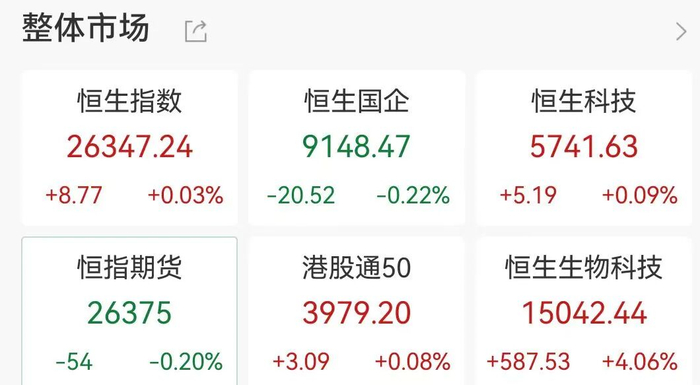
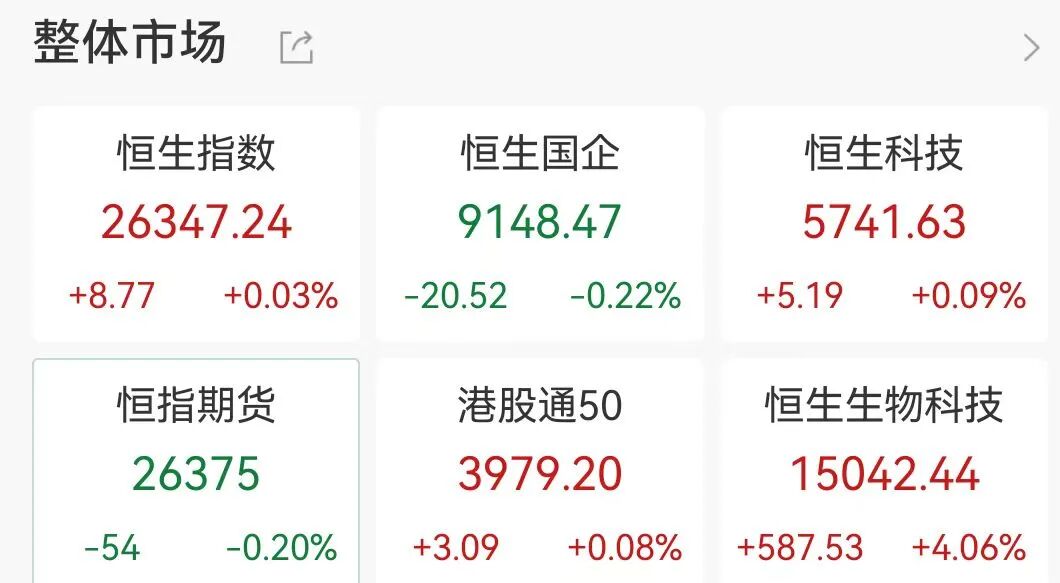
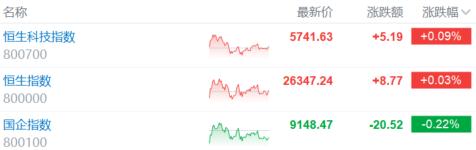
Market Overview - The Hong Kong stock market showed a narrow fluctuation today, with the Hang Seng Index slightly up by 0.03% to close at 26,347.24, while the Hang Seng China Enterprises Index fell by 0.22% to 9,148.47, and the Hang Seng Tech Index increased by 0.09% to 5,741.63 [1][2]. Technology Sector - The technology sector exhibited mixed performance, with Kuaishou rising over 11%, Bilibili increasing by over 4%, Alibaba up by over 2%, while NetEase and Xiaomi both dropped by over 2% [2]. Automotive Sector - The automotive stocks faced significant declines, with NIO down nearly 6%, XPeng Motors falling over 4%, and Li Auto dropping over 3%. Great Wall Motors also saw a decline of over 6% [4]. Biopharmaceutical Sector - The biopharmaceutical sector saw gains, with Rongchang Biopharmaceutical rising over 7%. The China Drug Evaluation Center (CDE) indicated that by December 31, 2025, 76 innovative drugs are expected to be approved, surpassing the 48 approved in 2024, marking a historical high [4]. Real Estate Sector - The real estate sector showed strength, with China Rongxin rising over 6% [5]. Brain-Computer Interface Sector - The brain-computer interface concept surged, with Nanjing Panda Electronics rising over 39%. Elon Musk announced that his company Neuralink plans to begin large-scale production of brain-computer interface devices in 2026 [5]. Oil Sector - The oil sector weakened, with PetroChina declining by over 3%. This follows reports of U.S. military actions against Venezuela, with plans for U.S. oil companies to invest billions in repairing Venezuela's oil infrastructure while maintaining an oil embargo [5].

瑞达期货铝类产业日报-20260105
Rui Da Qi Huo· 2026-01-05 09:14
1. Report Industry Investment Rating - No relevant content provided 2. Core Viewpoints of the Report - The alumina market may be in a stage of slightly converging supply and stable demand, suggesting light - position oscillatory trading [2]. - The Shanghai aluminum market may be in a stage of slightly increasing supply and off - season demand, with aluminum prices maintaining high - level oscillations due to positive macro expectations. It is recommended to go short - term long at low prices with a light position [2]. - The cast aluminum alloy market may be in a stage of converging supply and weakening demand, and light - position oscillatory trading is suggested [2]. 3. Summary by Related Catalogs 3.1 Futures Market - The closing price of the Shanghai aluminum main contract was 23,645 yuan/ton, up 720 yuan; the closing price of the alumina futures main contract was 2,770 yuan/ton, down 8 yuan [2]. - The LME electrolytic aluminum three - month quotation was 3,021 US dollars/ton, up 24 US dollars; the LME aluminum inventory was 509,250 tons, down 2,500 tons [2]. - The closing price of the cast aluminum alloy main contract was 22,520 yuan/ton, up 665 yuan; the registered warehouse receipts of the cast aluminum alloy on the Shanghai Futures Exchange were 69,620 tons, up 32 tons [2]. 3.2 Spot Market - The price of Shanghai Non - Ferrous Network A00 aluminum was 23,310 yuan/ton, up 850 yuan; the spot price of alumina in Shanghai Non - Ferrous was 2,610 yuan/ton, unchanged [2]. - The average price (tax - included) of ADC12 aluminum alloy ingots nationwide was 23,100 yuan/ton, up 650 yuan; the price of Yangtze River Non - Ferrous Market AOO aluminum was 22,520 yuan/ton, up 820 yuan [2]. 3.3 Upstream Situation - Alumina production in the current month was 813.80 million tons, up 27.30 million tons; the demand for alumina (electrolytic aluminum part) in the current month was 705.96 million tons, down 24.27 million tons [2]. - The average price of crushed raw aluminum in Foshan metal scrap was 17,500 yuan/ton, up 150 yuan; the average price of crushed raw aluminum in Shandong metal scrap was 17,050 yuan/ton, up 150 yuan [2]. 3.4 Industry Situation - The import volume of primary aluminum was 146,109.72 tons, down 101,652.54 tons; the export volume of primary aluminum was 53,047.69 tons, up 28,474.13 tons [2]. - The production of aluminum products was 593.10 million tons, up 23.70 million tons; the export volume of unwrought aluminum and aluminum products was 57.00 million tons, up 7.00 million tons [2]. 3.5 Downstream and Application - The production of recycled aluminum alloy ingots was 70.00 million tons, up 9.17 million tons; the export volume of aluminum alloy was 3.06 million tons, down 0.03 million tons [2]. - The automobile production was 351.90 million vehicles, up 24.00 million vehicles; the national real estate climate index was 91.90, down 0.52 [2]. 3.6 Option Situation - The historical volatility of Shanghai aluminum for 20 days was 17.05%, up 3.38%; the historical volatility for 40 days was 13.95%, up 1.88% [2]. - The implied volatility of the at - the - money option of the Shanghai aluminum main contract was 21.6%, up 0.0295; the call - put ratio of Shanghai aluminum options was 1.69, down 0.1008 [2]. 3.7 Industry News - In December 2025, China's manufacturing PMI, non - manufacturing PMI, and comprehensive PMI were 50.1%, 50.2%, and 50.7% respectively, up 0.9, 0.7, and 1.0 percentage points month - on - month [2]. - In 2025, the sales volume of trade - in related commodities nationwide exceeded 2.6 trillion yuan, benefiting more than 360 million people [2]. - The final value of the eurozone's manufacturing PMI in December 2025 was 48.8, with the expected and previous values both being 49.2 [2]. - Multiple car companies announced their December 2025 and full - year results. BYD's new - energy vehicle sales in December 2025 were 420,398 units, a year - on - year decline of about 18.2%; the full - year cumulative sales were 4,602,436 units, a year - on - year increase of 7.73% [2].
瑞达期货碳酸锂产业日报-20260105
Rui Da Qi Huo· 2026-01-05 09:11
| 项目类别 | 数据指标 | 最新 | 环比 数据指标 | 最新 | 环比 | | --- | --- | --- | --- | --- | --- | | | 主力合约收盘价(日,元/吨) | 129,980.00 | +8400.00↑ 前20名净持仓(日,手) | -126,463.00 | +11322.00↑ | | 期货市场 | 主力合约持仓量(日,手) | 515,292.00 | +25098.00↑ 近远月合约价差(日,元/吨) | -2,400.00 | -1180.00↓ | | | 广期所仓单(日,手/吨) | 20,281.00 | 0.00 | | | | 现货市场 | 电池级碳酸锂平均价(日,元/吨) | 119,500.00 | +1000.00↑ 工业级碳酸锂平均价(日,万元/吨) | 117,000.00 | +1500.00↑ | | | Li₂CO₃主力合约基差(日,元/吨) | -10,480.00 | -7400.00↓ | | | | 上游情况 | 锂辉石精矿(6%CIF中国)平均价(日,美元/吨) | 1,470.00 | +10.00↑ 磷锂铝石平均价(日 ...
科网股分化,快手涨超11%,汽车股下挫,蔚来跌近6%,小鹏跌超4%
2 1 Shi Ji Jing Ji Bao Dao· 2026-01-05 09:00
港股汽车股跌幅居前,蔚来跌近6%,小鹏汽车跌超4%、零跑汽车跌超3%,长城汽车(601633)跌超6%。 | 名称 | 现价 | 涨跌幅 -- | | --- | --- | --- | | 蔚来-SW | 38.860 | -5.95% | | 9866.HK | | | | 小鹏汽车-W | 76.650 | -4.60% | | 9868.HK | | | | 零跑汽车 | 47.880 | -3.39% | | 9863.HK | | | | 比亚迪股份 | 95.800 | -2.99% | | 1211.HK | | | | 长城汽车 | 14.190 | -6.15% | | 2333.HK | | | | 吉利汽车 | 17.600 | -3.30% | | 0175.HK | | | 生物医药股涨幅居前,荣昌生物涨超7%。2025年12月31日,CDE官网显示,荣昌生物维迪西妥单抗新适应症拟纳入突破性治疗品种。此外,1月3日晚 间,国家药监局官方微信公号发文称,2025年我国已批准上市的创新药达76个,大幅超过2024年全年48个,创历史新高。此外,2025年我国创新药对外 授权交易总金额超 ...
科网股分化,快手涨超11%,汽车股下挫,蔚来跌近6%,小鹏跌超4%
21世纪经济报道· 2026-01-05 08:55
| 名称 | 现价 | 涨跌幅 -- | | --- | --- | --- | | 快手-W | 73.600 | 11.09% | | 1024.HK | | | | 毕 哩 哔 里-W | 209.800 | 5.06% | | 9626.HK | | | | 华虹半导体 | 84.000 | 3.32% | | 1347.HK | | | | 京东健康 | 58.200 | 3.28% | | 6618.HK | | | | 阿里巴巴-W | 152.800 | 2.55% | | 9988.HK | | | | 阿里健康 | 5.320 | 2.11% | | 0241.HK | | | | 中芯国际 | 76.500 | 1.86% | | 0981.HK | | | | 金山软件 | 29.700 | 1.78% | | 3888 HK | | | 港股汽车股跌幅居前,蔚来跌近6%,小鹏汽车跌超4%、零跑汽车跌超3%,长城汽车跌超 6%。 | 名称 | 现价 | 涨跌幅 -- | | --- | --- | --- | | 蔚来-SW | 38.860 | -5.95% | | 9866.HK ...

吉利汽车1月5日斥资6031.47万港元回购342万股
Zhi Tong Cai Jing· 2026-01-05 08:47
吉利汽车(00175)发布公告,于2026年1月5日,该公司斥资6031.47万港元回购342万股。 ...
港股收评:脑机接口概念火爆!科技股分化,快手飙涨11%
Ge Long Hui· 2026-01-05 08:47
Market Overview - The Hong Kong stock market showed a narrow range of fluctuations on January 5, with the Hang Seng Index slightly up by 0.03%, the Hang Seng China Enterprises Index down by 0.22%, and the Hang Seng Tech Index up by 0.09% [1][2]. Sector Performance - Large tech stocks exhibited mixed performance, with Kuaishou surging by over 11%, while other notable stocks like Bilibili and Alibaba also saw gains of over 5% and 2%, respectively. Conversely, stocks like NetEase and Xiaomi fell by over 2% [2][4]. - The biotechnology sector was active, with companies like Rongchang Bio and Kelun-Bothai rising over 7%, and other firms like Fuhong Hanlin and Tigermed increasing by over 6% [7]. - The insurance sector saw strong gains, with China Pacific Insurance up over 6% and New China Life Insurance up over 5%. Analysts highlighted five key trends in the life insurance industry for 2026, including rapid growth in new business and a shift in customer demographics [8]. - The automotive sector faced declines, with Great Wall Motors dropping over 6% and NIO nearly 6%. Despite some brands achieving record sales in 2025, only a few met their annual sales targets [10]. Notable Stock Movements - Kuaishou's stock price reached 73.60 HKD, reflecting an increase of 11.09% with a market cap of 317.91 billion HKD [5]. - Nanjing Panda Electronics surged by nearly 40%, while Micron Brain Science and Brainhole Technology rose by nearly 20% and over 17%, respectively, following news of Neuralink's plans for large-scale production of brain-computer interface devices [6][4]. - The "three oil giants" saw significant declines, with China Petroleum and China National Offshore Oil Corporation both dropping over 3% due to geopolitical tensions and OPEC+ decisions [9]. Capital Flows - Southbound funds recorded a net inflow of 18.723 billion HKD, with the Shanghai-Hong Kong Stock Connect contributing 9.809 billion HKD and the Shenzhen-Hong Kong Stock Connect contributing 8.914 billion HKD [12]. Future Outlook - Goldman Sachs recommends overweighting Chinese stocks, predicting a 15% to 20% annual increase in the Chinese stock market for 2026 and 2027. Guosen Securities also sees potential in the market driven by a weaker US dollar and improved domestic liquidity in the spring of 2026 [15].
【快讯】每日快讯(2026年1月5日)
乘联分会· 2026-01-05 08:46
点 击 蓝 字 关 注 我 们 本文全文共 3527 字,阅读全文约需 12 分钟 目录 国内新闻 1.九部门:促进汽车绿色消费 支持消费者购买新能源汽车 2.国务院:加快出台新能源汽车动力电池综合利用管理办法 3.商务部:2025年汽车以旧换新超1150万辆 4.重庆即日起全面启动2026年消费品以旧换新补贴政策 5.比亚迪将在巴西推出首款灵活燃料插电式混合动力车 6.极氪瞄准德国企业用车市场 7.NIO Power新增上线36座站桩 8.红旗全固态电池首台样车成功下线 国外新闻 1.泰国2025年11月汽车销量同比增长21% 2.铃木将变革其印度市场汽车销售模式 3.Rivian宣布2025年交付新车42247辆 4.起亚2026年全球销量目标为335万辆 商用车 1. 2025年全年新增19.5万辆新能源重卡 2. 远程X7M 1200度液态新能源重卡首发交付 1月5日电,商务部等9部门关于实施绿色消费推进行动的通知1月5日对外发布。其中提到,促进汽车绿色 消费。支持消费者购买新能源汽车。做强汽车产业链,挖掘二手车、汽车租赁、汽车改装、汽车共享等"后市 场"潜力,探索盘活闲置车辆增收,支持发展房车露营、 ...