
泰格医药

Search documents
医药健康行业研究:Q4基金医药持仓情况出炉,关注板块调整后布局机遇
SINOLINK SECURITIES· 2026-01-25 07:50
Investment Rating - The report suggests a positive outlook for the innovative drug sector, indicating it will continue to be a core investment direction in 2026 due to the maturation of the industry chain and normalization of medical insurance negotiations [4]. Core Insights - The public fund's pharmaceutical holdings decreased to 8.11% in Q4 2025, down by 1.66 percentage points (pp) from the previous quarter. Excluding actively managed pharmaceutical funds, the holdings dropped to 3.90%, a decrease of 1.36pp [11][12]. - The innovative drug ETF reached a scale of 100.62 billion yuan in Q4, accounting for 13.11% of the pharmaceutical fund, which is a slight decrease of 1.35pp [13][15]. - The CXO sector saw a decline in holdings due to geopolitical disturbances, while the medical device sector benefited from innovations like brain-computer interfaces and surgical robots, leading to an increase in holdings [14][17]. - The report highlights the acquisition of PART by GSK for $2.2 billion to strengthen its position in the IgE antibody market, with the core product Ozureprubart showing significant market potential [2][31]. - The oral weight loss drug Wegovy has shown strong early commercial progress, with retail prescriptions reaching approximately 3,071 in the first four days post-launch, nearly three times that of its competitor Zepbound [2][31]. Summary by Sections Pharmaceutical Sector - The report indicates a significant decrease in public fund holdings in the pharmaceutical sector, with a noted resilience in the innovative drug segment [11][14]. - The report emphasizes the importance of focusing on leading companies with core pipeline competitiveness and global layout capabilities for investment [4]. Medical Devices - The introduction of new pricing guidelines for auxiliary medical services is expected to accelerate the adoption of innovative products in the medical device sector [3][17]. - The report suggests monitoring domestic leading companies in this sector for increasing product penetration [3]. Drugstores - The report discusses the potential for leading drugstore companies to increase market share, supported by recent government policies promoting high-quality development in the retail pharmaceutical industry [3][17]. - Specific companies like Yifeng Pharmacy and Dazhenglin are highlighted as having low valuations and significant cost reduction achievements [3]. CXO and Pharmaceutical Supply Chain - Several CXO companies have released optimistic earnings forecasts for 2025, indicating a clear upward trend in industry prosperity [2][31]. - The report recommends active investment in this sector due to the positive signals regarding industry growth [2][31].



2025年中国医药研发外包(CRO)行业政策分析 药审改革推动行业发展提速【组图】
Qian Zhan Wang· 2026-01-23 09:08
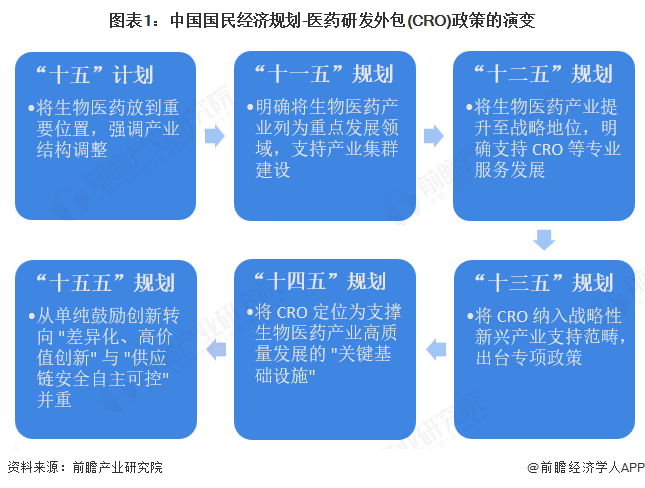
Core Viewpoint - The report highlights the significant growth and development of China's Contract Research Organization (CRO) industry, driven by a comprehensive policy framework and regulatory reforms that enhance innovation and operational efficiency in the pharmaceutical sector [1][3][9]. Group 1: Industry Overview - The main listed companies in China's CRO industry include WuXi AppTec (603259.SH), Kanglong Chemical (300759.SZ), Tigermed (300347.SZ), Kelaiying (002821.SZ), Zhaoyan New Drug (603127.SH), Jiuzhou Pharmaceutical (603456.SH), Haoyuan Pharmaceutical (688131.SH), Boteng Co., Ltd. (300363.SZ), Chengdu XianDao (688222.SH), and Yaoshi Technology (300725.SZ) [1]. - The CRO industry is recognized as a strategic emerging industry that supports pharmaceutical innovation, transitioning China from a major pharmaceutical market to a strong one [1]. Group 2: Policy Framework - The policy framework for the CRO industry is centered around the National Medical Products Administration (NMPA) and includes collaboration with other regulatory bodies such as the National Health Commission (NHC) and the Drug Administration (CDR) [3]. - Key regulatory measures include the Marketing Authorization Holder (MAH) system, implicit licensing for clinical trials, Good Laboratory Practice (GLP) and Good Clinical Practice (GCP) certifications, and priority review and approval processes [3]. Group 3: Industry Support Policies - National policies provide financial support through initiatives like the "Major New Drug Creation" program, tax reductions for high-tech enterprises, and increased deductions for R&D expenses, which lower operational costs for the industry [6]. - Local governments implement differentiated policies that align with regional industrial characteristics, including subsidies for innovative drug development and funding for CRO platform construction [6]. Group 4: Drug Review Reforms - Recent reforms in drug review processes have significantly improved approval efficiency, reducing the average clinical trial review time from 420 days to 30 days in pilot areas, and addressing a backlog of 22,000 cases [9][12]. - The definition of new drugs has shifted from "China New" to "Global New," aligning with international standards and enhancing the quality of innovation [12]. Group 5: Future Trends - The future of the CRO industry in China is expected to be driven by a robust policy framework, with trends including deeper collaboration in service models, increased application of AI and digital platforms, and a focus on specialized market segments [13]. - The competitive landscape is anticipated to evolve with the rise of domestic leaders and accelerated internationalization, benefiting from improved mechanisms for mutual recognition of clinical trial data [13].




医疗服务板块1月23日涨1.19%,诺禾致源领涨,主力资金净流入9.91亿元
Zheng Xing Xing Ye Ri Bao· 2026-01-23 09:04
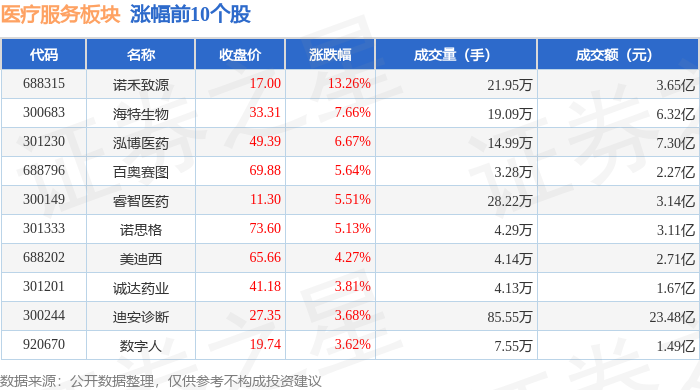
Core Viewpoint - The medical services sector experienced a rise of 1.19% on January 23, with notable gains from companies like Nuohua Zhiyuan, which led the sector's performance [1]. Group 1: Market Performance - The Shanghai Composite Index closed at 4136.16, up 0.33%, while the Shenzhen Component Index closed at 14439.66, up 0.79% [1]. - The medical services sector saw significant individual stock movements, with Nuohua Zhiyuan (688315) closing at 17.00, up 13.26%, and Hai Te Biological (300683) closing at 33.31, up 7.66% [1]. Group 2: Trading Volume and Value - Nuohua Zhiyuan had a trading volume of 219,500 shares and a transaction value of 365 million yuan [1]. - Hai Te Biological recorded a trading volume of 190,900 shares with a transaction value of 632 million yuan [1]. Group 3: Capital Flow - The medical services sector saw a net inflow of 999.1 million yuan from institutional investors, while retail investors experienced a net outflow of 1.069 billion yuan [2]. - The capital flow data indicates that major stocks like Diyan Diagnosis (300244) had a net inflow of 288 million yuan from institutional investors [3].





中欧基金葛兰:一季度医药板块有望延续结构性行情,看好创新药械产业链出海、消费医疗等投资机会
Sou Hu Cai Jing· 2026-01-23 06:53
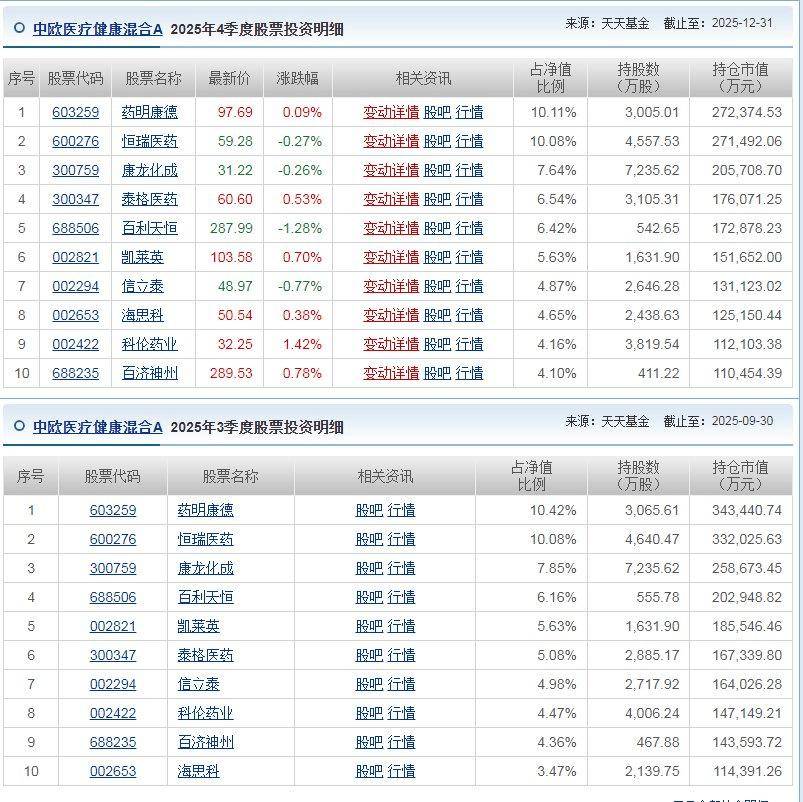
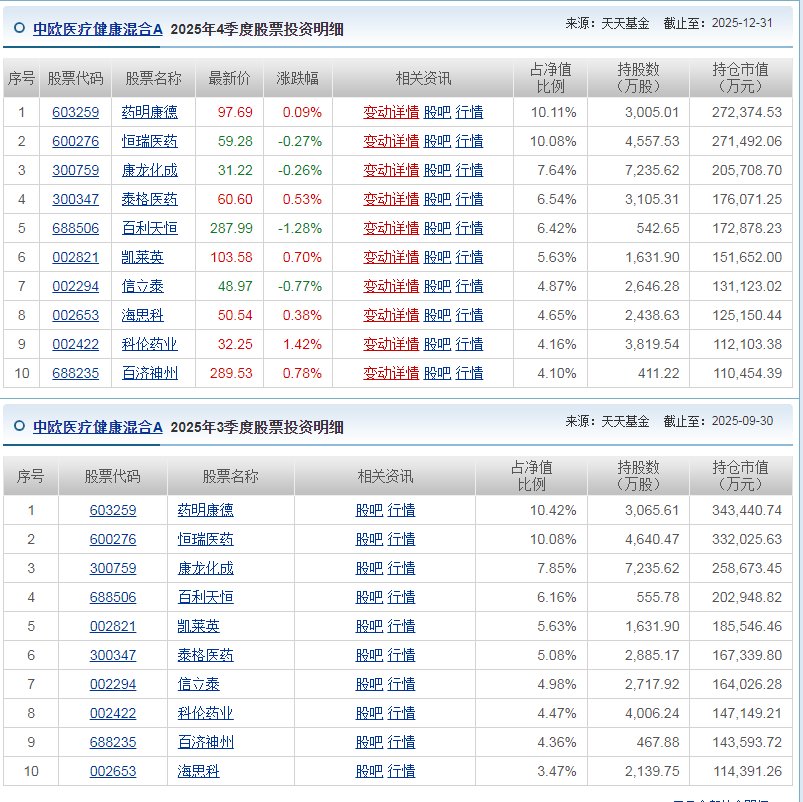
Core Viewpoint - The report highlights the performance of the China Europe Medical Health Mixed Fund managed by Ge Lan and Zhao Lei, indicating a decline in total fund size and negative returns compared to benchmarks [1][4]. Fund Performance - As of December 31, 2025, the total size of the funds managed by Ge Lan decreased from 43.544 billion to 35.389 billion yuan [1]. - The A-class share of the China Europe Medical Health Mixed Fund recorded a net value growth rate of -14.81%, while the C-class share saw a decline of -14.98%, both underperforming the benchmark return of -8.21% [1][3]. Holdings Overview - The top ten holdings of the China Europe Medical Health Fund include WuXi AppTec, Heng Rui Medicine, and Kanglong Chemical, with notable increases in holdings for Hai Si Ke and Tai Ge Medicine, while reductions were seen in stocks like Ke Lun Pharmaceutical and Xin Li Tai [1][2]. Market Context - In Q4 2025, the CSI Pharmaceutical Index fell by 12.7%, underperforming the CSI 300 Index, which declined by only 0.2%. The report notes significant differentiation within sub-sectors, with innovative industries experiencing corrections while traditional Chinese medicine and pharmaceutical commerce remained relatively stable [3]. Future Outlook - Looking ahead to Q1 2026, improvements in global liquidity are expected to boost investment and financing in innovative pharmaceuticals, supported by domestic policy enhancements. The innovative drug and device industry is anticipated to maintain a high level of activity, with several key domestic drugs approaching critical data readouts [4][5]. - The report suggests that the pharmaceutical sector may continue to experience structural trends due to macroeconomic improvements, supportive industry policies, and ongoing innovation, with investment opportunities focusing on the progress of innovative drug and device exports, domestic substitution in equipment, and recovery in consumer healthcare demand [5].

中欧基金葛兰:一季度医药板块有望延续结构性行情 看好创新药械产业链出海、消费医疗等投资机会
Zhi Tong Cai Jing· 2026-01-23 06:33
Core Viewpoint - The report highlights the performance of the China Europe Medical Health Mixed Fund, managed by Ge Lan and Zhao Lei, indicating a decline in total fund size and negative returns compared to benchmarks for the fourth quarter of 2025 [1][4]. Fund Performance - As of December 31, 2025, the total size of funds managed by Ge Lan decreased from 43.544 billion to 35.389 billion yuan [1]. - The net value growth rate for Class A shares of the China Europe Medical Health Mixed Fund was -14.81%, while the benchmark return was -8.21% [1]. - Class C shares experienced a net value growth rate of -14.98%, also underperforming the benchmark [1]. Holdings Overview - The top ten holdings of the China Europe Medical Health Mixed Fund include WuXi AppTec, Heng Rui Medicine, and Kanglong Chemical, with notable increases in holdings for Hai Si Ke and Tai Ge Medicine, while reductions were seen in stocks like Ke Lun Pharmaceutical and Xin Li Tai [1][2]. - The largest holding, WuXi AppTec, accounted for 10.11% of the fund's net value, with a market value of approximately 2.724 billion yuan [2]. Market Context - The CSI Medical Index fell by 12.7% in the fourth quarter of 2025, underperforming the Shanghai and Shenzhen 300 Index, which declined by only 0.2% [3]. - There was significant differentiation within sub-sectors, with the innovative industry chain entering a correction phase after previous gains, while traditional Chinese medicine and pharmaceutical commerce showed relative stability [3]. Future Outlook - Looking ahead to the first quarter of 2026, improvements in global liquidity are expected to boost investment and financing in innovative drugs, supported by domestic policy enhancements [4]. - The innovative drug and medical device industry chain is anticipated to maintain high levels of activity, with several key domestic drugs approaching critical data readout points [5]. - The CXO sector is expected to benefit from a recovery in biotechnology financing, leading to improved order conditions [5]. - The pharmaceutical sector is projected to experience structural trends driven by macroeconomic improvements, supportive industry policies, and ongoing innovation [5].
9部门:鼓励创新药等药品进零售药店销售渠道,创新药ETF(159992)涨超1%,昨日“吸金”2.4亿元
2 1 Shi Ji Jing Ji Bao Dao· 2026-01-23 02:57
消息面上,商务部等九部门发布关于促进药品零售行业高质量发展的意见提出,优化药品营销体系。倡 导医药生产企业与全国或区域大型医药流通企业深度合作,以市场为导向规范药品购、销价格体系,促 进药品零售行业跨省、跨地区公平竞争,引导零售药品价格保持合理水平。鼓励创新药、参比制剂等药 品进零售药店销售渠道。鼓励医药电商平台开放数据接口,加强线上、线下药品零售价与省级医药采购 平台挂网价的联动监测,加强定点药店医保药品量价比较指数和药品比价小程序的推广应用。 江海证券表示,我们认为随着全球生物医药投融资环境逐步回暖,中国创新药企业出海已成为核心发展 趋势。新年首周,国内创新药领域便落地5项对外授权合作,涵盖小分子抑制剂、单抗、双抗、ADC和 RDC等多个技术领域,充分展现了中国在生物医药各技术领域的全球领先布局实力。 (文章来源:21世纪经济报道) 1月23日,A股三大指数集体上涨,中证创新药产业指数截至发稿上涨1.37%,该指数成分股中,昭衍新 药上涨超5%,贝达药业、君实生物-U、荣昌生物、泰格医药、沃森生物等跟涨。 相关ETF方面,创新药ETF(159992)截至发稿涨1.17%,成交额超1.5亿元,盘中交投活跃。 ...
9部门发文促进药品零售行业高质量发展,生物医药ETF(159859)昨日获超1.3亿份净申购
2 1 Shi Ji Jing Ji Bao Dao· 2026-01-23 01:23
Group 1 - The three major indices collectively rose, while the National Securities Biopharmaceutical Index (399441) fell by 0.84%. Among its constituent stocks, Kanglong Chemical rose over 1%, Hualan Biological increased by 0.59%, Tigermed gained 0.52%, and Jianfan Biological was up by 0.5% [1] - The Biopharmaceutical ETF (159859) had a trading volume of 100 million yuan yesterday, ranking first among similar products. According to Wind data, the ETF saw a net subscription of over 130 million shares yesterday [1] - As of January 21, the Biopharmaceutical ETF experienced a net inflow of 23.95 million yuan, marking three consecutive trading days of net inflows, with a cumulative net inflow of 116 million yuan [1] Group 2 - The Biopharmaceutical ETF closely tracks the Biopharmaceutical Index, which is based on A-share listed companies in the biopharmaceutical industry, selecting the top 30 stocks based on market capitalization and liquidity [1] - Nine departments, including the Ministry of Commerce and the National Development and Reform Commission, jointly issued opinions to promote high-quality development in the pharmaceutical retail industry, proposing 18 specific measures [1] - According to Pacific Securities, the biopharmaceutical industry will enter a critical phase of innovation realization and global layout by 2026, supported by the synergy of industry, policy, and capital [2]
CXO行业跟踪报告:高景气度有望持续,JPM大会更新要点解读
Xinda Securities· 2026-01-22 11:11
Investment Rating - The industry investment rating is "Positive" [2] Core Insights - The report indicates a significant recovery in domestic innovative drug financing, with 512 events in 2025, a year-on-year increase of approximately 18%, and a total financing amount of $14.684 billion, up about 127% [3][14] - The report highlights that the secondary market played a crucial role in this recovery, with secondary market financing amounting to $9.466 billion, a year-on-year increase of approximately 317% [3][14] - The report notes that the overseas innovative drug financing events reached 754 in 2025, a year-on-year decrease of about 16%, with a total financing amount of $42.136 billion, down about 22% [4][23] - The report emphasizes the strong growth potential of companies like WuXi AppTec, WuXi Biologics, WuXi AppTec, and Tigermed, with each company showcasing impressive revenue growth forecasts and strategic initiatives [5][6][8][9] Summary by Sections 1. Domestic Innovative Drug Financing - In 2025, domestic innovative drug financing events totaled 512, with a financing amount of $14.684 billion, marking a 127% year-on-year increase [3][14] - The secondary market's contribution was significant, with financing amounting to $9.466 billion, reflecting a 317% increase [3][14] 2. Overseas Innovative Drug Financing - Overseas financing events reached 754 in 2025, with a total amount of $42.136 billion, representing a 22% decline [4][23] - The report notes that the Federal Reserve's interest rate changes have impacted financing costs, with a slight recovery observed in late 2025 [4][23] 3. Company Highlights - WuXi AppTec expects a revenue of approximately $45.456 billion in 2025, a year-on-year increase of about 15.84%, with adjusted net profit projected to grow by 41.33% [5][31] - WuXi Biologics reported a significant increase in dual-target antibody projects, contributing nearly 20% to total revenue, with a year-on-year growth exceeding 120% [6][35] - WuXi AppTec's acquisition of Easton Pharma is expected to enhance production capacity, with projected revenue growth exceeding 45% in 2025 [8][45] - Tigermed anticipates a robust demand in the clinical CRO sector, with a projected compound annual growth rate (CAGR) exceeding 12% from 2025 to 2028 [9][51]
医药周报:基药目录前瞻、JPM大会看点
Guolian Minsheng Securities· 2026-01-22 02:45
Investment Rating - The report maintains a positive investment rating for the pharmaceutical sector [6] Core Insights - The pharmaceutical sector experienced a week-on-week decline of 0.68%, underperforming compared to the ChiNext and CSI 300 indices, ranking 17th among all industries [2][36] - The report emphasizes the importance of innovation, international expansion, and overcoming challenges as key themes for investment in 2026, with a focus on BD 2.0, small nucleic acids, and supply chain opportunities [3][4] - The upcoming adjustment of the National Essential Drug List is seen as critical, aiming to address clinical needs that have evolved since the last update in 2018, particularly in pediatrics, oncology, and rare diseases [5][14] Summary by Sections National Essential Drug List Adjustment Analysis - The current drug list has not been updated since 2018, leading to a disconnect with clinical needs, necessitating a systematic adjustment [14] - The adjustment will focus on filling gaps in disease coverage, particularly in pediatrics, oncology, and rare diseases, while also solidifying the integration of collective procurement and national negotiation outcomes [18][19] - The report identifies potential beneficiaries in traditional Chinese medicine, particularly in areas with previously weak coverage [28] JP Morgan Conference Overview - The 44th JP Morgan Health Conference highlighted strategic developments from major global pharmaceutical companies, showcasing their core pipeline advancements and key clinical milestones for 2026 [33] - Companies like Pfizer, Merck, and Eli Lilly presented their focus on innovative treatments and upcoming clinical trials, indicating a robust pipeline for future growth [34][35] Pharmaceutical Market Review and Hotspot Tracking - The pharmaceutical sector's performance in early 2026 has shown a 7.08% increase, outperforming both the CSI 300 and ChiNext indices [36] - The report notes a shift in market sentiment, with certain innovative sectors like AI healthcare and medical robotics showing strong performance, while traditional sectors faced adjustments [2][3]
中泰国际每日晨讯-20260122
ZHONGTAI INTERNATIONAL SECURITIES· 2026-01-22 02:33
Market Overview - On January 21, Hong Kong stocks experienced a slight adjustment in the morning but rebounded in the afternoon, with the Hang Seng Index rising by 97 points (0.4%) to close at 26,857 points[1] - The Hang Seng Tech Index increased by 62 points (1.1%), closing at 5,746 points, with total market turnover reaching HKD 250.5 billion[1] - Southbound capital inflow expanded to HKD 13.89 billion[1] Sector Performance - The semiconductor sector remained strong, driven by Micron's announcement of a potential memory shortage lasting until 2028, with Hua Hong Semiconductor and SMIC rising by 4%-6%[1] - TCL Electronics surged by 14.8% after announcing a joint venture with Sony, holding a 51% stake[1] - Skyworth Group's stock jumped by 37.5% following its announcement of a spin-off and share buyback[1] Geopolitical Impact - Gold stocks generally rose due to heightened geopolitical tensions, with Lingbao Gold and Zhaojin Mining increasing by 5%-8%[1] - The report suggests a short-term focus on strong sectors such as semiconductors and gold[1] U.S. Market Reaction - In the U.S., the Dow Jones Index rebounded by 588 points (1.5%) to 49,077 points, while the Nasdaq and S&P 500 indices rose by 270 points (1.2%) and 78 points respectively[2] - Gold prices remained strong, peaking at USD 4,888.4 per ounce[2] Macroeconomic Policy - The National Development and Reform Commission outlined policy directions for 2026, focusing on strengthening domestic circulation and expanding domestic demand strategies[3] Automotive Sector - China National Heavy Duty Truck Group saw a 7.5% increase in stock price after a major shareholder reduced their stake by 2%[4] - The company is expected to maintain strong export growth and a high dividend yield of approximately 7%[4] Energy and Utilities - Defensive sectors like environmental protection and gas utilities received support amid rising geopolitical risks, with stocks like Hong Kong and China Gas and CLP Holdings rising by 1.1%-3.2%[4] - Alibaba and China National Nuclear Corporation formed a joint venture for nuclear energy, potentially benefiting related companies[4] Healthcare Sector - The Hang Seng Healthcare Index rose by 0.7%, with WuXi Biologics increasing by 3.5%[5] - The CXO sector is expected to see a rebound in demand, with a projected 20.6% increase in clinical trial projects per company by 2025[5]