
洽洽食品

Search documents
聚焦产销对接新路径 擘画“入湾出海”新蓝图
Nan Fang Nong Cun Bao· 2025-12-19 00:36
Core Viewpoint - The article discusses the successful conclusion of a three-day agricultural product supply and sales docking event in Huizhou, Guangdong, focusing on enhancing rural industry revitalization through the "832 platform" and promoting the integration of domestic and international markets [2][4][6]. Group 1: Event Overview - The event aimed to deepen the connection between supply and sales, showcasing a shift from simple product exhibitions to a comprehensive approach that includes consumer assistance, policy guidance, and market-driven strategies [4][6]. - The "832 platform" gathered suppliers, procurement representatives from various levels, and buyers from the Guangdong-Hong Kong-Macao Greater Bay Area, indicating a collaborative effort to enhance rural industries [5][6]. Group 2: Support Model Upgrade - The support model has evolved from "blood transfusion" to "blood production," emphasizing dual-track approaches of public training and industry partnership plans [9][10]. - The "832 platform" launched initiatives to enhance the internal development capabilities of impoverished areas, with plans to conduct over 40 training sessions in 2025, covering nearly 20,000 participants across 465 counties [19][20]. Group 3: Brand Development - The "832 platform" has made significant strides in brand building, with the "福字号" brand matrix showcasing products like "832福米" and "832福油," achieving sales exceeding 3 billion yuan and benefiting over 100,000 farming households [38][39]. - Collaborative projects with local governments have led to the creation of regional public brands, enhancing market recognition and cultural storytelling around products [42][47]. Group 4: Market Expansion - The event marked a significant step in expanding market boundaries, with over 100 central enterprises and 6,000 local state-owned enterprises participating in procurement through the platform [57][58]. - The signing of contracts with various enterprises and government departments illustrates the platform's commitment to expanding its market presence, particularly in the Greater Bay Area and exploring overseas opportunities [75][76].


推动千亿魔芋赛道爆发,卫龙美味成“最受关注魔芋企业”,产品心智渗透率达78%
2 1 Shi Ji Jing Ji Bao Dao· 2025-12-18 12:13
Core Insights - The core focus of the article is on the rapid growth and market dominance of the company Wei Long in the konjac food industry, particularly through its flagship product, "Konjac Shuang" [1][2][20]. Company Overview - Wei Long was established in 1999 and went public in 2022, becoming the first "spicy strip" stock in Hong Kong [2]. - The company pioneered the konjac snack category in China with the introduction of "Konjac Shuang" in 2014, which has since become the highest-selling konjac product in the country, with a production volume exceeding 100,000 tons and sales surpassing 3 billion yuan in 2024 [2][20]. Market Position - Wei Long holds a market share of over 60% in the konjac product segment, making it the leading company in the industry [2]. - The company has successfully established itself as the only publicly listed snack food company with two core products each generating over 2.5 billion yuan in sales [2]. Consumer Insights - The most popular konjac product among consumers is "spicy konjac tripe," with Wei Long being the most recognized brand, achieving a mention frequency of 51 times per month [1]. - The brand's mental penetration rate in the "Konjac Shuang" category is reported to be 78%, indicating strong brand recognition and consumer loyalty [4][12]. Product Characteristics - "Konjac Shuang" is characterized by its low-fat, low-calorie, and high dietary fiber content, making it appealing for health-conscious consumers [9][12]. - The company uses high-quality konjac sourced from Yunnan, ensuring superior product quality through direct partnerships with local farmers [12]. Marketing Strategy - Wei Long actively engages in brand building and consumer interaction, exemplified by its participation in the first "Konjac Superfood Launch Conference" to promote the health benefits of konjac [13][14]. - The company has leveraged social media and collaborations with popular brands like Pizza Hut and KFC to enhance consumer engagement and meet diverse consumer needs [15]. Industry Growth - The konjac industry in China is projected to grow significantly, with an estimated total output value of 32 billion yuan in 2024 and a potential increase to 45 billion yuan by 2030, reflecting a compound annual growth rate of 11.8% [17]. - Wei Long's revenue from konjac products has increased from 298 million yuan in 2018 to 3.37 billion yuan in 2024, marking an elevenfold growth over six years [16][20]. Future Outlook - The company is positioned to benefit from the expanding konjac market, with expectations of continued revenue growth and market expansion [20]. - Wei Long's market capitalization has reached approximately 26 billion HKD, reflecting a 53% increase year-on-year, indicating strong investor confidence in the company's growth potential [20].
2024休闲零食行业报告:供应链提效浪潮,零食行业三轮变迁与未来演进深度研究
Sou Hu Cai Jing· 2025-12-16 17:52
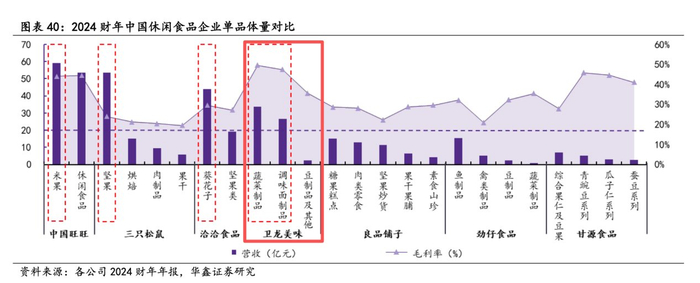
Group 1 - The leisure snack industry is undergoing a significant transformation driven by changes in consumer demand and channel dynamics, moving from a reliance on single-channel growth to a focus on supply chain efficiency [1][4] - The industry has experienced three phases of change: the supermarket era, the e-commerce boom, and the current phase characterized by diversification and a demand for high cost-performance products [9][10] - Key players in the market are adapting to these changes by either enhancing supply chain capabilities or focusing on brand strength to navigate the evolving landscape [3][4] Group 2 - Offline discount snack stores and online platforms like Douyin are emerging as significant channels, offering high cost-performance options and driving competition beyond just price [2][4] - The competition among brands has shifted from price wars to a comprehensive evaluation of store experience, supply chain responsiveness, and franchise support [2][3] - The current market environment emphasizes the need for companies to build long-term competitive advantages through either supply chain optimization or brand loyalty [4][10] Group 3 - The industry consensus is that a multi-channel approach and moderate category focus are essential strategies for success, with companies differentiating their responses based on their core competencies [3][4] - "Traffic-oriented" companies like Salted Fish and Three Squirrels are transitioning to strengthen their internal capabilities, while "big product" companies like Qiaqia and Jin Zai Foods are focusing on reinforcing their brand recognition [3][4] - The transformation in the snack industry reflects broader consumer trends, indicating that companies must adapt to changing market conditions to maintain competitiveness [4][10]



健康零食方兴未艾,量贩之风蒸蒸日上 - 零食行业2026年投资策略
2025-12-16 03:26
Summary of the Snack Industry Conference Call Industry Overview - The snack industry is experiencing significant differentiation in performance among companies, with leading firms benefiting from health-oriented product categories, while others face challenges due to high raw material costs and low-priced competition [1][2] - The market is dominated by two major players in the bulk snack segment, with "Very Busy" focusing on store expansion and "Wancheng" emphasizing profitability per store [1][2] Key Companies and Performance - **Hecha Food**: Under pressure due to high costs of sunflower seeds and nuts, as well as competition from private label brands [1][2] - **Jinzai and Ganyuan**: Focused on e-commerce and retail channels, but increased channel costs are suppressing short-term profits [1][2] - **Very Busy**: Over 21,000 stores, leading in store count [2] - **Wancheng**: 19,000 stores, focusing on single-store profitability [2] - **Market Share**: The two leading companies hold nearly 80% of the C22 market share [2] Investment Recommendations - **Focus on Leading Brands**: There is a recommendation to pay attention to Wancheng Group and Very Busy due to their potential for category expansion and supply chain efficiency [1][4] - **Innovative Categories**: The potential for innovation in konjac and oat products is highlighted, with companies like Weilong, Yanjin, and Ximai expected to perform well [1][4] - **Profitability Trends**: The snack industry is entering a phase of profit elasticity release, with net profit margins expected to improve through reduced subsidies, upstream price negotiations, and scale effects [3][6] Market Dynamics - **Consumer Demand**: The snack industry remains highly fragmented with diverse consumer demands, leading to two main investment themes: expansion of product categories by leading brands and innovation in specific product lines [4] - **Konjac Market**: The konjac snack market is currently valued at approximately 18 billion yuan, with potential growth to 30-80 billion yuan, indicating sustained high growth in the coming years [5] Competitive Landscape - Concerns about new brands entering the konjac market and the impact of declining raw material prices are deemed manageable, as established brands like Weilong and Yanjin are expected to maintain their market positions through brand and shelf competition [5] - The focus on brand loyalty and market expansion is anticipated to continue, with both companies likely to lead industry growth [5] Future Outlook - The snack industry is expected to continue its growth trajectory, with emphasis on multi-category models, store operations, membership systems, and private label development as key areas for future development [6] - Recommendations for investment include Ximai, Wancheng, Yanjin, and Weilong, with a note on the potential for Very Busy’s IPO to catalyze investment returns [3][6]
繁荣之下暗流汹涌! 休闲零食难掩盈利之困力
Sou Hu Cai Jing· 2025-12-16 02:53
Core Viewpoint - The leisure snack industry is facing significant challenges, including declining gross margins and increasing pressure on net profit due to rising raw material costs and market competition [1][5]. Group 1: Financial Performance - Salted Fish's half-year report shows revenue of 2.941 billion yuan, a year-on-year increase of 19.58%, and a net profit of 373 million yuan, up 16.7%, but growth momentum is weakening compared to previous years [3]. - The gross margin for Salted Fish has decreased from 32.53% to 29.66%, marking a continuous decline over five years with a cumulative drop of over 12 percentage points [3]. - Other brands like Yummy and Three Squirrels also reported declines in gross margins, with Yummy's margin down 9.16% to 31.58% and Three Squirrels down 0.70 percentage points to 25.27% [4]. Group 2: Industry Challenges - The overall consumption capacity and willingness are declining, making the leisure snack industry, a non-essential category, face more severe challenges [5]. - The industry is expected to grow, with the market size projected to exceed 1.6 trillion yuan by 2025, maintaining an annual growth rate of about 6%-8% [5]. - Brands are advised to focus on upgrading supply chains and product innovation rather than relying on marketing for short-term performance [5]. Group 3: Raw Material Costs - Rising raw material costs are a direct pressure source, with some brands reporting cost increases of over 30% for key ingredients [6]. - For example, a brand's operating costs rose by 24.67% to 2.068 billion yuan due to increased prices of core raw materials [6]. - Many brands are struggling with the inability to control raw material procurement effectively, leading to increased costs and reduced profit margins [7]. Group 4: Channel Transformation - New emerging channels like snack wholesale stores and Douyin interest e-commerce are rapidly changing the growth path of traditional snack brands [8]. - Traditional channels are expected to shrink to 50% of market share by 2025, down from 80% in 2015, leading to significant revenue declines for brands reliant on these channels [8]. - Brands that adapt to new channels have seen success, with some reporting significant revenue growth through strategic partnerships [8]. Group 5: Scale vs. Profitability - Brands are expanding market scale through various strategies, but this often leads to increased costs without corresponding profit growth [10]. - Sales expenses are rising faster than revenue, with brands spending heavily on marketing to maintain competitive positions in new channels [11]. - The contradiction between scale and profitability is becoming more pronounced, necessitating a reevaluation of growth strategies and cost structures [11]. Group 6: Product Differentiation - Many brands rely on OEM models, leading to high product similarity and increased competition, which compresses profit margins [13]. - Some brands recognize the need for differentiation but face challenges in investing in R&D and production capabilities [14]. - Successful brands are investing in supply chain integration and product innovation to enhance competitiveness and profitability [15][16]. Group 7: Multi-Dimensional Strategies - Brands need to explore multiple dimensions for breakthroughs, including increasing R&D investment and innovating product offerings to meet consumer demands [17]. - There is a growing need for brands to adopt a user-centric approach, building emotional connections with consumers through storytelling and sustainable practices [18]. - The industry must achieve systematic breakthroughs in product strength, channel efficiency, and brand value to overcome current challenges [18].

食品饮料行业2026年投资策略:需求多元、供给升级,大众消费的嬗变与曙光
2025-12-15 01:55
Summary of the Food and Beverage Industry Conference Call Industry Overview - The food and beverage sector experienced a poor performance in 2025, with a year-on-year decline of 8.1%, primarily due to weak domestic demand and alcohol restrictions [1][8] - Despite the overall downturn, leading companies in the consumer goods segment demonstrated resilience, achieving a revenue growth of 4.5% and a profit increase of 2.3% in the first three quarters [1][8] - The industry is currently undervalued, with an absolute valuation of approximately 20 times PE, which is a 50% premium over the CSI 300 index, nearing levels seen in 2013-2014 [1][10] Key Factors Affecting Performance - Major factors impacting the 2025 performance include consumption scene restrictions, pessimistic sentiment, and profit pressures [2][3] - The ban on alcohol has negatively affected the consumption of liquor, beer, and the restaurant supply chain, putting pressure on earnings per share (EPS) [3] Investment Strategy for 2026 - The investment strategy for 2026 focuses on a bottom-up approach, particularly in the liquor sector, with an emphasis on identifying signs of recovery in distressed companies [1][9] - Recommended companies include Dongpeng, Weilong, Moutai, Anjuke, Qiaqia, Yanghe, and Qianhe Flavor Industry, along with opportunities in the upstream and downstream of the restaurant supply chain [1][9] Consumer Trends and Channel Changes - Future development in the consumer goods sector will hinge on adapting to modern consumption patterns, with accelerated channel transformations including traditional retail adjustments, O2O integration, and instant retail [1][13] - Companies need to optimize their channel systems to seize new retail opportunities and adapt to changing cooperation models [1][14] Expected Changes in Consumer Behavior - Consumer confidence is expected to improve in 2026, with a shift from extreme price comparison to a focus on high quality-to-price ratios [1][15] - The supply side will likely see broader opportunities for product and service innovation as consumers are willing to pay for added value that meets their needs [1][15] Company Performance Insights - As of December 5, 2025, 83 stocks in the food and beverage sector recorded positive growth, with a total market value increase of 21% and profit growth of 12.5% compared to the previous year [5] - Notable performers include Nongfu Spring, Weilong, and Babi Foods, with respective stock price increases of 57%, 51%, and 67% [5] Valuation and Trading Volume - The food and beverage industry's valuation is relatively low, with trading volumes declining sharply to around 1.4% in the fourth quarter, indicating increased industry pressure but also potential for value recovery [10][11] Sector-Specific Insights - The beer industry is expected to face weak growth prospects, with opportunities arising from differentiated products and the importance of new retail channels [4][17] - The snack industry is experiencing significant channel changes, with emerging channels like high-end membership supermarkets and instant retail showing strong vitality [21][22] - The dairy sector is under pressure, particularly liquid milk, but leading companies like Yili and Mengniu are optimistic about future growth due to proactive inventory management and product innovation [30] Recommendations for Investment - Investment recommendations include focusing on value recovery companies, value creation firms, and those with strong earnings certainty [7] - Specific recommendations for the restaurant supply chain include companies like Hai Tian and Anjuke, which are expected to benefit from demand recovery and improved operational efficiency [31][34] Conclusion - The food and beverage industry is navigating a challenging landscape with opportunities for recovery and growth in specific segments. Investors are advised to focus on companies that can adapt to changing consumer preferences and channel dynamics while capitalizing on the potential for value recovery in the sector.
明日起,A股重要调整!
中国基金报· 2025-12-14 12:31
【导读】A股多个重要指数迎重大调整 中国基金报记者 莫琳 12月15日(周一),深证成指、创业板指等指数的样本定期调整将正式实施。 根据深圳证券交易所及深圳证券信息有限公司公告,深证成指更换17只样本股,创业板指更 换8只样本股,深证100更换7只样本股,创业板50更换5只样本股。 "新质生产力"成主线 市场人士认为,追踪这些指数的庞大被动资金(包括各类ETF),将会按照新的成 份 股进行 配置。这意味着,所有调入名单上的公司,将在短期内迎来实实在在的增量买盘,而调出公 司则面临被动卖压。 深交所在公告中提到,本次调整后,创业板指战略性新兴产业权重占比 为 93%,新一期样本 公司前三季度研发费用同比增速为13%,研发费用占营业收入 的 比重为5%,其中30家公司 研发强度超10%。深证100新质蓝筹属性更加突出,战略性新兴产业权重提升至81%,先进 制造、数字经济、绿色低碳等重点领域权重提升至79%。创业板50战略性新兴产业权重达 98%,其中以人工智能、芯片、光模块等为代表的新一代信息技术产业占比达45%。 其中,深证成指将调入德明利、沃尔核材、拓维信息、四方精创等,调出国药一致、中国天 楹、海德股份、洽 ...

2025年零食行业消费趋势洞察
Sou Hu Cai Jing· 2025-12-14 09:25
Core Insights - The Chinese snack market is undergoing a significant transformation, shifting from traditional consumption focused on satiety to a new era driven by health, personalization, and emotional value [1][7] - Young consumers, making up over 70% of the market, exhibit a dual focus on "rational health" and "stress relief," indicating a complex consumer behavior that emphasizes snacks as emotional and social facilitators [1][7] Consumer Trends - Key factors influencing snack selection include taste, ingredient quality, and consumption context, with rising interest in low-sugar, low-fat, low-calorie, high-protein, and clean-label products [2][7] - Diverse consumption scenarios have emerged, extending from casual snacking to specific contexts like late-night binge-watching, outdoor camping, and travel gifts, highlighting snacks as solutions for various life moments [2][7] - The demand for snacks designed to alleviate stress and anxiety has surged, with related social media content experiencing significant growth [2][7] Regional and Social Dynamics - Local specialty snacks are revitalizing through cultural recognition and national trends, leveraging traditional craftsmanship and regional flavors, amplified by social media [3][7] - The "social currency" aspect of snacks is increasingly important, with consumers actively engaging in creative consumption methods, DIY snacks, and sharing experiences, transforming consumption into a social activity [3][7] Marketing Strategies - Xiaohongshu (Little Red Book) has emerged as the primary platform for snack brand marketing, showing significant year-on-year growth in commercial posts and user engagement around health and clean ingredients [4][7] - In contrast, Douyin (TikTok) has seen a contraction in snack marketing, focusing more on narrative-driven content and price-oriented promotions, indicating a differentiated marketing ecosystem [4][7] Competitive Landscape - Competition among snack categories is intensifying, with mixed nuts remaining a key focus despite a decline in overall social media engagement, while meat snacks and baked goods are experiencing stable growth [5][7] - Brands that can identify niche demands and create standout products are gaining market traction, exemplified by companies like Wang Xiaolu and Hema, which have successfully launched innovative products [5][7] - The current snack market is characterized by a shift towards consumer-driven, emotional, and social values, necessitating brands to enhance product quality and understand consumer emotional needs [5][7]
洽洽食品“失宠”,被踢出深证成指样本股
Shen Zhen Shang Bao· 2025-12-14 07:01
Core Viewpoint - The Shenzhen Stock Exchange announced a periodic adjustment of sample stocks for various indices, including the Shenzhen Component Index, with Qiaqia Food (002557) being removed from the index due to its declining performance [1] Group 1: Company Performance - In the first three quarters of this year, Qiaqia Food reported revenue of 4.501 billion CNY, a year-on-year decrease of 5.38% [3] - The net profit attributable to shareholders was 168 million CNY, down 73.17% year-on-year, with a significant drop in the net profit margin from 15.53% in 2021 to 3.76% in Q3 of this year [4] - The company's gross profit margin fell to 21.94% in the first three quarters, down 8.31 percentage points from 30.25% in the same period last year [4] Group 2: Reasons for Decline - The decline in profitability is attributed to rising costs of sunflower seeds and core nut raw materials, along with increased expenses for product and channel restructuring [4] - The company has faced ongoing quality complaints, including issues related to product freshness and safety, which have resurfaced recently due to social media controversies [7] Group 3: Market Reaction - Qiaqia Food's stock performance has been negatively impacted by its removal from the Shenzhen Component Index, raising concerns about its future market position [1] - The company has been under scrutiny for quality issues, which may further affect consumer trust and sales [7]

中原证券晨会聚焦-20251211
Zhongyuan Securities· 2025-12-10 23:30
Core Insights - The report indicates that the Chinese economy is expected to grow by 5.0% in 2025 and 4.5% in 2026 according to the IMF, reflecting a moderate recovery phase [5][8] - The A-share market is experiencing a phase of consolidation with potential upward movement supported by favorable policies and improved liquidity [9][12] - The semiconductor industry is in an upward cycle, driven by strong demand for AI computing hardware and significant capital investments from major tech companies [19][30] Domestic Market Performance - The Shanghai Composite Index closed at 3,900.50 with a slight decline of 0.23%, while the Shenzhen Component Index rose by 0.29% to 13,316.42 [4] - The average P/E ratios for the Shanghai Composite and ChiNext are 16.04 and 49.54 respectively, indicating a suitable environment for medium to long-term investments [12] Industry Analysis - The food and beverage sector saw a rebound in November 2025, particularly in pre-packaged foods and alcoholic beverages, although overall performance remains weak with a cumulative decline of 0.16% from January to November [14][15] - The semiconductor industry experienced a 5.10% decline in November, but year-to-date performance remains strong with a 38.02% increase [19] - The electric power and utilities sector showed resilience, with a 10.4% year-on-year increase in electricity consumption in October 2025, driven by the charging and swapping service industry [23][24] Investment Strategies - The report suggests focusing on sectors such as commercial retail, precious metals, and automotive for short-term investment opportunities [12][18] - In the semiconductor space, companies involved in AI chip production and infrastructure are recommended due to the ongoing demand and technological advancements [19][30] - The food and beverage sector is advised to consider investments in soft drinks, health products, and baked goods, with specific companies highlighted for potential growth [35][36]