供应链提效

Search documents
万辰集团(300972):25Q4零食量贩业务净利率创新高
HTSC· 2026-03-18 06:44
Investment Rating - The investment rating for the company is maintained as "Buy" [1] Core Views - The company reported a significant increase in net profit margin for its snack wholesale business, reaching a new high in Q4 2025. The net profit margin for the snack wholesale business increased by 3.0 percentage points to 5.7% [7][9] - The company achieved a revenue of RMB 51.46 billion in 2025, representing a year-on-year growth of 59.2%, with a net profit of RMB 1.34 billion, up 358.1% year-on-year, exceeding the forecast range [7] - The company is expected to continue its positive same-store sales trend in 2026, supported by the expansion of non-snack categories, store operations optimization, and instant retail layout [7][10] Summary by Sections Financial Performance - Revenue for 2025 is projected at RMB 51,459 million, with a year-on-year growth of 59.17%. The net profit attributable to the parent company is expected to reach RMB 1,345 million, reflecting a growth of 358.09% [6] - The earnings per share (EPS) for 2025 is estimated at RMB 7.03, with a return on equity (ROE) of 104.18% [6] Store Expansion and Operations - The company opened 2,949 new stores in the second half of 2025, bringing the total to 18,314 stores, with a year-on-year increase of 62% in average store count [8] - The company closed 602 stores in 2025, resulting in a closure rate of 3.3%, which is considered low in the chain retail industry [8] Profitability and Cost Management - The gross margin for Q4 increased by 2.8 percentage points to 14.2%, marking a new quarterly high. The gross margins for the snack wholesale and mushroom businesses were 13.0% and 29.2%, respectively [9] - The company managed to reduce its selling expense ratio by 1.4 percentage points to 3.2% in Q4, contributing to improved profitability [9] Strategic Initiatives - The company is expanding its product categories, including low-temperature short-shelf-life food and beverages, to enhance store efficiency and customer base [10] - Efforts to improve supply chain efficiency and brand building are expected to further enhance profitability in the medium to long term [10] Valuation - The target price for the company is set at RMB 280, based on a price-to-earnings (PE) ratio of 23.5x for 2026, reflecting an upward adjustment from the previous target of RMB 276 [11]
鸣鸣很忙20260311
2026-03-12 09:08
Company and Industry Summary Company Overview - **Company Name**: Mingming Hen Mang - **Industry**: Snack Retail - **Current Store Count**: Over 21,000 stores - **Projected Store Count**: Potential to reach 35,000 stores, indicating over 65% growth from current levels [2][4] - **Market Position**: Leading player in the bulk snack retail sector, expected to rank first in store count by 2025 [3] Key Insights and Arguments Market Dynamics - **Market Concentration**: The company and its competitor, Wancheng, form a duopoly with a combined market share (CR2) of 70.7% in GMV and 63.5% in store count [2][8] - **Growth Sources**: Key growth areas include lower-tier cities and northern markets, with a focus on expanding store presence in these regions [2][4][5] Financial Performance - **Revenue Projections**: Expected revenues for 2025, 2026, and 2027 are 65.08 billion, 87.18 billion, and 101.31 billion CNY, respectively, with growth rates of 65.4%, 34.0%, and 16.2% [18] - **Profitability Targets**: Aiming for a net profit margin of 5%, with gross margin improvements driven by supply chain efficiencies and an increase in private label products [2][11][18] Store Efficiency and Sales Trends - **Store Revenue Recovery**: Q3 2025 saw a 7.1% year-on-year increase in single-store revenue for the "Snacks Are Busy" brand, indicating a recovery trend [2][9] - **Customer Metrics**: The average customer transaction value has decreased by 10.6%, but the company expects this to stabilize as price competition eases [9] Strategic Initiatives - **Brand Strategy**: The company is implementing a dual-brand strategy with "Snacks Are Busy" focusing on central China and "Zhao Yiming" expanding into eastern regions [3] - **Product Diversification**: Introduction of private label products and expansion into fresh food snacks through the "You Dian Chan" brand, targeting high-end markets [2][10][13] Additional Important Insights Competitive Landscape - **Industry Penetration**: The penetration rate of bulk snacks in the leisure food and beverage category is currently at 4%, with potential for 5-10% growth [8] - **Emerging Competitors**: New entrants in the Southeast Asian market, such as "You Dian Qu," are being explored, with initial success in Vietnam [15][16] Operational Improvements - **Cost Management**: The company is focused on reducing sales and management expenses, with a projected decrease of 1-1.5% in sales expense ratio by 2025 [11][12] - **Supply Chain Enhancements**: Plans to build additional smart warehouses to improve logistics efficiency and reduce costs [11][12] Future Growth Plans - **Store Expansion**: Plans to add 7,000, 4,500, and 2,500 new stores from 2025 to 2027, primarily through the "Zhao Yiming" brand [17] - **Long-term Goals**: Aiming for a significant increase in private label sales to enhance gross margins and overall profitability [12][18] Conclusion - **Investment Rating**: The company is rated as a "Buy" due to its strong growth potential, strategic positioning in the market, and expected improvements in profitability metrics [19]
万辰集团(300972):精细运营与供应链提效有望驱动业绩持续释放
HTSC· 2026-01-28 01:39
Investment Rating - The investment rating for the company is maintained as "Buy" with a target price of RMB 276.00 [1] Core Views - The report indicates that fine operations and supply chain efficiency improvements are expected to drive performance, with a focus on expanding product categories and enhancing store operations [6][7] - The company is projected to maintain a rapid pace of store openings, with ongoing expansion in non-food categories and proprietary brands, which will support same-store performance [6][8] - The gross margin is expected to continue improving due to collaboration with upstream suppliers to enhance supply chain efficiency [9] Financial Projections - Revenue projections for the company are as follows: - 2024: RMB 32,329 million - 2025: RMB 51,941 million (up 60.66%) - 2026: RMB 62,330 million (up 20.00%) - 2027: RMB 72,305 million (up 16.00%) [5] - Net profit attributable to the parent company is forecasted to be: - 2024: RMB 293.52 million - 2025: RMB 1,381 million (up 370.61%) - 2026: RMB 2,054 million (up 48.67%) - 2027: RMB 2,520 million (up 22.71%) [5] - The report also highlights an increase in EPS from RMB 1.55 in 2024 to RMB 13.34 in 2027 [5] Operational Insights - The company has deepened its membership operations, with 150 million members and an increase in purchase frequency among active members [7] - The integration of instant retail services has expanded the customer base within a 3-5 km radius of stores, contributing to significant sales growth [7] - Continuous optimization of supply chain and operational efficiency is expected to enhance gross margin and overall profitability [9] Valuation Adjustments - The net profit forecasts for 2025-2027 have been adjusted upwards by 12.1%, 23.4%, and 12.6% respectively, reflecting improved operational efficiency and profitability [10] - The target price is set at RMB 276, based on a 25x PE ratio for 2026, indicating a premium valuation due to the company's competitive advantages [10]
中金:维持古茗跑赢行业评级 上调目标价至36港元
Zhi Tong Cai Jing· 2026-01-23 01:48
Core Viewpoint - The company has raised its adjusted net profit forecasts for 2025 and 2026 by 9% and 19% respectively, reaching 2.52 billion and 3.2 billion yuan, and introduced a profit forecast of 3.9 billion yuan for 2027, reflecting better-than-expected store opening pace and gross margin improvements [1][2]. Group 1 - The company is expected to achieve a 64% year-on-year growth in core profit for 2025, with a projected revenue increase of 46% [2]. - The adjusted core net profit for 2025 is forecasted to reach 2.52 billion yuan, with a significant increase in the second half of 2025, driven by store openings and improved gross margins [2][3]. - The company anticipates a net increase of nearly 3,500 stores in 2025, surpassing a total of 13,000 stores, with strong same-store performance and expansion in key markets [3]. Group 2 - In 2026, the company will focus on dine-in services and brand upgrades, with expectations for same-store revenue growth of 0-5% despite the reduction in delivery subsidies [4]. - The company plans to enhance its brand recognition and value through the upgrade of its store image and the introduction of new products, aiming to solidify its competitive advantage [4]. - The company’s team and franchisees have demonstrated strong execution capabilities, indicating resilience in performance despite external challenges [4].
拼多多杀入商超零售赛道?
Hua Er Jie Jian Wen· 2026-01-14 05:52
Core Viewpoint - Pinduoduo is quietly testing a new business called "Billion Supermarket" within its app, focusing on essential consumer goods, while major competitors like Alibaba and Meituan are heavily investing in instant retail and AI technologies [2][4]. Group 1: Business Development - The "Billion Supermarket" initiative leverages Pinduoduo's established "Billion Subsidy" system, offering limited-time coupons and low-price subsidies, currently available to a select group of users [2][4]. - The service is integrated into the existing "Billion Subsidy" channel on the app, without a separate entry point, which may hinder user recognition of the supermarket as a distinct offering [9]. Group 2: Competitive Landscape - Pinduoduo's entry into the supermarket sector is seen as a strategic move to enhance user engagement and retention, especially in the fast-moving consumer goods (FMCG) market, where competition is intensifying [4][5]. - Competitors like Alibaba's Tmall Supermarket and Meituan are aggressively expanding their instant retail capabilities, with Tmall aiming to dominate the market by enhancing its delivery services [6][8]. Group 3: Market Challenges - The supermarket sector is crowded with established players, making it challenging for Pinduoduo to gain a foothold, especially as the focus shifts from simple traffic subsidies to supply chain efficiency and service quality [9][10]. - Pinduoduo's current offering lacks the depth of product variety and delivery speed compared to competitors, which could impede its ability to compete effectively in the supermarket space [9][10]. Group 4: Strategic Advantages - Pinduoduo's strengths lie in its cost control capabilities and a strong foundation in lower-tier markets, which could provide a competitive edge in the supermarket sector [10]. - The company has a skilled team experienced in community group buying, which may enhance its supply chain capabilities as it ventures into supermarket retail [10].



2024休闲零食行业报告:供应链提效浪潮,零食行业三轮变迁与未来演进深度研究
Sou Hu Cai Jing· 2025-12-16 17:52
Group 1 - The leisure snack industry is undergoing a significant transformation driven by changes in consumer demand and channel dynamics, moving from a reliance on single-channel growth to a focus on supply chain efficiency [1][4] - The industry has experienced three phases of change: the supermarket era, the e-commerce boom, and the current phase characterized by diversification and a demand for high cost-performance products [9][10] - Key players in the market are adapting to these changes by either enhancing supply chain capabilities or focusing on brand strength to navigate the evolving landscape [3][4] Group 2 - Offline discount snack stores and online platforms like Douyin are emerging as significant channels, offering high cost-performance options and driving competition beyond just price [2][4] - The competition among brands has shifted from price wars to a comprehensive evaluation of store experience, supply chain responsiveness, and franchise support [2][3] - The current market environment emphasizes the need for companies to build long-term competitive advantages through either supply chain optimization or brand loyalty [4][10] Group 3 - The industry consensus is that a multi-channel approach and moderate category focus are essential strategies for success, with companies differentiating their responses based on their core competencies [3][4] - "Traffic-oriented" companies like Salted Fish and Three Squirrels are transitioning to strengthen their internal capabilities, while "big product" companies like Qiaqia and Jin Zai Foods are focusing on reinforcing their brand recognition [3][4] - The transformation in the snack industry reflects broader consumer trends, indicating that companies must adapt to changing market conditions to maintain competitiveness [4][10]



今年双十一,有品牌“自补”接替“国补”让利消费者
Di Yi Cai Jing· 2025-10-23 01:13
Core Insights - The 2023 Double 11 shopping festival faces significant pressure compared to last year, with intense price competition and a shift in focus from price to quality and supply chain efficiency among major brands [1][3][6] Market Trends - The home appliance market is experiencing a decline in sales and revenue due to the limitation of national subsidies, with predictions of a decrease in sales across various categories including air conditioners, refrigerators, and washing machines [7][8] - Despite the overall market challenges, certain segments like large-screen TVs (98 inches and above) and emerging categories such as washing machines and dishwashers are showing growth potential [8][9] Competitive Landscape - Major brands like Gree and Midea are adapting to the market by launching products in the lower price segment and focusing on differentiated branding strategies [4][5] - The competition is not only among leading brands but also includes mid-tier and lower-tier brands, all engaging in aggressive pricing strategies [5][6] Consumer Behavior - Consumers are increasingly looking for value, with many brands offering additional incentives such as bundled services and promotions to stimulate demand [9][10] - The trend towards smart home appliances continues, with brands simplifying features to make products more accessible to consumers [10] Sales Performance - Initial sales data from platforms like JD.com indicate strong performance in specific categories, particularly AI-related products and new home appliances, with some products seeing sales growth of over 200% [3][6] - The overall expectation for the 2023 Double 11 is that it will not surpass the previous year's performance due to reduced subsidy impacts and market saturation [6][7]


小菜园(0999.HK)投资价值分析报告:大众餐饮高性价比标杆 供应链提效稳质价
Ge Long Hui· 2025-10-15 20:32
Core Viewpoint - The company "小菜园" is a leading brand in the mass casual dining sector, focusing on "New Huai Cuisine" with a price range of 50-70 yuan, holding a 0.2% market share in 2023, ranking among the top three in the Chinese casual dining chain market [1][2]. Industry Overview - The mass casual dining market in China reached a scale of 36,187 billion yuan in 2023, accounting for 88.7% of the Chinese dining market, with a projected compound annual growth rate (CAGR) of 8.7% from 2023 to 2028 [2]. - The community dining segment grew from 11.4 trillion yuan in 2018 to 13.7 trillion yuan in 2023, with an expected CAGR of 9.4% from 2023 to 2028 [2]. Company Strategy - 小菜园 targets the 50-100 yuan price segment, aligning with consumer trends for quality and value, while maintaining strict control over ingredient quality [2]. - The company employs a centralized procurement, central processing, and cold chain distribution model to create cost barriers, with individual store investments ranging from 1.3 to 1.7 million yuan and a payback period shorter than the industry average [2]. - The brand utilizes a "现炒现做" (freshly cooked) approach combined with standardization, covering dining in-store, takeout, and community outlets [2]. Expansion Plans - The company plans to accelerate the opening of 小菜园 stores, targeting 800 stores by the end of 2025 and 1,000 by the end of 2026, with long-term projections suggesting a potential of 2,050 stores [3]. - The sub-brand "菜手" focuses on community dining with a price range of 20-40 yuan, leveraging the supply chain of 小菜园 to fill the low-price market gap and enhance overall penetration [3]. Financial Projections - The company forecasts net profits of 750 million yuan, 922 million yuan, and 1.132 billion yuan for 2025, 2026, and 2027 respectively, translating to earnings per share (EPS) of 0.64, 0.78, and 0.96 yuan [3]. - The current stock price corresponds to price-to-earnings (PE) ratios of 16X, 13X, and 11X for the years 2025, 2026, and 2027 [3].
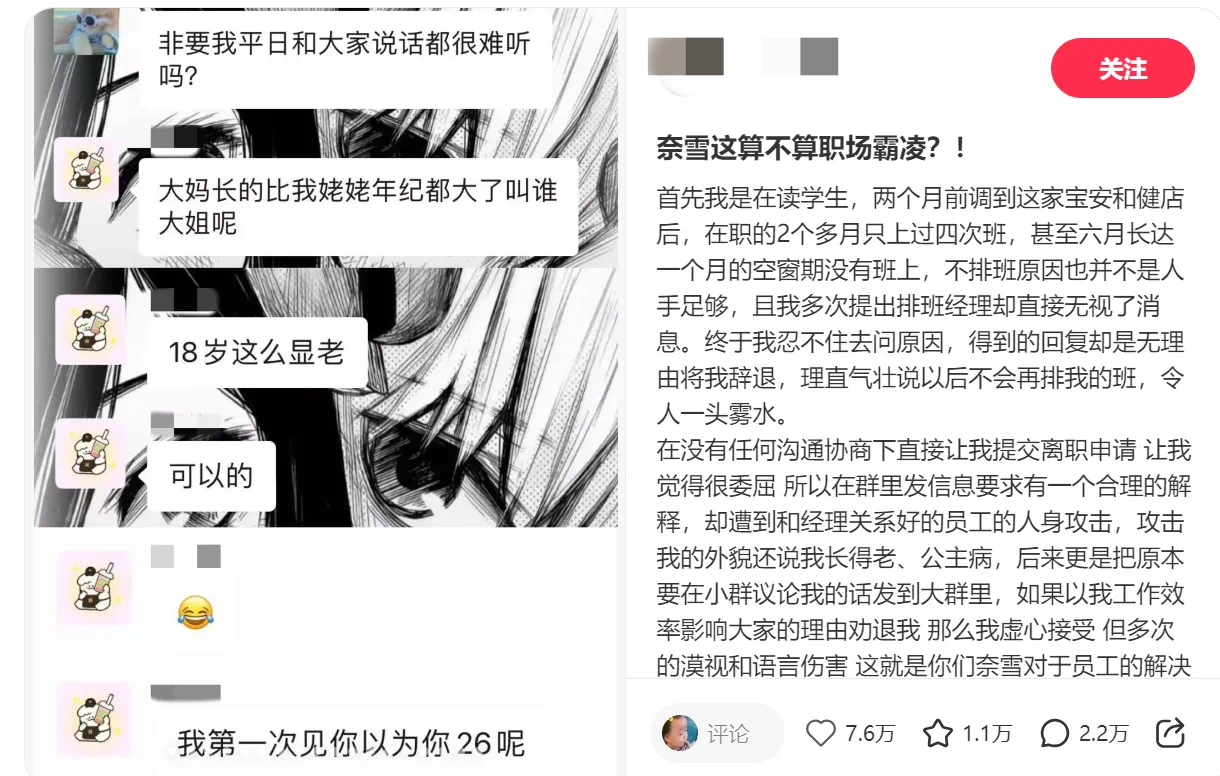
茶咖日报|“长得比我姥姥年纪都大”,奈雪的茶兼职员工称遭职场霸凌
Guan Cha Zhe Wang· 2025-07-08 12:31
Group 1 - A part-time employee at Nayuki Tea in Shenzhen reported workplace bullying and sudden dismissal, claiming verbal abuse from staff [1][3] - The incident highlights a pattern of complaints from part-time workers at Nayuki Tea regarding poor training and management attitudes [3] Group 2 - Bawang Tea Ji opened its first tea garden-themed store in Beijing, integrating traditional architecture with modern design to create a unique consumer experience [3] - This store is part of Bawang Tea Ji's strategy to differentiate its market presence through innovative store formats [3] Group 3 - Lipton's Greater China General Manager conducted a site visit in Huangshan for a new project with an investment exceeding 50 million, aimed at improving logistics and supply chain efficiency [4][5] - The project, named Liheng Central Warehouse, is expected to generate over 20 million in annual output value upon completion [4] Group 4 - Galaxy Securities released a report projecting the coconut water market in China to reach approximately 70 billion by 2024, with a compound annual growth rate (CAGR) of about 20% over the next five years [5] - The report emphasizes the potential for growth in the coconut water category, identifying supply chain and distribution as key competitive advantages [5] Group 5 - Jia Lian Technology confirmed its provision of various packaging products to popular tea brands, including customized solutions for cups and lids [5]