小米

Search documents
禾赛25Q2跟踪报告:GAAP盈利超预期,国内外客户拓展顺利
CMS· 2025-08-24 09:33
Investment Rating - The report maintains a "Recommended" rating for the industry, indicating a positive outlook for the sector's fundamentals and expectations for the industry index to outperform the benchmark index [5]. Core Insights - The report highlights that the company achieved a revenue of 706 million yuan in Q2 2025, representing a year-over-year increase of 53.9%, and a significant turnaround in GAAP net profit to 44 million yuan, exceeding expectations [1][2]. - The laser radar delivery volume exceeded expectations, with a total of 352,100 units delivered in Q2 2025, marking a year-over-year increase of 306.9%, driven primarily by the ADAS segment [3][4]. - The company has deepened collaborations with leading domestic clients and is steadily advancing its global expansion efforts, including partnerships with major automotive manufacturers [4]. Revenue Performance - In Q2 2025, the company reported a revenue of 706 million yuan, which aligns with the guidance provided for Q1 2025 [2]. - For the first half of 2025, the company achieved a total revenue of 1.232 billion yuan, reflecting a year-over-year growth of 50.6% [2]. Profitability Metrics - The gross margin for Q2 2025 was reported at 42.5%, with a slight year-over-year decrease of 2.6 percentage points, but an increase of 0.8 percentage points quarter-over-quarter [2]. - The GAAP net profit margin for Q2 2025 was 6.23%, significantly surpassing the breakeven guidance for Q1 2025 [2]. Delivery Volume and Market Share - The company delivered 54,790 units of laser radar in the first half of 2025, achieving a year-over-year increase of 276.2% [3]. - The company holds the leading market share in both the ADAS and robotics sectors, with the highest installation volume of laser radar in the ADAS field for the first half of 2025 [3]. Client Collaborations - The company has established partnerships with 24 automotive manufacturers, with recent agreements for 20 new models from major brands such as Geely and Great Wall [4]. - Internationally, the company is progressing with projects involving top European automotive manufacturers, laying the groundwork for mass production in 2026 [4].
【金山云(3896.HK)】公有云AI业务延续高增,调整后EBITDA率17.3%再创新高——2Q25业绩点评(付天姿/黄铮)
光大证券研究· 2025-08-24 00:04
Core Viewpoint - The article highlights the strong performance of Kingsoft Cloud in Q2 2025, driven by AI-related revenue growth and strategic collaborations with Xiaomi and Kingsoft ecosystem [4][5]. Group 1: Financial Performance - Kingsoft Cloud reported total revenue of 2Q25 at 2.349 billion yuan, with year-on-year and quarter-on-quarter growth of 24.2% and 19.3% respectively, primarily benefiting from high AI revenue [4]. - The adjusted gross profit for 2Q25 reached 351 million yuan, reflecting year-on-year and quarter-on-quarter increases of 8.4% and 17.0% [4]. - Adjusted EBITDA for 2Q25 was 406 million yuan, showing a significant year-on-year increase of 570.1%, with an adjusted EBITDA margin of 17.3%, up 14.1 percentage points year-on-year [4]. Group 2: AI and Public Cloud Growth - Public cloud revenue in 2Q25 was 1.625 billion yuan, with year-on-year and quarter-on-quarter growth of 31.7% and 20.1%, respectively; AI-related revenue reached 729 million yuan, growing over 120% year-on-year [5]. - AI revenue accounted for 44.8% of public cloud revenue, marking the eighth consecutive quarter of triple-digit growth [5]. - Revenue from the Xiaomi and Kingsoft ecosystem reached 629 million yuan in 2Q25, a year-on-year increase of 69.5%, contributing to 40% of the annual related transaction cap for 2025 [5]. Group 3: Industry Cloud Development - Industry cloud revenue in 2Q25 was 724 million yuan, with year-on-year and quarter-on-quarter growth of 10.1% and 17.4%, driven by increased demand for software IT services and accelerated project deliveries [6]. - In the public service sector, Kingsoft Cloud is advancing its government cloud and state-owned assets cloud businesses, launching the Kingsoft Government AI Integrated Machine [6]. - In the healthcare sector, the company secured several key projects, enhancing operational efficiency significantly [6]. Group 4: Cash Reserves - As of the end of 2Q25, Kingsoft Cloud's cash and cash equivalents reached 5.464 billion yuan, a substantial increase from 2.323 billion yuan at the end of 1Q25, providing a solid financial foundation for future AI business expansion [7].


智启广告新篇:中国主场聚势,亚洲同频共舞——2025第32届中国国际广告节及第34届亚洲广告大会将在北京海淀举办
Jing Ji Guan Cha Wang· 2025-08-23 05:25
Core Insights - The signing ceremony between the China Advertising Association and the Haidian District People's Government marks the establishment of the China International Advertising Festival in Beijing from 2025 to 2029, with the Asian Advertising Conference being held concurrently for the first time, enhancing the international expression of the integration of technology, culture, and advertising [1][2] Policy Guidance - The 2025 Central Urban Work Conference emphasizes promoting high-quality urban development and enhancing cultural continuity, with Haidian District leveraging its technological and cultural resources to upgrade the advertising industry, supported by major tech companies like Douyin, Kuaishou, Xiaomi, and Baidu [2][3] - During the first half of 2025, revenue from large-scale advertising enterprises in Beijing grew by 10.5%, with Haidian playing a significant role in this growth [2] Strategic Collaboration - The next five years will focus on three key dimensions: creating a global advertising technology testing ground, integrating cultural heritage and academic resources, and establishing a long-term cooperation mechanism to promote sustainable development through the advertising festival [4][5] - The advertising festival will feature major events, awards, exhibitions, and forums that promote the integration of advertising with AI, digital technology, and the metaverse [4] Industry Development - Haidian District is positioned as a hub for both technological innovation and cultural creativity, with the partnership expected to inject strong momentum into the high-quality development of the advertising industry [5][6] - Representatives from major companies like Douyin, Tencent, and Baidu expressed their commitment to actively participate in the festival, exploring new forms and models of advertising [6]
岚图汽车将登陆港股:年营收194亿 武汉诞生首家新能源上市企业
Sou Hu Cai Jing· 2025-08-22 23:44
Group 1 - Dongfeng Group's subsidiary, Lantu Automotive, will be listed on the Hong Kong Stock Exchange through an introduction listing, while Dongfeng Group will complete its privatization and delisting [3][4] - The transaction involves a "share distribution + absorption merger" model, where Dongfeng Group will distribute 79.67% of its shares in Lantu to all shareholders and then absorb the remaining shares [3][4] - H shareholders will receive 0.3552608 shares of Lantu for each H share held, along with a cash payment of HKD 6.68, resulting in a total theoretical value of approximately HKD 10.85 per H share [4][5] Group 2 - Lantu Automotive has shown rapid growth, with a projected delivery of 85,697 vehicles in 2024, representing a year-on-year increase of about 70% [12] - The company has been operating independently and is recognized as a high-end electric vehicle brand under Dongfeng, with a focus on market-driven operations [12][23] - Lantu's collaboration with Huawei has led to the development of the Lantu Zhiyin, which is positioned to compete with models like Tesla Model Y [14][23] Group 3 - Dongfeng Group's stock has been underperforming, with a market value of HKD 49.268 billion and a share price of HKD 5.97 prior to suspension [6][7] - The overall acquisition price for the transaction is HKD 10.85 per share, with cash compensation of HKD 6.68 and equity compensation of HKD 4.17 [5] - After the transaction, Dongfeng will remain the largest shareholder with approximately 62% ownership, while independent H shareholders will hold about 20.85% [20]

300亿撬动13700亿!小米雷军,揭开新势力造车骗局
Sou Hu Cai Jing· 2025-08-22 23:17
Core Viewpoint - Xiaomi's automotive division is on the verge of profitability after investing only 30 billion yuan, contrasting sharply with other new car manufacturers that have incurred losses in the hundreds of billions [1][6][10] Financial Performance - In Q2, Xiaomi's automotive gross margin reached an impressive 26.4%, up 11 percentage points year-on-year, indicating a strong competitive position against rivals like Tesla and Li Auto [3] - Xiaomi's total revenue for Q2 was 116 billion yuan, a record high with a year-on-year growth of 30.5%, with the automotive segment generating 21.3 billion yuan, surpassing competitors such as Xpeng and Zeekr [4] Investment and Cost Efficiency - Xiaomi has spent approximately 30 billion yuan on its automotive venture since officially starting in March 2021, which is significantly lower than the losses reported by other new entrants in the market [6][10] - The company aims to deliver 135,000 vehicles in 2024, setting a record for new car brands, and has already delivered over 300,000 vehicles since its launch [7] Market Position and Valuation - Xiaomi's market capitalization has surged to 1.37 trillion yuan, making it the third-largest automotive company globally, trailing only Tesla and Toyota, and significantly ahead of BYD [7][8] - The success of Xiaomi's automotive division has exposed the shortcomings of other new car manufacturers that rely on financial manipulation rather than solid product development [10]
人形机器人热管理解决方案怎么选?
DT新材料· 2025-08-22 16:04
Core Viewpoint - The first humanoid robot sports event highlights the advancements in humanoid robotics, showcasing their capabilities in various competitive scenarios, while also emphasizing the critical importance of thermal management technology for their performance and safety [2][6][43]. Group 1: Humanoid Robot Sports Event - The inaugural humanoid robot sports event, featuring 280 teams from 16 countries, will include 487 competitions across 26 events, demonstrating cutting-edge achievements in intelligent decision-making and collaborative movement [2]. - Unlike traditional robot combat or laboratory demonstrations, this event allows humanoid robots to compete in running, weightlifting, and combat, showcasing their strength and speed [2]. - The event serves as a platform for testing thermal management technologies, which are essential for maintaining stable operation during high-intensity activities [6][19]. Group 2: Development and Key Technologies of Humanoid Robots - Humanoid robots, designed to mimic human shape and behavior, have evolved through various stages, from mechanical systems to advanced autonomous intelligent systems, driven by advancements in multiple disciplines [8][9]. - The last decade has seen humanoid robots enter commercialization, with products like Tesla's Optimus and Xiaomi's CyberOne marking a shift from laboratory to industry [12]. - Key technologies in humanoid robotics include mechanical design, sensing technology, control algorithms, and artificial intelligence, enabling complex perception, movement, and interaction capabilities [14]. Group 3: Thermal Management Challenges - Humanoid robots face significant thermal management challenges due to limited internal space, multiple heat sources, weight constraints, and complex environmental conditions [19][20]. - Common thermal management solutions include passive methods like structural optimization and high thermal conductivity materials, as well as active methods such as liquid cooling and bio-inspired cooling systems [20]. Group 4: Thermal Management Suppliers - Companies like Feirongda, Lingyi Zhizao, Sanhua, and Aled are actively involved in providing thermal management solutions for humanoid robots, focusing on materials and systems that enhance performance and safety [22][27][33][42]. - Feirongda has invested in Guoli Intelligent, aiming to advance the development of dexterous robotic hands, while Lingyi Zhizao has accumulated technology in industrial and special robots since 2009 [24][29]. - Sanhua is recognized for its innovative liquid cooling modules that significantly enhance the endurance of humanoid robots, while Aled specializes in thermal interface materials for critical components [33][42].
中国品牌掘金超跑市场
Zhong Guo Qi Che Bao Wang· 2025-08-22 11:18
Core Viewpoint - The supercar market is undergoing a significant transformation, with Chinese brands emerging as challengers against the long-standing dominance of European brands in the high-end automotive sector [2][3][11] Market Landscape - The global supercar market has been historically centered around European brands like Ferrari, Lamborghini, and Porsche, which have established strong market barriers through technology, brand recognition, and supply chain control [3][4] - In 2024, the top 10 supercars in China priced over 1 million yuan sold a total of 4,219 units, with European brands accounting for over 90% of both brand and sales statistics [3] Technological Advancements - Chinese brands are exploring diverse paths in the supercar sector, achieving breakthroughs in both electric and fuel-powered vehicles [3][4] - NIO's EP9 set a record at the Nürburgring with a time of 6 minutes and 45.90 seconds, while BYD's Yangwang U9 has begun mass production, showcasing the feasibility of "overtaking" in the high-end electric supercar market [3][4] - Great Wall Motors is developing a hybrid supercar with a 4.0T V8 engine and electric motor, achieving a combined power of 1,000 horsepower and a 0-100 km/h acceleration time of under 2.5 seconds [4] Industrial Foundation - Chinese brands have made significant advancements in core technology, enabling self-research and development of key components, which supports the industrialization of supercars [5][6] - Great Wall's 4.0T V8 engine boasts a thermal efficiency of 38.5%, while BYD's blade battery achieves an energy density of 180 Wh/kg, enhancing safety and charging capabilities [5][6] Cost and Supply Chain Advantages - Chinese brands benefit from a complete electric vehicle supply chain, with core components costing 30%-40% less than those of European brands, allowing for lower production costs for electric supercars [7] - The upcoming luxury car tax adjustment in China may initially pressure high-end markets but could ultimately foster technological upgrades and enhance brand recognition for domestic brands [8] Marketing and Brand Strategy - Chinese brands are investing in marketing innovations and global positioning to build a unique brand ecosystem, with NIO and Great Wall Motors focusing on experiential marketing to enhance brand perception [9][10] - The strategic value of supercars extends beyond direct sales, as they serve as brand symbols that elevate overall brand equity and profitability [8][10] Challenges and Future Outlook - Despite advancements, Chinese brands face challenges in brand recognition, cost control, and service systems, which require long-term efforts to transition from technical advantages to ecological advantages [10] - The future of the global supercar market is expected to integrate electrification, intelligence, and sustainability, providing greater opportunities for Chinese brands to redefine their roles and establish new market standards [11]


未来五年增长确定性最高的中国科技公司,小米提前预定了
Feng Huang Wang· 2025-08-22 08:24
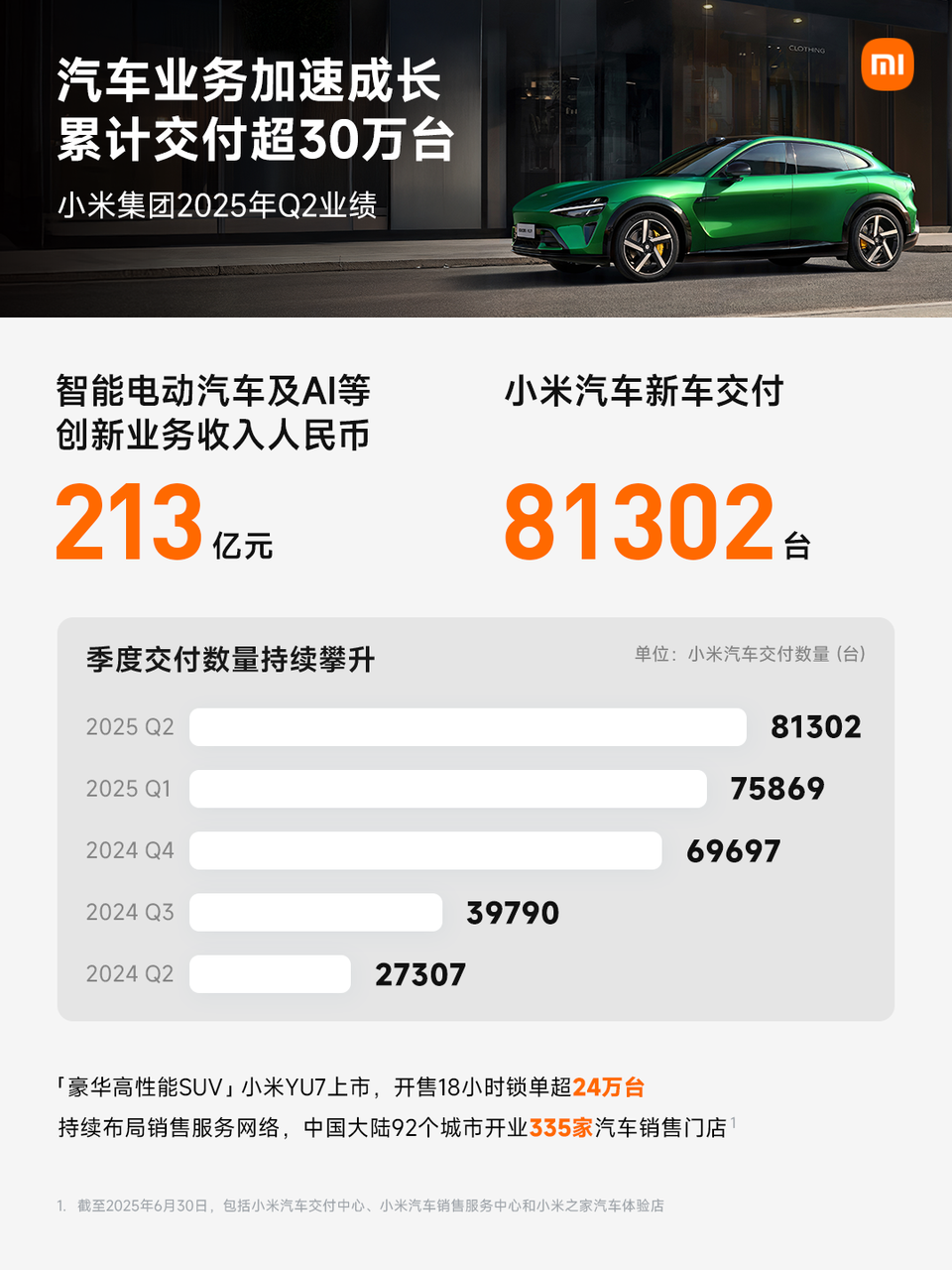
Core Insights - Xiaomi has achieved a remarkable Q2 2025 financial performance with total revenue of 116 billion yuan and a year-on-year growth of 30.5%, marking a historical high amidst a challenging industry environment [1][2][17] - The company's growth is attributed to its "human-vehicle-home ecosystem" strategy, which is not only supporting current financial performance but also establishing growth certainty for the next 3 to 5 years [1][11][17] Financial Performance - Xiaomi's Q2 2025 revenue of 116 billion yuan includes contributions from multiple business lines, with smart electric vehicles and innovative businesses contributing 21.3 billion yuan [2] - The automotive segment generated 20.6 billion yuan in revenue with a record delivery of 81,302 vehicles in a single quarter, indicating a strong position in the domestic new energy vehicle market [2][4] Automotive Business - Despite the YU7 model not yet being delivered, Xiaomi's automotive division delivered a total of 157,000 vehicles in the first half of the year, achieving an average tax-inclusive price of 280,000 yuan [4] - Xiaomi's strategy emphasizes product strength over price competition, with plans to enter the European electric vehicle market by 2027 [4][11] Smartphone and AIoT Performance - In Q2 2025, Xiaomi's global smartphone shipments reached 43 million units, maintaining a market share of 14.7% and ranking among the top three globally for 20 consecutive quarters [5] - The high-end smartphone strategy is showing results, with a 27.6% market share in the high-end segment in China, and significant growth in the 4,000-6,000 yuan price range [5] - The AIoT segment, particularly large home appliances, saw a 66.2% year-on-year revenue growth, with air conditioning units achieving both volume and price growth [5] Ecosystem Strategy - Xiaomi's "human-vehicle-home ecosystem" is a unified strategy that integrates smartphones, vehicles, and home appliances, creating a seamless user experience [9][11] - The company has established itself as a leader in this ecosystem, with other industry players beginning to adopt similar strategies, indicating a broader industry trend [11][12] Competitive Advantages - Xiaomi's competitive edge lies in its technological integration, scale, R&D investment, and strong brand loyalty, which collectively create a robust barrier to entry for competitors [15][16] - The company has invested 102 billion yuan in R&D over the past five years, with a current R&D expenditure of 7.8 billion yuan in Q2 2025, representing 6.7% of its revenue [16] Future Outlook - The automotive business is expected to continue its growth trajectory, potentially becoming a significant profit driver as new models are launched and supply chains are optimized [17] - Xiaomi aims to transition from hardware sales to a model focused on subscription services and data monetization, enhancing its profit margins [17]
“补涨”行情已来?恒生科技指数ETF(513180)大涨,中芯国际、小鹏汽车股价狂飙
Mei Ri Jing Ji Xin Wen· 2025-08-22 05:45
Group 1 - The Hong Kong stock market indices collectively rose on August 22, with the Hang Seng Tech Index increasing nearly 2% in the afternoon session [1] - The semiconductor sector experienced significant gains, with stocks like Hua Hong Semiconductor rising over 11% and SMIC increasing more than 7% [1] - The automotive sector also showed strength, particularly with XPeng Motors, which saw its stock price rise over 10% following a share buyback by its chairman [2] Group 2 - The Hang Seng Tech Index ETF (513180) attracted nearly 5.5 billion HKD in net inflows over the last 20 trading days, indicating a strong interest in tech stocks [2] - The ETF includes 30 leading Hong Kong tech companies, focusing on the AI industry chain, with major players like Alibaba, Tencent, Xiaomi, Meituan, and BYD identified as potential "seven giants" of Chinese tech [2] - DeepSeek announced the release of DeepSeek-V3.1, which features significant adjustments and is designed for the next generation of domestic chips [1]

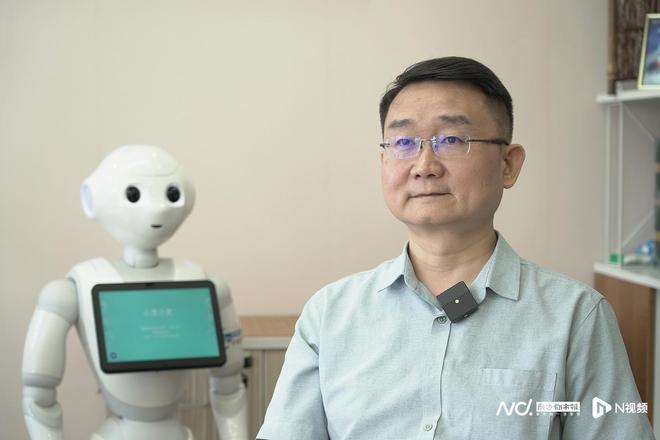
琶洲“模术”秀专访:大模型不必“大而全”,也可“小而美”
Nan Fang Du Shi Bao· 2025-08-22 03:30
Core Insights - The article highlights the rapid development and application of AI large models, particularly focusing on the innovations brought by Lingju Information Technology Co., Ltd. and its CEO Zhang Sheng [1][3][4] Company Overview - Lingju Information was founded in 2013 with a focus on AI, specifically targeting natural language processing (NLP) and service robots [3] - The company has developed its core product, the "Lingju Artificial Brain," which integrates semantic analysis, knowledge graphs, and cognitive computing [3][4] Product Development - Lingju has launched its own AI large model, the "Lingju Lingna Xunling Model," which emphasizes flexible deployment and quick response, catering to specific application scenarios [1][5] - The company focuses on "small models" that require fewer parameters (around tens of millions) compared to general large models that may have hundreds of billions of parameters, achieving cost control and efficiency [5][8] Market Position and Strategy - Lingju's technology is widely used in various applications, including enterprise conversational AI, personal AI applications, digital humans, service robots, and AIoT products, serving major companies like Huawei, Alibaba, and Xiaomi [4][5] - The company aims to leverage its unique technology and open-source advancements to create tailored solutions for specific industry needs, emphasizing the importance of application scenarios in AI development [4][10] Future Plans - Lingju plans to deepen its focus from industry-level applications to specific scenarios, expanding from B2B to B2C markets to explore more possibilities for AI utilization [10][11]