
联发科

Search documents
联发科冲6G!结盟苹果、爱立信 2027年挑战赚逾十个股本
Jing Ji Ri Bao· 2026-02-26 00:02
Group 1 - MediaTek has positioned itself as a key player in the global 6G ecosystem, collaborating with Apple and Ericsson to develop 6G technology [1][2] - The partnership signifies Taiwan's entry into the first tier of global 6G technology development, with MediaTek expected to lead the charge [1] - 6G technology is projected to enhance transmission speeds by 5 to 50 times compared to 5G, with potential speeds reaching 1 Tbps and latency reduced by 10 to 100 times, making it crucial for AI advancements [1] Group 2 - Ericsson plays a central role in connecting MediaTek and Apple to build the 6G ecosystem, emphasizing an open and globally scalable innovation platform based on 3GPP standards [2] - The collaboration aims to validate and demonstrate key 6G capabilities, ensuring the new generation of mobile networks meets the evolving demands driven by AI applications [2] - The first version of the 6G standard is expected to be released by the end of 2026 to 2027, with initial technical specifications anticipated to be completed by 2029 and commercialization by 2030 [2] Group 3 - At MWC 2026, Ericsson and MediaTek will showcase 6G centimeter wave technology, addressing the growing data transmission needs for emerging applications and devices [3] - The collaboration will integrate Ericsson's Radio Access Network (RAN) with MediaTek's user equipment (UE) prototypes, presenting new 6G technologies essential for AI-enhanced applications [3] - Additionally, Ericsson and Apple are working on a multi-radio access technology spectrum sharing solution to facilitate a smooth transition from 5G to 6G, minimizing resource waste and signal transmission burdens [3]


半导体行业:行业整体景气上行,存储、设备、晶圆代工需求火
Dongguan Securities· 2026-02-25 07:29
Group 1: Overall Industry Outlook - The semiconductor industry is experiencing an upward trend in performance, driven by strong demand in storage, equipment, and foundry sectors [1] - The report maintains an overweight recommendation for the semiconductor sector due to the overall industry recovery and growth potential [1] Group 2: Performance of Overseas Listed Companies - North American cloud service providers, including Microsoft, Amazon, Google, and Meta, reported significant year-on-year growth in cloud revenues, driven by AI demand, with capital expenditures expected to increase substantially in 2026 [14][15][16][17] - TSMC, the global leader in foundry services, reported a 25.5% year-on-year increase in Q4 2025 revenue, reaching $33.73 billion, with net profit growing over 40% [21] - Micron Technology's Q1 FY26 revenue reached approximately $13.64 billion, benefiting from rising storage prices driven by AI demand [31] - Texas Instruments and Analog Devices showed signs of recovery in the analog chip sector, with Texas Instruments reporting a 10% year-on-year revenue increase in Q4 2025 [39][41] Group 3: Performance of Domestic Listed Companies - SMIC reported a Q4 2025 revenue of 17.81 billion yuan, a year-on-year increase of 11.9%, with net profit growing by 23.2% [57] - The semiconductor packaging and testing sector is recovering, with several companies reporting improved profitability and growth driven by AI demand [60] - The analog chip sector is also showing signs of recovery, with many companies reporting improved performance compared to 2024 [62] Group 4: Investment Recommendations - The report suggests focusing on high-growth segments driven by AI, such as computing chips, storage, advanced packaging, and semiconductor equipment [7]



2026年手机厂商开始失去定价权
3 6 Ke· 2026-02-24 23:42
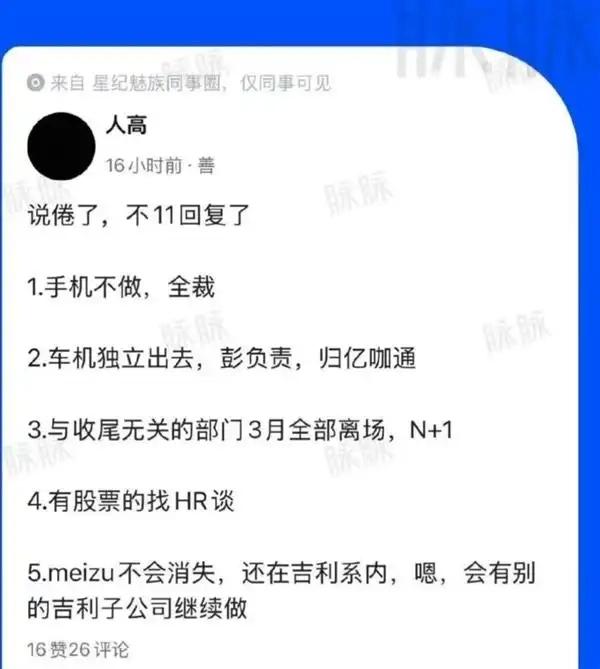
Core Insights - The mobile industry is experiencing significant shifts due to supply chain pressures, leading to different responses from companies like vivo, Meizu, and Nubia [1][2][3] - The rise in DRAM prices has disproportionately affected mid-tier smartphone manufacturers, pushing some towards the brink of collapse [2][3][5] - Historical parallels are drawn between the current situation and the fall of Nokia, emphasizing how supply chain dynamics can redefine industry leaders [2][13] Company Responses - Meizu has officially canceled the launch of its Meizu 22 Air due to rising memory costs, reflecting its inability to sustain operations [5][6] - Vivo has appointed Hu Baishan as the new president, signaling a strategic shift towards technology and innovation beyond smartphones [7][9] - Xiaomi is diversifying its business model by focusing on automotive and smart home sectors, indicating a shift in growth strategy [9][10] Market Dynamics - The high-end smartphone market is thriving, with predictions that devices priced over $600 will capture over 35% of the global market share by 2026 [6] - The mid-tier market is shrinking, with longer replacement cycles and reduced consumer willingness to upgrade due to rising costs [6][10] - The entry of AI into the smartphone market is creating new dynamics, with companies like ByteDance testing user willingness to cede control for convenience [11][12] Future Outlook - The combination of rising DRAM prices and the introduction of AI is reshaping the survival thresholds in the smartphone industry [13] - Companies that adapt to these changes, like Xiaomi with its automotive ambitions, may find new avenues for profitability [10][13] - The overall landscape of the smartphone market is expected to evolve significantly, with AI playing a central role in defining future consumer experiences [12][13]

软件困局:OpenAI与Anthropic是友敌还是死敌?
Xin Lang Cai Jing· 2026-02-24 09:08
Group 1 - OpenAI is perceived as a potential threat to enterprise software companies like ServiceNow, Salesforce, and Snowflake, as it aims to replace their software with its own AI products and agents [2][4][11] - OpenAI announced a new series of partnerships with consulting firms to enhance its sales of cutting-edge AI management software, although the incremental value of these partnerships remains unclear [3][11] - The stock prices of software companies, including Salesforce and ServiceNow, have seen significant declines, with drops between 3% to 9% on a recent day, contributing to an overall market decline of 1.2% in the Nasdaq index [4][11][12] Group 2 - PayPal's stock has plummeted 85% over the past five years, leading to a market capitalization of approximately $41 billion, raising questions about potential acquisition interest from competitors [12][13] - Stripe, a competitor of PayPal, may find it challenging to acquire PayPal due to cultural differences, despite PayPal owning Braintree, a competitor of Stripe [12][13] - Block, led by Jack Dorsey, could consider acquiring PayPal, but regulatory concerns may arise due to its direct competition with PayPal's Venmo [13]



未知机构:美银发布AI特殊应用ICASIC报告指出根据供-20260224
未知机构· 2026-02-24 04:15
(联合报系资料照) 张量处理器(TPU)需求强劲,美银证券将 2026 年 TPU 预估出货量从 400 万颗上修至,看好相关供应链,包 括台积电(2330)、京元电子(2449)、日月光投控(3711)、致茂(2360)、颖崴(65 美银发布 AI 特殊应用 IC(ASIC)报告指出,根据供应链在财报季的回馈,将 TPU 今年预估出货量上调到 460 万颗,比去年的 230 万颗增加一倍。 (联合报系资料照) 张量处理器(TPU)需求强劲,美银证券将 2026 年 TPU 预估出货量从 400 万颗上修至,看好相关供应链,包 括台积电(2330)、京元电子(2449)、日月光投控(3711)、致茂(2360)、颖崴(6515)、旺矽(6223)、 世芯 – KY(3661)等。 美银发布 AI 特殊应用 IC(ASIC)报告指出,根据供应链在财报季的回馈,将 TPU 今年预估出货量上调到, 比去年的 230 万颗增加一倍。 美银发布 AI 特殊应用 IC(ASIC)报告指出,根据供应链在财报季的回馈,将 TPU 今年预估出货量上调到 460 万颗,比去年的 230 万颗增加一倍。 其中,训练晶片组由博通主导 ...
【开工啦】2025,知产财经共发布45个专题供您留存!(可下载)
Sou Hu Cai Jing· 2026-02-24 03:52
· 附判决┃全球涉人工智能知识产权案例合集(44件) PART.02 PDF文件类专题 · 附判决┃2020-2025年涉知识产权技术秘密侵权案例合集(27件) · 必存!55家法院发布562件知识产权典型案例收录┃附判决 · 附判决┃29个涉知识产权千万级高判赔案件合集(2024-2025年) · 附判决下载┃2022-2025年33个涉知识产权恶意诉讼案例合集 · 附判决┃判赔额过亿知识产权案件合集(2020-2024) · 附判决┃2020-2025年最高院审理涉医药领域专利侵权案例合集 · 附表格裁决下载┃结束全球诉讼!华为与联发科全球52起诉讼梳理 · 附判决┃45个涉商品包装、装潢不正当竞争案例合集(2022-2025) · 附判决┃16件涉知识产权代理机构侵权案例合集 · 附判决┃28件涉驰名商标抢注案例合集(2020-2025) · 附判决┃39件计算机软件著作权侵权案例合集 · 4·26特辑┃聚焦人工智能与音乐版权案例+文章合集 · 附判决┃2024年离职员工侵犯公司商业秘密案件合集(27件) · PDF对照下载┃"两高"《关于办理侵犯知识产权刑事案件适用法律若干问题的解释》 · PDF对照 ...
2026年端侧AI产业深度:应用迭代驱动终端重构,见证端侧SoC芯片的价值重估与位阶提升
Soochow Securities· 2026-02-24 00:45
Investment Rating - The report maintains a rating of "Buy" for the electronic industry, indicating a positive outlook for investment opportunities in this sector [1]. Core Insights - The IoT market is identified as the largest blue ocean market, presenting significant opportunities for domestic substitution, particularly in customized solutions and software ecosystems [2]. - The report emphasizes the importance of hardware supply chain enterprises in the AI transformation, as major internet and cloud computing companies accelerate their hardware ecosystem development [2]. - The evolution of edge AI is seen as a critical trend, with the need for high-performance edge hardware driving innovation in traditional mobile and PC markets [5][6]. - The automotive sector is highlighted as a prime application area for edge AI, with significant opportunities arising from the upgrade of in-vehicle chips and the construction of domestic ecosystems [5]. Summary by Sections 1. Edge AI and Domestic Supply Chain Opportunities - The transition of edge AI from concept to a well-defined industry path marks a strategic shift towards physical world applications, driven by privacy, security, and latency considerations [15]. - The deep restructuring of edge hardware provides a systemic elevation opportunity for domestic supply chains, particularly in new terminal markets like AI glasses and embodied intelligent robots [16]. 2. AI Empowering Mobile and PC Market Innovations - The demand for high-end smartphones is increasing due to the rapid adoption of AI technology, with projections indicating that by 2028, 54% of smartphones will feature edge AI capabilities [18]. - The average selling price (ASP) of smartphones is expected to rise, with a notable increase in the proportion of high-end models, driven by the demand for AI functionalities [21][19]. - The report notes that the semiconductor industry is experiencing a shift towards higher-end chip manufacturing processes, with TSMC's 2nm technology expected to enhance performance and efficiency significantly [23][24]. 3. Automotive Electronics and Edge AI Growth - The automotive sector is positioned as a second growth engine for edge AI, with in-vehicle chips evolving to meet the demands of intelligent driving and user interaction [5]. - The report discusses the competitive landscape of automotive chips, highlighting the rapid advancements in domestic chip manufacturers and their collaboration with new energy vehicle companies [5]. 4. Internet Giants Building Edge-Cloud Collaborative Ecosystems - Major internet companies are establishing comprehensive strategies that integrate cloud, AI, and chip development to strengthen their hardware foundations for AI transformation [10]. - The report outlines the strategic moves of companies like Alibaba, ByteDance, and Tencent in creating a cohesive hardware ecosystem that supports AI applications across various sectors [10].
融入下一代PC生态体系,英伟达推出笔记本电脑芯片,重返消费级PC市场
Hua Er Jie Jian Wen· 2026-02-23 05:38
Core Insights - Nvidia is re-entering the consumer PC market with new chip products aimed at laptops, leveraging its AI technology to integrate into the next-generation PC ecosystem [1] - Major PC manufacturers like Dell and Lenovo are expected to launch laptops featuring Nvidia chips this year, with initial products possibly available in the first half of the year [2] - Nvidia's strategy focuses on maintaining consumer connections in an era where AI capabilities are expected to be standard across all devices [1] Group 1: Strategic Partnerships - Nvidia is employing a dual collaboration strategy in the PC chip sector, partnering with Intel to integrate its CPU with Nvidia's graphics and AI technologies [2] - The collaboration with MediaTek, revealed during Nvidia CEO Jensen Huang's visit to Taiwan, involves developing models based on Nvidia-MediaTek system-on-chip designs [2] - While specific launch dates for PCs featuring Nvidia chips have not been disclosed, supply chain sources indicate that initial products may be released in the first half of this year [2] Group 2: Technology and Market Positioning - The new PC processors from Nvidia utilize a system-on-chip design that combines the CPU with Nvidia's powerful GPU units, which are essential for AI model performance [3] - This system-on-chip technology, already standard in smartphones, aims to provide efficiency and battery life typically associated with mobile devices without sacrificing performance [3] - Nvidia has previously powered devices like the Nintendo Switch and early Microsoft Surface tablets, but has recently focused on GPUs for gaming and AI [3] Group 3: Target Market and Challenges - A key target demographic for Nvidia's PC chips includes gamers who are willing to pay a premium for hardware and are familiar with Nvidia's leadership in the graphics chip sector [3] - Compatibility with mainstream games and applications, originally designed for Intel standards, poses a significant technical challenge for the Nvidia-MediaTek collaboration [4] - Pricing strategy is crucial, with industry experts suggesting that Nvidia needs to keep the price of PCs built around its chips between $1,000 and $1,500 to avoid being perceived as a niche luxury product [5]

全球半导体TOP10,谁主沉浮
3 6 Ke· 2026-02-23 04:03
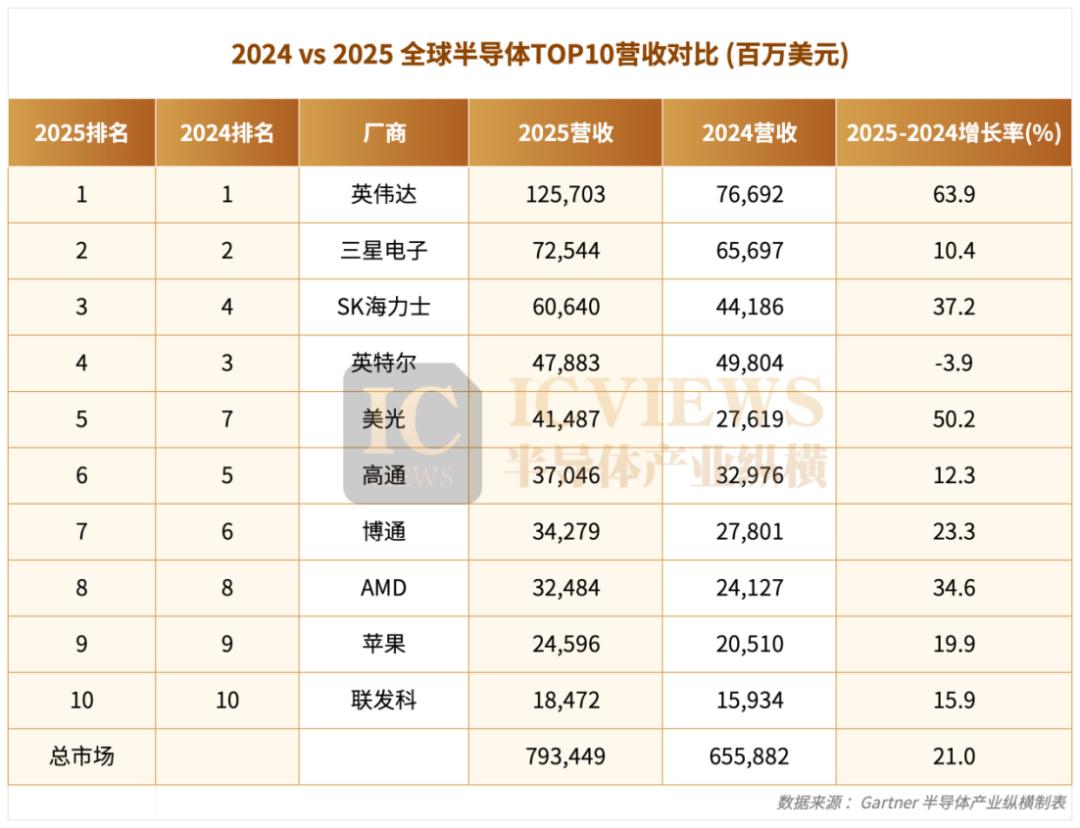
Core Insights - The global semiconductor industry is experiencing a historic turning point in 2025, with total revenue reaching $793 billion, a 21% year-on-year increase, signaling a fundamental shift in growth logic driven by AI infrastructure [1][6]. Group 1: Market Dynamics - Nvidia leads the semiconductor market with $125.7 billion in revenue, a 63.9% increase, marking the first time a company has surpassed $100 billion in annual revenue [6][4]. - Samsung Electronics and SK Hynix follow, with revenues of $72.5 billion and $60.6 billion, respectively, reflecting growth rates of 10.4% and 37.2% [4][6]. - Intel's revenue declined by 3.9%, dropping from third to fourth place, with a market share of only 6%, half of what it was in 2021 [7][8]. Group 2: Key Growth Drivers - The demand for High Bandwidth Memory (HBM) is driving growth, with HBM sales exceeding $30 billion and accounting for 23% of the DRAM market in 2025 [7][13]. - Companies like Nvidia, AMD, SK Hynix, and Micron are benefiting significantly from the data center and AI sectors, with Nvidia alone contributing over 35% to the industry's total growth [6][13]. - Broadcom reported a 28% revenue increase in Q4, driven by a 74% rise in AI semiconductor sales, indicating a strong correlation between AI and revenue growth [13]. Group 3: Strategic Shifts - Nvidia's success is attributed to its "software-defined hardware" approach, creating high entry barriers through its CUDA ecosystem, which integrates hardware, software, and developer communities [10]. - Vertical integration is making a comeback, with Apple and Samsung leveraging their strengths in chip design and manufacturing to create robust ecosystems [11]. - The semiconductor industry's value chain is shifting towards design and IP value, moving away from traditional manufacturing and scale advantages [19]. Group 4: Historical Comparison - Comparing 2015 to 2025, Intel's revenue has decreased from $51.4 billion to $47.9 billion, while Nvidia has risen from not being in the top 10 to $125.7 billion, highlighting a significant shift in market leadership [18][19]. - The top 10 semiconductor companies in 2025 include more fabless and design-driven firms, indicating a transition in the industry towards application and software-defined solutions [19]. Group 5: Future Outlook - The semiconductor landscape is expected to evolve further, with companies like Google and Amazon developing custom AI chips that may challenge Nvidia's dominance [20][21]. - The shift of AI from cloud to edge devices, such as smartphones and cars, presents new growth opportunities for mobile chip giants like Qualcomm and MediaTek [21].


三力驱动旺到2027年 产值将逼近1万亿美元
Jing Ji Ri Bao· 2026-02-21 23:30
Group 1 - The global semiconductor market value is forecasted to reach $772 billion in 2026, a 7% increase, with a year-on-year growth of 22%, marking a record high [1] - The growth is primarily driven by the IC design, wafer foundry, and packaging/testing industries, with expectations for continued growth into 2027, projected to exceed $975 billion [1] - TSMC has revised its global AI market growth outlook positively, and major memory manufacturers are optimistic about their performance for this year and next [1] Group 2 - MediaTek is confident that its data center ASIC revenue will exceed $1 billion this year, with expectations to reach several billion dollars by 2027 [1] - Creative Technology anticipates continued growth in revenue and profits this year, despite potential pressure on gross margins from two major cloud service provider chip productions [2] - The DRAM market remains tight due to limited new capacity, with demand driven by AI and general server needs, and this situation is expected to persist until mid-next year [2] Group 3 - Advanced packaging and testing leader ASE Technology is optimistic about revenue growth this year, with momentum expected to continue into next year due to the expansion of advanced processes and AI trends [2]