
联想

Search documents
Omdia:2025年Q4全球智能手机市场同比增长4% 苹果以25%市场份额领跑
智通财经网· 2026-02-12 01:33
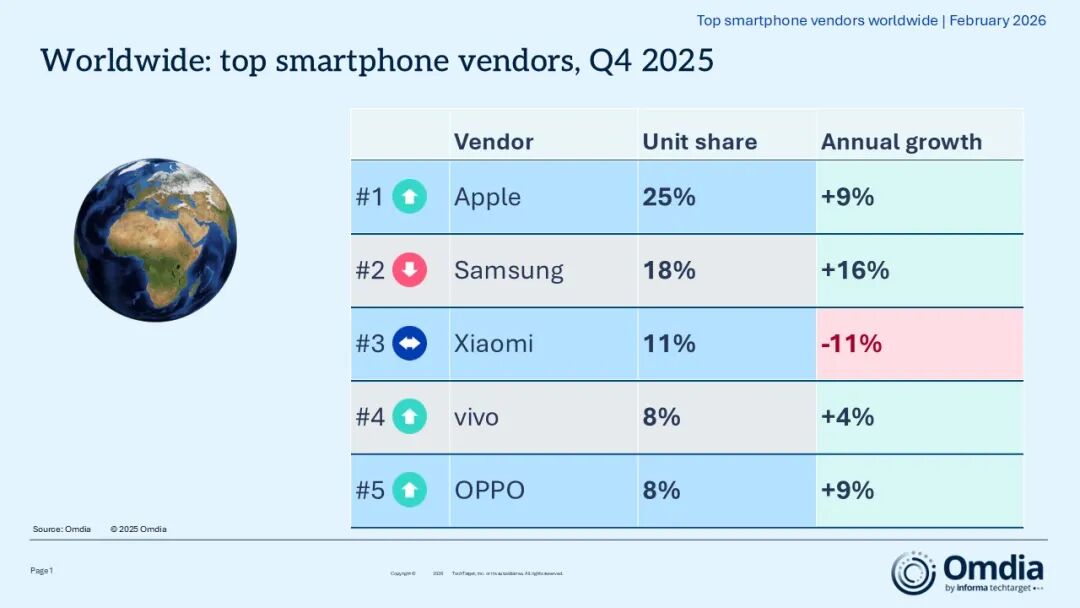
Core Insights - The global smartphone market is expected to grow by 4% year-on-year in Q4 2025, driven by seasonal demand recovery and improved inventory management, despite some manufacturers facing rising component costs [1] - Apple leads the market with a 25% share, benefiting from strong demand for the iPhone 17 series, achieving record quarterly shipments and maintaining its position as the largest smartphone manufacturer for three consecutive years, slightly ahead of Samsung [1] - Samsung holds the second position with an 18% market share, primarily driven by strong sales of models priced below $300, particularly the Galaxy A17 4G and 5G series [1] Global Market Rankings - In Q4 2025, the top smartphone vendors by unit share are: - Apple: 25% (+9% growth) - Samsung: 18% (+16% growth) - Xiaomi: 11% (-11% growth) - Vivo: 8% (+4% growth) - OPPO: 8% (+9% growth) [2] Regional Performance - In the APAC region (excluding Greater China), the top vendors are: - Samsung: 19% (+18% growth) - Apple: 18% (+4% growth) - Vivo: 15% (+11% growth) - OPPO: 11% (+6% growth) - Xiaomi: 10% (-23% growth) [4] - In Latin America, the rankings are: - Samsung: 33% (+21% growth) - Lenovo: 16% (+14% growth) - Xiaomi: 15% (+6% growth) - HONOR: 9% (+64% growth) - Apple: 7% (-8% growth) [4] - In India, the top vendors are: - Vivo: 25% (+16% growth) - OPPO: 16% (+4% growth) - Samsung: 14% (-11% growth) - Xiaomi: 12% (-26% growth) - Apple: 11% (-1% growth) [6] - In the United States, the rankings are: - Apple: 69% (+8% growth) - Samsung: 14% (-3% growth) - Lenovo: 9% (+13% growth) - Google: 3% (-15% growth) - TCL: 2% (-7% growth) [6] - In Brazil, the top vendors are: - Samsung: 39% (-1% growth) - Lenovo: 23% (+12% growth) - Xiaomi: 15% (+12% growth) - Apple: 11% (+10% growth) - realme: 5% (-7% growth) [7]



半导体行业月报:海外云厂商26年资本支出再加速,半导体产业链迎来全面涨价潮
Zhongyuan Securities· 2026-02-11 00:20
Investment Rating - The semiconductor industry is rated as "Outperform" compared to the market [1] Core Insights - The semiconductor industry is experiencing a comprehensive price increase driven by the accelerated capital expenditures of overseas cloud vendors in 2026, with significant demand from AI servers leading to a shortage in testing capacity and subsequent price hikes across the supply chain [4][8] - In January 2026, the domestic semiconductor industry saw an increase of 18.63%, significantly outperforming the Shanghai and Shenzhen 300 index, which rose by 1.65% [7][13] - Global semiconductor sales continued to grow year-on-year, with a 37.1% increase in December 2025, marking 26 consecutive months of growth [28] Summary by Sections 1. Semiconductor Industry Performance - In January 2026, the semiconductor sector (CITIC) rose by 18.63%, with integrated circuits up by 18.52%, discrete devices by 18.91%, semiconductor materials by 19.04%, and semiconductor equipment by 18.88% [7][13] - The Philadelphia Semiconductor Index increased by 12.92% in January 2026, outperforming the Nasdaq 100, which rose by 1.20% [19][20] 2. Global Semiconductor Sales Growth - December 2025 global semiconductor sales reached approximately $78.9 billion, with a year-on-year growth of 37.1% and a month-on-month increase of 2.7% [28] - The sales of logic products grew by 39.9% year-on-year, reaching $301.9 billion, while memory products saw a 34.8% increase, totaling $223.1 billion [28] 3. Capital Expenditure Trends - The capital expenditures of the four major North American cloud vendors (Google, Microsoft, Meta, Amazon) increased by 67% year-on-year in Q4 2025, with expectations for continued acceleration in 2026 [7][8] - Google is projected to spend between $175 billion and $185 billion in 2026, a year-on-year increase of 91-102% [7] 4. Price Trends in Semiconductor Products - In January 2026, DRAM and NAND Flash spot prices continued to rise, with DRAM prices increasing by approximately 39% and NAND prices by about 35% month-on-month [7] - TrendForce has raised its price forecast for Q1 2026, expecting a 90-95% increase in general DRAM contract prices and a 55-60% increase in NAND Flash contract prices [7] 5. Investment Opportunities - The report suggests focusing on investment opportunities in AI PCB, optical chips, wafer foundries, testing, power devices, server CPUs, and memory sectors due to the ongoing price increases and strong demand driven by AI [8]
国补淘宝天猫春节不打烊,江苏浙江券量加码,全国220个城市正常送货
Yang Zi Wan Bao Wang· 2026-02-10 05:39
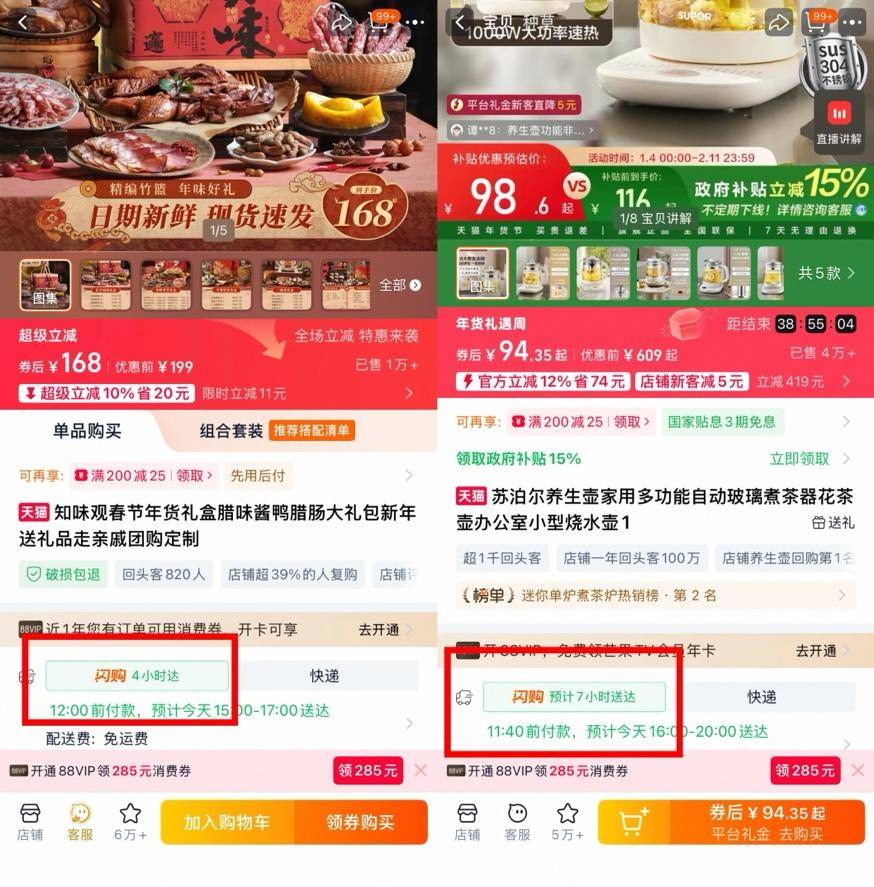
春节期间,天猫超市全国100个重点城市支持正常配送。与去年平均"次日达"的配送效率相比,今年能够至少提前"半天"送到。全国新增34个城市支持天 猫超市闪购,其中,杭州、上海、广州、北京、深圳等13个核心城市,消费者在天猫超市下单后,能够最快4小时送到家。 史上最长春节假期即将到来,淘宝天猫宣布,春节不打烊,闪购快递不放假。 2月12日,淘宝天猫"春节不打烊"活动将正式启动,覆盖整个春节假期。淘宝天猫官方立减商品9折起,全国220个城市正常送货。 值得一提的是,品牌官方旗舰店入驻淘宝闪购,安踏、乔丹、联想、苏泊尔(002032)、倍轻松、良品铺子(603719)、知味观等品牌全力保障应急年货 即时送达,让P人过年也不慌。良品铺子相关负责人介绍,良品铺子全国2000家线下门店均接入了淘宝闪购,春节期间所有门店照常营业,消费者下单 后,最快半个小时就能送货上门。 为点燃春节消费热潮,浙江、江苏、山东等地国补券量加码,消费者购买家电数码等品类,叠加平台大促优惠低至5折,美的、海信、海尔、格力、西门 子、华为、小米等千余品牌参与。此外,天猫送装服务开启"春节不打烊"模式,官方物流、上门安装、售后保障照常运行,确保消费者 ...
港股午评:恒指涨0.54% 科指涨0.84% 创新药概念股走强 AI应用股大涨 智谱涨超21%
Xin Lang Cai Jing· 2026-02-10 04:03
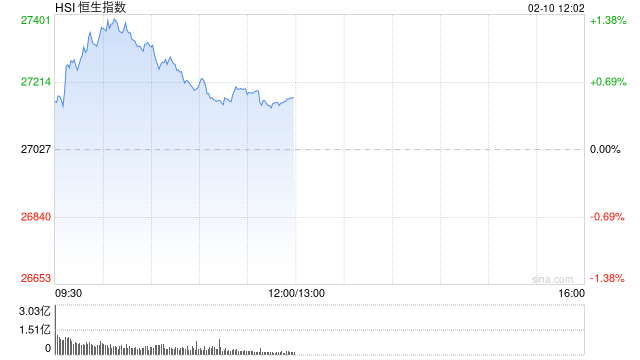
Market Overview - The Hong Kong stock market indices collectively rose, with the Hang Seng Index increasing by 0.54% to 27,172.87 points, the Hang Seng Tech Index up by 0.84%, and the State-Owned Enterprises Index rising by 0.78% [1][9] Technology Sector - Tech stocks showed mixed performance, with Xiaomi, JD.com, and NetEase rising over 2%, while Meituan fell over 3% and Tencent dropped over 1% [1][9] - AI application stocks surged, particularly Zhiyun, which increased by over 21% following the internal testing of ByteDance's Seedance 2.0 video model [2][10] Pharmaceutical Sector - Innovative drug concept stocks collectively rose, with CSPC Pharmaceutical gaining over 6%. The company has entered a platform-level collaboration with AstraZeneca worth up to $18.5 billion [4][12] - The innovative drug sector is experiencing rapid revenue growth, with over 70% of companies expected to achieve positive revenue growth by 2025 [4][12] Consumer Sector - The new consumption concept saw some stocks rise, with Pop Mart increasing by over 4%. The company announced plans to sell over 400 million products globally by 2025 [5][13] New Listings - Two new stocks were listed today, with Lexin Outdoor surging over 121% and Aixin Yuan Zhi rising nearly 1% [6][14]
板块一年暴涨80%,AI 吞噬式需求引爆存储超级周期
3 6 Ke· 2026-02-10 01:15
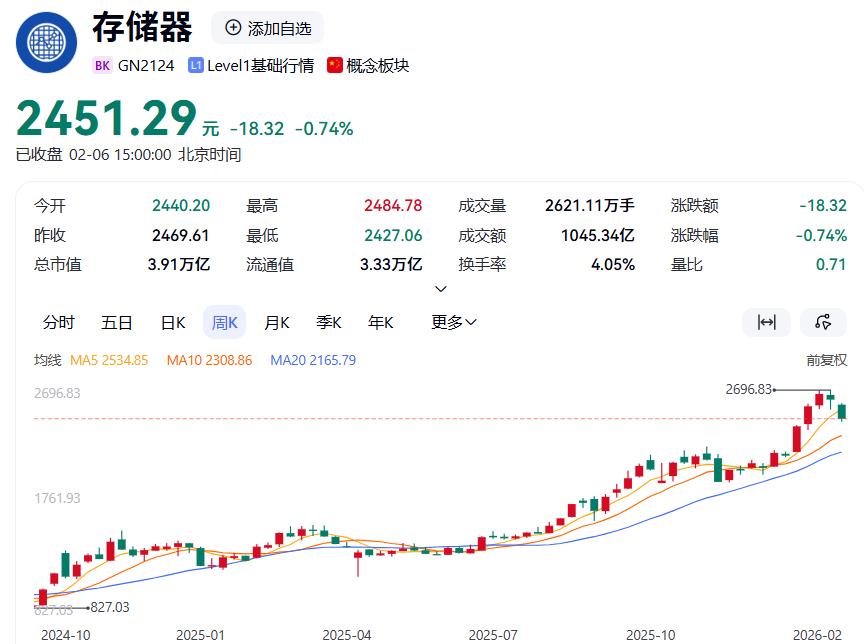
Core Viewpoint - The Chinese storage industry is experiencing a "value reassessment" with a significant surge in stock prices and a 50% increase in the storage sector within a month, marking the onset of a "super bull market" driven by AI demand and domestic production capabilities [1][3][5]. Group 1: Market Dynamics - Over ten trading days, more than 20 stocks hit the daily limit, with companies like Zhaoyi Innovation seeing an 80% increase in ten days and Changjiang Storage achieving a 180% rise this year [3][5]. - The price of 256GB DDR5 server memory has exceeded 50,000 yuan, while the price of 16GB DDR4 memory has surged from 180 yuan to 420 yuan, indicating extreme market volatility [5][7]. - The current demand for AI servers is 8-10 times higher than traditional servers, consuming 53% of global memory production capacity, while supply is constrained due to major manufacturers reallocating 80% of advanced capacity to higher-margin products [7][9]. Group 2: Technological Advancements - The establishment of the domestic storage ecosystem alliance and a 5 billion yuan special fund aims to focus on core technologies such as DRAM and NAND Flash, with significant improvements in efficiency and cost reductions [3][9]. - The HBM3e high-bandwidth memory has achieved mass production, and Changjiang Storage's 232-layer 3D NAND has reduced unit storage costs by 70% [3][9]. - The transition from imported reliance to domestic alternatives in storage chips signifies a major shift in the industry, with the storage cycle moving from "moderate growth" to a "super bull market" [3][9]. Group 3: Financial Performance - SK Hynix's net profit is expected to surge by 119% in Q3 2025, while Samsung's semiconductor business profits are projected to grow by 31.81% [11][12]. - Domestic module manufacturers like Jiangbolong are experiencing a V-shaped recovery, with net profits increasing by 1994% year-on-year [11][12]. - The overall market for storage chips in China is projected to reach nearly 500 billion yuan by 2026, with domestic manufacturers rapidly filling the gap in mature process fields [12][13]. Group 4: Industry Structure and Future Outlook - The storage chip industry is evolving from a traditional cyclical market to a core component of AI infrastructure, necessitating a comprehensive restructuring of the industry chain [13][25]. - The domestic storage industry is poised for a significant rebound in 2026, supported by government initiatives and market demand, with a focus on high-end breakthroughs [25][26]. - Companies that can integrate data, storage, and computing solutions will establish barriers in AI inference, edge computing, and smart terminals, positioning themselves as key players in the storage era [23][25].
莆田老板数据线起家 冲刺H股上市
2 1 Shi Ji Jing Ji Bao Dao· 2026-02-09 12:45
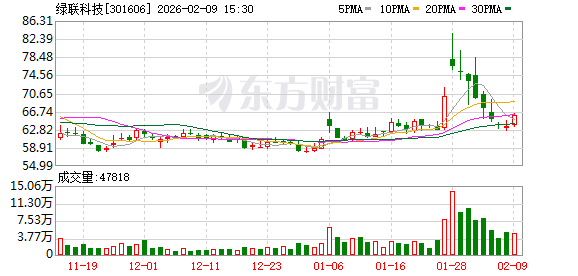
Core Viewpoint - Zhang Qingsen founded Ugreen Technology, transitioning from OEM data cables to establishing a self-branded e-commerce presence, leading to significant revenue growth and market expansion [2][4]. Group 1: Company Growth and Financial Performance - Ugreen Technology's revenue for the first three quarters of 2023, 2024, and 2025 reached approximately 4.801 billion RMB, 6.166 billion RMB, and 6.361 billion RMB, with net profits of 394 million RMB, 460 million RMB, and 467 million RMB respectively [2]. - The company successfully went public on the A-share Growth Enterprise Market, with a market capitalization of 27.301 billion RMB as of February 9, 2024 [3]. - For the full year of 2025, Ugreen expects a net profit of 653 million to 733 million RMB, representing a year-on-year growth of 41.26% to 58.56% [4]. Group 2: Product Diversification and Market Strategy - Ugreen has diversified its product offerings beyond charging accessories to include creative charging products, smart office products, smart audio-visual products, and smart storage products [4]. - In 2025, the revenue breakdown shows that creative charging products accounted for 46.4%, smart office products for 26.2%, smart audio-visual products for 16.0%, and smart storage products for 11.4% [4]. - The company has established a global strategy, with revenue from overseas markets growing faster than domestic markets, achieving a revenue split of 40.4% from China and 59.6% from overseas by the end of Q3 2025 [8]. Group 3: Competitive Landscape and Challenges - Ugreen's market share in the consumer electronics accessory sector is only 1.5%, indicating a highly fragmented industry with low concentration [8]. - The company faces significant competition from major tech firms like Huawei, Xiaomi, and Lenovo, which integrate NAS products into their ecosystems [12]. - Ugreen's NAS products have gained traction after initial setbacks, with revenue from storage products reaching 328 million RMB in 2023 and expected to grow further in 2024 and 2025 [11].
2.9犀牛财经晚报:交易所宣布优化再融资一揽子措施
Xi Niu Cai Jing· 2026-02-09 10:26
Group 1: Financing Measures and Market Reactions - The Shanghai and Shenzhen Stock Exchanges announced a package of measures to optimize refinancing, aiming to support high-quality listed companies and improve refinancing efficiency [1] - The domestic gold jewelry prices have rebounded, with prices reaching 1555-1560 RMB per gram [1] - The lithium carbonate market saw a rebound with prices increasing by over 5% due to improved market sentiment [1] Group 2: Price Adjustments and Market Trends - Major global PC manufacturers, including Lenovo and HP, have initiated price increases due to rising upstream storage costs, with some products seeing price hikes of over 600 RMB in a single day [2] - The storage industry is projected to see significant growth, with its value expected to reach 551.6 billion USD, surpassing that of the wafer foundry sector [2] Group 3: Corporate Developments - The company Dingxin Communications faced penalties for short-term trading by its executive, resulting in a fine of 120,000 RMB [7] - Sanbo Brain Science announced the lifting of a supervisory order against its chairman, allowing normal operations to resume [8] - Jinwei Co. plans to acquire 100% of Fusheng Mining for 210 million RMB, expanding its mining operations [10] Group 4: Project Wins and Acquisitions - Yitong Century won a bid for a project worth 107 million RMB to provide comprehensive maintenance services for China Tower [11] - Jida Communication is expected to receive approximately 51 million RMB from a project with China Mobile [12] - Zhongmin Energy intends to acquire 51% of Fujian Yongtai Mintou Pumped Storage Co. for 864 million RMB [13] Group 5: Financial Performance - Qianjin Pharmaceutical reported a slight revenue increase of 0.13% for 2025, with a net profit growth of 24.74% [17] - Dongwei Technology achieved a significant net profit growth of 86.81% for 2025, with total revenue increasing by 47.65% [18] Group 6: Market Performance - The market saw a strong performance with the ChiNext Index rising nearly 3%, driven by AI applications and other sectors [20]



全球供应紧张,惠普等PC巨头考虑使用中国存储芯片
Sou Hu Cai Jing· 2026-02-05 23:30
Core Viewpoint - The global memory chip market is experiencing a supply-demand imbalance driven by the AI boom, leading to rising memory prices and prompting PC manufacturers like HP and Dell to consider sourcing from Chinese manufacturers such as Changxin Memory [1][2]. Group 1: Supply Chain Dynamics - HP is in the process of certifying products from Changxin Memory to establish alternative supply options, with plans to monitor the memory supply situation until mid-2026 [1]. - Dell is also beginning to certify Changxin Memory's DRAM products due to concerns over continued price increases in memory chips [1]. - Acer and Asus are increasingly relying on mainland Chinese manufacturers for memory chips, with Acer's chairman stating that new production capacity from mainland suppliers could help alleviate current supply tensions [2]. Group 2: Market Competition and Trends - Major memory chip manufacturers like Micron, Samsung, and SK Hynix are prioritizing production for AI giants, leaving the consumer electronics market in a challenging position [1]. - The traditional division of labor in the PC manufacturing sector is shifting, with manufacturers now seeking to leverage their contract manufacturers' supply chain relationships to expand memory procurement channels [5]. - Changxin Memory has captured approximately 5% of the global DRAM market, while Yangtze Memory Technologies is projected to reach about 10% of the NAND market by 2025 [5][6]. Group 3: Impact of Chinese Manufacturers - Chinese manufacturers like Changxin Memory and Yangtze Memory are increasingly influencing the global market, with significant market shares in both DRAM and NAND sectors [5][6]. - Despite being blacklisted by the U.S., Yangtze Memory remains a key player in the NAND flash market and continues to sell solid-state drives internationally [6]. - Analysts believe that the Chinese memory industry is achieving economies of scale in NAND and is expected to enter a similar phase in DRAM soon, making Chinese companies more critical during downturns in the market [6].


【高通(QCOM.O)】FY26Q1业绩符合预期, 内存短缺拖累下游需求——FY26Q1业绩点评(付天姿)
光大证券研究· 2026-02-05 23:08
Core Viewpoint - Qualcomm's FY26Q1 performance met expectations, but the guidance for FY26Q2 fell short due to adverse impacts from memory shortages and price increases affecting downstream demand [4]. Group 1: FY26Q1 Performance - Qualcomm achieved Non-GAAP revenue of $12.252 billion in FY26Q1, slightly above Bloomberg's consensus estimate of $12.196 billion, representing a year-on-year increase of 5% [4]. - The QCT business generated $10.613 billion in revenue, also up 5% year-on-year, while the QTL business reported $1.592 billion, a 4% increase [4]. - Non-GAAP net profit for FY26Q1 was $3.781 billion, exceeding the consensus estimate of $3.690 billion, with Non-GAAP EPS at $3.50, above the expected $3.407 [4]. Group 2: FY26Q2 Guidance - Qualcomm's guidance for FY26Q2 indicates Non-GAAP revenue between $10.2 billion and $11 billion, below the consensus estimate of $11.16 billion [4]. - The projected Non-GAAP diluted EPS for FY26Q2 is between $2.45 and $2.65, compared to the consensus estimate of $2.874 [4]. - The guidance shortfall is primarily attributed to the negative impact of memory shortages and price increases on downstream demand [4]. Group 3: QCT Mobile Business - In FY26Q1, the mobile business revenue was $7.824 billion, reflecting a 3% year-on-year growth, driven by increased shipments of Snapdragon chips [5]. - Qualcomm secured a 75% supply share for high-end smartphone chips for Samsung's upcoming series, and ByteDance's AI smartphone features Qualcomm's Snapdragon Elite chips [5]. - The company anticipates that the ongoing memory chip shortage will constrain the growth of its mobile business in the short term, with FY26Q2 mobile revenue expected to be around $6 billion [5]. Group 4: QCT IoT Business - The IoT business generated $1.688 billion in revenue in FY26Q1, a 9% year-on-year increase, mainly due to higher shipments in edge networking and consumer products [6]. - Qualcomm is expanding its presence in vertical applications, launching new products at CES 2026, including the Dragonwing Q-7790 and Q-8750 for various applications [6]. - The company introduced the Snapdragon X2 Plus chip, enhancing CPU single-core performance by 35% and NPU performance by 78%, with multiple PC products based on Snapdragon showcased at CES [7]. Group 5: QCT Automotive Business - The automotive business reported $1.101 billion in revenue for FY26Q1, a 15% year-on-year increase, driven by higher shipments of vehicles equipped with Qualcomm's smart cockpit technology [8]. - Qualcomm signed a long-term supply agreement with Volkswagen Group, expanding its supply to brands like Audi and Porsche [8]. - The company is collaborating with CARIAD and Bosch to develop autonomous driving systems, indicating progress in its smart driving initiatives [8].

高通(QCOM):FY26Q1业绩符合预期,内存短缺拖累下游需求
EBSCN· 2026-02-05 11:09
Investment Rating - The report maintains a "Buy" rating for Qualcomm (QCOM.O) [6] Core Insights - Qualcomm's FY26Q1 performance met expectations, but the guidance for FY26Q2 fell short due to adverse impacts from memory shortages and price increases affecting downstream demand [1] - FY26Q1 Non-GAAP revenue was $12.252 billion, a 5% year-over-year increase, with Non-GAAP net profit at $3.781 billion [1] - The guidance for FY26Q2 is projected Non-GAAP revenue of $10.2 to $11 billion, below the consensus estimate of $11.16 billion [1] Summary by Sections QCT Mobile Business - FY26Q1 mobile business revenue was $7.824 billion, up 3% year-over-year, driven by increased shipments of Snapdragon chips [2] - Qualcomm secured a 75% supply share for high-end smartphone chips for Samsung's upcoming series [2] - The guidance for FY26Q2 mobile revenue is approximately $6 billion, with expectations of growth being constrained by memory chip shortages [2] QCT IoT Business - FY26Q1 IoT revenue reached $1.688 billion, a 9% year-over-year increase, primarily due to higher shipments in edge networking and consumer products [3] - The company continues to expand into vertical applications in edge networking and industrial IoT, with new products launched at CES 2026 [3] - The PC segment saw the release of the Snapdragon X2 Plus chip, enhancing performance significantly [3] QCT Automotive Business - FY26Q1 automotive revenue was $1.101 billion, a 15% year-over-year increase, attributed to higher shipments of vehicles equipped with Qualcomm's smart cockpit technology [4] - Qualcomm signed a long-term supply agreement with Volkswagen Group, expanding its supply to brands like Audi and Porsche [4] - The company is collaborating with CARIAD and Bosch to develop autonomous driving systems [4] Financial Forecast and Valuation - The report forecasts GAAP net profits of $11.5 billion, $12.5 billion, and $13 billion for FY2026, FY2027, and FY2028 respectively, with growth rates of 107.7%, 8.4%, and 4.2% [4] - The current price corresponds to FY2026-2028 P/E ratios of 14X, 13X, and 12X [4]
