鸿蒙智行

Search documents
春晚40年赞助商变迁史,从康巴丝到机器人见证中国经济跃迁
Sou Hu Cai Jing· 2026-02-18 02:17
Group 1 - The article discusses the evolution of sponsorship in the CCTV Spring Festival Gala over the past 40 years, reflecting changes in Chinese society and consumer behavior [2][3] - The first sponsor, 康巴丝 (Kambas), set a precedent in 1984 by using 3,000 quartz watches as payment, marking the beginning of brand sponsorship in the gala [6][8] - The transition from watches to bicycles as the next major sponsor in 1995 illustrates the shift in consumer goods that represented status during the era of material scarcity [10][12] Group 2 - The late 1990s saw a surge in consumer spending on new household appliances, with 山东孔府宴酒 (Shandong Confucius Banquet Wine) becoming the first "mark king" of the gala in 1995, paying 30.79 million yuan [10][12] - The rapid growth of the liquor industry during this period was fueled by "human consumption," where premium liquor became a social currency [12][14] - The article highlights the consequences of over-reliance on advertising without maintaining product quality, as seen in the case of 秦池酒 (Qin Pool Wine), which faced a significant drop in sales after quality issues emerged [14][15] Group 3 - From the early 2000s, the focus shifted to home appliances, with 美的 (Midea) becoming a prominent sponsor, securing 16 sponsorships from 2003 to 2019 [17][19] - The cost of advertising during the gala increased significantly, with Midea's sponsorship fee rising from 6.8 million yuan in 2005 to 57.2 million yuan in 2011, reflecting the growing viewership [17][19] - The brand storytelling approach adopted by companies like 海尔 (Haier) and 格力 (Gree) during this period indicates a shift towards building emotional connections with consumers [20] Group 4 - The rise of internet companies post-2010 transformed the gala's advertising landscape, with platforms like WeChat leveraging the event for massive user engagement through interactive features like the "red envelope battle" [21][23] - The article notes that the 2015 Spring Festival Gala saw WeChat's user engagement peak, with over 10.1 billion red envelopes sent, showcasing the event's potential as a digital marketing platform [21][23] - The involvement of tech giants in the gala reflects a broader trend of digital economy reshaping traditional advertising methods, with companies like 快手 (Kuaishou) and 抖音 (Douyin) entering the sponsorship arena [25][27] Group 5 - The article concludes by emphasizing the transition from showcasing products to highlighting technological advancements, as seen with the introduction of robots in recent galas [27] - This shift signifies a broader change in China's economic landscape, moving from manufacturing to innovation-driven growth, with a focus on high-tech industries [27] - The future of the Spring Festival Gala sponsorship landscape remains uncertain, raising questions about which industries will dominate the next decade [27]




春晚广告位争夺战:四十年国民记忆与商业暗流
创业邦· 2026-02-17 10:32
Core Viewpoint - The evolution of the Spring Festival Gala sponsorship reflects the changing landscape of China's economy and consumer behavior over the past 40 years, showcasing the transition from material scarcity to technological innovation and brand storytelling [4][24]. Group 1: 1980s to Early 1990s - The 1980s marked a period of material scarcity, where items like watches and radios were symbols of wealth and status, leading to the first brand sponsorship by 康巴丝 (Kangbasi) at the Spring Festival Gala [5][7]. - 康巴丝 sponsored the gala by trading 3,000 quartz watches for advertising, which significantly boosted its brand recognition and sales, reaching an annual production of 1.26 million watches by 1987 [8]. - The sponsorship model evolved, with 中华自行车 (Zhonghua Bicycle) taking over the sponsorship in 1995, reflecting the changing consumer demands and economic conditions [9][14]. Group 2: Mid-1990s to Early 2000s - The mid-1990s saw a surge in consumer spending, with the emergence of "标王" (advertising king) sponsorships, particularly in the liquor industry, exemplified by 山东孔府宴酒 (Shandong Confucius Feast Wine) and 秦池酒 (Qinchijiu) [11][12]. - 秦池酒's sponsorship led to a dramatic increase in sales from 1.8 billion yuan in 1995 to 9.5 billion yuan in 1996, highlighting the impact of gala sponsorship on brand visibility and sales [16]. - The era was characterized by a shift towards consumerism, with brands leveraging the gala to enhance their market presence, although some faced backlash due to quality issues [16]. Group 3: 2000s to Early 2010s - The early 2000s marked the rise of home appliance brands, with 美的 (Midea) becoming a prominent sponsor, securing 11 sponsorships from 2003 to 2014, reflecting the growing importance of brand trust [17][19]. - The cost of advertising skyrocketed, with Midea's sponsorship fee increasing from 6.8 million yuan in 2005 to 57.2 million yuan in 2011, indicating the gala's significant viewership and advertising value [21]. - Brands began to focus on storytelling and emotional connections with consumers, moving beyond mere product promotion to build brand loyalty [23]. Group 4: Mid-2010s to Present - The 2010s saw the rise of internet companies as key players in the advertising space, with platforms like WeChat revolutionizing audience engagement through interactive features like the "red envelope battle" during the gala [25][26]. - The digital transformation of the gala allowed for unprecedented levels of interaction, with WeChat reporting 10.1 billion red envelope transactions on New Year's Eve, significantly enhancing its user base [26]. - The emergence of technology companies in the gala sponsorship landscape reflects a broader shift towards innovation and digital engagement, with brands like Xiaomi and AI robotics showcasing advancements in technology [32].





2026车企新车规划盘点 这些新车值得关注
Zhong Guo Zhi Liang Xin Wen Wang· 2026-02-13 06:54
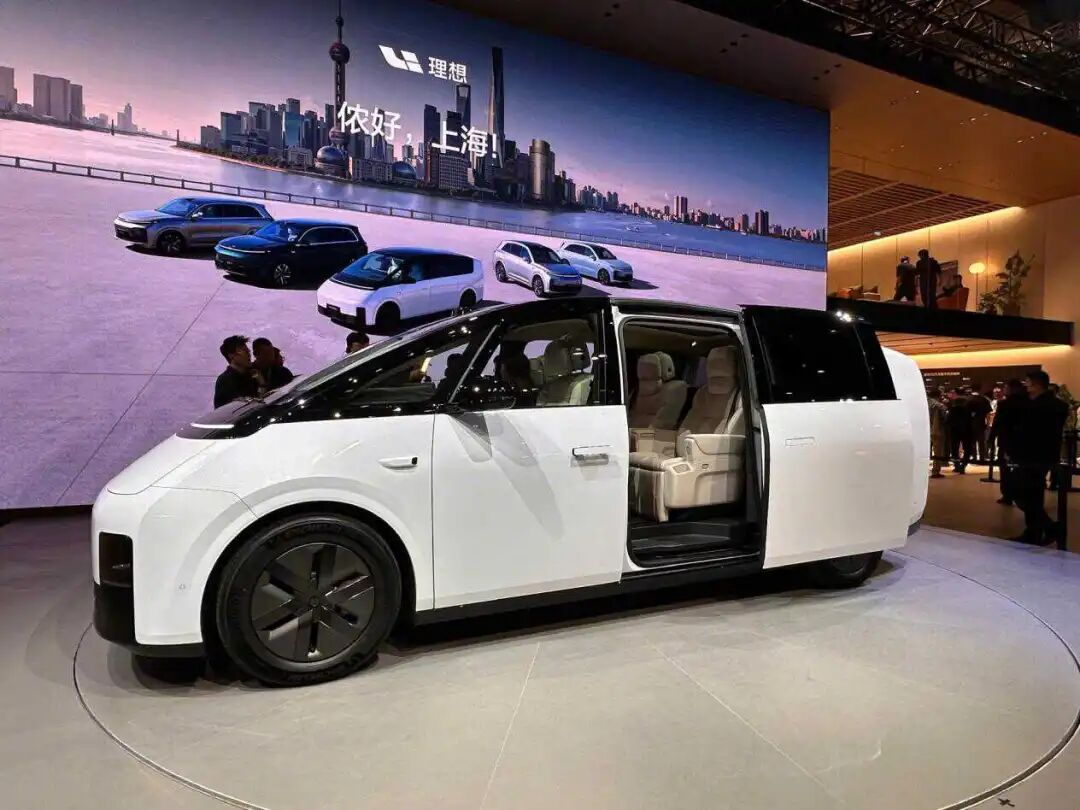
Industry Overview - The domestic automotive industry is entering a new phase focused on quality and efficiency, moving away from price competition to technology innovation and product upgrades to attract consumers [1] - In 2025, domestic passenger car production and sales are expected to reach new highs, with various automakers announcing new vehicle plans across different segments [1] BMW Group - BMW Group plans to launch approximately 20 new models across its three brands by 2026, including the locally produced BMW iX3 long-wheelbase version [2] - The new models will incorporate advanced technologies such as BMW's new generation electric drive technology and AI integration [2][4] Mercedes-Benz - Mercedes-Benz will introduce over 15 new and updated products in 2026, adhering to a strategy of "oil-electric homogeneity" and "oil-electric intelligence" [5] - The lineup will include new models like the long-wheelbase pure electric GLC SUV and the next-generation S-Class sedan [5][7] FAW-Volkswagen - FAW-Volkswagen plans to launch up to 13 new models in 2026, covering fuel, hybrid, and pure electric vehicles [9] - New models will include the all-new Sagitar S, Tayron S, and several Audi models, with a focus on advanced intelligent cockpit and driving assistance systems [9] SAIC Volkswagen - SAIC Volkswagen aims to release at least 7 new energy vehicles in 2026, emphasizing a strategy of "oil-electric co-progression" [11] - The ID.ERA 9X will be the first model in the new ID.ERA series, marking a significant step in the brand's transition to new energy [11] BYD - BYD plans to launch multiple new models across its various brands in 2026, including flagship models in the Dynasty and Ocean series [13] - The company will hold 12 product launch events throughout the year, covering high-end SUVs, performance supercars, and sedans [13] Geely - Geely is expected to introduce over 10 new energy models in 2026, covering various segments such as sedans, SUVs, and MPVs [15] - The Galaxy series will see the addition of new mid-to-large sedans and SUVs, while the Zeekr brand will focus on high-end models [15] Leap Motor - Leap Motor plans to launch 4 new models targeting the mainstream and high-end markets, including a small pure electric SUV and a flagship MPV [17] NIO - NIO will introduce several new models across its three brands, including the flagship ES9 SUV and the L80, a "super five-seat SUV" [18] XPeng Motors - XPeng Motors will launch 7 new "dual-energy" models in 2026, including the new AI luxury SUV [20] - The company emphasizes the integration of self-developed technologies in its new models [20] Hongmeng Zhixing - Hongmeng Zhixing plans to launch 12 new models in 2026, covering a wide price range from family cars to ultra-luxury vehicles [22] - The lineup will include new SUVs and MPVs, with a focus on differentiating market segments [22]


观察|1月车市三把“王座”全部易主
Guang Zhou Ri Bao· 2026-02-13 03:15
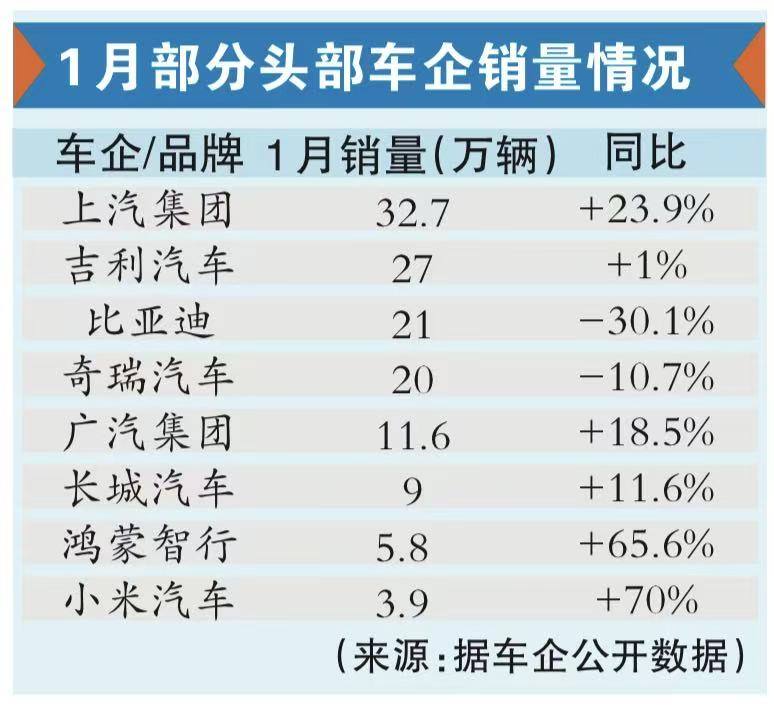
Core Insights - The January sales figures indicate a significant shift in the competitive landscape of the Chinese automotive market, with traditional giants like SAIC and Geely reclaiming leadership positions, while BYD's dominance is challenged [1][3][4] Group 1: Sales Performance - SAIC Group achieved sales of 327,000 vehicles in January, marking a year-on-year increase of 23.9% [2][4] - Geely Automotive sold 270,100 vehicles, a year-on-year growth of 1%, surpassing BYD to become the top-selling domestic brand [2][4] - BYD's sales fell to 210,000 vehicles, experiencing a significant year-on-year decline of 30.1% [2][4] - New energy vehicle sales for SAIC reached 85,000 units, growing by 39.7% [4] - The overall automotive production and sales in January were 2.45 million and 2.346 million units, respectively, with a slight year-on-year production increase of 0.01% [7] Group 2: New Players and Market Dynamics - The new energy vehicle segment saw a reshuffling, with Hongmeng Zhixing leading the new force with 57,915 units sold, a remarkable year-on-year increase of 65.6% [6] - Xiaomi Automotive followed closely with over 39,000 units sold, achieving a year-on-year growth of approximately 70% [6] - The previous leaders in the new force segment, such as Leap Motor, have seen a decline, with their sales dropping to 32,059 units [6] Group 3: International Market Growth - The overseas market is identified as a key growth area for automotive companies, with January exports reaching 681,000 vehicles, a year-on-year increase of 44.9% [7] - Exports of new energy vehicles doubled to 302,000 units, highlighting the importance of global expansion for competitive advantage [7]



电厂 | 汽车深陷“黑公关”泥潭:谁在制造有利可图的温床
Xin Lang Cai Jing· 2026-02-12 11:16
Core Viewpoint - The article discusses the impact of malicious public relations and online water army attacks on the automotive industry, particularly focusing on Li Auto's MEGA model and the broader implications for the industry as a whole [1][2][18]. Group 1: Li Auto's MEGA Launch and Negative Publicity - Li Auto's first pure electric model, MEGA, launched in March 2024, did not meet initial sales expectations of 8,000 units per month due to negative publicity and malicious interpretations circulating on social media [1][2]. - The negative sentiment was exacerbated by a coordinated attack involving altered promotional content and derogatory associations with the vehicle, leading to a loss of at least 10 confirmed orders from customers who had previously made deposits [1][2][18]. - The severity of the situation prompted Li Auto to conduct internal research to assess the impact of these negative narratives on consumer perception and order changes [1][2]. Group 2: Investigation and Industry Context - In April 2024, police in Hebei launched an investigation into the "black public relations" incident related to Li Auto MEGA, uncovering involvement from at least four other automotive companies and their agencies [2][4]. - Li Auto's CEO, Li Xiang, described the incident as one of the largest smear campaigns in automotive history, reflecting a troubling trend within the Chinese automotive industry over the past few years [2][4]. Group 3: Organized Attacks and Industry Response - A police operation in December 2025 dismantled a network responsible for spreading negative information about electric vehicles, involving multiple companies, including Xiaomi and Li Auto [4]. - Li Auto identified a pattern of coordinated attacks characterized by the use of multiple accounts to disseminate false information, particularly during new product launches, which is a common tactic in the industry [6][11]. - The company reported that negative comments about the Li i8 model reached 30% of total comments during its pre-launch period, significantly higher than the typical rate for new automotive products [6][7]. Group 4: Financial Impact and Strategic Adjustments - The negative publicity surrounding the MEGA model led to a market value loss of over 180 billion yuan within just ten days of its launch, with ongoing discussions about its design continuing to affect the brand's long-term value perception [18]. - As a result of the backlash, Li Auto had to invest approximately 2 billion yuan to redesign its product line, indicating the substantial financial implications of the negative publicity [18]. Group 5: Broader Industry Implications - The phenomenon of black public relations and online water army attacks has become a widespread issue in the automotive sector, affecting various companies, including NIO and Leado, which have also faced similar challenges [11][12]. - The rise of social media and the competitive landscape has intensified the focus on "traffic" as a critical element for automotive companies, inadvertently providing fertile ground for malicious activities [24][25][26]. - The interconnectedness of traffic, sales, and corporate image has created a challenging environment where the growth of online engagement can lead to increased vulnerability to smear campaigns, complicating the relationship between brand reputation and market performance [26].

乘联分会:1月全国乘用车市场零售154.4万辆 新能源车渗透率为38.6%
智通财经网· 2026-02-12 06:41
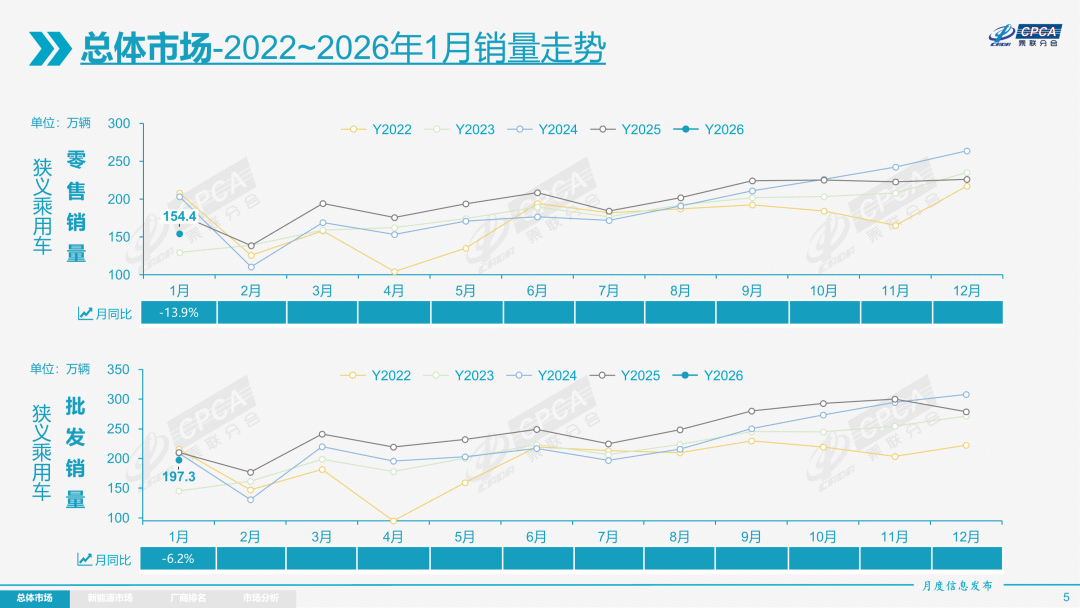
Core Insights - The overall retail sales of passenger cars in January decreased by 13.9% year-on-year, with a total of 1.544 million units sold. The retail sales of new energy vehicles (NEVs) reached 596,000 units, representing a penetration rate of 38.6%, down 3 percentage points from the previous year [1][11]. Retail Market Overview - In January, the retail sales of self-owned fuel passenger cars were 250,000 units, up 17% year-on-year, while self-owned NEVs sold 226,000 units, marking a significant increase of 115%. NEVs accounted for 47.5% of self-owned exports, indicating growing international influence [2]. - The retail sales of self-owned brands totaled 890,000 units, down 18% year-on-year, with a domestic market share of 57.5%, a decrease of 3.5 percentage points [2]. - Mainstream joint venture brands sold 470,000 units, down 4% year-on-year, with German brands increasing their market share to 19.8%, up 1.4 percentage points [2]. Production and Wholesale Analysis - In January, the production of passenger cars was 2.003 million units, down 4.4% year-on-year. The wholesale volume was 1.973 million units, a decrease of 6.2% year-on-year [4]. - The wholesale of self-owned brands was 1.326 million units, down 8%, while luxury car wholesale increased by 4% to 228,000 units [4]. - The overall wholesale landscape is changing, with some mid-tier companies showing strong performance, such as SAIC-GM-Wuling and NIO [4]. New Energy Vehicle Insights - The production of NEVs reached 938,000 units, a slight decrease of 0.6% year-on-year, while wholesale sales were 864,000 units, down 3.3% [5][6]. - NEV retail sales were 596,000 units, down 20% year-on-year, with conventional fuel vehicles selling 948,000 units, down 10% [7]. - NEV exports reached 286,000 units, a remarkable increase of 103.6%, accounting for 49.6% of total passenger car exports [11][12]. Market Trends and Future Outlook - The new energy vehicle market is expected to face challenges in February due to the impact of the Spring Festival, which may lead to lower sales volumes [16]. - The transition from merely selling cars to exporting entire industrial chains is anticipated, indicating a shift towards quality growth in the automotive export sector [17].


1月车企OTA内容盘点:安全与体验双升级
Zhong Guo Zhi Liang Xin Wen Wang· 2026-02-11 07:28
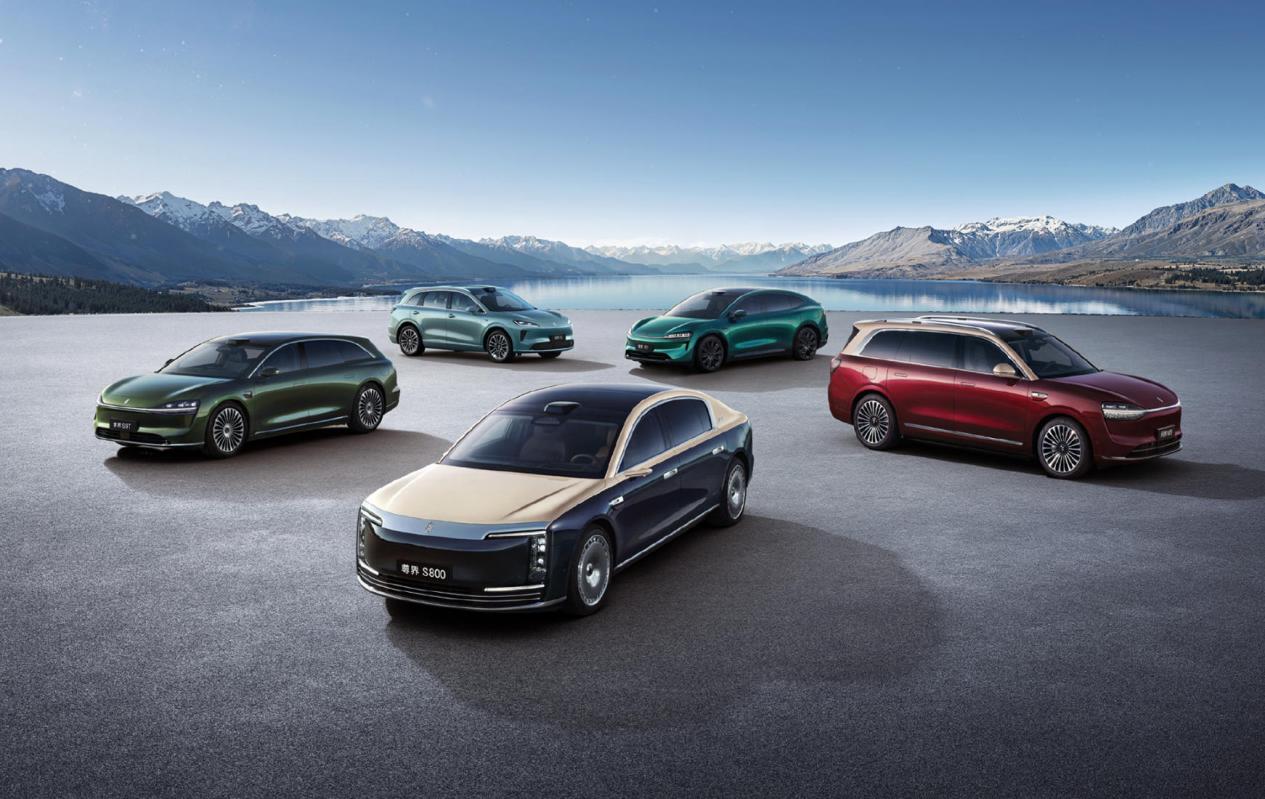
Core Insights - The automotive industry is experiencing a surge in Over-The-Air (OTA) updates in January 2026, with major manufacturers focusing on smart driving, cabin interaction, and active safety features [1] Group 1: Hongmeng Zhixing - Hongmeng Zhixing launched its first OTA update of 2026 on January 30, introducing 63 new features and 31 experience optimizations across five brands [2] - The update enhances smart driving capabilities, improving vehicle stability and decision-making in scenarios like lane changes and emergency steering [4] - Cabin interaction improvements include a more natural voice assistant and personalized experiences, such as exclusive voice packs for specific models [4] Group 2: Deep Blue Automotive - Deep Blue Automotive announced a new round of OTA updates on January 24, focusing on specific models like the Deep Blue L06 and S07 [5] - The updates include enhancements to the smart driving assistance system and the introduction of practical features like lane-level navigation [7] Group 3: Dongfeng Nissan - Dongfeng Nissan's N7 model received an OTA update on January 27, focusing on cabin comfort features and real-time monitoring of occupants' health [8][10] - The update also includes improvements to the driving assistance system and voice interaction capabilities [10] Group 4: Zeekr Automotive - Zeekr Automotive initiated an OTA update in January, introducing 37 new features across multiple models [11] - Key enhancements include lane-level navigation, AI-generated customizations, and emergency parking assistance for safety [13] Group 5: Tengshi Automotive - Tengshi Automotive's N9 model received a significant OTA update on January 30, focusing on smart driving, cabin interaction, and range management [14] - The update includes advanced features like emergency steering assistance and adaptive display adjustments for improved user experience [16] Group 6: Extreme Fox Automotive - Extreme Fox Automotive pushed an upgrade on January 31 for its Alpha S5 and T5 models, focusing on navigation enhancements [17] - New features include real-time traffic light countdowns and charging station recommendations based on remaining battery life [17]
“我是大彬同学”被判赔偿鸿蒙智行150万
新华网财经· 2026-02-11 07:20
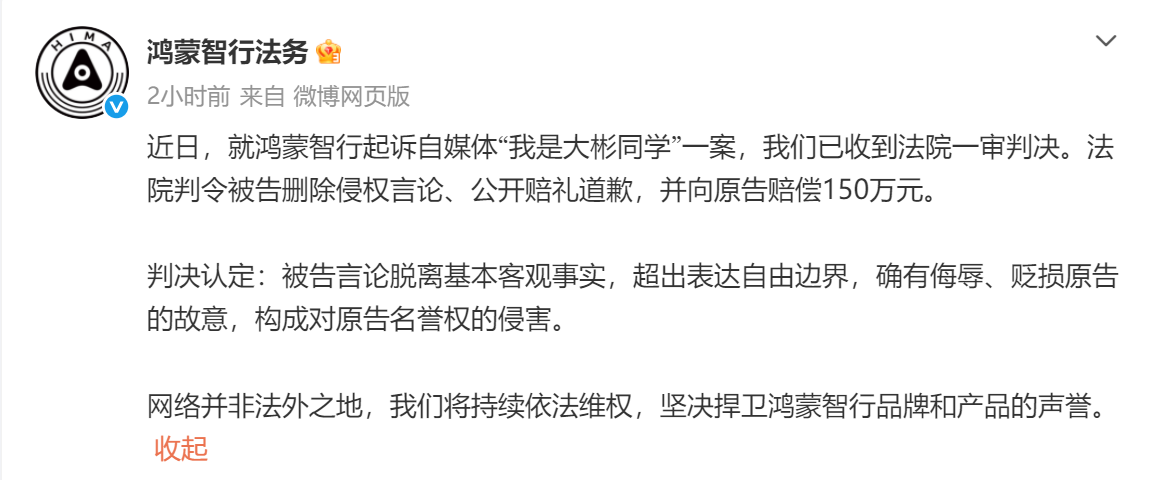
2月11日,鸿蒙智行法务发布公告,称起诉自媒体"我是大彬同学"一案,已收到法院一审判决。 公告表示, 近日,就鸿蒙智行起诉自媒体"我是大彬同学"一案,我们已收到法院一审判决。法院判令被告删除侵权言论、公开赔礼道歉, 并向原告赔偿150万元。 判决认定:被告言论脱离基本客观事实,超出表达自由边界,确有侮辱、贬损原告的故意,构成对原告名誉权的 侵害。 去年3月,鸿蒙智行法务官方微博宣布正式起诉自媒体"我是大彬同学",称根据网友线索和前期搜集证据,发现该自媒体及其相关矩阵账号 据鸿蒙智行方面披露,经网友线索反馈及前期证据搜集核实,该自媒体及其关联矩阵账号长期在多个网络平台发布针对鸿蒙智行品牌及产 品的不实信息和侮辱性言论,对品牌声誉造成不良影响 。 鸿蒙智行法务表示,"网络并非法外之地,我们将持续依法维权,坚决捍卫鸿蒙智行品牌和产品的声誉。" 当前新能源汽车行业竞争日趋白热化,部分自媒体为博取流量、谋取不当利益,不惜编造虚假信息、恶意抹黑企业及产品,形成行业乱 象。多家新能源车企都遭遇到自媒体恶意诋毁,并纷纷通过法律途径捍卫自身合法权益。 截至目前,自媒体"我是大彬同学"方面尚未就该一审判决作出回应。1月16日,其 ...
鸿蒙智行诉“我是大彬同学”案一审胜诉:获赔150万
Xin Lang Cai Jing· 2026-02-11 05:58
鸿蒙智行法务今日发文称,起诉自媒体"我是大彬同学"一案,已收到法院一审判决。法院判令被告删除 侵权言论、公开赔礼道歉,并向原告赔偿150万元。 判决认定:被告言论脱离基本客观事实,超出表达自由边界,确有侮辱、贬损原告的故意,构成对原告 名誉权的侵害。 鸿蒙智行强调,网络并非法外之地,将持续依法维权,坚决捍卫鸿蒙智行品牌和产品的声誉。 鸿蒙智行法务今日发文称,起诉自媒体"我是大彬同学"一案,已收到法院一审判决。法院判令被告删除 侵权言论、公开赔礼道歉,并向原告赔偿150万元。 判决认定:被告言论脱离基本客观事实,超出表达自由边界,确有侮辱、贬损原告的故意,构成对原告 名誉权的侵害。 鸿蒙智行强调,网络并非法外之地,将持续依法维权,坚决捍卫鸿蒙智行品牌和产品的声誉。 去年3月,鸿蒙智行正式起诉自媒体"我是大彬同学",称该账号及其相关矩阵账号,一直在各平台上肆 意发布不实及侮辱性言论,造谣诋毁鸿蒙智行品牌及产品,通过夸大炒作不实信息和负面话题,挑起群 体极端对立情绪,扰乱网络秩序,误导社会公众,严重降低鸿蒙智行品牌及产品的社会评价,损害鸿蒙 智行品牌声誉。 责任编辑:王翔 去年3月,鸿蒙智行正式起诉自媒体"我是大彬 ...
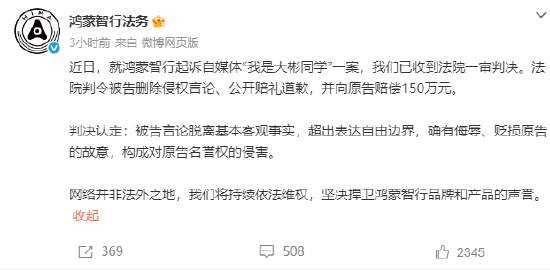
鸿蒙智行法务:法院判令“我是大彬同学”赔偿150万元
Mei Ri Jing Ji Xin Wen· 2026-02-11 04:37
每经AI快讯,2月11日,鸿蒙智行法务官方微博发文称,近日,就鸿蒙智行起诉自媒体"我是大彬同学"一案,我们已收到法院一审判决。法院判令被告删除 侵权言论、公开赔礼道歉,并向原告赔偿150万元。判决认定:被告言论脱离基本客观事实,超出表达自由边界,确有侮辱、贬损原告的故意,构成对原告 名誉权的侵害。 ...