泸州老窖

Search documents
食品饮料行业周报:行业继续筑底,关注高股息品种-20251012
Shenwan Hongyuan Securities· 2025-10-12 11:13
Investment Rating - The report maintains a "Positive" investment rating for the food and beverage industry, with a focus on structural opportunities within the sector [2][3]. Core Insights - The industry is in a bottoming phase, particularly for the liquor segment, which requires patience as it undergoes inventory destocking and price stabilization. The report emphasizes the importance of identifying structural opportunities in food companies [3][7]. - Key recommendations include high-dividend stocks such as Guizhou Moutai, Shanxi Fenjiu, and Luzhou Laojiao in the liquor sector, and Yili, Qingdao Beer, and Uni-President in the consumer goods sector [3][7][9]. - The report anticipates a 20-30% year-on-year decline in overall liquor demand during the 2025 Mid-Autumn Festival and National Day, with inventory levels expected to increase by 10-20% [8][9]. Summary by Sections 1. Weekly Insights on Food and Beverage - The food and beverage sector experienced a slight decline of 0.15% last week, with liquor down 1.17%, underperforming the Shanghai Composite Index by 0.52 percentage points [6][32]. - The report highlights the performance of various sub-sectors, noting that beverage and dairy products outperformed the benchmark index [32]. 2. Market Performance of Food and Beverage Sectors - The report indicates that the beverage and dairy sector outperformed the benchmark index by 3.16 percentage points, while the liquor sector underperformed by 0.75 percentage points [32][38]. 3. Liquor Sector Analysis - Current prices for Moutai are 1765 RMB for loose bottles and 1795 RMB for boxed sets, both down 35 RMB from the previous period. The report expects continued pressure on liquor companies' financials through Q3 2025 [8][14]. - The report notes that the liquor industry is entering a destocking phase, with a significant time required for inventory digestion and price stabilization [8][9]. 4. Consumer Goods Sector Analysis - The report maintains a positive outlook on the dairy sector, citing cost reductions and supply-demand improvements as key trends. Recommendations include Yili and New Dairy [9][30]. - The snack and beverage segments are highlighted for their structural growth opportunities, with specific recommendations for companies like Uni-President and Wei Long [9][30].





食品饮料周观点:秋糖在即,关注品类、渠道等边际反馈-20251012
GOLDEN SUN SECURITIES· 2025-10-12 09:43
Investment Rating - The report maintains an "Increase" rating for the food and beverage industry [5] Core Views - The upcoming autumn sugar festival is expected to provide insights into brand strategies, product matrices, and channel transformations in the liquor sector, particularly focusing on new channel developments [2] - The report highlights that the white liquor sector is currently at a double bottom in terms of fundamentals and expectations, with further sales improvements anticipated during the Mid-Autumn Festival and National Day [2] - The beverage sector is seeing significant competition and innovation, with companies like East Peak Beverage accelerating their listing process on the Hong Kong Stock Exchange [3] Summary by Sections White Liquor - The autumn sugar festival will focus on terminal sales dynamics, inventory pricing, channel changes, and category expansion [2] - The report anticipates that Q3 financial results will show continued pressure release, with expectations for gradual improvement in sales and channel performance [2] Beer and Beverages - The report notes organizational changes at Lanzhou Yellow River, which has established a beverage division to seek higher growth [3] - The beer sector is entering a low season, and the report suggests focusing on stable growth leaders and key products [3] - East Peak Beverage's renewed application for a public listing indicates a fast-tracking of its dual listing strategy [3] Food Sector - The Mid-Autumn Festival and National Day have been identified as critical periods for consumer spending, with online sales leading the growth [4] - The report mentions that the sales of mooncakes reached 13.98 million boxes, a year-on-year increase of 1.75% [4] - Wanchen Group has received clearance from the State Administration for Market Regulation regarding its anti-monopoly review, allowing it to recover minority shareholder rights [4]
五粮液/泸州老窖/神农架酒业/黔醉酒业纳新|酒业招聘
Xin Lang Cai Jing· 2025-10-12 07:36
Core Insights - The article focuses on recruitment opportunities within the liquor industry, specifically highlighting job openings at Wuliangye Group for various positions across different levels and functions [2]. Recruitment Overview - Wuliangye Group is actively recruiting for both campus and social recruitment, with a diverse range of positions available [2]. - The recruitment includes roles in strategic research, economic operation management, legal affairs, human resources, auditing, new product development, and various operational roles [2][4]. Job Positions and Requirements - **Campus Recruitment**: Positions include strategic research and management, economic operation management, legal affairs management, human resources specialist, and various technical roles such as brewing technology researchers and supply chain management [2][4]. - **Social Recruitment**: Positions include software development, medical roles, and operational roles such as packaging operators and fire control operators [2][4]. Candidate Criteria - Candidates must be 2026 graduates, with specific educational backgrounds required for each position, including degrees in economics, management, engineering, and law [4][6]. - Additional requirements include proficiency in office software, strong communication skills, and the ability to work in a team [4][6][10]. Assessment Methods - The recruitment process includes a combination of written tests (40%) and interviews (60%) for most positions, ensuring a comprehensive evaluation of candidates [4][6][10].

文旅商深度融合的“酒城”方案
Mei Ri Jing Ji Xin Wen· 2025-10-12 03:35
Core Insights - During the National Day and Mid-Autumn Festival holiday, Luzhou emerged as a surprising tourism destination, with a 45% increase in travel orders compared to last year [1] - From October 1 to 8, Luzhou's major commercial areas attracted 9.35 million visitors, generating a consumption of 649 million yuan, a year-on-year increase of 37.6% [1] - The surge in tourism and consumption was driven by various cultural and sports events, including a music festival and a local football match [1][3] Tourism and Events - Luzhou hosted multiple events that significantly boosted local tourism, including a music concert by the local band "San Tiao Che," which attracted over 52,000 attendees and generated more than 15 million yuan in surrounding consumption [1][6] - The Luzhou Wine Festival and Galaxy Left Bank Music Festival saw participation from 150,000 young music fans, with over 88% of attendees coming from outside the city [1][6] - The local football match on October 8 attracted 14,000 fans, further contributing to the city's vibrant atmosphere during the holiday [1] Cultural and Economic Transformation - Luzhou is transitioning from being known primarily as a "wine city" to a more diversified cultural and tourism hub, integrating music, sports, and commerce [3][4] - The city has actively pursued the integration of cultural, tourism, and commercial sectors to enhance its brand and attract younger demographics [3][9] - Luzhou's government has shown proactive engagement in addressing visitor concerns, achieving a high problem resolution rate during the events [10] Young Consumer Engagement - The city is focusing on appealing to younger consumers by modernizing its cultural offerings, such as the introduction of music festivals that resonate with the youth [9][13] - Luzhou's music festival featured a "micro-drunk" experience area, showcasing local liquor brands and innovative products aimed at younger audiences [13][15] - The city is also enhancing its nightlife and cultural experiences through themed street renovations that attract young visitors [15][16] Future Developments - Luzhou is set to establish the Sichuan China Baijiu Museum, which aims to be a world-class industry museum, further embedding the city in the narrative of Chinese liquor culture [19][21] - The city is developing a new cultural district named "Wine Festival," which will serve as a hub for cultural and commercial activities, reinforcing its status as a regional center [21][22] - Luzhou's strategy includes promoting low-alcohol and experiential products to connect with younger consumers and enhance the local liquor industry's appeal [22]

透过双节酒市窥见行业的“三重变革”时代:价格带分化、区域重构与渠
Sou Hu Cai Jing· 2025-10-12 00:42
Core Insights - The dual festival period of National Day and Mid-Autumn Festival in 2025 did not yield the expected sales peak for the liquor industry, with retail and catering sales only growing by 3.3% year-on-year, indicating a significant slowdown compared to the May Day holiday [1][3] - The liquor market is experiencing a structural transformation driven by rational consumption, channel revolution, and brand resilience, highlighting both challenges and opportunities for the industry [3] Market Performance - High-end liquor brands showed stable sales during the dual festival period, benefiting from effective volume control and price maintenance strategies, which helped stabilize core product pricing [3][4] - In contrast, mid-range and lower mid-range liquors faced significant challenges, with many products seeing price drops from the 400 yuan range to 200-300 yuan, and sales volumes declining by over 30% for most brands [4][6] - Low-end liquor performed relatively well, with some star products experiencing over 20% year-on-year sales growth, reflecting a shift towards value-for-money consumption [6][8] Regional Variations - The overall liquor market in Sichuan saw a year-on-year sales decline of approximately 20%, with significant drops in the Chengdu market [9][11] - In Guangdong, liquor sales also fell by 20-30% year-on-year, with a notable reduction in corporate group orders and a shift towards lower-priced products [9][11] - The Anhui market saw an increase in banquet events, but the average spending per table decreased, indicating a shift in consumer behavior [11][12] - The Henan market displayed structural opportunities, with some brands achieving growth through product innovation and cultural marketing [12] - Northern provinces like Shandong and Hebei showed signs of recovery, benefiting from a faster rebound in banquet markets [12] Channel Evolution - The liquor industry is undergoing a digital transformation in its channel ecosystem, with major brands adopting instant retail strategies to enhance consumer access [13][15] - Instant retail channels saw significant growth during the dual festival period, with sales on platforms like Meituan increasing by 8 times year-on-year [13][15] - The rise of instant retail reflects a shift in consumer habits towards immediate satisfaction, with younger consumers (aged 25-35) making up over 45% of buyers on these platforms [15][16] Future Trends - The liquor industry's competition is shifting from traditional brand and channel advantages to a more comprehensive competition based on digital capabilities, including data insights and supply chain efficiency [16] - The future of liquor consumption is expected to be characterized by rational, diverse, and instant purchasing behaviors, necessitating a reevaluation of product positioning and marketing strategies by companies [16]



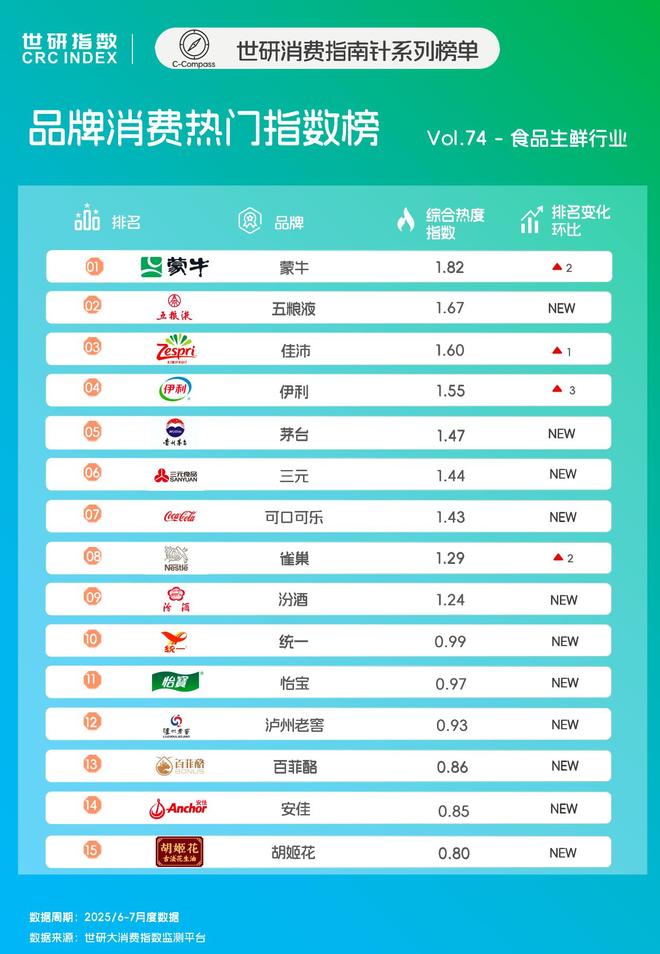
乳品聚焦夏季营养补给,特色食材价值重构|世研消费指数品牌榜Vol.74
3 6 Ke· 2025-10-11 11:04
Group 1 - The core viewpoint of the articles highlights the innovation in the dairy industry, focusing on health technology and targeted nutritional solutions to meet summer dietary needs [2] - Major dairy brands such as Mengniu, Yili, and San Yuan are leveraging biotechnological breakthroughs to address specific consumer pain points, such as children's immunity and digestive sensitivity [2] - The report indicates a shift from homogeneous nutritional offerings to precise health management, driven by technological advancements and unique processing methods [2] Group 2 - The scarcity attributes of specialty ingredients are reshaping their value, with brands like Zespri and Hu Jihua enhancing product appeal through health claims and cultural connections [3] - Zespri is positioning its products as "healthy luxury symbols" by utilizing unique varieties and premium packaging, while Hu Jihua emphasizes traditional craftsmanship to differentiate its peanut oil [3] - Brands like Coca-Cola and Yibao are effectively tapping into basic consumer needs, transforming their products into emotional and experiential offerings [3] Group 3 - The report outlines a comprehensive index evaluation system developed by Shiyan Index, which includes various consumption trend reports across multiple industries [4] - The index aims to objectively present trends in consumer behavior, assisting brands and industries in tracking market dynamics and enhancing competitive strength [4]

白酒“上车”即时零售,千亿风口下的狂欢与隐忧|行业风向标
Sou Hu Cai Jing· 2025-10-10 15:47
Core Viewpoint - The article highlights the contrasting performance of the liquor market, with offline sales remaining sluggish while online sales, particularly through instant retail platforms, are booming. This shift indicates a significant transformation in the retail landscape, driven by the rise of instant retail and the active participation of liquor companies in this new channel [2][3][5]. Group 1: Market Dynamics - Instant retail is evolving from a niche e-commerce model to a mainstream channel, with a projected penetration rate in the liquor sector expected to rise from 1% in 2023 to 6% by 2027, potentially reaching a market size of hundreds of billions [2][3]. - Major players in the instant retail space include comprehensive e-commerce platforms like Meituan and JD, which have significantly increased their market presence and sales volumes [3][4]. - Meituan's flash purchase service has seen explosive growth, with a reported 90-fold increase in liquor sales during the "618" shopping festival, and daily order peaks surpassing 1.5 billion [4]. Group 2: Company Strategies - Liquor companies are increasingly taking proactive roles in the instant retail space, with 34.9% of them prioritizing the expansion of this channel [5][7]. - Guizhou Moutai has initiated deep collaborations with platforms like Taobao Flash Purchase, offering rapid delivery services to enhance consumer access to their products [5][6]. - Other liquor brands, such as Guotai and various major Chinese liquor companies, are also forming strategic partnerships with instant retail platforms to establish a comprehensive authenticity assurance system [6][7]. Group 3: Consumer Behavior - The shift towards instant retail reflects changing consumer preferences, with a growing demand for immediate gratification in purchasing liquor, particularly for gifts and social occasions [7][8]. - Younger consumers, who are accustomed to instant delivery services, represent a key demographic for liquor brands looking to expand their market reach [9]. Group 4: Challenges and Concerns - The rise of instant retail poses risks to the traditional pricing structure of the liquor industry, with potential price wars threatening the profitability of distributors and manufacturers [10][11]. - Concerns about the role of traditional distributors evolving into mere delivery agents for platforms, along with the risk of counterfeit products, highlight the challenges facing the industry [11][12]. - The need for a balance between the efficiency of online sales and the experiential aspects of in-store purchases remains a critical issue for the industry [12][13].

食品饮料行业深度报告:食品饮料:存量时代的品牌突围路径
Capital Securities· 2025-10-10 13:12
Investment Rating - The report rates the food and beverage industry as "Positive" [1] Core Insights - The food and beverage sector is entering a "stock era" where consumption per capita has peaked, leading to dual pressure on volume and price. This shift necessitates a change in investment logic, with leading companies focusing on shareholder returns and high dividend yields to provide a safety margin [5][18] - Brands are adapting to the trend of consumption substitution by enhancing product cost-effectiveness or quality-price ratios, which may lead to a restructuring of the industry landscape [5] - There are localized opportunities benefiting from consumption upgrades, particularly in categories like juice and liquid milk, where consumers are willing to pay more for improved quality [5] - The emergence of niche products catering to specific consumer groups, particularly among Generation Z, is noted, with these products often having emotional attributes and social relevance [5] - Changes in traffic and channel dynamics present new opportunities for smaller and new brands, with the growth of discount supermarkets and high-end membership stores expected to drive industry growth [5] - Domestic food and beverage brands are increasingly looking to expand overseas, particularly in Southeast Asia, where the market for snacks is projected to exceed $20 billion in 2024, presenting significant growth potential [5] Summary by Sections 1. Characteristics of the Stock Era - The overall consumption market has shown moderate recovery, with retail sales in China reaching 32.39 trillion yuan from January to August 2025, a year-on-year increase of 4.6% [14] - The food and beverage industry shows internal differentiation, with some sub-sectors like fresh meat and edible oils experiencing growth, while others like liquor and beer face declines [15] 2. Brand Breakthrough Paths in Food and Beverage - The report emphasizes the importance of enhancing product value propositions to maintain competitive advantages amid rising consumption substitution trends [5] - It highlights the significance of localized consumption upgrades in specific product categories, which can drive higher consumer spending [5] 3. Sub-industry Analysis - The report provides detailed insights into various sub-industries, including liquor, beer, dairy products, condiments, snacks, and soft drinks, analyzing their performance and market dynamics [7] 4. Investment Recommendations - The report suggests that leading companies in the food and beverage sector are increasingly focusing on shareholder returns, with a notable rise in dividend rates, particularly in the liquor industry [33]
动作连连,剑南春做好上市准备了吗?
Sou Hu Cai Jing· 2025-10-10 10:16
Core Viewpoint - The recent investment by state-owned assets in Jian Nan Chun is seen as a significant step towards resolving historical disputes and paving the way for a potential IPO in the future [5][6][10]. Group 1: Investment and Shareholding Changes - Mian Zhu state-owned assets have invested 137 million yuan to become the second-largest shareholder of Jian Nan Chun Group, holding 14.51% of the shares [5]. - Jian Nan Chun Group plans to reduce its holdings in Huaxi Securities by 26.25 million shares, amounting to approximately 255 million yuan based on the closing price [5][11]. - The entry of state-owned assets is interpreted as a resolution of past conflicts, which may facilitate Jian Nan Chun's future listing [6][10]. Group 2: Company Background and Historical Context - Jian Nan Chun has a long history dating back 1500 years, originally serving as a royal wine during the Tang Dynasty [7]. - The company underwent privatization in 2004, with the management team led by Qiao Tianming acquiring a majority stake [8]. - Jian Nan Chun Group has multiple business segments, with the main asset being the Jian Nan Chun brand, which has been planning for an IPO for years [8]. Group 3: Financial Performance and Market Position - Jian Nan Chun's projected revenue for 2024 is 10.66 billion yuan, with a net profit of 3.057 billion yuan, indicating a growth of 14.87% and 17.76% respectively [12]. - Compared to other major liquor companies, Jian Nan Chun is positioned behind brands like Moutai and Wuliangye but ahead of competitors like Shunxin Agriculture [13][14]. - The company aims to achieve a revenue target of 30 billion yuan by 2025, which may be challenging given its current market position [14].

品牌控价的核心处理方法有哪些
Sou Hu Cai Jing· 2025-10-10 09:47
Core Viewpoint - Brand price control is essential for market positioning, profit margins, and consumer trust, requiring a systematic approach that includes prevention, monitoring, handling, and optimization [1] Group 1: Communication and Legal Measures - Communication with violating sellers through various channels (phone, email, etc.) is crucial, using documents like "Price Maintenance Letters" and "Lawyer Letters" to enhance deterrence [3] - Agreements with distributors should specify minimum prices and penalties for violations to control pricing behavior from the source [3] - Intellectual property complaints can be filed against infringement actions, such as unauthorized use of brand logos, to request the removal of violating links [3] Group 2: Channel and Source Control - Establishing a strict authorization system allows only authorized distributors to sell products, utilizing technologies like QR codes and invisible anti-counterfeiting codes to track product flow [3] - Conducting source investigations on offline channels helps control pricing inconsistencies [3] Group 3: Diverse Price Control Methods - Brands should implement a combination of strategies for effective price control, including tiered handling and reward-punishment mechanisms [4] - Flexible communication can guide compliance through rebates for first-time violators, while severe penalties can be imposed on repeat offenders [4] - Incentives for compliant distributors can include higher profit margins [4] Group 4: Platform and Administrative Coordination - Utilizing e-commerce platform's intellectual property protection centers to register brand qualifications can facilitate the bulk processing of low-price link reports [5] - Reporting price violations to regulatory bodies can lead to penalties for persistent offenders [6] Group 5: Third-Party Price Control Services - Collaborating with professional price control companies can provide 24-hour monitoring and efficient handling of violations [7] Group 6: Evidence Collection and Consumer Education - Collecting evidence through purchasing authentication and notarization services can enhance the success rate of complaints [8] - Educating consumers about suggested retail prices can increase awareness of risks associated with unauthorized low prices [9] Group 7: Anti-Counterfeiting and Legal Actions - Implementing anti-counterfeiting technologies can boost consumer trust in authorized channels [10] - Legal actions against severe infringement can include lawsuits to stop violations and seek damages [10] - Judicial measures can quickly curb low-price behaviors by freezing store funds or applying for pre-litigation injunctions [11] Group 8: Overall Strategy - By combining these methods, brands can effectively balance market share and profit while maintaining market order and brand value [12]