
福耀玻璃

Search documents
汽车行业双周报(2025、12、26-2026、1、8):2026年汽车报废更新标准更新-20260109
Dongguan Securities· 2026-01-09 09:31
Investment Rating - The report maintains an "Overweight" rating for the automotive industry, indicating an expectation that the industry index will outperform the market index by more than 10% over the next six months [2][38]. Core Insights - The automotive sector has shown a recent upward trend, with the Shenwan Automotive Index rising by 3.52% over the past two weeks, outperforming the CSI 300 Index by 1.47 percentage points [4][11]. - The report highlights the implementation of a new vehicle scrappage and replacement policy for 2026, which includes subsidies for purchasing new energy vehicles and fuel-efficient cars, aimed at boosting consumer confidence and sales [33][34]. - The report notes a significant decline in retail sales of passenger vehicles in December 2025, with a year-on-year decrease of 13%, indicating a cautious market sentiment as consumers await new subsidy policies [21][34]. Summary by Sections Automotive Industry Trends and Valuation Review - As of January 8, 2026, the Shenwan Automotive Index has increased by 1.49% since the beginning of the year, ranking 23rd among 31 industries [11][12]. - The automotive sub-sectors have also experienced growth, with the automotive parts sector rising by 4.66% and the motorcycle and other sectors increasing by 2.44% [13][14]. Industry Data Tracking - Raw material prices have seen increases, with steel prices up by 0.70%, aluminum by 6.95%, and lithium carbonate by 16.88% as of January 8, 2026 [18][19]. Industry News - The Ministry of Industry and Information Technology has initiated testing and safety evaluations for smart connected vehicles equipped with autonomous driving features [20]. - The Ministry of Commerce projects that 17.67 million vehicles will be scrapped from 2024 to 2025, with an annual growth rate of 45.8% [22]. Corporate News - Xiaomi's new electric vehicle, the SU7, is expected to launch in April 2026 [26]. - Desay SV plans to issue H-shares and list on the Hong Kong Stock Exchange to enhance its international presence [28]. - Hesai Technology has been selected by NVIDIA as a lidar partner for its autonomous driving platform [30]. Investment Recommendations - The report suggests focusing on companies like BYD and Seres, which are expanding their overseas markets and benefiting from the increasing penetration of smart driving technologies [33][35].




广发证券:“定比例”补贴对乘用车行业利润拉动几何?
Zhi Tong Cai Jing· 2026-01-09 07:57
Core Viewpoint - The adjustment of the vehicle trade-in policy to a "proportional subsidy" will significantly benefit mid-to-high-end vehicles, with an estimated profit increase of 15.9 billion yuan for the passenger car industry in 2026 [1][2]. Group 1: Policy Changes and Impact - The new policy, effective from December 30, 2025, provides a subsidy of 12% for new energy vehicles and 10% for fuel vehicles, with maximum subsidies of 20,000 yuan and 15,000 yuan respectively for scrapping [1]. - The trade-in subsidy for purchasing new energy and fuel vehicles will be 8% and 6% respectively, with maximum subsidies of 15,000 yuan and 13,000 yuan [1]. - The adjustment in Chongqing shows that the sales proportion of vehicles priced above 200,000 yuan increased to 39.1% in November 2025, up by 6.3 percentage points from July 2025 [1]. Group 2: Profit Projections - The estimated profit increase of 15.9 billion yuan for the passenger car industry in 2026 is based on the assumption that domestic terminal sales will remain flat year-on-year [1]. - The theoretical profit space for different price segments is projected to grow as follows: 0 billion yuan for under 100,000 yuan, 0.3 billion yuan for 100,000-150,000 yuan, 0.7 billion yuan for 150,000-200,000 yuan, and 2.5 billion yuan for above 200,000 yuan [1]. - The total amount of trade-in subsidies is expected to decline by approximately 30 billion yuan in 2026, but the subsidies for vehicles priced above 150,000 yuan will increase by about 14 billion yuan [2]. Group 3: Investment Recommendations - Recommended stocks in the passenger vehicle chain include Geely Automobile, BYD, Chery Automobile, and others for right-side opportunities, while Great Wall Motors and Changan Automobile are suggested for left-side opportunities [3]. - Companies showing potential turning points include SAIC Motor [3]. - In the upstream and downstream chains, recommended stocks include Minth Group, Yinlun Machinery, and others for right-side opportunities, while Yongda Automobile and New Coordinates are suggested for left-side opportunities [3].

广发证券:“定比例”补贴对乘用车行业利润拉动几何?
Zhi Tong Cai Jing· 2026-01-09 03:29
Core Viewpoint - The adjustment of the vehicle trade-in policy to a "proportional subsidy" will significantly benefit mid-to-high-end vehicles, with an expected profit increase of 15.9 billion yuan for the passenger car industry in 2026 [1][2][3]. Group 1: Policy Changes and Impacts - The new policy, effective from December 30, 2025, includes a scrapping subsidy of 12% for new energy vehicles and 10% for fuel vehicles, with maximum subsidies of 20,000 yuan and 15,000 yuan respectively [1]. - The trade-in subsidy will provide 8% for new energy vehicles and 6% for fuel vehicles, with maximum subsidies of 15,000 yuan and 13,000 yuan respectively [1]. Group 2: Profit Projections - Based on data from Chongqing, the proportional subsidy is expected to increase the profit of the passenger car industry by 15.9 billion yuan in 2026, with profit growth in different price segments projected as follows: 0 yuan for under 100,000 yuan, 300 million yuan for 100,000-150,000 yuan, 2.9 billion yuan for 150,000-200,000 yuan, and 12.8 billion yuan for above 200,000 yuan [2][3]. - The total amount of trade-in subsidies is projected to decline by approximately 30 billion yuan in 2026, but the subsidy amount for vehicles priced above 150,000 yuan is expected to increase by about 14 billion yuan [3]. Group 3: Investment Recommendations - The report suggests focusing on various companies within the passenger vehicle supply chain, including Geely, BYD, Chery, and others as potential investment opportunities [4]. - Companies positioned for growth include SAIC Motor, while others like Great Wall Motors and Changan Automobile are identified as left-side targets [4].
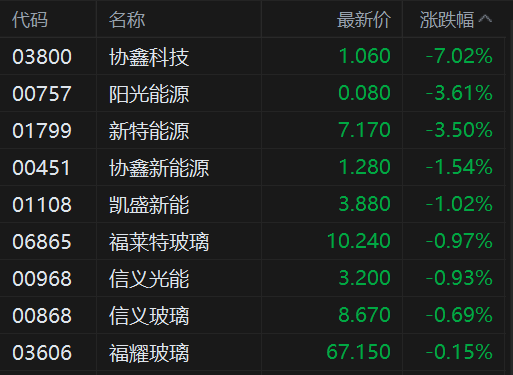
港股异动丨光伏股走低 据称市场监管总局约谈光伏龙头,禁止约定产能与价格
Ge Long Hui· 2026-01-09 03:02
Group 1 - The core viewpoint of the news is that the Hong Kong solar stocks have collectively declined due to regulatory scrutiny from the market supervision authority regarding potential monopoly risks in the solar industry [1] - GCL-Poly Energy has seen a drop of over 7%, while other companies like Sunshine Energy and Xinte Energy have also experienced declines of 3.5% [1][2] - The market supervision authority has held discussions with several key players in the solar industry, including the China Photovoltaic Industry Association and major companies, to address issues related to market manipulation and has mandated corrective actions by January 20 [1] Group 2 - The market supervision authority has prohibited the discussed companies from agreeing on production capacity, utilization rates, sales volumes, and pricing [1] - Companies are also restricted from dividing markets, production volumes, and profits through any form of investment ratio [1] - The authority has required the companies to submit written corrective measures by January 20 [1]



智通AH统计|1月8日
智通财经网· 2026-01-08 08:17
Group 1 - The article highlights the top three companies with the highest AH premium rates: Northeast Electric (00042) at 785.25%, Zhejiang Shibao (01057) at 433.39%, and Hongye Futures (03678) at 275.07% [1] - The bottom three companies with the lowest AH premium rates are Ningde Times (03750) at -12.17%, Hengrui Medicine (01276) at -1.77%, and China Merchants Bank (03968) at -0.48% [1] - The article also lists the top three companies with the highest deviation values: Zhejiang Shibao (01057) at 104.40%, Goldwind Technology (02208) at 57.76%, and Nanjing Panda Electronics (00553) at 27.70% [1] Group 2 - The companies with the lowest deviation values include Northeast Electric (00042) at -95.85%, Chenming Paper (01812) at -26.90%, and Nanhua Futures (02691) at -19.11% [2] - The top ten AH stocks by premium rate include Sinopec Oilfield Service (01033) at 266.67% and Fudan Zhangjiang (01349) at 242.24% [1] - The bottom ten AH stocks by premium rate include WuXi AppTec (02359) at 4.34% and Weichai Power (02338) at 7.12% [1]

观车 · 论势 || 本土化与生态“出海”将是破局关键
Zhong Guo Qi Che Bao Wang· 2026-01-08 01:19
Core Insights - In 2025, China's automobile exports reached 6.343 million units, a year-on-year increase of 18.7%, with new energy vehicle (NEV) exports at 2.315 million units, up 102.9% [1] - The growth momentum is expected to continue into 2026, with a transition to a "stable quantity and improved quality" phase, as the industry expands export scale and deepens localization efforts [1] - Multiple challenges such as rising trade barriers and stricter compliance requirements will test the global operational capabilities of Chinese automakers [1] Export Predictions - Various organizations predict optimistic growth for China's automobile exports in 2026, with estimates ranging from 6.8 million to 8 million units, and NEV exports expected to reach 3.5 million units [2] - The export growth rate is anticipated to slow down, with forecasts suggesting a 10% to 20% increase, driven primarily by NEVs [2] - Key markets for growth include emerging markets and developed markets, with Mexico, UAE, Brazil, Philippines, UK, and Belgium identified as significant contributors [2] Localization Efforts - The localization process for Chinese automakers is accelerating, with investments in overseas factories to create multi-regional production layouts [3] - Companies like BYD and Chery are establishing production facilities in Europe and Southeast Asia, aiming to enhance capacity and localization rates [3] - Core component supply chains are also being localized, with companies like CATL and Guoxuan High-Tech establishing overseas production bases to mitigate supply chain risks [3] Market Adaptation - Chinese automakers are optimizing product configurations to meet diverse market demands and are building comprehensive service ecosystems covering sales, after-sales, charging, and financing [4] - The establishment of overseas charging networks and new business models like used cars and car subscriptions is accelerating, contributing to a sustainable overseas operational ecosystem [4] - This ecological "going global" model is shifting the Chinese automotive industry from a "participant" to a "leader" in the global value chain [4] Challenges Ahead - The road to 2026 will not be smooth, as trade barriers and compliance requirements are expected to intensify, particularly in the EU, which is imposing stricter localization standards [4] - Mexico's new tariff policy, effective January 1, 2026, will significantly increase import duties on vehicles from non-free trade agreement countries, impacting the competitiveness of Chinese brands [4] - Supply chain risks, particularly in automotive-grade chips and geopolitical factors, pose significant challenges for Chinese automakers [5][6] - The varying technical standards and consumer habits across different markets will require higher operational standards from Chinese companies [6]
福建省省长赵龙主持召开民营企业座谈会 宁德时代、八马茶业等19家龙头企业共话发展
Jin Tou Wang· 2026-01-07 09:52
Group 1 - The meeting was chaired by the Governor of Fujian Province, Zhao Long, focusing on discussions with leaders from 19 major local enterprises, including Ningde Times, Fuyao Glass, and Yuhui Supermarket, regarding economic development and business environment [1] - Baima Tea, as the only invited company from the tea industry, highlighted its position as the leading brand in China's tea chain stores and plans to go public in Hong Kong by 2025, aiming to become the "first high-end Chinese tea stock" [1] - The company has consistently ranked first in tax contributions among tea enterprises in key production areas such as Anxi and Wuyishan [1] Group 2 - Governor Zhao encouraged entrepreneurs to focus on their core businesses, strengthen real industries, innovate, and adhere to green and low-carbon development [1] - He emphasized the importance of fair competition and the need for businesses to embody patriotism, legal compliance, innovation, and social responsibility to contribute to high-quality development and common prosperity [1]


这家中国企业太厉害!仅拥有34%的市场,却能够拿下全球55%的利润
Sou Hu Cai Jing· 2026-01-07 09:21
Core Insights - The article highlights the impressive performance of Fuyao Glass, a Chinese company that holds a 34% market share in the global automotive glass industry while capturing 55% of the profits, showcasing its competitive edge over established players like Apple and Saint-Gobain [1][12]. Company Overview - Fuyao Glass specializes in automotive glass production, including windshields, side windows, and sunroofs, as well as high-end products like smart panoramic roofs and adjustable glass [5]. - Despite being a relatively new player compared to century-old companies like Saint-Gobain and Asahi Glass, Fuyao has managed to outperform them in profitability [7][12]. Competitive Advantages - Fuyao's success is attributed to its focus on lean manufacturing, minimizing waste, and maximizing material utilization, which allows for efficient production processes [17]. - The company invests significantly in technology and R&D, ensuring it attracts top talent and acquires necessary equipment, thereby enhancing its cost control capabilities and creating a technological moat [19]. - Fuyao maintains a high self-sufficiency rate in raw materials, with a 95% self-sufficiency in silica sand and over 90% in float glass, which reduces reliance on intermediaries and associated costs [28]. Operational Efficiency - The company has implemented automated production lines and AI quality inspection systems, which lower labor costs and allow for flexibility in handling small batch orders [30]. - Fuyao has established factories in 12 countries to reduce transportation and tariff costs, enhancing profit margins and providing comprehensive "one-stop" glass solutions for global automotive manufacturers [32]. Management Philosophy - The founder, Cao Dewang, emphasizes a frugal management style, focusing on practical and efficient operations while being willing to invest in critical areas like R&D [15][34].

本土化与生态“出海”将是破局关键
Zhong Guo Qi Che Bao Wang· 2026-01-07 01:35
Core Insights - In 2025, China's automobile exports reached 6.343 million units, a year-on-year increase of 18.7%, with new energy vehicle (NEV) exports at 2.315 million units, growing by 102.9% [2] - The growth momentum is expected to continue into 2026, with a transition towards "stable quantity and improved quality" as the industry expands export scale and deepens localization [2] Group 1: Export Predictions - Multiple organizations predict optimistic growth for China's automobile exports in 2026, with estimates ranging from 680,000 to 800,000 units, and NEV exports projected at 350,000 units [3] - The China Automobile Industry Association anticipates continued growth in exports but with a slowing growth rate, while Morgan Stanley forecasts 6.97 million passenger car exports, focusing on Europe, Southeast Asia, and Latin America as key markets [3] - The export strategy has evolved into a dual-driven model of "emerging market expansion + developed market breakthroughs," with countries like Mexico, UAE, Brazil, and the UK becoming significant growth contributors [3] Group 2: Localization Efforts - The localization process for Chinese automakers is accelerating, with companies increasing investments in overseas factories, such as BYD's plant in Hungary and Chery's joint venture in Spain [4] - Key components supply chains are also being localized, with companies like CATL and Fuyao Glass establishing production bases abroad to enhance local manufacturing capabilities and reduce supply chain risks [4] - The deepening of localization is crucial for building a collaborative manufacturing system that integrates vehicle and component production [4] Group 3: Market Adaptation and Challenges - Chinese automakers are optimizing product configurations to meet diverse market demands and are developing comprehensive service ecosystems, including sales, after-sales, and charging networks [5] - The EU's stringent localization requirements pose challenges, necessitating deep local R&D and production capabilities rather than simple assembly [5] - Trade protectionism, particularly Mexico's increased tariffs on imports from non-free trade agreement countries, threatens to undermine the competitive advantage of Chinese brands [5] Group 4: Supply Chain Risks - Supply chain risks, particularly in automotive-grade chips and power semiconductors, are significant challenges for global automakers, including Chinese companies [6] - Variations in technical standards and consumer habits across different markets, along with geopolitical policy fluctuations, demand higher operational standards from Chinese automakers [6] - The year 2026 is characterized by both growth and challenges, requiring Chinese automakers to focus on technological innovation and diversified ecosystems to achieve high-quality development [6]
“斜杠企业”未必都是好企业
Xin Lang Cai Jing· 2026-01-05 16:39
Core Viewpoint - The concept of "slash enterprises," akin to "slash youth," reflects companies that operate across multiple unrelated fields, which may not guarantee long-term success due to the inherent complexities and differences in various industries [1][3] Group 1: Business Strategy - Companies often pursue a "slash" model to capture new growth opportunities and mitigate risks from intensified competition in single sectors, but this approach can lead to increased organizational and management costs [1][3] - Successful companies like Bosch, ASML, and Fanuc focus on core competencies, achieving excellence in their respective fields rather than diversifying into unrelated areas [2] Group 2: Industry Examples - Gree Electric, Fuyao Glass, and CATL exemplify firms that concentrate their resources on specific products, achieving global leadership in their niches through efficiency and technological advancement [2] - Apple, Boeing, and Airbus illustrate the importance of deep social division of labor, relying on specialized suppliers for components while focusing on design and assembly [2] Group 3: Modern Challenges - The attempt to cover the entire supply chain with a few "slash enterprises" reflects a flawed understanding of division of labor, particularly in fast-evolving sectors like AI and biotechnology [3] - The AI computing industry highlights the value of collaboration and specialization, where companies focus on their strengths and work together through standardized interfaces to enhance overall system efficiency [3] Group 4: Recommendations - Companies should return to a capability-driven approach, concentrating on core businesses to build sustainable competitive advantages, while industries should embrace openness and collaboration to foster resilience [3] - Encouraging the development of "hidden champions" and specialized enterprises can enhance overall competitiveness by forming a network based on comparative advantages [3]