
上海银行

Search documents
A股低开高走,三大股指收涨:黄金股再度上涨,两市成交近2.9万亿元
Xin Lang Cai Jing· 2026-01-27 07:32
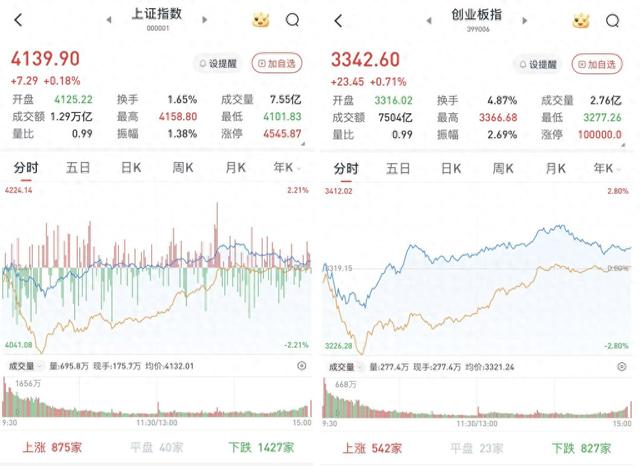
Market Overview - The three major A-share indices opened lower on January 27, with the Shanghai Composite Index closing at 4139.9 points, up 0.18% [2] - The ChiNext Index rose by 0.71% to 3342.6 points, while the Sci-Tech 50 Index increased by 1.51% to 1555.98 points [2] Trading Activity - A total of 1928 stocks rose, while 3450 stocks fell, with 91 stocks remaining flat [3] - The total trading volume was 28.949 billion yuan, a decrease of 3.533 billion yuan from the previous trading day [3] Sector Performance - Semiconductor stocks saw significant gains, with over 20 stocks hitting the daily limit or rising more than 10% [5] - Gold stocks also performed well, with several stocks reaching the daily limit or increasing by over 10% [5] - Coal and basic metal sectors experienced notable declines, with major coal stocks dropping over 4% [6] Market Sentiment and Predictions - Financial analysts suggest that the A-share market may continue to experience fluctuations in the short term due to increased overseas uncertainties and pressure at previous high levels [7] - The current market is viewed as a short-term adjustment risk, with expectations for continued upward movement in the medium term [7] - Long-term perspectives indicate that the current market trend is still in its mid-stage, with potential for a "slow bull" market to continue [8][9] Investment Recommendations - Analysts recommend focusing on sectors such as technology, particularly AI and robotics, as well as industries benefiting from price increases like chemicals and non-ferrous metals [8][9] - Short-term investment opportunities are suggested in power equipment and photovoltaic sectors, which are supported by market demand and policies [10]





辞旧岁迎新程,陆家嘴金融沙龙2026年首场活动即将拉开序幕
Di Yi Cai Jing· 2026-01-27 02:14
Core Insights - The Lujiazui Financial Salon series will kick off in 2026, reflecting on the achievements of 2025 and focusing on the theme "Golden Horse Welcomes Spring: Financial Empowerment to Ignite New Spring Consumption in Pudong" [2] - The event will take place on January 28 in Shanghai Pudong, featuring a summary video of the 2025 salon activities and a keynote speech by Lian Ping, Chairman of the China Chief Economist Forum [2] - The salon aims to explore key issues such as innovation in consumer financial products and the synergy between finance and consumption ecosystems [2] Event Details - The Lujiazui Financial Salon has hosted 40 events in the past year, gathering insights from over 200 guests, establishing a professional position and brand recognition in the financial industry [2] - The event will include a dialogue session featuring industry experts discussing the balance between consumption stimulation and risk prevention, as well as the use of digital RMB and AI risk control technologies [3] - Notable speakers include Hu Haozhong, Executive Vice President of China UnionPay, and Wang Lijuan, Vice President of Ant Group, who will share their extensive experience in financial services and digital payment [3][4] Organizational Support - The Lujiazui Financial Salon is guided by the Shanghai Municipal Financial Office and the Pudong New Area Government, with media support from Yicai and Zhitong Finance [4] - The series aims to create a regular communication platform that complements the "Lujiazui Forum," focusing on financial reform and empowering high-quality economic development in Pudong [4]

上银医药精选股票型发起式证券投资基金基金份额发售公告
Shang Hai Zheng Quan Bao· 2026-01-26 19:25
Fund Overview - The fund is named "Shangyin Medical Selected Stock Fund" and is a type of stock investment fund [14] - The fund is managed by Shangyin Fund Management Co., Ltd. and the custodian is Changsha Bank Co., Ltd. [2][51][52] - The fund will be available for subscription from February 2, 2026, to March 2, 2026 [1][17] Subscription Details - The minimum subscription amount for the fund is set at 1,000,000 RMB for the initiators, while individual investors can start with as little as 1 RMB [6][27] - The fund is open to various types of investors, including individual investors, institutional investors, qualified foreign investors, and others permitted by regulations [5][14] - The fund does not impose a cap on the total amount raised during the subscription period, but the management may adjust the fundraising limits as necessary [5][18] Fund Structure - The fund operates as a contract-based, open-end fund with no fixed duration [14] - Investors can make multiple subscriptions during the fundraising period, but once accepted, subscription applications cannot be revoked [28][29] - The fund will issue two classes of shares: Class A and Class C, with different fee structures [14][22] Investment Strategy - The fund aims to achieve long-term stable appreciation of assets while strictly controlling risks [15] - The fund may invest in various asset classes, including stocks, stock index futures, and asset-backed securities, among others [9][10][11] Management and Custody - The fund management company was established on August 30, 2013, and is wholly owned by Shanghai Bank [51] - The custodian bank, Changsha Bank, has been operational since August 18, 1997, and is responsible for safeguarding the fund's assets [52] Regulatory Compliance - The fund has been registered with the China Securities Regulatory Commission (CSRC) and is subject to its regulations [1] - The fund's contract will become effective upon meeting the legal conditions and after verification by a statutory auditing firm [49]
25Q4基金转债持仓分析:“固收+”大发展,转债仓位继续被“稀释”
SINOLINK SECURITIES· 2026-01-26 15:04
2026 年 01 月 26 日 "固收+"大发展,转债仓位继续被"稀释" 25Q4 基金转债持仓分析 固定收益专题报告 证券研究报告 固定收益组 分析师:尹睿哲(执业 S1130525030009) yinruizhe@gjzq.com.cn 分析师:李玲(执业 S1130525030012) liling3@gjzq.com.cn 核心观点 25 年四季度权益转入高位震荡、纯债也进入波动但利率水平较低,固收类资金继续向权益市场要收益,但转债不断新 高的估值也带动各产品规模&仓位&持券偏好出现分化。 二级债基"一只独秀",转债仓位表现分化。1)四季度由于权益转入震荡混合型基金规模基本持平,但对转债的仓位 继续下降、不过降幅有所收窄,目前已来到 17 年,其中偏债混产品的转债仓位主动降低至 3.89%、回到 21 年初的位 置,灵活配置型的转债仓位在连续 2 年的下降后终于止跌回升到 0.66%、但仍然处于历史较低位置。2)一级债基由于 弹性有限、继续表现为小幅赎回,其中仅有转债仓位超 50%的产品表现为净申购,而利率低位的背景下仍然需要向转 债要收益,因此在经过一段时间的仓位降低后一级债基对转债仓位止跌回升 ...
银行股顽强收红!农业银行涨超1%,银行ETF汇添富(512820)连续12日吸金超1.3亿元!板块下探至关键支撑?最新PB至0.65倍
Xin Lang Cai Jing· 2026-01-26 10:06
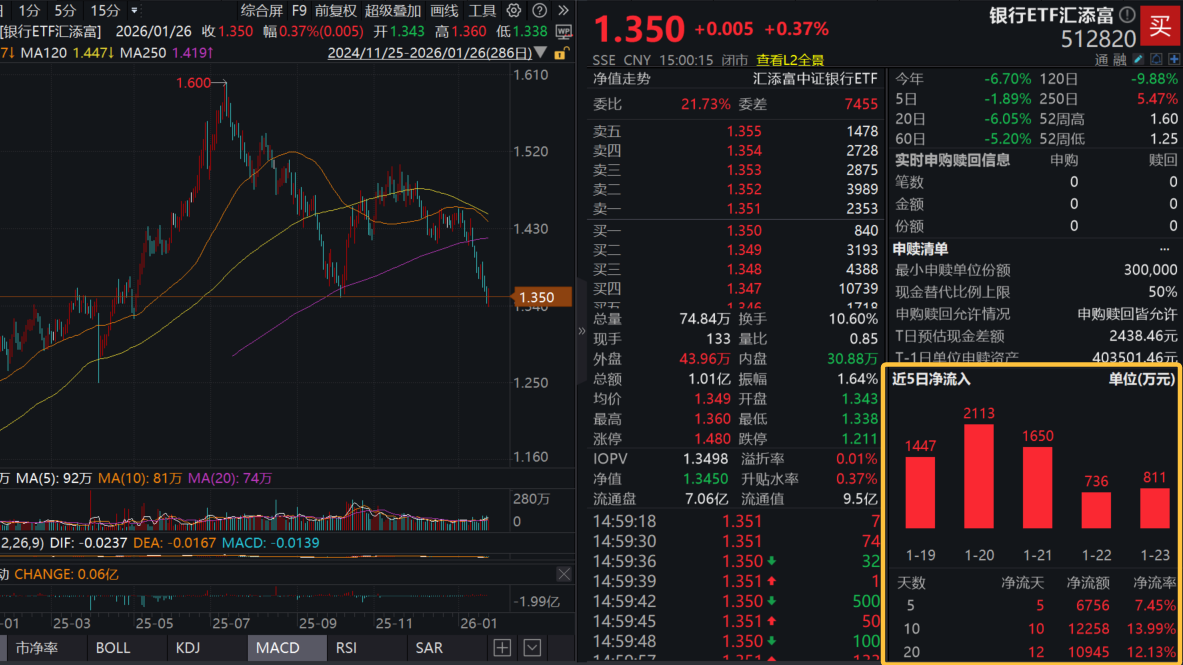
1月26日,A股市场震荡,顺周期板块强势,截至15:00,银行ETF汇添富(512820)逆势收涨0.37%,终结三连阴,资金持续涌入高股息的银行板块,银行 ETF汇添富(512820)已连续12日吸金超1.3亿元。 | 1分 5分 15分 = | 综合屏 F9 前复权 超级叠加 画线 工具 Q 2 » | 银行ETF汇添 | 1.350 +0.005 +0.37% | 【银行ETF汇添富】2026/01/26 收1.350 幅0.37%(0.005) 开1.343 高1.360 低1.338 四 | 512 | | | | | | | | | | | | | | --- | --- | --- | --- | --- | --- | --- | --- | --- | --- | --- | --- | --- | --- | --- | --- | --- | --- | | 7J MA120 1.447J MA250 1.4191 | 2024/11/25-2026/01/26(286日)▼ | SSE CNY 15:00:15 闭市 查看L2全图 | -1.610 | 交生 | -6.70% 120日 ...



短期与中期逻辑均具备坚实支撑!红利低波ETF(512890)近20个交易日吸金18.8亿
Xin Lang Cai Jing· 2026-01-26 04:22
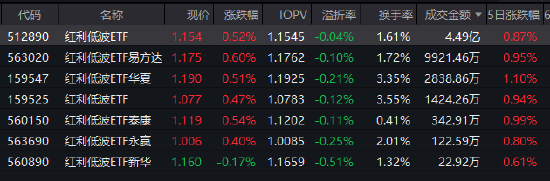
Core Viewpoint - The report focuses on the investment opportunities in AI applications, commercial aerospace, and nuclear fusion for 2026, highlighting the performance of the Dividend Low Volatility ETF (512890) amidst a mixed market environment [1][7]. Market Performance - On January 26, A-shares showed mixed results with the Shanghai Composite Index up by 0.12%, while the Shenzhen Component and ChiNext Index experienced declines [1][7]. - The Dividend Low Volatility ETF (512890) rose by 0.52%, closing at 1.154 yuan, with a turnover rate of 1.61% and a transaction volume of 449 million yuan [1][7]. Fund Holdings - The latest quarterly report indicates a mixed performance among the top ten holdings of the Dividend Low Volatility ETF. Notable movements include Shanghai Bank down by 0.21%, Nanjing Bank up by 1.35%, and Gree Electric down by 0.58% [2][9]. - The specific holdings and their market values are as follows: - Shanghai Bank: 781.92 million yuan - Nanjing Bank: 747.01 million yuan (up 32.82%) - Ping An Bank: 712.31 million yuan - Agricultural Bank of Shanghai: 704.49 million yuan - China National Sugar: 690.55 million yuan (down 7.95%) [9]. Fund Flow - The Dividend Low Volatility ETF has seen significant net inflows, with 1.34 billion yuan over the last 5 trading days, 1.88 billion yuan over the last 20 days, and 4.39 billion yuan over the last 60 days. As of January 23, 2026, the fund's circulation scale was 27.845 billion yuan [9]. Investment Strategy - Analysts suggest that the current liquidity environment is a key driver for the spring market rally, supported by new insurance premiums, maturing deposits, and the appreciation of the RMB attracting foreign capital [4][11]. - The report emphasizes the importance of focusing on sectors with strong earnings performance and relatively low price increases, such as AI hardware, batteries, pharmaceuticals, steel, and non-bank financials [11]. - The Dividend Low Volatility strategy is seen as a robust tool for asset allocation in volatile markets, with a three-year return of 36.01%, outperforming its benchmark [12].
看好交投持续活跃下优质金融股机会
HTSC· 2026-01-26 02:45
Investment Rating - The report maintains an "Overweight" rating for the securities and banking sectors, while also recommending the insurance sector [8]. Core Insights - The market remains active with an average daily trading volume of 28 trillion yuan in A-shares, and the financing balance stabilizing at 2.7 trillion yuan. However, the ETF market has experienced significant volatility, with major outflows from core broad-based ETFs [11][16]. - The sentiment for market bullishness is strong, and the spring rally is expected to continue, particularly in the insurance sector where beta trading opportunities are anticipated [2][26]. - The central bank's governor indicated that there is still room for interest rate cuts, with the latest Loan Prime Rate (LPR) remaining unchanged for eight consecutive months [11][32]. Securities Sector Summary - The report highlights a positive outlook for the securities sector, with several brokerages reporting significant profit growth for 2025. The recommendation includes top brokerages such as CITIC Securities, Guotai Junan, and GF Securities [2][12]. - The average daily trading volume in the A-share market is noted at 28 trillion yuan, with a stable financing balance, indicating a recovery opportunity for the brokerage sector [11][12]. Insurance Sector Summary - The report suggests focusing on quality leading companies in the insurance sector, as the market sentiment remains strong and the spring rally is expected to continue [26][27]. - The insurance sector's fund holdings have increased, with major stocks like Ping An and China Life being highlighted for their significant market presence [27][31]. Banking Sector Summary - The banking sector is characterized by stable performance, with several banks reporting positive earnings forecasts for 2025. The report recommends quality individual stocks such as Nanjing Bank and Chengdu Bank [3][40]. - The central bank's comments on potential interest rate cuts and the expansion of wealth management products indicate a favorable environment for banks [32][33]. - The report notes a decline in bond allocations within bank wealth management products, with an increase in deposits and funds [37][34].



看好金融股战略配置机会
HTSC· 2026-01-26 02:45
Investment Rating - The report maintains an "Overweight" rating for both the banking and securities sectors [6]. Core Insights - The financial sector shows a strategic allocation opportunity, with increased fund positions in banking, securities, and insurance stocks [1][5]. - The banking sector's fund position has slightly increased, indicating a return of risk appetite among investors [2][13]. - The securities sector is experiencing a recovery in fund positions, driven by market activity and performance expectations [3][5]. - The insurance sector has seen a significant increase in fund positions, with major insurance stocks being favored by investors [4][5]. Summary by Sections Banking Sector - As of Q4 2025, the banking sector's fund position increased by 0.04 percentage points to 1.89%, with large banks and joint-stock banks seeing gains, while city commercial banks experienced a decline [2][13]. - The top three heavy-weighted stocks in the banking sector account for 46.0% of the total fund position, indicating a concentration in holdings [13][27]. - The dividend yield for A/H shares in the banking sector is approximately 4.87%/4.88%, making it attractive compared to the 10-year government bond yield of 1.83% [5]. Securities Sector - The securities sector's fund position rose by 0.10 percentage points to 0.72%, although it remains at a historically low level [3][5]. - Major securities firms like CITIC Securities and Guotai Junan have been favored for their performance potential amidst market recovery [5][8]. - The average price-to-book ratio for large and small securities firms is 1.44x and 1.67x, respectively, indicating they are trading at 27% and 42% of their historical averages [5]. Insurance Sector - The insurance sector's fund position increased by 0.94 percentage points to 1.72%, with major stocks like Ping An and China Pacific receiving significant increases in holdings [4][5]. - The insurance index's price-to-book ratio is at 1.53x, which is at the 40th percentile of valuations since 2014, suggesting potential for valuation recovery [4][5]. - Strong sales performance in life insurance is noted, with a focus on high-elasticity stocks as key investment opportunities [4].




银行周报(2026/1/19-2026/1/23):银行快报陆续披露,25A业绩稳健增长
GUOTAI HAITONG SECURITIES· 2026-01-25 10:50
Investment Rating - The report assigns an "Overweight" rating to the banking sector [4]. Core Insights - As of January 23, 2026, eight banks have reported stable growth in performance and maintained asset quality. The outlook for 2026 suggests continued improvement in listed banks' performance, supported by narrowing interest margin declines and decreasing credit costs [2][4]. Summary by Sections Performance Indicators - Eight banks reported their performance for 2025, showing stable growth and asset quality. The revenue growth rates for major banks were as follows: - Shanghai Pudong Development Bank: +1.9% - Industrial Bank: +0.2% - China Merchants Bank: +0.01% - CITIC Bank: -0.6% - Regional banks like Nanjing Bank and Ningbo Bank showed stronger growth at +10.5% and +8.0% respectively [4][6]. - Profit growth was stable across listed banks, with notable increases in Hangzhou and Shanghai Pudong Development Bank exceeding 10% [4][6]. Scale and Growth - Quality regional banks continued to experience strong credit growth, with year-end asset growth rates for Nanjing, Ningbo, and Hangzhou at 16.6%, 16.1%, and 12.0% respectively. Loan growth rates were 13.4%, 17.4%, and 14.3% respectively [4][6]. - Overall deposit growth remained stable, with city commercial banks maintaining over 10% growth and joint-stock banks at 7%-8% [4][6]. Asset Quality - Non-performing loan ratios showed a stable or declining trend among the eight banks, with Shanghai Pudong, Suzhou Rural, and CITIC banks reporting decreases to 1.26%, 0.88%, and 1.15% respectively [4][6]. - The provision coverage ratio remained robust, with Hangzhou and China Merchants Bank showing declines of over 10 percentage points but still at high absolute levels [4][6]. Outlook for 2026 - The report anticipates continued improvement in bank performance in 2026, driven by narrowing interest margin declines and decreasing credit costs. Key factors include: - Net interest income growth expected to improve due to the expiration of high-cost long-term deposits and stable LPR [4][6]. - Fee income growth driven by insurance and wealth management channels [4][6]. - Asset quality improvements as risks in key corporate sectors are resolved [4][6]. Investment Recommendations - The report suggests focusing on three main investment lines for 2026: 1. Identifying banks with potential for performance growth, recommending Ningbo Bank, China Merchants Bank, and Nanjing Bank. 2. Considering banks with convertible bond expectations, recommending Chongqing Bank and Changshu Bank. 3. Continuing dividend strategies, recommending Bank of Communications, Jiangsu Bank, and Chongqing Rural Commercial Bank [4][6].
金融行业周报(2026、01、25):业绩比较基准新规正式落地,坚定保险中长期向好逻辑-20260125
Western Securities· 2026-01-25 10:30
Investment Rating - The report maintains a positive long-term outlook for the insurance sector, indicating a strong continuity in market performance despite recent fluctuations [2][12][16]. Core Insights - The financial sector experienced a mixed performance this week, with the non-bank financial index down by 1.45%, underperforming the CSI 300 index by 0.83 percentage points. The insurance sector saw a decline of 4.02%, while the brokerage sector decreased by 0.61% [1][10]. - The insurance sector's performance is driven by two main factors: policy support leading to economic recovery and liquidity easing combined with a strong stock market. The report suggests a shift from liquidity-driven growth to a focus on macro policy support and economic recovery expectations [2][13][16]. - The brokerage sector is expected to benefit from new regulations that enhance investment management quality, with a recommendation to focus on larger, undervalued firms and those involved in mergers and acquisitions [3][18]. - The banking sector is facing a slight decline, but there are signs of recovery in profitability for leading banks, with recommendations to focus on banks with high dividend yields and those expected to benefit from market conditions [19][21]. Summary by Sections Insurance Sector - The insurance sector's recent decline is attributed to short-term market sentiment and liquidity changes, but the long-term outlook remains positive due to strong support from both the liability and asset sides [2][12][16]. - Key recommendations include focusing on companies like China Pacific Insurance, China Ping An, China Life (H), and China Taiping, with a specific recommendation for New China Life [4][16]. Brokerage Sector - The brokerage sector's performance is slightly better than the overall market, with a focus on the new guidelines from the regulatory body that aim to improve fund management quality [3][17]. - Recommended firms include Guotai Junan, Huatai Securities, and others, particularly those with strong merger and acquisition prospects [4][18]. Banking Sector - The banking sector has shown a decline but is expected to stabilize, with recommendations to focus on banks with high earnings elasticity and strong dividend yields [19][21]. - Specific banks to watch include Hangzhou Bank, Ningbo Bank, and others, with a focus on those that have previously been undervalued [4][21].



