
华创证券

Search documents
收益差择时模型:基于A股指数与恒生指数的实证
Huachuang Securities· 2025-10-29 05:48
Quantitative Models and Construction Simple Return Model - **Model Name**: Simple Return Model - **Construction Idea**: The model uses the simple return of closing prices to track trends and make trading decisions [12][13] - **Construction Process**: 1. Calculate the simple return as: $ \text{Simple Return} = \frac{\text{Closing Price (Day t)}}{\text{Closing Price (Day t-1)}} - 1 $ 2. Compute the 60-day Exponential Moving Average (EMA) of the simple return 3. If the 60-day EMA value is greater than 0, take a long position; otherwise, close the long position [12][13] - **Evaluation**: The model performed poorly in backtesting, with low win rates (below 30%) and failing to outperform the benchmark indices [13] Trend Return Difference Model - **Model Name**: Trend Return Difference Model - **Construction Idea**: The model improves upon the simple return model by introducing the concept of upward and downward return differences to better capture market trends [17][18] - **Construction Process**: 1. Define upward return as: $ \text{Upward Return} = \frac{\text{Highest Price (Day t) - Opening Price (Day t)}}{\text{Closing Price (Day t)}} $ 2. Define downward return as: $ \text{Downward Return} = \frac{\text{Opening Price (Day t) - Lowest Price (Day t)}}{\text{Closing Price (Day t)}} $ 3. Calculate the upward and downward return difference: $ \text{Upward-Downward Return Difference} = \text{Upward Return} - \text{Downward Return} $ 4. Compute the 60-day EMA of the upward-downward return difference 5. If the 60-day EMA value is greater than 0, take a long position; otherwise, close the long position [17][18] - **Evaluation**: The model outperformed the simple return model and the benchmark indices in terms of annualized return, Sharpe ratio, and risk control. It is characterized as a mid-term model with an average long position holding period of approximately 3 weeks [18] Turnover Comprehensive Return Difference Model - **Model Name**: Turnover Comprehensive Return Difference Model - **Construction Idea**: Combines turnover and upward-downward return difference to enhance trend-following capabilities by assigning higher weights to trends during high turnover periods [26][27] - **Construction Process**: 1. Define turnover comprehensive return difference as: $ \text{Turnover Comprehensive Return Difference} = \text{Upward-Downward Return Difference} \times \text{Turnover} $ 2. Compute the 60-day EMA of the turnover comprehensive return difference 3. If the 60-day EMA value is greater than 0, take a long position; otherwise, close the long position [27][28] - **Evaluation**: The model demonstrated superior performance compared to the simple return model and the upward-downward return difference model. It effectively distinguishes market trends and performs better in high turnover scenarios [27][28] Composite Signal Turnover Comprehensive Return Difference Model - **Model Name**: Composite Signal Turnover Comprehensive Return Difference Model - **Construction Idea**: Combines the turnover comprehensive return difference signals from both the Hang Seng Index and the Hang Seng China Enterprises Index to eliminate the randomness caused by differences in index composition [32][33] - **Construction Process**: 1. Define the composite signal: - If either the Hang Seng Index or the Hang Seng China Enterprises Index turnover comprehensive return difference signal indicates a long position, take a long position in the respective index 2. Compute the 60-day EMA of the composite signal 3. If the composite signal's 60-day EMA value is greater than 0, take a long position; otherwise, close the long position [32][33] - **Evaluation**: The model significantly outperformed the benchmark indices and single-signal turnover comprehensive return difference models, showcasing robust trend-following capabilities [35][36] --- Model Backtesting Results Simple Return Model - **Hang Seng Index**: Annualized return 1.26%, maximum drawdown 52.96%, Sharpe ratio -0.044 [15][16] - **Hang Seng China Enterprises Index**: Annualized return 1.91%, maximum drawdown 68.79%, Sharpe ratio 0.034 [15][16] Trend Return Difference Model - **Hang Seng Index**: Annualized return 4.23%, maximum drawdown 22.98%, Sharpe ratio 0.154 [19][20] - **Hang Seng China Enterprises Index**: Annualized return 6.15%, maximum drawdown 37.2%, Sharpe ratio 0.267 [19][20] Turnover Comprehensive Return Difference Model - **Hang Seng Index**: Annualized return 3%, maximum drawdown 28.84%, Sharpe ratio 0.039 [31] - **Hang Seng China Enterprises Index**: Annualized return 9.73%, maximum drawdown 24.56%, Sharpe ratio 0.47 [31] Composite Signal Turnover Comprehensive Return Difference Model - **Hang Seng Index**: Annualized return 7.78%, maximum drawdown 23.81%, Sharpe ratio 0.401 [33][36] - **Hang Seng China Enterprises Index**: Annualized return 10.03%, maximum drawdown 24.63%, Sharpe ratio 0.484 [33][36] Sensitivity Analysis of Composite Signal Turnover Comprehensive Return Difference Model - **Hang Seng Index**: - 40-day EMA: Annualized return 6.1%, maximum drawdown 26.78%, Sharpe ratio 0.281 [39] - 50-day EMA: Annualized return 7.02%, maximum drawdown 27.44%, Sharpe ratio 0.34 [39] - 60-day EMA: Annualized return 7.78%, maximum drawdown 23.81%, Sharpe ratio 0.401 [39] - 70-day EMA: Annualized return 7.31%, maximum drawdown 27.2%, Sharpe ratio 0.375 [39] - 80-day EMA: Annualized return 6.86%, maximum drawdown 24.9%, Sharpe ratio 0.343 [39] - **Hang Seng China Enterprises Index**: - 40-day EMA: Annualized return 8.3%, maximum drawdown 26.72%, Sharpe ratio 0.382 [40] - 50-day EMA: Annualized return 8.97%, maximum drawdown 28.88%, Sharpe ratio 0.416 [40] - 60-day EMA: Annualized return 10.03%, maximum drawdown 24.63%, Sharpe ratio 0.484 [40] - 70-day EMA: Annualized return 9.36%, maximum drawdown 29.04%, Sharpe ratio 0.454 [40] - 80-day EMA: Annualized return 9.04%, maximum drawdown 25.04%, Sharpe ratio 0.438 [40]
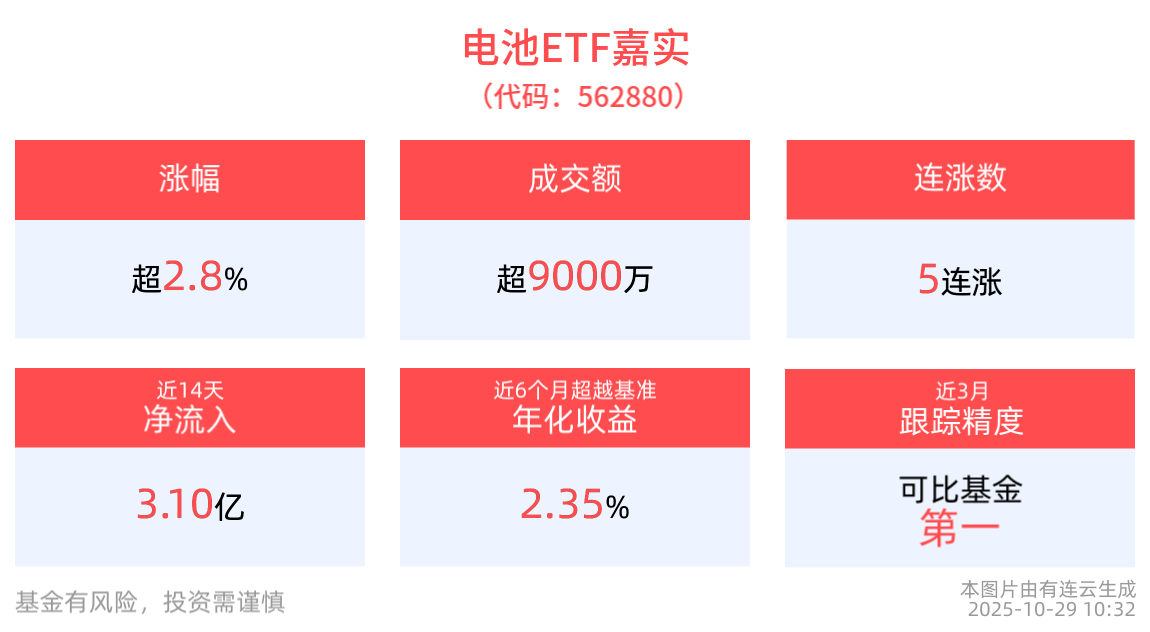
固态电池产业化进程正在加速推进,电池ETF嘉实(562880)涨近3%,冲击5连涨!
Sou Hu Cai Jing· 2025-10-29 03:12
Group 1 - The core viewpoint highlights the significant liquidity and performance of the battery ETF, with a turnover rate of 5.73% and a transaction volume of 98.36 million yuan, while its latest scale reached 1.677 billion yuan [3] - Over the past 14 trading days, the battery ETF has attracted a total of 310 million yuan in inflows, indicating strong investor interest [3] - As of October 28, the net value of the battery ETF has increased by 79.68% over the past six months, ranking 78th out of 3,796 index equity funds, placing it in the top 2.05% [3] Group 2 - The solid-state battery industry is advancing rapidly, with recent breakthroughs in all-solid-state lithium battery technology by Chinese research teams, which may resolve endurance issues [3] - Leading companies like CATL and EVE Energy are planning to achieve small-scale production of all-solid-state batteries by 2027, while also advancing pilot line construction and automotive-grade verification [3] - The industry is steadily moving towards a goal of large-scale production by 2030, with the equipment sector expected to benefit first from the investment opportunities arising from technological advancements [3] Group 3 - As of September 30, 2025, the top ten weighted stocks in the CSI Battery Theme Index include Sungrow Power, CATL, EVE Energy, and others, collectively accounting for 55.79% of the index [4] - The performance of key stocks includes Sungrow Power with a rise of 7.48% and a weight of 14.31%, CATL with a rise of 2.53% and a weight of 8.95%, and EVE Energy with a rise of 4.10% and a weight of 6.94% [6] - Investors without stock accounts can access battery industry investment opportunities through the Battery ETF Jiashi connecting fund (016567) [6]





产业放在首位、金融强国升维,这些“十五五”增量信息值得关注
Jing Ji Guan Cha Bao· 2025-10-29 01:39
(原标题:产业放在首位、金融强国升维,这些"十五五"增量信息值得关注) 10月28日,新华社受权发布二十届四中全会审议通过的《中共中央关于制定国民经济和社会发展第十五 个五年规划的建议》和习近平主席《关于<中共中央关于制定国民经济和社会发展第十五个五年规划的 建议>的说明》。 另一方面,"金融强国"的建设可以实现"定价权"与"财富效应"的双重突破,既要掌握核心资产的定价自 主权,防止定价权旁落;也要让股市成为居民财产性收入的重要来源,可以进一步切实增强民众的消费 底气。 新兴产业要成为支柱,未来产业重在"前瞻布局"。前者是新旧动能转换的重点,在新能源、新材料、航 空航天、低空经济等方面形成产业集群;后者重在抢得先机、占据主动,重点布局量子科技、生物制 造、氢能和核聚变能、脑机接口、具身智能、第六代移动通信等。 华创证券研究所副所长、首席宏观分析师张瑜表示,从产业来看,得益于"十四五"时期对现代化产业体 系、实体经济以及制造业的重视,未来五年中国权益资产投资将具备非常丰富的可选择投资赛道与品种 及增长空间。 张瑜认为,通过建设现代化产业体系以巩固壮大实体经济根基主要具备三大优势:第一,承接以房地产 为代表的旧经 ...
央行重启公开市场国债买卖操作,市场热议会否替代降准
Di Yi Cai Jing· 2025-10-28 11:24
Core Viewpoint - The People's Bank of China (PBOC) has announced the resumption of open market government bond trading operations, which had been suspended for nearly 10 months, to inject confidence into the bond market amid recent fluctuations [1][2]. Market Analysis - The resumption of government bond trading reflects a flexible regulatory approach closely tied to market conditions, responding to the need for sustained macroeconomic policy efforts as highlighted in the recent Fourth Plenary Session [2]. - The bond market's overall stability has prompted this timely policy adjustment, indicating that the current interest rate levels are recognized by regulators, thus limiting the risk of further increases in rates [2]. Operational Details - The PBOC's bond trading operations began in August 2024, with a cumulative purchase of 1 trillion yuan. The operations were paused earlier this year due to supply-demand imbalances in the bond market [2][3]. - Analysts predict that the PBOC may adjust its operational model to avoid significant market disruptions, likely opting for one-time or multiple purchases from major banks without immediate market sales [3][4]. - The anticipated operational scale for the remainder of 2025 is estimated to be between 700 billion to 1 trillion yuan to counterbalance maturing bonds and meet basic currency supply needs [5]. Market Reaction - Following the announcement, the bond market reacted positively, with significant increases in government bond futures prices, indicating a rapid rise in expectations for policy easing [6][7]. - The resumption of bond trading is seen as a mechanism to release liquidity and stabilize market expectations, aligning with the overall easing policy direction [6]. Potential Implications - The bond trading operations may serve as a substitute for reserve requirement ratio (RRR) cuts, potentially reducing the necessity for further RRR adjustments in the near term [7]. - This approach could alleviate pressure on commercial banks' bond holdings while achieving effects similar to RRR cuts, thereby supporting stable market operations in the fourth quarter [7].
活在供给危机中的有色
远川投资评论· 2025-10-28 07:05
Group 1 - The article highlights a significant shift in the global copper supply, with estimates indicating a transition from a surplus of 105,000 tons to a shortage of 55,000 tons due to various mining disruptions [2] - Major copper mines, including Kamoa-Kakula and El Teniente, faced operational halts due to seismic activities, while the Grasberg mine in Indonesia experienced a landslide, exacerbating supply issues [2] - As a result of the reduced supply, copper prices have surged, with LME copper prices increasing by over 20% year-to-date, approaching historical highs [2] Group 2 - The article discusses the performance of the non-ferrous metal ETF (516650), which tracks various metals including gold, copper, aluminum, and lithium, achieving a year-to-date increase of 73.85% [3] - The historical context of the 1970s is referenced to explain the current surge in metal prices, drawing parallels between past inflationary pressures and today's economic environment [6] - The article notes that during the 1970s, significant geopolitical events led to supply crises, resulting in dramatic price increases for various commodities, including copper, which rose by 68% during that period [8][9] Group 3 - The article emphasizes that the current price increases in metals are primarily driven by supply-side crises rather than explosive demand growth, with the ongoing U.S. debt crisis and dollar depreciation acting as catalysts [10][12] - The discussion includes the impact of U.S. government debt, which has escalated from $23.7 trillion in early 2020 to $38 trillion, raising concerns about the stability of the dollar and increasing interest in commodity holdings [12] - The article also highlights the significant rise in cobalt prices, which surged by 155.35% due to export restrictions from the Democratic Republic of Congo, the largest cobalt producer [13] Group 4 - The article concludes that the current environment of liquidity expansion in the U.S. suggests that commodities will serve as a hedge against currency devaluation, similar to the dynamics observed in the 1970s [15] - It suggests that the ongoing supply-demand mismatch in resource commodities, particularly gold, is likely to persist until a global order reconstruction is fully realized [16] - The article points out that the rising prices of commodities will benefit related listed companies, with the gold stock ETF (159562) reporting a revenue increase of 3.28% and a net profit growth of 33.84% in the first half of the year [19]

美国9月CPI数据点评:美国通胀或阶段性见顶
Huachuang Securities· 2025-10-26 12:13
Inflation Data Overview - In September, the U.S. CPI increased year-on-year from 2.9% to 3%, below the expected 3.1%[1] - Core CPI decreased year-on-year from 3.1% to 3%, matching the forecast[1] - Month-on-month CPI rose by 0.3%, below the expected 0.4%[1] Price Trends - Core goods prices rose by 0.2%, down from 0.3%, with used car prices falling by 0.4%[2] - Rent growth slowed, with primary residence rent increasing by 0.2%, the smallest increase since January 2021[2] - Super core services prices remained stable at 0.3%, with notable price increases in medical services (0.3%) and entertainment services (0.4%)[2] Inflation Peak Insights - Inflation has likely peaked temporarily, with CPI rising from 2.3% in April to 3% in September, a total increase of 0.7 percentage points[3] - The effective tariff rate has increased from 2.3% to 9.5% from February to July, indicating manageable tariff impacts on inflation[3] - The remaining tariff effects on core goods prices are estimated to be around 0.5 percentage points, contributing only about 0.1 percentage points to overall CPI[4] Future Projections - Inflation is expected to stabilize around 3% in Q4 2023, with a projected decline to approximately 2.5% for CPI and 2.8% for core CPI by Q2 2024[5] - The Federal Reserve may continue to implement preventive rate cuts, with potential reductions of 25 basis points in October and December[5] Market Reactions - Following the inflation report, market expectations for rate cuts have slightly increased, with the number of anticipated cuts rising from 1.92 to 2.0 for the year[34] - U.S. stock indices reached new highs, with the Nasdaq up 1.15% and the S&P 500 up 0.79%[34]
存单周报(1020-1026):月末扰动增多,存单或延续偏高震荡-20251026
Huachuang Securities· 2025-10-26 11:41
Report Information - Report Title: [Bond Weekly Report] Certificate of Deposit Weekly Report (1020 - 1026): More Disturbances at the Month - End, CDs May Continue to Fluctuate at a Relatively High Level [1] - Report Date: October 26, 2025 - Research Institution: Huachuang Securities Research Institute - Analysts: Zhou Guannan, Song Qi Industry Investment Rating - Not provided in the report Core Viewpoints - Tax payments and new - share subscriptions on the Beijing Stock Exchange may increase capital disturbances. As the transition period of the "interest rate adjustment safeguard clause" approaches the end of November and the maturity scale of CDs is relatively large, CD issuance may still be in demand and remain in a high - level oscillation state in the short term. From a pricing perspective, CDs may continue to fluctuate at a relatively high level, with the weighted issuance rate of 1 - year national and joint - stock bank CDs fluctuating around 1.65 - 1.7%, and the price increase pressure above 1.7% being controllable, allowing for opportunistic layout [2][50] Summary by Directory Supply: Net Financing Increases, and the Term Structure Lengthens - This week (October 20 - 26), the CD issuance scale was 96.324 billion yuan, and the net financing was 34.535 billion yuan (compared to 22.27 billion yuan from October 13 - 19). In terms of supply structure, the issuance proportion of state - owned banks increased from 14% to 19%, and that of joint - stock banks increased from 36% to 43%. In terms of terms, the issuance proportion of 1 - year CDs increased from 19% to 28%, and the weighted issuance term of CDs rose to 7.08 months (previously 6.07 months). Next week (October 27 - November 2), the maturity scale will increase to 56.431 billion yuan, a week - on - week decrease of 5.28 billion yuan [2][5] Demand: Wealth Management and Other Product Categories Are the Main Secondary - Market Allocation Forces, and the Primary - Market Subscription Rate Rises - In the secondary - market allocation, wealth management and other product categories are the main forces, with weekly net purchases of 52.116 billion yuan and 58.277 billion yuan respectively. The net sales of city commercial banks decreased from 102.508 billion yuan to 91.151 billion yuan. In the primary - market issuance, the overall market subscription rate (15DMA) rose to around 87%. By institution, the subscription rate of city commercial banks increased from 84% to 85%, that of joint - stock banks increased from 83% to 86%, and that of state - owned banks decreased from 85% to 84% [2][15] Valuation: CDs See a Slight Price Increase in the Primary Market and Slight Yield Fluctuations in the Secondary Market - In the primary - market pricing, the weighted issuance rate of 1 - year national and joint - stock bank CDs is around 1.68%. Specifically, the 1 - month variety decreased by 1bp compared to last week, the 6 - month and 9 - month varieties remained unchanged, the 1 - year variety increased by 1bp, and the 3 - month variety increased by 2bp. In terms of term spreads, the 1Y - 3M term spread of joint - stock banks decreased by 1bp, at the 18% historical quantile. In terms of credit spreads, the spread between 1 - year city commercial banks and joint - stock banks widened from 7.76BP to 10.35BP, at around the 14% quantile, and the spread between rural commercial banks and joint - stock banks narrowed from 8.27BP to 6.31BP, close to the 9% quantile. In the secondary - market yields, the yields of AAA - rated CDs fluctuated slightly. The 1 - month variety decreased by 1bp compared to last week, the 3 - month, 6 - month, and 9 - month varieties remained unchanged, and the 1 - year variety increased by 1bp, reaching the 8% historical quantile since 2019. The 1Y - 3M term spread of AAA - rated CDs rose to the 20% historical quantile [2][21][31] Comparison: The Spread between Medium - and Short - Term Notes and CDs Continues to Narrow - In terms of asset comparison, the spread between medium - and short - term notes and CDs continued to narrow. Specifically, the spread between the 1 - year AAA - rated CD yield and the 15DMA of DR007 widened from 18.44BP to 23.33BP; the spread with the 15DMA of R007 widened from 9.99BP to 16.68BP; the 1 - year Treasury yield increased by 2.82bp, and the spread between CDs and Treasuries narrowed from 22.29BP to 20.34BP, with the quantile dropping to around 2%; the spread between CDs and China Development Bank bonds narrowed from 4.13BP to 3.30BP, with the quantile dropping to 0%; in addition, the spread between AAA - rated medium - and short - term notes and CDs narrowed from 5.91BP to 3.02BP, with the quantile dropping to 9% [2][38]
15只百亿科创债ETF涌现,科创债ETF鹏华551030以192亿规模居沪市同类第一
Zhong Guo Jing Ji Wang· 2025-10-24 03:19
Core Insights - The launch of two batches of Sci-Tech Bond ETFs in 2025 marks the beginning of a "hard technology" era in China's bond ETF market, with a total market size of 245.2 billion yuan as of October 22, 2025 [1] - The Penghua Sci-Tech Bond ETF has become a significant choice for investors, ranking second in the market with a scale of 19.247 billion yuan and first in the Shanghai market [1] - The continuous improvement of the "technology board" system and favorable policies are driving the growth of Sci-Tech Bond ETFs, which are seen as a financial bridge connecting capital markets with technology innovation enterprises [1][2] Market Performance - The Penghua Sci-Tech Bond ETF has shown strong trading activity since its launch on July 17, 2025, with an average daily trading volume exceeding 6.4 billion yuan and a turnover rate of 42% [1] - The ETF focuses on high-credit-rated (AAA) bonds from technology innovation companies, providing investors with a convenient tool for bond allocation [1] Index Tracking - The 24 listed Sci-Tech Bond ETFs primarily track three types of indices: 16 track the CSI AAA Technology Innovation Company Bond Index, 6 track the SSE AAA Technology Innovation Company Bond Index, and 2 track the SZSE AAA Technology Innovation Company Bond Index [2] - The indices consist of bonds from publicly listed technology innovation companies with high credit ratings, mainly state-owned enterprises, offering a good safety margin in the current macroeconomic environment [2] Strategic Importance - The Penghua Fund emphasizes the importance of expanding Sci-Tech Bond ETFs to meet wealth management needs, especially in a low-interest-rate environment, allowing various investors to share in the growth of technology innovation [2] - The initiative supports national strategies by directing financial resources towards strategic emerging industries, aiding in the transformation of technological achievements and upgrading industrial structures [2] - Enhancing market liquidity and pricing efficiency of the Sci-Tech Bond market is crucial for reinforcing the positive momentum of stock-bond linkage in supporting technology innovation [2]
重磅会议提及“科技自立自强”,500质量成长ETF(560500)盘中涨0.6%
Sou Hu Cai Jing· 2025-10-24 02:48
Core Viewpoint - The news highlights the performance of the CSI 500 Quality Growth Index and its ETF, emphasizing the importance of technological self-reliance and innovation in the context of China's economic strategy and the ongoing global technological competition [1][2]. Group 1: Index Performance - As of October 24, 2025, the CSI 500 Quality Growth Index rose by 0.51%, with notable increases in constituent stocks such as Shengyi Electronics (19.99%) and Deep Technology (6.33%) [1]. - The CSI 500 Quality Growth ETF experienced a 0.60% increase, with a significant growth in scale of 10.88 million yuan over the past month and an increase of 20 million shares [1]. Group 2: Strategic Context - The emphasis on accelerating high-level technological self-reliance is seen as a response to the ongoing global technological competition and the need for China to enhance its innovation capabilities [2]. - The development of a domestic computing power system is identified as a crucial measure for China to address technological blockades and ensure industrial security, particularly in the semiconductor industry [2]. Group 3: Index Composition - As of September 30, 2025, the top ten weighted stocks in the CSI 500 Quality Growth Index accounted for 22.61% of the index, with companies like Huagong Technology and Kaiying Network among the leaders [3]. - The index is designed to provide diverse investment options by selecting 100 companies with strong profitability, sustainable earnings, and robust cash flow from the broader CSI 500 Index [2].




【资产配置快评】2025年第46期:Riders on the Charts:每周大类资产配置图表精粹-20251022
Huachuang Securities· 2025-10-22 03:12
Group 1: Market Trends - The ratio of the Dow Jones Index to gold prices has decreased to 1.2 times, the lowest level since October 2014[3] - The S&P 500 Index to gold price ratio has fallen to 1.8 times, nearing its year-to-date low[3] - The oil-to-gold price ratio has dropped to 10.9, the second-lowest level in over 100 years, indicating strong recession expectations[6] Group 2: Investment Insights - Short selling of ultra-long U.S. Treasury ETFs has reached 24% of total shares, the highest since February 2022, suggesting upward pressure on long-term Treasury yields[10] - The net interest margin for U.S. small and medium banks remains high, with margins of 3.8% for banks with assets between $100 million and $1 billion[13] - The equity risk premium (ERP) for the CSI 300 Index is at 4.5%, below the historical average, indicating potential for valuation uplift[18] Group 3: Economic Indicators - The expectation for the 10-year U.S. Treasury yield to fall below 4% is not supported by trading data, as short selling increases[10] - The 10-year Chinese government bond forward arbitrage return is currently 30 basis points, 60 basis points higher than in December 2016[21] - The copper-to-gold price ratio has decreased to 2.5, indicating a divergence with the offshore RMB exchange rate, which has risen to 7.1[26]