
滨江集团

Search documents
告别高周转,房地产开始做起慢生意
Xi Niu Cai Jing· 2026-01-13 07:20
Core Viewpoint - The real estate industry in China is transitioning from a "high turnover" model characterized by rapid land acquisition and construction to a "slow business" model that emphasizes quality, operational resilience, and deep understanding of customer needs [2][3][12]. Group 1: Industry Transition - The industry is moving away from the "456" high turnover model, which relied on high leverage and rapid expansion, towards a long-term strategy focused on low leverage and operational excellence [3][12]. - By 2025, the real estate sector is expected to face a debt maturity of approximately 525.7 billion yuan, indicating a significant increase in financial pressure [3]. - The market is shifting from new development to stock competition, where the ability to manage projects throughout their lifecycle is becoming crucial [3][12]. Group 2: Characteristics of "Slow" Companies - "Slow" companies like Hejing Chuangzhan, Binhai Group, and Chenjia Development are emerging as benchmarks in the industry due to their careful financial strategies and focus on high-end products in core cities [2][9]. - These companies prioritize product quality and service over rapid expansion, leading to unique offerings that meet market demands [9][11]. - The operational strategies of these firms include localized product design and a focus on understanding the values of new-generation consumers [3][11]. Group 3: Financial Performance and Business Models - Hejing Chuangzhan's commercial segment is projected to contribute 2.2 billion HKD in revenue in the first half of 2025, accounting for over one-third of the company's total revenue [6]. - The company has successfully implemented a "light asset" model, with commercial project management accounting for over 70% of new projects in 2025 [6][11]. - The "Mian" brand of Hejing Chuangzhan has achieved a gross margin of 39% in the first half of 2025, surpassing the industry average, demonstrating the effectiveness of its operational strategies [10]. Group 4: Market Dynamics and Future Outlook - The industry is evolving towards a comprehensive model that balances development, operation, and service, moving beyond mere construction and sales [5][12]. - The focus on quality living and sustainable urban development is becoming increasingly important, aligning with the broader goal of enhancing the quality of life for residents [12][13]. - As the market transitions, companies that can provide high-quality living products and create long-term value in urban operations will be better positioned for success [17].

看开局|头部房企2026开年说了啥
Zhong Guo Jing Ji Wang· 2026-01-13 06:56
Core Viewpoint - The real estate industry is gradually bottoming out and undergoing value reconstruction, adhering to the core concept of "long-termism" [1] Group 1: Sales Performance - In 2025, 10 real estate companies achieved sales exceeding 100 billion yuan, with 4 companies surpassing 200 billion yuan [1] - The top 10 companies by sales in 2025 were: Poly Developments (253 billion), Greentown China (251.9 billion), China Overseas Land & Investment (251.2 billion), China Resources Land (233.6 billion), China Merchants Shekou (186 billion), Vanke (178 billion), Jianfa Real Estate (156 billion), China Jinmao (135 billion), Yuexiu Property (128 billion), and Binjiang Group (105 billion) [2] Group 2: Investment Trends - The investment amount in 2025 reflects the industry's situation, with state-owned enterprises dominating the top ten in investment [2] - China Overseas Land & Investment, China Resources Land, Poly Developments, and China Merchants Shekou accounted for over 30% of the total investment among the top ten companies [2] - Private enterprises showed signs of recovering investment confidence, with total land acquisition exceeding 100 billion yuan in 2025, marking an 8% year-on-year increase [3] Group 3: Market Outlook - The year 2026 is expected to be a pivotal year for the industry, with ongoing debt restructuring among real estate companies and a focus on completing housing delivery tasks [3] - The market is anticipated to seek a new supply-demand balance while maintaining a stable adjustment, with potential structural recovery in residential market transactions [3] - The average annual sales area of new residential buildings in the next five years is projected to remain between 700 million and 800 million square meters [4] Group 4: Company Visions for 2026 - Poly Developments aims to enhance its core value through refined operations and digital marketing while expanding into property services and light-asset construction [5] - Greentown China focuses on product innovation and community service, emphasizing high quality and sustainability [6] - China Overseas Land & Investment plans to deepen its core business and enhance its competitive edge through technology and investment [7] - China Resources Land intends to accelerate its strategic layout and ensure high-quality project execution [8] - China Jinmao aims to become a leader in product innovation and sustainable development through a three-step strategic plan [9] - Yuexiu Property emphasizes high-quality growth through enhanced service offerings and community engagement [10] - Country Garden is shifting its focus from housing delivery to optimizing its debt structure and restoring normal operations [11] - China Communications Construction Company is committed to urban deep cultivation and digital transformation [12]





头部房企2026开年说了啥
Zhong Guo Jing Ji Wang· 2026-01-13 06:54
Core Insights - The real estate industry is gradually bottoming out and undergoing value reconstruction, adhering to the core concept of "long-termism" [1] - In 2025, 10 real estate companies achieved sales exceeding 100 billion yuan, with 4 companies surpassing 200 billion yuan [1] - The top 10 companies by sales in 2025 include Poly Developments, Greentown China, China Overseas Property, and others [2] Sales Performance - The sales performance of the top 10 real estate companies in 2025 is as follows: - Poly Developments: 253 billion yuan - Greentown China: 251.9 billion yuan - China Overseas Property: 251.2 billion yuan - China Resources Land: 233.6 billion yuan - China Merchants Shekou: 186 billion yuan - Vanke: 178 billion yuan - Jianfa Real Estate: 156 billion yuan - China Jinmao: 135 billion yuan - Yuexiu Property: 128 billion yuan - Binjiang Group: 105 billion yuan [2] Investment Trends - In 2025, the investment amount of the top 10 companies is primarily dominated by state-owned enterprises, with China Overseas Property, China Resources Land, Poly Developments, and China Merchants Shekou accounting for over 30% of the total investment [2] - Private enterprises show signs of recovering investment confidence, with total land acquisition exceeding 100 billion yuan, a year-on-year increase of 8% [3] Market Outlook - The year 2026 is expected to be a pivotal year for the real estate industry, with ongoing debt restructuring and the completion of housing delivery tasks [3] - The market is anticipated to seek a new supply-demand balance, with potential structural recovery in residential market transactions, while prices are expected to remain stable [3] Company Strategies - Poly Developments aims to enhance its core value through refined operations and digital marketing, expanding its service offerings [6] - Greentown China focuses on product innovation and community service to enhance quality and sustainability [7] - China Overseas Property emphasizes its main business and aims for steady growth through differentiated competition [8] - China Resources Land plans to accelerate its strategic layout and enhance project management capabilities [9] - China Jinmao is committed to becoming a leader in product innovation and transformation [10] - Yuexiu Property aims for high-quality growth through enhanced service offerings and community engagement [11] - Country Garden is shifting focus from housing delivery to optimizing debt structure and restoring normal operations [12] - China Communications Real Estate is concentrating on core urban areas and digital transformation [13]

新房二手房成交环比增长,沈阳优化公积金贷款政策:房地产行业周报(2026年第2周)-20260113
Huachuang Securities· 2026-01-13 05:11
Investment Rating - The report maintains a "Recommendation" rating for the real estate sector [2] Core Insights - The real estate sector index increased by 5.1% in the second week of January 2026, ranking 11th among 31 primary industry sectors [8][10] - New housing transactions in 20 monitored cities saw a 37% year-on-year decrease, while the average daily transaction volume increased by 104% week-on-week [22][27] - The report highlights three main issues in the real estate market: declining new housing demand, unresolved inventory issues, and the negative impact of land finance on the economy [34][35] Summary by Sections Industry Basic Data - The total market capitalization of the real estate sector is approximately 12,626.37 billion [2] Policy News - In Shenyang, new policies were implemented to optimize housing fund loans, including extending the minimum down payment policy to December 31, 2026, and increasing the loan limit for new citizens and youth [18][19] - Shanghai emphasized creating a fair market competition environment through new regulations [18][19] Sales Data - In the second week, the average daily transaction volume for new homes in 20 cities was 21.8 million square meters, with total transactions of 153 million square meters [26][27] - The average daily transaction volume for second-hand homes in 11 cities was 30.3 million square meters, with total transactions of 212 million square meters [27][32] Financing - The report notes that most companies issuing bonds this week are local state-owned enterprises, with New Hope Real Estate issuing the largest amount of 8.8 billion [33] Investment Recommendations - The report suggests focusing on three areas to find alpha in the real estate market: precision in land acquisition for developers, stable assets like leading shopping centers, and leading real estate agencies [34][35]


房地产行业2026年年度策略:正视困境,冲出重围,长坡薄雪,向阳而生
Bank of China Securities· 2026-01-13 02:12
Core Insights - The real estate industry is currently facing significant challenges, with a decline in GDP contribution from the real estate and construction sectors, dropping from 15% in 2019 to 12% in the first three quarters of 2025 [7] - The shift in housing demand from "having a house" to "having a good house" indicates a structural change in the market, with a projected annual housing demand of over 860 million square meters until 2035, primarily driven by improvement needs [7] - The report emphasizes the need for policy adjustments to address the ongoing market downturn, with potential policy directions including administrative, public fund, fiscal, urban renewal, and stock activation measures [7][9] Macro Perspective - The economy is undergoing a transformation, with a noticeable decline in the contribution of the real estate sector to GDP [7] - The population peaked in 2021 and has been declining, affecting housing demand dynamics, particularly among potential first-time buyers [7] - Employment and income expectations remain weak, impacting consumer willingness to purchase homes [7] Mid-Macro Perspective - Market transaction volumes and prices are continuously declining, with new home transactions in 100 cities down 15% year-on-year from January to November 2025 [7] - The frequency and effectiveness of local policy interventions have decreased, leading to rising inventory levels and prolonged de-stocking periods [7] - Real estate companies are experiencing significant financial strain, with funding levels dropping from 20.1 trillion yuan in 2021 to 10.8 trillion yuan in 2024 [7] Micro Perspective - Home prices in first-tier cities have seen significant declines, with second-hand home prices dropping over 35% from their peak [7] - The expectation of falling home prices is growing among residents, with 23.5% anticipating further declines as of Q3 2025 [7] - The market is witnessing a shift towards improvement-type housing, with larger units (over 120 square meters) gaining market share [7] Policy Space - Future policy adjustments are expected to focus on loosening purchase restrictions in major cities and enhancing public fund policies [9] - Fiscal measures may include subsidies for home loans and adjustments to tax policies related to property transactions [9] - Urban renewal initiatives are anticipated to expand, particularly in transforming urban villages [9] Opportunities in the Real Estate Sector - The commercial real estate sector is poised for growth by adapting to new consumer demands and creating innovative shopping experiences [9] - Residential developers focusing on core cities and high-demand housing types are likely to benefit from market shifts [9] - The report highlights the potential for real estate investment trusts (REITs) to expand, particularly in commercial properties, as the market matures [9] Investment Recommendations - The report suggests focusing on companies with strong fundamentals in core cities, such as China Resources Land and China Merchants Shekou [9] - Smaller, agile firms that have made significant sales and land acquisition strides since 2024 are also recommended for consideration [9] - Companies innovating in the commercial real estate space, such as China Resources Vientiane Life and Swire Properties, are highlighted as potential investment opportunities [9]


靠两张王牌,这家房企躲过了“斩杀线”
3 6 Ke· 2026-01-13 02:05
Core Insights - The real estate industry is facing significant challenges, with many companies experiencing a sharp decline in fortunes due to market cooling and high land acquisition costs, leading to a situation where selling properties results in losses while holding them leads to cash flow issues [1] - Successful real estate companies, particularly private enterprises, have managed to survive by minimizing errors and maintaining high-quality products, allowing them to generate cash flow even during market downturns [3][4] Group 1: Financial Challenges and Market Dynamics - The real estate sector has a fundamental flaw where properties cannot be produced on an order basis, requiring substantial upfront investment in land and construction before sales can occur, exposing risks only at the point of sale [3] - Companies that have survived the downturn typically possess strong product lines and have been able to sell properties regardless of market fluctuations, with examples like Luhuk and He Sheng demonstrating resilience [4][5] Group 2: Importance of Quality Products - High-quality products not only sell well but also help companies save costs, as evidenced by the rapid sales rates of successful projects like Luhuk and the consistent demand for He Sheng's products [6][7] - The speed of sales directly impacts financing costs, with quicker project turnover leading to significant savings in interest payments [5] Group 3: Strategic Adaptation and Business Models - Companies that have avoided the "slaughter line" share common traits, including a focus on financial discipline and strategic consistency, which have allowed them to navigate market fluctuations effectively [8] - Successful firms often develop secondary revenue streams through commercial operations and light asset businesses, providing a stable cash flow that supports their primary real estate activities [9][10] Group 4: Long-term Viability and Market Positioning - The current market environment necessitates a shift in strategy, where companies must focus on core competencies and profitable business lines to ensure long-term survival rather than rapid growth [12][15] - The industry's competitive landscape is tightening, emphasizing the importance of maintaining strong product offerings and operational efficiency to thrive in a contracting market [14][15]
房地产行业第2周周报(2026年1月3日-2026年1月9日):新房、二手房成交同比降幅扩大,成都、沈阳等地持续优化公积金政策-20260113
Bank of China Securities· 2026-01-13 00:04
Investment Rating - The report rates the real estate industry as "Outperform" [1] Core Views - The current market is under pressure with declining transaction volumes and prices, but there is potential for policy adjustments in the first quarter of the year to stabilize the market [9] - The report suggests focusing on companies with strong fundamentals in core cities, smaller firms with significant breakthroughs, and commercial real estate companies exploring new consumption scenarios [9] Summary by Sections 1. Key City New Housing Market, Second-hand Housing Market, and Inventory Tracking - New housing transaction area decreased by 45.7% month-on-month and 35.6% year-on-year, with a notable increase in the decline rate [20][28] - Second-hand housing transaction area increased by 35.5% month-on-month but decreased by 21.6% year-on-year [51] - New housing inventory area increased by 0.2% month-on-month and decreased by 8.6% year-on-year, with an average de-stocking cycle of 16.3 months [44][45] 2. Land Market Tracking - Total land transaction area across 100 cities was 1,744.7 million square meters, down 60.3% month-on-month and 2.2% year-on-year [67] - Total land transaction value was 32.19 billion, down 71.2% month-on-month and 63.3% year-on-year, with an average floor price of 1,844.7 yuan per square meter [67][73] - The land premium rate was 0.6%, down 7.9 percentage points month-on-month and 4.6 percentage points year-on-year [67][69] 3. Policy Overview - Various cities are optimizing housing fund policies, such as extending the mutual assistance policy for housing fund withdrawals in Chengdu until the end of 2026 [5][104] - In Shenyang, five housing fund loan policies were optimized starting January 2026, including extending the minimum down payment ratio of 15% [5][104] 4. Sector Performance Review - The real estate sector's absolute return was 5.1%, up 5.8 percentage points from the previous week, and the relative return compared to the CSI 300 was 2.3%, up 2.4 percentage points [106][107] - The sector's price-to-earnings ratio was 25.66X, an increase of 1.02X from the previous week [110] 5. Key Company Announcements - New City Holdings reported a shareholding change with its controlling shareholder holding 1.4 billion shares, representing 6.11% of the total [118]



【12日资金路线图】两市主力资金净流出超210亿元 计算机等行业实现净流入
Zheng Quan Shi Bao· 2026-01-12 12:40
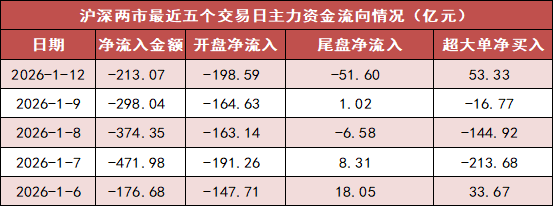
Market Overview - The A-share market experienced an overall increase on January 12, with the Shanghai Composite Index closing at 4165.29 points, up 1.09%, the Shenzhen Component Index at 14366.91 points, up 1.75%, and the ChiNext Index at 3388.34 points, up 1.82% [1] - The total trading volume for both markets reached 360.14 billion yuan, an increase of 47.87 billion yuan compared to the previous trading day [1] Capital Flow - The net outflow of main funds from the Shanghai and Shenzhen markets exceeded 21 billion yuan, with an opening net outflow of 19.86 billion yuan and a closing net outflow of 5.16 billion yuan, totaling 21.31 billion yuan for the day [2] - The CSI 300 index saw a net outflow of 7.26 billion yuan, while the ChiNext index experienced a net outflow of 1.42 billion yuan [3] Sector Performance - The computer industry saw a significant net inflow of 36.56 billion yuan, with a growth rate of 6.97%, driven by stocks like Tonghuashun [5] - Other sectors with notable inflows included defense and military (7.07 billion yuan, 6.02% increase), media (7.02 billion yuan, 7.35% increase), non-bank financials (3.70 billion yuan, 1.62% increase), and retail (3.61 billion yuan, 2.83% increase) [5] - Conversely, sectors with significant outflows included power equipment (-8.94 billion yuan, 1.73% increase), non-ferrous metals (-6.92 billion yuan, 2.06% increase), electronics (-5.97 billion yuan, 1.97% increase), basic chemicals (-5.47 billion yuan, 1.00% increase), and real estate (-3.79 billion yuan, -0.13% decrease) [5] Institutional Activity - The top stocks with net inflows from institutions included Shanzigaoke (484.20 million yuan, 10.09% increase), Leike Defense (234.98 million yuan, 10.00% increase), and Zhongke Xingtai (186.52 million yuan, 20.00% increase) [8] - Notable stocks with significant institutional outflows included Kunlun Wanwei (-5.36 billion yuan, 19.99% decrease) and other companies like Xinyuan Technology and Yanjin Technology, which also faced substantial outflows [8] Analyst Recommendations - Analysts have given strong buy ratings to stocks such as Xianle Health (target price 32.5 yuan, current price 24.39 yuan, 33.25% upside) and ZheShang Securities' recommendation for Dongfang Securities (target price 15.06 yuan, current price 10.99 yuan, 37.03% upside) [10] - Other stocks with favorable ratings include Yaxiang Integration (target price 162.8 yuan, current price 124.59 yuan, 30.67% upside) and China Merchants Bank (target price 55 yuan, current price 41.12 yuan, 33.75% upside) [10]
俊发多项目密集重启,棕树营城中村改造将启动
Sou Hu Cai Jing· 2026-01-12 10:16
Market Overview - In the week of January 5-11, 2026, the Kunming real estate market experienced a decline in both transaction volume and prices, with a total of 2 projects supplying approximately 23,300 square meters, a 75% decrease week-on-week [1] - Total transactions amounted to about 29,300 square meters, reflecting a 54% week-on-week drop, with an average transaction price of approximately 11,727 yuan per square meter, down 9% [1] Key Projects - Junfa Sheng Tang Cheng topped the sales list with a sales amount of approximately 29 million yuan, selling 31 units at an average price of about 9,036 yuan per square meter, with an average unit price of around 940,000 yuan [1] - Junfa · Dianchi ONE recorded a sales amount of about 14 million yuan, with a high average price of 27,122 yuan per square meter, making it the highest-priced project on the list [1] - Zhongtong Lian Daxu Mountain, a new four-generation residential product, achieved sales of approximately 12 million yuan, selling 10 units at an average price of about 10,890 yuan per square meter [1] Land Supply and Development - No land supply or transactions occurred in Kunming's main urban area during the week [4] - The market saw the launch of only two projects, Bangtai Guanyun Phase II and Poly City, with no new project openings [5] Project Launches - Bangtai Guanyun launched 48 units of four-generation residential products, with a total area of about 176 square meters, achieving a subscription of 22 units and a sales rate of approximately 46%, with an average price between 19,000 and 21,000 yuan per square meter [6] - Poly City launched 120 high-rise units with areas of 128 and 143 square meters, achieving a subscription of 15 units and a sales rate of about 13%, with an average price between 13,500 and 14,000 yuan per square meter [7] Educational Infrastructure - The local education bureau responded regarding the demand for junior high school placements for residents of Longhu Tianjing, indicating a shortage of educational resources in the area, with plans to allocate students to the new Kunming No. 8 Middle School [7][8] Urban Renewal Projects - The urban renewal project at the A2 plot of the Baoshuying Village is set to begin, with a total investment of approximately 544.44 million yuan, covering an area of about 103.7 acres [9] - The project involves significant redevelopment, including a shift from commercial to mixed-use residential land, with residential space accounting for 70% and a reduced floor area ratio [13] - The original "Zhongjun Tianyu" project has been renamed "Zhuyou Tianyu Mansion," marking the official takeover by local developer Zhuyou Real Estate [14]

房地产:2025全年二手房库销水平维持稳定
2026-01-12 01:40
证券研究报告 2026.01.11 2025 全年二手房库销水平维持稳定 李昊 分析员 张宇 分析员 徐曼迪 联系人 SAC 执证编号:S0080522070007 SFC CE Ref:BSI853 hao5.li@cicc.com.cn SAC 执证编号:S0080512070004 SFC CE Ref:AZB713 eric.zhang@cicc.com.cn SAC 执证编号:S0080124070018 mandi.xu@cicc.com.cn 纵轴:相对值(%) 91 100 109 118 127 136 2025-01 2025-04 2025-07 2025-10 2026-01 沪深300 中金房地产 | 股票 | 股票 | 目标 | P/E (x) | | | --- | --- | --- | --- | --- | | 名称 | 评级 | 价格 | | 2026E 2027E | | 滨江集团-A | 跑赢行业 | 14.25 | 10.2 | 9.4 | | 招商蛇口-A | 跑赢行业 | 12.20 | 17.9 | 16.4 | | 华润万象生活-H | 跑赢行业 | 48. ...